
More than half of adults with ADHD receive their first diagnosis in adulthood, not in childhood, and emotional dysregulation is among the most commonly missed signs. That pattern matters because many people spend years compensating with overwork, caffeine, and constant improvisation before anyone connects the dots.
A person in Pennsylvania can look successful on paper, keep up at work, and still feel like every ordinary task takes too much effort. Deadlines slip, the kitchen stays chaotic, messages pile up, and the frustration never seems proportional to the problem. That mismatch is often the clue that brings adults to an ADHD evaluation, not a childhood report card.
Table of Contents
- Why Adult ADHD Symptoms Often Go Unrecognized
- Core Adult ADHD Symptoms and How They Present
- Common Misconceptions About Adult ADHD
- ADHD Versus Other Conditions That Look Similar
- When to Seek an ADHD Evaluation and What It Involves
- Evidence-Based Treatment Options for Adult ADHD
- Finding ADHD Care in Pennsylvania Through Telehealth
Why Adult ADHD Symptoms Often Go Unrecognized
A lot of adults recognize the pattern only after years of managing life with brute force. They stay late to finish what others seem to finish on time, use alarms for everything, rely on notes everywhere, and still feel one missed step away from falling behind. That does not point to a lack of effort. It points to a nervous system that has been compensating for a long time.
The CDC reported that in 2023 an estimated 15.5 million U.S. adults had a current ADHD diagnosis, equal to 6.0%, or about 1 in 16 adults. The same CDC reporting says more than half of adults with ADHD were first diagnosed in adulthood, which helps explain why so many people feel like they have been “fine” until adult responsibilities exposed the strain. The CDC also notes that worldwide about 2% to 5% of adults experience ADHD symptoms, so this is not a niche concern, it is a common clinical pattern across countries and health systems. Those figures matter in telehealth visits, where adults often arrive after years of being told they are just stressed, disorganized, or inconsistent. CDC adult ADHD data

Why the adult pattern gets mislabeled
Adult ADHD usually does not look like a child running through a classroom. It looks more like missed deadlines, chaotic routines, and the constant feeling that basic organization takes too much energy. A clinician who looks only for obvious hyperactivity can miss the quieter signs, especially when the adult has built a life around compensation.
Practical rule: if someone's daily systems only work when they are under pressure, the problem may not be laziness. It may be a persistent executive-function issue that has been hidden by effort and urgency.
That pattern often becomes visible after burnout, relationship strain, or occupational instability. The symptoms were there earlier, but they were easier to hide when life was more structured. Once adult demands increase, the cracks show up in work, home, and relationships, exactly where ADHD tends to create functional impairment.
Why women and high achievers are often missed
Adults who appear organized on the outside can still struggle intensely on the inside. Some people use strict routines, over-preparation, or constant self-monitoring to keep functioning, which can hide ADHD for years. That is one reason an ADHD assessment has to look beyond polished performance and ask how much energy is required to maintain it.
Women are especially likely to be overlooked when their symptoms show up as internal distress, overcompensation, or emotional overload rather than disruptive behavior. For a closer look at that pattern, ADHD treatment for women can help explain why the diagnosis is often delayed.
The missed story is often not obvious impulsivity. It is the cost of control. When every task requires extra effort just to keep up, the symptom is often the amount of invisible work needed to appear normal. Clinicians also pay close attention to emotional dysregulation, because repeated frustration, rapid shifts in mood, and feeling flooded by small setbacks can be the clue that a checklist misses. Symptom-tracking tools and DSM-5 criteria help show whether those patterns are consistent across settings, rather than isolated bad weeks.
Core Adult ADHD Symptoms and How They Present
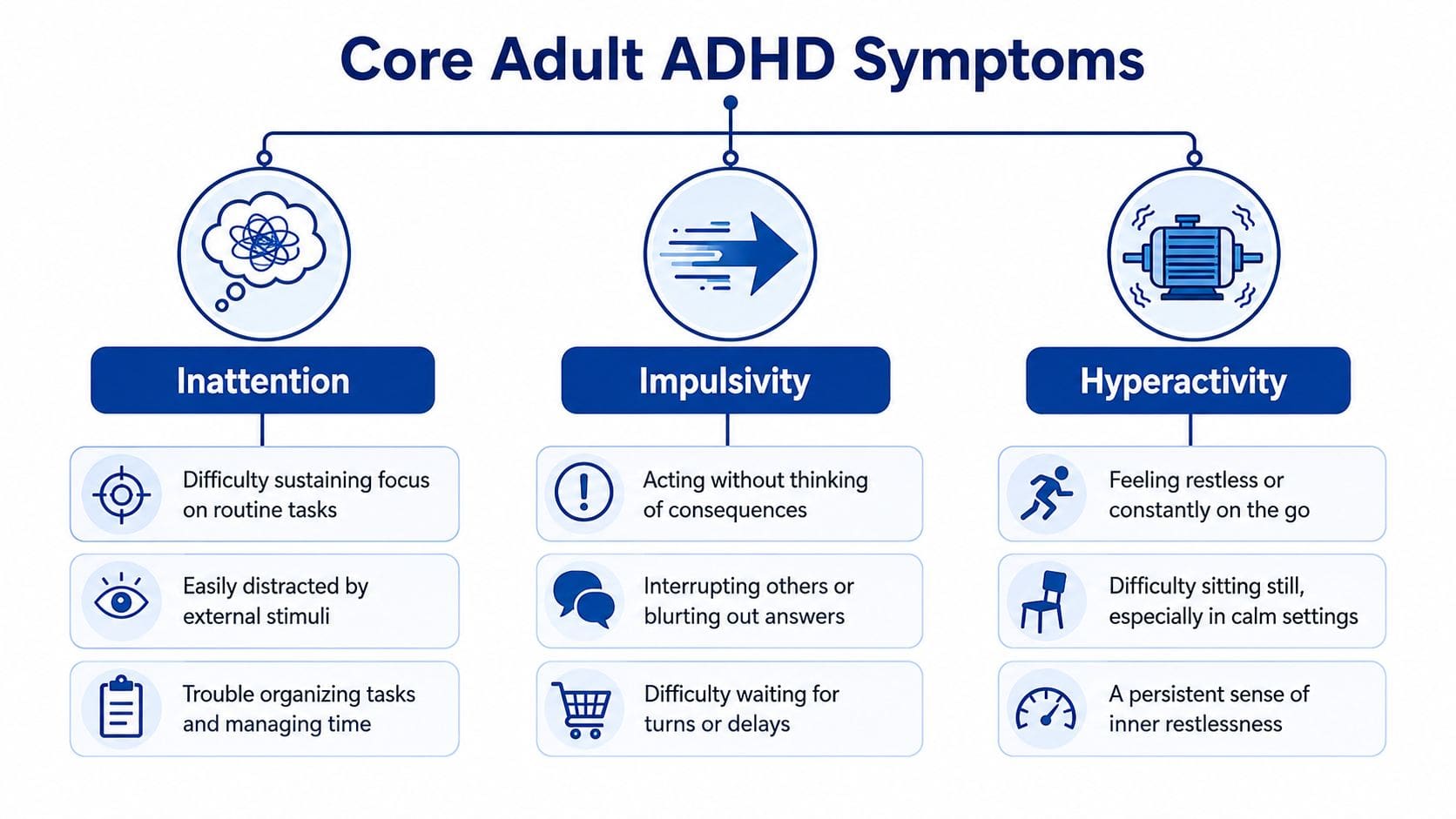
A calendar that keeps getting missed, a task list that never quite moves, and a short fuse over small setbacks are common adult ADHD clues. Adult ADHD usually combines inattention, impulsivity, and restlessness, but the pattern looks different from one person to the next. In adults, the most visible problems are often the repeated breakdowns in attention, planning, follow-through, and emotional control that interfere with ordinary life.
Inattention often shows up as time and task problems
Adult inattention is less about staring off into space and more about managing daily demands poorly. It can look like losing items, forgetting appointments, underestimating how long something will take, or starting tasks and never finishing them. Adults often describe sitting down to work and feeling mentally slippery, as if attention will not stay where it is needed. For a fuller look at how this shows up at work, see can't concentrate at work.
The AAFP notes that adult presentations frequently center on difficulty sustaining attention, losing items, forgetfulness, and poor time management, and that emotional dysregulation commonly coexists. Mayo Clinic also lists poor planning, disorganization, and trouble coping with stress as part of the adult picture. Those details matter because they map directly onto the frustrations adults bring to a psychiatric evaluation. Missed deadlines, unfinished chores, and repeated “I meant to do it” moments are often the surface of a deeper pattern. AAFP adult ADHD overview Mayo Clinic adult ADHD symptoms
Restlessness is often internal, not physical
Hyperactivity in adults is frequently less obvious than childhood hyperactivity. The CDC notes that in adults it may show up as extreme restlessness, and that symptoms can become more severe as adult demands increase. Instead of running or climbing, adults often report needing to move, check, shift, tap, or mentally jump between tasks just to stay engaged. CDC adult ADHD
Internal restlessness matters. A person may look calm in a meeting while feeling unable to settle their mind, and that gap is one reason surface observation can miss the diagnosis. Structured symptom tracking often picks up the pattern more clearly than a casual interview, especially when the person has learned to cover the outward signs.
Impulsivity and emotional dysregulation are easy to overlook
Impulsivity in adults can mean interrupting, blurting out comments, making quick decisions, or switching directions before a task is complete. The subtler sign, and often the one clinicians miss, is emotional dysregulation. Adults may have low frustration tolerance, quick mood shifts, or outsized reactions to minor setbacks.
Mayo Clinic includes frequent mood swings and low frustration tolerance in the adult symptom picture. That is why emotional reactivity should not be treated as a side issue. In many adults, it is one of the clearest clues that the problem is not just attention, it is regulation. Small stressors can trigger a response that feels bigger than the situation warrants, and that pattern often shows up repeatedly across home, work, and relationships. Mayo Clinic adult ADHD symptoms
Adults often do not describe ADHD as “I can't pay attention.” They describe it as “I can't make myself start, stay organized, or calm down when the day goes sideways.”
The symptom pattern is more useful than any single complaint
One forgotten appointment does not mean ADHD. The pattern matters. When inattention, restlessness, and impulsivity keep disrupting work, home routines, and relationships, the concern becomes more clinically relevant, especially when emotional swings are part of the picture.
That is why a good ADHD diagnosis looks at the whole pattern, not just whether a person seems distractible. It asks how often the symptoms happen, where they happen, and what they keep interfering with. Symptom-tracking tools and DSM-5 criteria help reveal whether the same difficulties keep showing up across settings, while a checklist alone can miss the emotional and functional cost.
Common Misconceptions About Adult ADHD
The biggest myth is that ADHD is only a childhood disorder. Diagnostic criteria changed because adult cases kept showing the same patterns in people who had learned to hide them. DSM-5 moved adult ADHD away from a childhood-only frame, set the age-of-onset threshold to before age 12, and lowered the adult symptom threshold from six symptoms to five in either the inattentive or hyperactive/impulsive domain. Earlier milestones also matter, the term ADHD appeared in DSM-III in 1987, and the familiar 18-symptom framework came in DSM-IV in 1994. DSM-5 adult ADHD introduction
Adult ADHD is not just the childhood stereotype
Many adults assume they cannot have ADHD because they were never the disruptive child at the back of the room. Adult presentation often looks different. Hyperactivity is usually less obvious, while inattention, disorganization, and emotional strain become more visible.
Adult ADHD is an executive-function problem. It affects starting tasks, prioritizing, holding information in mind, and following through when something is boring or complicated. A person can look capable and still struggle to manage ordinary life without constant corrective effort, missed steps, or last-minute rescue work.
High achievement can hide ADHD
Some adults compensate so well that the diagnosis stays hidden for years. They rely on structure, perfectionism, late-night bursts of focus, or strong self-pressure to keep up. From the outside, that can look like steady performance. Inside, it often feels like exhaustion.
Recent expert commentary argues that current diagnostic criteria still under-capture invisible struggles in adults who maintain outward performance through compensatory strategies, especially in women. That concern comes up often in clinical work, and it is one reason a careful evaluation needs to look past grades, job titles, and polished routines. The same blind spot appears in women who have learned to mask their symptoms, and a women-focused ADHD treatment resource can help show how those patterns are missed. Frontiers commentary on adult ADHD blind spots
ADHD is not the same as being distracted
Another common mistake is reducing ADHD to distractibility alone. That framing leaves out task initiation, prioritization, working memory, emotional control, and persistence. In practice, those are the features that drive the most frustration.
A more accurate view is that ADHD disrupts regulation of effort and attention across real-life demands. That is why surface-level checklists miss adults who seem only mildly distracted but repeatedly lose threads, miss deadlines, or react too strongly when stress builds. The subtle signs clinicians frequently miss are often emotional dysregulation, inconsistent follow-through, and the way symptoms show up only after work, home, and relationship demands are all weighed together.
A practical way to think about the diagnosis
Adults often ask whether their pattern is “bad enough” for help. That question is less useful than asking whether the symptoms are persistent, started early, and affect more than one setting.
Symptom-tracking tools help here because they capture patterns over time, not just a single bad day. DSM-5 criteria do the same by forcing the evaluation to look for childhood onset, cross-setting impairment, and symptom clusters that repeat under pressure. For adults comparing ADHD with anxiety, the adult ADHD and anxiety guide can help separate worry-driven avoidance from attention and regulation problems. For readers who also want a closer look at repetitive self-soothing behaviors, the stimming guide for parents can be useful for understanding where that pattern overlaps with other conditions.
ADHD Versus Other Conditions That Look Similar
Adults often come in with a short list of complaints, trouble focusing, irritability, restlessness, and a sense that daily tasks take more effort than they should. Those complaints can point to ADHD, but they can also reflect anxiety, depression, sleep disruption, PTSD, or autistic traits. The evaluation has to sort out what is driving the symptom, because the same surface behavior can come from very different causes.
Anxiety can look like inattention, but the driver is different
ADHD often causes missed steps because attention drifts, priorities blur, or working memory drops the thread. Anxiety can look similar on the outside, yet the person is often avoiding tasks because worry, fear, or constant scanning is taking over. A Neurology Clinical Practice differential discussion describes that split clearly, noting that ADHD can involve losing items, interrupting, and difficulty prioritizing, while anxiety more often leads to delay tied to concern or dread.
That difference shows up in how people describe their own experience. Someone with ADHD may say, “I meant to do it and lost the thread.” Someone with anxiety may say, “I kept putting it off because I was worried I'd do it wrong.” The behavior can look alike from the outside, but the treatment plan changes once the driver is clear.
For adults comparing those patterns more directly, the ADHD and anxiety in adults resource can help, and the gender-specific presentation discussed in the ADHD treatment for women material can be relevant when anxiety and ADHD overlap.
Depression and sleep problems can blur the picture
Depression can bring low energy, slower thinking, poor concentration, and less motivation. Sleep deprivation can create a similar picture, especially when an adult is running on too little rest for too long. PTSD can also interfere with attention through intrusive thoughts and constant alertness to the environment. Each of these can resemble ADHD closely enough to make a self-check unreliable.
The pattern usually separates by history. ADHD tends to be long-standing and shows up across work, home, and relationships, while depression and sleep problems often rise and fall with mood state or sleep quality. That is why a careful clinician asks about the timeline, the settings affected, and what the person was like before the current stressor or episode.
Stimming, restlessness, and repetitive movement are not always ADHD
Some adults and families wonder whether repetitive movement or self-soothing behaviors point to ADHD. Sometimes they do, sometimes they point somewhere else. The stimming guide for parents is a useful reference because it shows why repetitive movement can belong to different conditions and should not be read in isolation.
ADHD vs Common Mimics
| Condition | Core Mechanism | Key Differentiator from ADHD |
|---|---|---|
| ADHD | Executive-function regulation problems | Long-standing pattern across settings, with initiation, prioritization, and follow-through problems |
| Anxiety | Fear and hypervigilance | Inattention often comes from worry or avoidance, not drifting attention |
| Depression | Low mood and reduced drive | Concentration problems usually travel with persistent low mood or loss of interest |
| Sleep disorder | Inadequate or poor-quality sleep | Attention improves if sleep is corrected, while ADHD patterns usually persist |
| PTSD | Trauma-related arousal and intrusion | Distractibility is tied to trauma cues, scanning, or intrusive memories |
When symptom patterns overlap, the right next step is a full ADHD assessment that looks at onset, context, impairment, and the way the symptoms cluster over time. Surface checklists rarely capture that level of detail, which is why a clinician has to look beyond the first explanation that seems to fit.
When to Seek an ADHD Evaluation and What It Involves
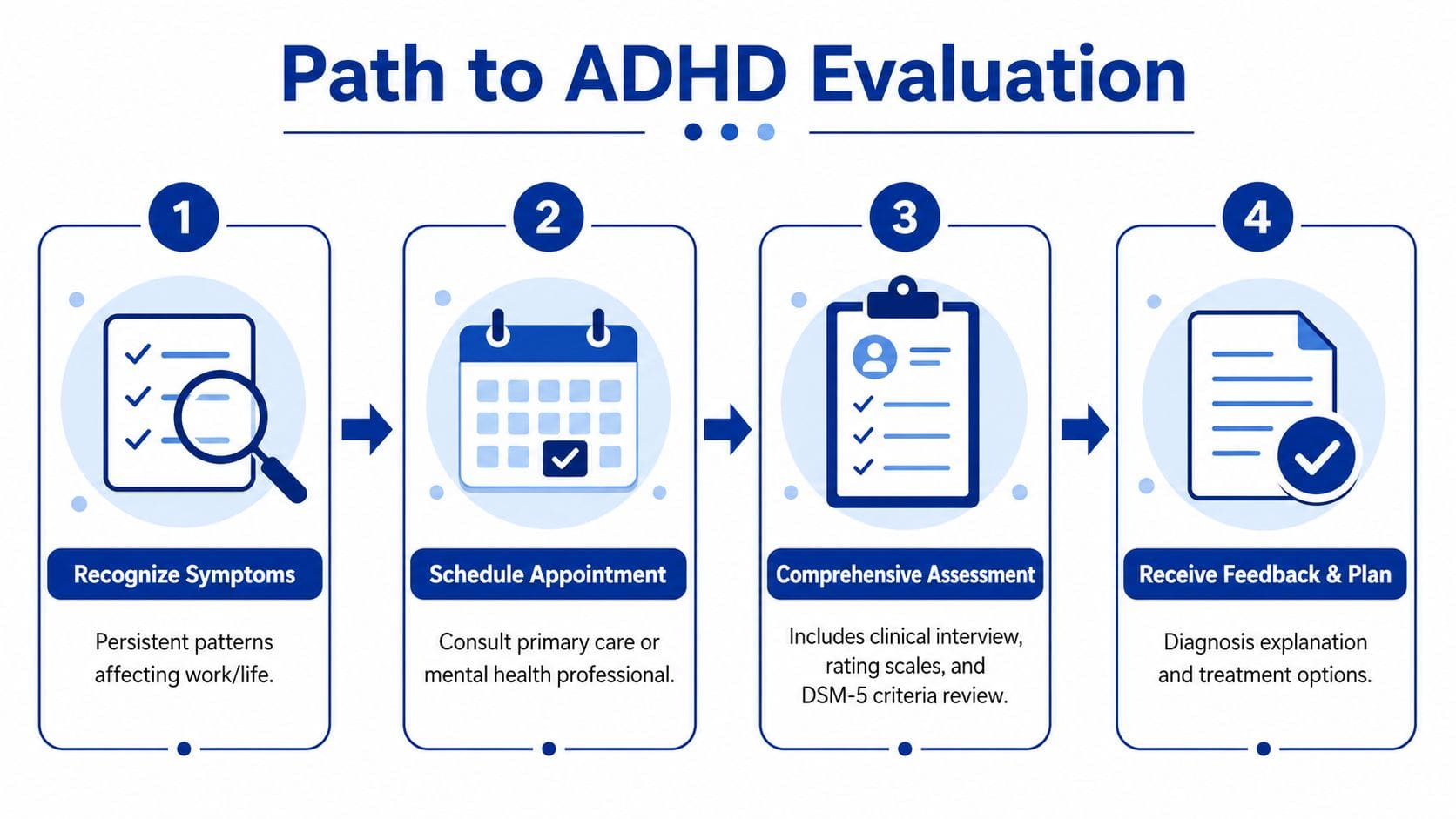
A missed deadline, a half-finished project, and a relationship that keeps circling the same complaint can all point to more than stress. An ADHD evaluation makes sense when the pattern has been present for years and keeps interfering with daily life. Adults are typically evaluated using the DSM-5 benchmark, which calls for at least five symptoms of inattention and/or hyperactivity-impulsivity lasting six months or longer, present in at least two settings, with evidence that symptoms began before age 12. PMC adult ADHD review
What the evaluation checks
There are no laboratory tests that confirm adult ADHD. Assessment depends on developmental history, symptom pattern, and functional impairment across settings such as work and home. That limitation matters because it rules out the idea of a single quick adult ADHD test that settles the question in one minute.
A thorough ADHD evaluation usually includes a clinical interview, symptom questionnaires, and questions about school history, work history, relationships, and coping strategies. When possible, collateral history from someone who knew the person earlier in life can help, but the diagnosis still rests on the overall pattern, not one witness or one scale. PMC review of adult ADHD diagnosis
Clinicians also watch for the subtler signs that surface-level checklists miss. Emotional dysregulation, chronic underestimation of how long tasks take, and inconsistent follow-through can matter as much as overt distractibility. Those patterns often show up in adults who look organized at first glance, then fall apart under pressure, especially when the person has spent years compensating with rigid routines or overwork. Symptom tracking helps show that pattern clearly, which is why it can be more useful than a rushed self-rating form.
Why symptom tracking matters in telehealth
Structured tracking often reveals more than a surface checklist. In virtual practice, DSM-5-based symptom tracking has been especially revealing because adults tend to minimize symptoms until they see the pattern laid out over time. That is one reason an online ADHD evaluation can work well when it includes a careful review of history and impairment, not just a brief intake form.
Clinical insight: the most useful data often comes from tracking when symptoms happen, what setting they happen in, and what the person was trying to do at the time.
For adults trying to prepare, the how to get an ADHD diagnosis as an adult guide can help organize the right information before the appointment. If symptoms have been especially hard to manage around cycle-related mood shifts, the conversation may also overlap with ADHD treatment for women, where timing, sleep, and emotional regulation can change how symptoms present.
Why some adults should seek an evaluation sooner
A professional review becomes more important when symptoms are persistent, show up in more than one area of life, and create repeated problems with deadlines, relationships, or home routines. Emotional dysregulation deserves attention too, especially when it shows up as low frustration tolerance, sharp reactions to small setbacks, or a day that derails after one missed detail.
The point of the evaluation is not to force a label. It is to determine whether the pattern fits ADHD, another condition, or more than one condition at the same time. Adults who want help translating that pattern into day-to-day change can also benefit from tailored productivity tactics for ADHD once the clinical picture is clear.
Evidence-Based Treatment Options for Adult ADHD
Treatment works best when it matches the person's actual pattern, not a generic checklist. For many adults, that means combining ADHD medication management with behavioral strategies, sleep support, and practical systems that lower friction in daily life. Medication can improve attention and regulation, but it does not organize a calendar, build routines, or fix burnout by itself.
Medication is one tool, not the whole plan
Stimulant and non-stimulant options are both used in adult ADHD care, and the choice depends on symptoms, medical history, side effects, and comorbid conditions. The goal is not medication for its own sake. The goal is better functioning so the rest of the treatment plan can be used.
Follow-up matters because the first prescription is rarely the end of the process. Dosing, timing, sleep, appetite, anxiety, and daily functioning all need review after medication starts, and the plan may need changes over time. For adults who want coordinated care, Integrative Psychiatry of America offers ADHD Treatment and Medication Management through telehealth, which can be useful when regular check-ins are part of the plan.
Behavioral strategies make medication more usable
ADHD care gets stronger when daily routines reduce decision fatigue. External structure matters more than motivation. A calendar reminder, a task breakdown, or a fixed start time can separate follow-through from avoidance.
A helpful complement for readers building routines is personalized productivity tactics for ADHD, especially when time blindness and task initiation are the biggest pain points. Adults who need a more specific treatment discussion can also review ADHD treatment for women, where timing, sleep, and emotional regulation can change how symptoms show up in practice.
Integrative care supports the parts medication does not cover
Sleep optimization, exercise counseling, nutritional education, and stress-regulation techniques can all support adult ADHD treatment. These do not replace diagnosis or medication when medication is appropriate. They provide the scaffolding that makes symptom control more durable.
The reason is simple. Adults with ADHD are usually not just trying to pay attention. They are managing energy, mood, frustration, and follow-through while trying to keep work and family life from unraveling. A whole-person plan addresses those pieces together instead of treating them as separate problems.
What usually works better than trying harder
The most effective plans are specific. They use reminders, routines, follow-up, and medication when indicated. They also recognize that emotional dysregulation may be part of the clinical picture, not a character flaw to push through.
Good ADHD treatment is less about willpower and more about building a system the brain can use.
Finding ADHD Care in Pennsylvania Through Telehealth
Adults in Pennsylvania can get help without turning an appointment into a full-day project. That matters for people in Philadelphia, Pittsburgh, Harrisburg, Erie, Scranton, Allentown, Lancaster, and Reading, where work schedules, transportation, and family demands can make in-person care hard to keep up with. Telehealth makes it easier to complete an ADHD evaluation and continue ADHD medication management without unnecessary travel.
What to look for in a provider
A good ADHD provider should be comfortable with adult presentations, not just childhood cases. They should ask about school history, work problems, home routines, and how symptoms have changed over time. They should also be willing to consider anxiety, depression, PTSD, sleep issues, and other mimics instead of forcing every complaint into one label. For women, that review needs to include the ways ADHD can show up as emotional overload, masking, inconsistent follow-through, and a long history of being overlooked, which is why ADHD treatment for women belongs in the conversation when provider qualifications are discussed.
It helps to choose a clinician who uses structured symptom review and explains the reasoning behind the diagnosis. That level of clarity matters because many adults arrive after years of mixed messages and self-doubt. A careful clinician can separate a surface-level checklist from the deeper pattern that shows up across settings, including the emotional dysregulation clinicians often miss.
How to prepare for a virtual assessment
Preparation makes the visit more useful. Adults should collect old report cards if available, write down the patterns that cause the most disruption, and note where the problems happen, work, home, relationships, or all three. A simple symptom log can show whether the pattern is stable and long-standing, and it can reveal shifts in attention, irritability, and follow-through that a one-time conversation may miss.
An online ADHD evaluation also goes better when the adult can describe what has already been tried and what helped or did not help. That context gives the clinician a clearer picture of the impairment, not just the headline complaint. It also helps the clinician compare the reported symptoms with DSM-5 criteria and look for the recurring pattern that points to ADHD rather than a single bad week.
Helpful tools before the appointment
A few support tools can make the process easier. The AI Notetaker can help adults capture thoughts before they disappear, which is useful when attention drifts during the day. Integrative Psychiatry of America also offers free patient tools such as the ADHD Assessment, the Anxiety Symptom Checker, the Daily Agenda Planner, the Feeling Journal, the Exercise Routine Generator, and the 5-4-3-2-1 Grounding Tool to help people organize symptoms and get ready for care.
These tools matter because adult ADHD often looks inconsistent from the outside. A person may seem organized in one area and overwhelmed in another, or calm in a brief visit and reactive at home later in the day. Symptom-tracking tools give the clinician a better view of those patterns than a quick checklist alone.
A practical next step
For adults in Pennsylvania who keep wondering whether their pattern is ADHD, the next step is a real psychiatric evaluation, not another round of self-blame. Integrative Psychiatry of America provides virtual psychiatric evaluations and evidence-informed treatment throughout Pennsylvania, including ADHD treatment in Pennsylvania through secure telehealth. The right appointment can clarify whether the issue is ADHD, another condition, or both, and it can start a plan that fits real life instead of fighting it.
If adult ADHD symptoms are interfering with work, relationships, or daily routines, Integrative Psychiatry of America can help with virtual evaluations, medication management, and evidence-informed treatment across Pennsylvania. Visit Integrative Psychiatry of America to learn more, verify insurance coverage, and explore the free ADHD Assessment and related mental health tools.