
If you’ve spent years feeling like you're constantly swimming against the tide—struggling with focus, organization, or impulsivity—you’re not just imagining it. You’re probably wondering how to get an ADHD diagnosis as an adult. Many adults grapple with these challenges, often without realizing there's a name for their experience.
The path forward isn't about getting a label; it’s about getting clarity. It starts with a professional evaluation from a qualified mental health provider, like a psychiatric nurse practitioner, who can finally help you understand what's going on and unlock the right support. This comprehensive guide will walk you through the process, from recognizing the signs of adult ADHD to building a life that works for you post-diagnosis.
Recognizing Adult ADHD Is The First Step
That nagging feeling that something is "off" isn't just in your head. For so many adults in Pennsylvania and beyond, the constant battle with deadlines, misplaced keys, and overwhelming projects is more than a personality quirk. It’s often a sign that warrants a closer look from a professional, and understanding adult ADHD symptoms is the first step.
As psychiatric nurse practitioners at Integrative Psychiatry of America, we see this story every day. Adults come to us frustrated and exhausted, wondering why they haven't "outgrown" these challenges. But ADHD doesn't look the same in adults. The classic hyperactivity of childhood often morphs into a quiet but persistent internal restlessness. Inattention shows up as difficulty managing complex work projects or just keeping the household running. The process of getting an ADHD evaluation can be life-changing.
The Rise of Adult Diagnosis
If this sounds familiar, you are far from alone. Adult diagnoses are more common than ever. Many people seek help when they realize their struggles are affecting their executive function, which includes skills like planning, organizing, and time management.
An estimated 15.5 million U.S. adults (6.0% of the population) have a current ADHD diagnosis. What's really telling is that about half of them—roughly 7.75 million people—received their diagnosis at age 18 or older.
This trend is especially noticeable during the prime working years. For adults aged 25-29, the rate of new diagnoses spikes, accounting for 62.8% of cases. It's often the pressures of a career and adult responsibilities that finally bring these underlying symptoms to the surface.
This shift shows we're finally moving past the old myth of ADHD as a childhood-only condition. More adults are recognizing their lifelong struggles have a name—and more importantly, a solution.
This simple flowchart breaks down the journey into a clear, manageable path.
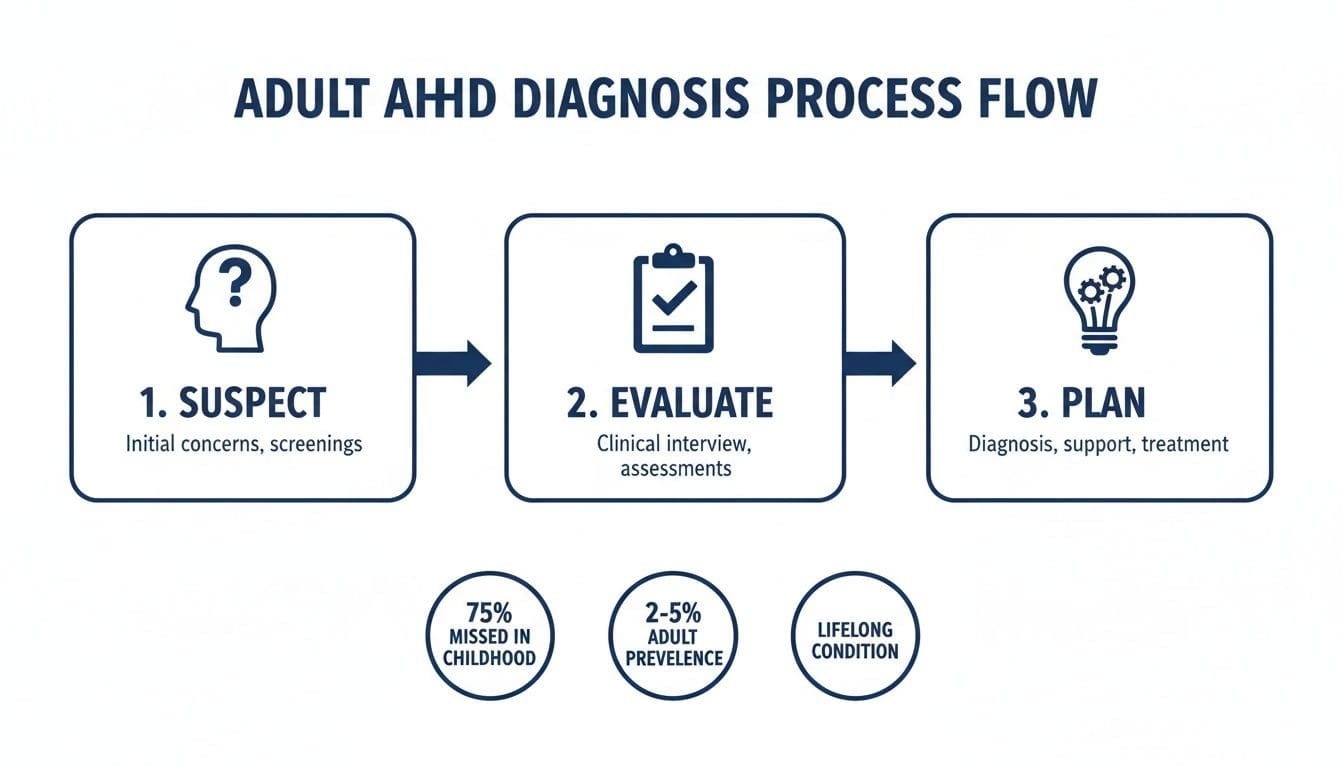
As you can see, it really comes down to three phases: suspecting you might have ADHD, getting a professional evaluation, and then creating a personalized plan to move forward.
To give you a clearer roadmap, here’s a quick summary of the process from initial suspicion to a confirmed diagnosis and treatment plan.
Your Path to an Adult ADHD Diagnosis
| Phase | Your Action | What It Achieves |
|---|---|---|
| 1. Suspect & Research | Acknowledge your struggles and gather personal history (school reports, work feedback, family input). | Builds a strong case for evaluation and helps you articulate your symptoms clearly. |
| 2. Professional Evaluation | Schedule an appointment with a psychiatric provider for a comprehensive assessment. | You get a definitive diagnosis (or rule out ADHD) and identify any co-occurring conditions. |
| 3. Treatment & Planning | Work with your provider to create a personalized treatment plan (medication, therapy, lifestyle changes). | You gain access to the tools and support needed to manage symptoms and improve your quality of life. |
Each step builds on the last, moving you from a place of uncertainty to one of control and understanding.
Moving From Uncertainty to Empowerment
We know the idea of seeking a diagnosis can feel intimidating. But it’s one of the most powerful moves you can make toward self-understanding and control. Think of it less as confirming a "flaw" and more as finally getting the user manual for your unique brain. The right ADHD doctor or psychiatric nurse practitioner can guide you through this.
Modern telehealth evaluations make this process more accessible and private than ever. You can connect with a qualified provider, like our team of psychiatric nurse practitioners, right from your own home. If you're weighing your options, it helps to read up on what to expect. This guide on How to Get Diagnosed with ADHD is a great resource.
Ultimately, getting an evaluation is an act of self-advocacy. It’s your chance to shift the narrative from, "What's wrong with me?" to "What do I need to thrive?" That’s the first and most important step toward building a more manageable and fulfilling life. For a closer look at our approach, you can learn more about how we treat ADHD in adults at Integrative Psychiatry of America.
How To Prepare For Your ADHD Evaluation
Walking into an evaluation prepared can make a huge difference. It helps reduce anxiety and allows you and your provider to get to an accurate outcome more efficiently. Think of it as organizing the story of your life so far. The clearer you can be about your experiences, the better we, as psychiatric nurse practitioners, can understand your situation. This preparation is key for anyone seeking an ADHD diagnosis.

This prep work is even more critical for a telehealth evaluation. Since we aren't in the same room, having your information gathered and ready makes the conversation flow much more smoothly. It lets us dive into the nuances of your symptoms instead of using valuable time trying to recall forgotten details. This is an important part of the adult ADHD testing process.
Gather Your Historical Evidence
A core part of diagnosing adult ADHD is showing that symptoms were present before age 12. This can feel like a tall order, but you're essentially becoming a detective of your own past. Start by digging up any old documents you can get your hands on.
Here are a few examples of what can be incredibly helpful:
- Childhood School Reports: Look for those classic teacher comments like "doesn't live up to potential," "is a daydreamer," or "disrupts the class by talking." These are often the earliest, overlooked signs.
- Past Medical Records: Any prior evaluations for behavioral issues or learning disabilities provide invaluable context.
- Work Performance Reviews: Do you notice a pattern of feedback about missed deadlines, careless mistakes, or struggles with organization? This helps demonstrate how symptoms are impacting your adult life.
Bringing these items helps build a timeline showing a persistent pattern of challenges, which is a cornerstone of an accurate ADHD diagnosis.
Document Your Real-World Struggles
Beyond old documents, your own notes are the most powerful tool you have. It’s all too easy to go blank or forget specific examples when you're feeling nervous in an appointment. Writing them down beforehand makes sure nothing important gets missed.
Think about how your symptoms show up in different parts of your life, and be specific.
Examples of Notes to Bring:
- Career: "I missed a major project deadline last month because I got hyperfocused on a minor part of it and lost track of time. It resulted in a formal warning from my manager."
- Relationships: "My partner gets really frustrated because I frequently interrupt them or seem like I’m not listening, even when I am trying to focus on what they're saying."
- Daily Life: "I have paid over $200 in late fees this year alone because I forget to pay bills, even with calendar reminders set on my phone."
Your personal stories provide the data we need. A vague statement like "I'm disorganized" is far less helpful than a concrete example like, "I spent an hour looking for my car keys this morning and ended up being late for a critical meeting."
The Role of Self-Screeners And Collateral Information
Online self-screening tools, like the Adult ADHD Self-Report Scale (ASRS), can be a great place to start. It's important to know they are not for self-diagnosis. Think of them as a structured way to organize your thoughts and see which symptoms are most prominent for you. Bring the results to your appointment to help guide the conversation. These tools can be part of the initial online ADHD diagnosis process.
Another powerful piece of the diagnostic puzzle is collateral information. This is simply input from someone who knows you well—a parent, a long-term partner, or even a close friend. They can often offer an objective view of your behaviors that you might not see yourself.
Asking a parent about what you were like as a child or a spouse about your current habits can fill in crucial gaps in your own memory. This external perspective is invaluable for clinicians. Our job is to put all these pieces together. If you're wondering about the line between normal struggles and needing professional help, you can learn more about when to see a psychiatric provider on our blog. Taking these steps is the best way to participate in your own care and finally get the clarity you’re looking for.
What To Expect During Your Diagnostic Evaluation
The thought of a psychiatric evaluation can be intimidating, but our goal is to make the process clear and collaborative. At Integrative Psychiatry of America, we approach an adult ADHD evaluation as a guided conversation—not an interrogation. It’s about understanding your unique story and finding the best path forward. A key keyword here is psychiatrist, as many people search for this term when looking for mental health care, but it's important to know that psychiatric nurse practitioners are also highly qualified to diagnose and treat ADHD.

This process is designed to be thorough. During your telepsychiatry appointment, our psychiatric nurse practitioners will lead you through a detailed clinical interview. We go beyond simple checklists to explore how your symptoms impact your daily life, career, and relationships.
The Clinical Interview: A Guided Conversation
Your evaluation will feel like a structured, in-depth talk. We’ll discuss your current struggles, but we’ll also explore your childhood experiences, which is a critical part of the diagnostic puzzle for adult ADHD.
We listen for specific patterns based on the gold standard for diagnosis: the DSM-5 criteria. This requires a persistent pattern of inattention and/or hyperactivity-impulsivity that was present before age 12 and now impairs function in multiple areas of your life. With less than 20% of adults with ADHD even aware they have it, this detailed workup is essential. You can learn more about these statistics from the National Institute of Mental Health.
Think of this as a fact-finding mission we embark on together. You provide the raw data—your life experiences—and we use our clinical training to assemble the pieces into a clear picture.
Ruling Out Other Conditions
A key part of a responsible evaluation is the differential diagnosis. Many other conditions can look a lot like ADHD, which is a common reason why self-diagnosis can be misleading. This is a crucial aspect of an ADHD assessment.
Your symptoms could be caused or worsened by a number of issues.
- Anxiety Disorders: Constant worry and a racing mind can absolutely destroy your ability to focus.
- Depression: The lack of motivation and "brain fog" associated with depression often mimic ADHD's executive dysfunction.
- Sleep Disorders: Chronic sleep deprivation makes anyone inattentive, irritable, and forgetful.
- Post-Traumatic Stress Disorder (PTSD): Hypervigilance and intrusive thoughts can make sustained concentration feel impossible.
We carefully screen for these and other conditions. Getting the diagnosis right is the most important step toward effective treatment.
Our Integrative And Holistic Viewpoint
As psychiatric nurse practitioners in an integrative practice, we look at you as a whole person, not just a list of symptoms. A crucial part of your evaluation involves understanding your complete lifestyle.
We'll ask about things you might not expect, such as:
- Your Nutrition: Are you eating regular, balanced meals? Blood sugar crashes can wreak havoc on focus.
- Your Exercise Habits: Physical activity is a powerful tool for managing attention and mood.
- Your Stress Levels: How do you cope with stress? Chronic stress can mimic or worsen ADHD symptoms.
- Your Sleep Hygiene: Are you getting consistent, quality sleep? This is foundational for mental clarity.
This whole-person approach is central to how we practice. We believe that your mental health is directly connected to your physical health and daily habits. By considering all these factors, we can build a much more accurate and nuanced understanding of what's going on.
Getting Your Diagnosis In Pennsylvania via Telehealth
If you're a resident of Pennsylvania, getting an adult ADHD diagnosis is more straightforward than ever before. You no longer need to deal with long commutes or stuffy waiting rooms. Telehealth ADHD diagnosis now offers a private, effective, and much more convenient alternative to in-person appointments.
At Integrative Psychiatry of America, this is exactly the kind of care we provide. Our entire process is designed to deliver expert mental health services directly to you through a secure, HIPAA-compliant telehealth platform. As board-certified psychiatric nurse practitioners, we bring the evaluation right to your home, office, or wherever you're most comfortable.
Booking Your Telehealth Appointment
Taking that first step is surprisingly simple. We've built our system to be direct and intuitive, letting you move from wondering if you have ADHD to getting real answers. You can begin the process right away through our patient portal.
Think of the portal as your home base for managing your care. From there, you can:
- Request an appointment that works with your own schedule.
- Securely message our team with any questions before your visit.
- Complete all intake forms on your own time, without feeling rushed.
This initial step puts you firmly in control of your health journey. It’s all about making high-quality care fit into your life, not the other way around.
Navigating Insurance And Costs In PA
We get it—the financial side of healthcare can be a huge source of stress. Many people put off getting help because they worry if their insurance will cover telehealth or what an evaluation might cost out-of-pocket. Our goal is to make this part completely transparent, especially when considering the cost of ADHD diagnosis.
Integrative Psychiatry of America accepts many major insurance plans in Pennsylvania. Before you even schedule a visit, you can easily verify your insurance coverage through our portal. This helps you avoid any surprises down the road.
Your peace of mind is our priority. Knowing your financial options upfront lets you focus on what really matters—getting the answers and support you need for your mental health.
For anyone without insurance coverage or who prefers to pay directly, we offer clear, affordable cash-pay rates and membership options. These create a predictable cost for your evaluation and follow-up care, ensuring that expert mental health support is always within reach. You can find all the details on our flexible payment structures when you book your appointment.
What To Expect From Your Virtual Visit
Your first virtual evaluation is a comprehensive appointment that usually lasts between 60 to 90 minutes. You’ll connect with one of our experienced psychiatric nurse practitioners over a secure video call for a private, one-on-one conversation.
This is a full clinical evaluation, just like one you would have in a traditional clinic. We conduct a thorough assessment, explore potential differential diagnoses to rule out other conditions, and make sure all your questions are answered in a supportive setting. The only real difference is the convenience.
By focusing on local, accessible care, we aim to be a trusted partner for Pennsylvanians. We understand the specific needs of residents and are licensed to provide care across the entire state. For a closer look at our services, check out our guide to online psychiatry and ADHD care in Pennsylvania. Our mission is to make the process of getting an adult ADHD diagnosis both clear and empowering.
Life After Diagnosis Your Integrative Treatment Plan
Getting an official ADHD diagnosis isn't the finish line. It's the starting block. Figuring out how to get diagnosed as an adult was the first hurdle. Now, the real work—and the real progress—begins. You’re shifting from understanding what is going on to mastering how you can thrive with the right ADHD treatment.
This is where we help you build a life that works with your brain, not against it.

As psychiatric nurse practitioners, we see a diagnosis as the blueprint for your personalized care plan. At Integrative Psychiatry of America, we don’t just treat symptoms. We treat the whole person. Your plan will be as unique as you are, combining evidence-based medicine with practical, real-world strategies.
Building Your Personalized Care Plan
Your treatment plan is a collaboration between you and your provider. Think of it as a living document that we’ll adjust as your needs change. Our integrative philosophy means we look beyond just medication to create a complete approach that supports both your mind and body.
The core parts of an effective plan usually include:
- Evidence-Based Medication Management: For many adults, stimulant or non-stimulant medications are highly effective. They can dramatically improve focus and reduce impulsivity, creating the mental space for other strategies to take root.
- Targeted Psychotherapy: Therapy like Cognitive Behavioral Therapy (CBT) gives you practical skills. You'll learn to reframe unhelpful thought patterns, create better organizational systems, and manage emotional ups and downs.
- Lifestyle Adjustments: This is where our integrative approach really makes a difference. We see your nutrition, exercise habits, and sleep hygiene as powerful tools for managing ADHD.
- Skills Training and Coaching: We help you put strategies into action for time management, organization, and planning—all designed specifically for an ADHD brain.
We’re not just putting a bandage on the problem. We’re giving you the tools to build a stronger foundation for long-term success. After a diagnosis, knowing what post-diagnostic support for Autism and ADHD is available is a critical step.
A Whole-Person Approach To Treatment
"Integrative care" isn't just a buzzword for us. It’s our commitment to seeing you as more than a diagnosis. Your mental clarity is directly connected to your physical health and daily routines. That’s why your plan will include specific, tailored recommendations.
For instance, we might explore:
- Nutritional Counseling: We may suggest focusing on protein-rich meals to stabilize your energy and focus. Adding omega-3 fatty acids is another common recommendation, as studies show it supports brain function.
- Personalized Exercise Plans: Regular physical activity is one of the most effective non-medical tools for ADHD. Even a brisk 20-minute walk can boost dopamine and improve executive function.
- Mindfulness and Meditation: These practices help train your attention and reduce that constant feeling of being overwhelmed. We can guide you toward simple techniques that feel doable.
Your plan isn't a generic checklist. It's a strategic guide built around your specific challenges, goals, and lifestyle. If you’re a night-shift worker, your sleep plan will look different. If you hate running, we'll find an activity you actually enjoy.
Specialized And Culturally Competent Care
We know that your life experiences shape how ADHD affects you. That’s why we are committed to culturally competent care that respects your unique identity and background.
We have experience working with diverse communities, including LGBTQ+ individuals and professionals in high-stress fields like first responders. We understand your specific context, and that insight informs your treatment.
A diagnosis isn't a limitation—it's the key that unlocks your potential. With the right support, you can move from frustration to confidence, improve your focus, and boost your overall well-being. You can explore the full range of ADHD treatment options for adults to see how a complete plan comes together.
The goal is always hope and transformation, one strategic step at a time.
Your Adult ADHD Questions Answered
Even after laying out the steps for an adult ADHD diagnosis, you probably still have a few questions. That’s completely normal. As psychiatric nurse practitioners at Integrative Psychiatry of America, we answer these kinds of questions every single day.
Our job is to give you straightforward, compassionate answers based on our clinical experience. We want you to have the clear information you need to move forward with confidence on your health journey.
How Long Does An Adult ADHD Diagnosis Take?
This is one of the most common questions we hear, and the answer is usually faster than people think, especially with modern telepsychiatry. Your first comprehensive evaluation with one of our nurse practitioners is typically scheduled for 60 to 90 minutes.
During this initial appointment, we conduct a thorough clinical interview. A diagnosis can often be confirmed within one to three sessions, depending on the complexity of your symptoms and whether we need more information, like input from a partner or parent.
At Integrative Psychiatry of America, our focus is on being both thorough and efficient. This means you could have a clear diagnostic picture and be ready to discuss a treatment plan within a few weeks of your first visit.
What If I Was Never Diagnosed As A Child?
This is an incredibly common scenario. It is not a barrier to getting an adult ADHD diagnosis. Many adults, particularly women and those with inattentive-type ADHD, had their symptoms missed or mislabeled during childhood. The classic "hyperactive boy" stereotype meant a lot of people flew under the radar.
As trained psychiatric nurse practitioners, we are skilled at retrospectively identifying childhood symptoms. During your evaluation, we’ll ask detailed questions about your school performance, social experiences, and home life growing up.
We look for evidence of symptoms before age 12 by exploring old school report cards, discussing teacher feedback you remember, and reviewing your own memories. Your experience of being called a "daydreamer" or constantly struggling to finish homework is valuable clinical information.
Can I Get An ADHD Diagnosis Online In Pennsylvania?
Yes, absolutely. Getting an ADHD diagnosis online is a recognized, effective, and convenient way to receive care. At Integrative Psychiatry of America, our board-certified psychiatric nurse practitioners are licensed to provide comprehensive ADHD evaluations for adults across the entire state of Pennsylvania through our secure telehealth platform.
An online diagnosis provides the same standard of care as an in-person visit. We conduct the same detailed clinical interview, use the same DSM-5 criteria, and offer the same level of personalized attention. The only real difference is you can do it all from the comfort and privacy of your own home, saving you time and travel.
It's also important to know that a psychiatric nurse practitioner is fully qualified to diagnose ADHD and develop a treatment plan. You can learn more by reading about how a psychiatric provider can prescribe medicine for ADHD in our related article.
What Happens If My Symptoms Are Not From ADHD?
This is a critical part of any responsible diagnostic process and a sign of high-quality care. Our comprehensive evaluation is designed to perform a differential diagnosis—that is, to differentiate ADHD from other conditions that cause similar symptoms.
Many different issues can mimic ADHD, including:
- Anxiety Disorders
- Depression
- Sleep Disorders
- Trauma-related conditions like PTSD
- Thyroid problems or other medical conditions
If we find that another condition is the primary cause of your symptoms, we will discuss those findings with you openly and honestly. As an integrative practice, we are equipped to create a treatment plan for your actual diagnosis, whether it's ADHD, anxiety, depression, or something else. Our top priority is making sure you get the most accurate and effective care for your specific needs.
At Integrative Psychiatry of America, we are here to provide the clarity and support you deserve. If you're ready to take the next step and get answers, we invite you to schedule your telepsychiatry evaluation with our expert team of psychiatric nurse practitioners today. Visit us at https://integrativepsychiatryofamerica.com to get started.