

By 9:30 a.m., the pattern is already familiar. A worker in Philadelphia opens an email, rereads the same paragraph, clicks to Slack, checks a calendar, glances at a phone, then returns to the email and realizes nothing registered. The task still matters. The deadline is still real. The brain just won't lock in.
That experience can feel embarrassing, especially for adults who used to think of themselves as capable, organized, and dependable. Many people searching for can't concentrate at work secretly worry that they're becoming lazy, burnt out, or less sharp than they used to be. Most aren't dealing with a character flaw. They're dealing with a symptom.
Sometimes the cause is straightforward. Sleep is off. Notifications never stop. The workday is fragmented. Sometimes the explanation is more clinical. Anxiety can trap attention in worry loops. Depression can slow thinking and drain motivation. Adult ADHD can make it hard to sustain effort on tasks that don't naturally pull interest, even when the person cares about the outcome.
That distinction matters because generic productivity advice only goes so far. A cleaner desk helps some people. A timer helps some people. But when concentration problems are persistent, disruptive, and emotionally costly, the next step isn't more self-criticism. It's a more accurate explanation.
Table of Contents
- That Feeling When Your Brain Just Wont Cooperate
- Environmental and Lifestyle Factors Draining Your Focus
- Could It Be ADHD Anxiety or Depression
- Evidence-Based Strategies for Improving Workplace Concentration
- Your Path to a Diagnosis via Telehealth in Pennsylvania
- Find Your Focus A Clear Path to Mental Health Care in PA
That Feeling When Your Brain Just Wont Cooperate
A lot of adults in Pittsburgh, Harrisburg, or Allentown describe the same morning. They sit down ready to work. The screen is open. The to-do list is visible. Yet every task feels slippery. One report turns into six browser tabs. One meeting leads to a half-finished reply, then a forgotten follow-up, then a sudden jolt of anxiety about everything still undone.
That spiral often creates a second problem. The person isn't only distracted. They're also ashamed of being distracted. By lunchtime, the internal story becomes, “Why can't I just do this?”
That's the wrong question.
The more useful question is, “What is interfering with concentration?” For many adults, the answer isn't lack of discipline. It's a mix of environmental pressure, chronic stress, disrupted sleep, and untreated mental health symptoms. Mental Health America reported that 70% of employees struggled with maintaining focus during the second year of the COVID-19 pandemic, up from 65% in 2018 according to its 2022 Mind the Workplace report, summarized in this report coverage.
Poor concentration at work is common. Persistent poor concentration that affects performance, mood, and daily functioning deserves clinical attention.
Some people notice the problem only at work because work is where the demands are highest. Tight deadlines, unclear priorities, frequent interruptions, and pressure to perform expose attention problems fast. A person can get through errands and home tasks, then hit a wall once sustained mental effort is required.
Others have a longer history. They remember always needing last-minute pressure to finish projects. They remember being called bright but inconsistent. They remember struggling with organization, procrastination, or mental restlessness long before their current job.
That history matters. Concentration problems can be temporary, but they can also point to a long-standing pattern that finally became impossible to ignore.
Environmental and Lifestyle Factors Draining Your Focus
Not every concentration problem starts with a diagnosis. A lot of people are trying to focus in conditions that make focus nearly impossible.
Why modern work breaks attention so quickly
Open office noise, nonstop email, messaging platforms, and meeting-heavy schedules pull the brain out of sustained work again and again. According to workplace distraction data summarized here, workplace distractions in the United States generate an estimated economic loss of $650 billion annually, the average knowledge worker loses nearly 4 hours per day to interruptions and task-switching, and the average focused work session dropped to 13 minutes and 7 seconds in 2025.
Those numbers match what many patients already feel. They're not failing to focus in a calm environment. They're trying to focus in a fragmented one.
A separate white paper on workplace focus found that visual and auditory distractions can reduce focus work performance by 3% to 23%, and it explains the role of attention residue, the carryover effect that keeps part of the brain stuck on the previous task instead of fully engaging the current one. That same paper supports 45 to 90 minute focus blocks and 5 to 15 minute breathing windows between high-value tasks as practical ways to reduce cognitive drag, as outlined in this workplace focus white paper.
A few common workplace patterns are especially damaging:
- Notification stacking. Slack, Teams, text messages, and email create constant re-entry costs.
- Context switching. Jumping from spreadsheet to meeting to inbox to phone call makes sustained thought harder.
- Reactive scheduling. When the day belongs to everyone else, deep work rarely happens.
- Noise exposure. Background conversations and unpredictable sounds keep the brain scanning the room.
Later in the workday, practical strategies can help. This short video gives a useful overview of common reasons attention drifts and what tends to work better than forcing it.
Lifestyle factors that quietly lower concentration
Focus also depends on physical inputs. Sleep disruption, poor nutrition, inactivity, and chronic stress can all lower the brain's ability to sustain effort.
Digital overload is a major example. When work follows someone into the evening through notifications and screen exposure, sleep quality often suffers. The next morning doesn't feel like a motivation problem. It feels like fog. People often blame themselves when the more accurate explanation is that the brain never recovered overnight.
Food quality matters too. Large swings in energy, inconsistent meals, and heavily processed eating patterns can make concentration less stable across the day. For readers interested in how diet may affect mental clarity, this discussion of ultra-processed foods and neural inflammation is a useful starting point.
Practical rule: If concentration worsens most on days with poor sleep, constant interruptions, skipped meals, or nonstop screens, start by fixing the load on the brain before assuming a personal weakness.
Could It Be ADHD Anxiety or Depression
When attention problems keep returning, the key question isn't only whether someone is distracted. It's how they're distracted. The quality of the disruption often points toward the underlying issue.
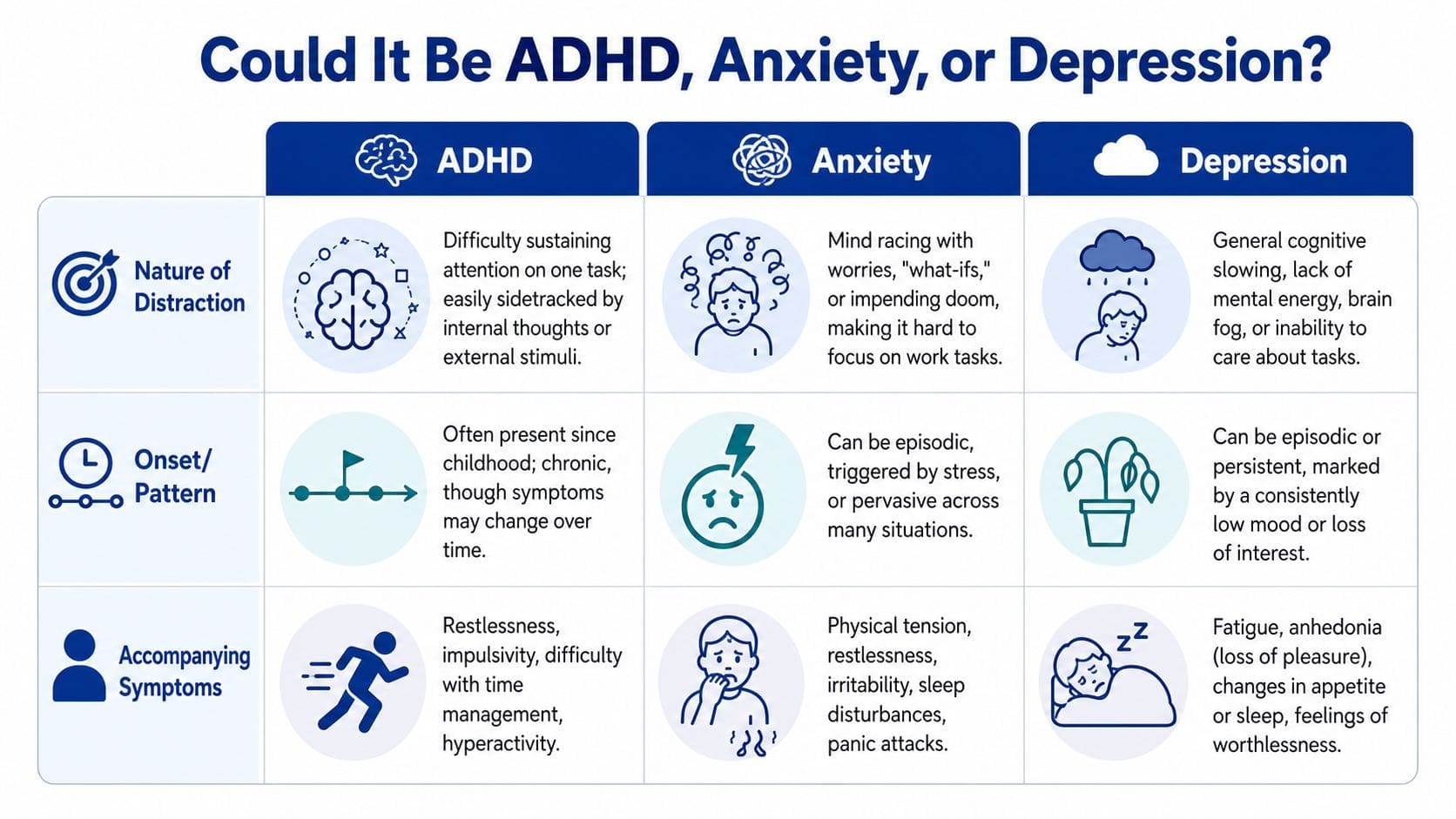
How ADHD inattention feels different
Adult ADHD often doesn't look like the stereotype people expect. Many adults are not physically hyperactive in an obvious way. They may look successful from the outside while privately struggling with missed deadlines, disorganization, mental restlessness, and an inability to start or sustain non-preferred tasks.
That distinction is central. Some adults with ADHD can focus intensely on interesting or urgent tasks, then feel completely blocked by routine paperwork, email, or administrative work. That pattern often gets mislabeled as laziness or burnout when it's better understood as an attention regulation problem.
As summarized in this discussion of focus and ADHD, many adults with undiagnosed ADHD are misdiagnosed as “burned out” because their inability to sustain effort on non-preferred tasks is seen as a willpower issue, not a result of dopamine dysregulation. That misunderstanding can delay access to treatments such as medication management.
Adults also need a different diagnostic lens than children. DSM-5 criteria require that adults age 17 and older show at least five symptoms of inattention or hyperactivity-impulsivity with symptoms present before age 12, as summarized in this adult ADHD diagnostic overview.
For readers who suspect this pattern, structured self-screening can help organize the conversation before an evaluation. An Adult ADHD Assessment can be a practical first step, especially when concentration issues have existed for years.
How anxiety disrupts focus
Anxiety pulls attention away from the task and toward threat monitoring. The person may appear distracted, but the mind is busy. It's scanning for mistakes, imagining consequences, replaying conversations, or jumping into “what if” scenarios.
At work, that often looks like:
- Overchecking. Reading the same email repeatedly to make sure nothing sounds wrong.
- Avoidance. Delaying tasks that carry uncertainty or possible criticism.
- Mental noise. Worry thoughts crowding out the ability to think clearly.
- Physical activation. Tension, restlessness, shallow breathing, or poor sleep making focus even harder.
Someone with anxiety may want to concentrate and even sit still at the desk for hours, yet get very little done because internal worry consumes the bandwidth.
How depression can look like poor concentration
Depression-related concentration problems usually feel slower and heavier. Instead of racing thoughts, many people describe brain fog, low mental energy, reduced motivation, and difficulty caring about tasks they would normally complete.
The workday often feels dulled. Simple tasks take more effort. Decision-making becomes slower. Memory may feel less reliable. The person may not say “I feel sad” first. They may say, “I can't think.”
That's why concentration problems should never be reduced to a productivity issue alone. They can be one of the clearest functional signs that mood is suffering.
A quick comparison
| Pattern | What concentration feels like | Clues that often show up alongside it |
|---|---|---|
| ADHD | Attention drifts, especially on boring or multi-step tasks | Time blindness, disorganization, restlessness, inconsistent follow-through |
| Anxiety | Focus gets hijacked by worry and mental rehearsal | Tension, irritability, sleep problems, reassurance-seeking |
| Depression | Thinking feels slowed, flat, or foggy | Fatigue, loss of interest, low motivation, negative self-talk |
For patients trying to understand their own pattern, a focused external resource on managing ADHD attention can add useful day-to-day tactics. It works best when paired with clinical assessment if the symptoms are persistent.
Evidence-Based Strategies for Improving Workplace Concentration
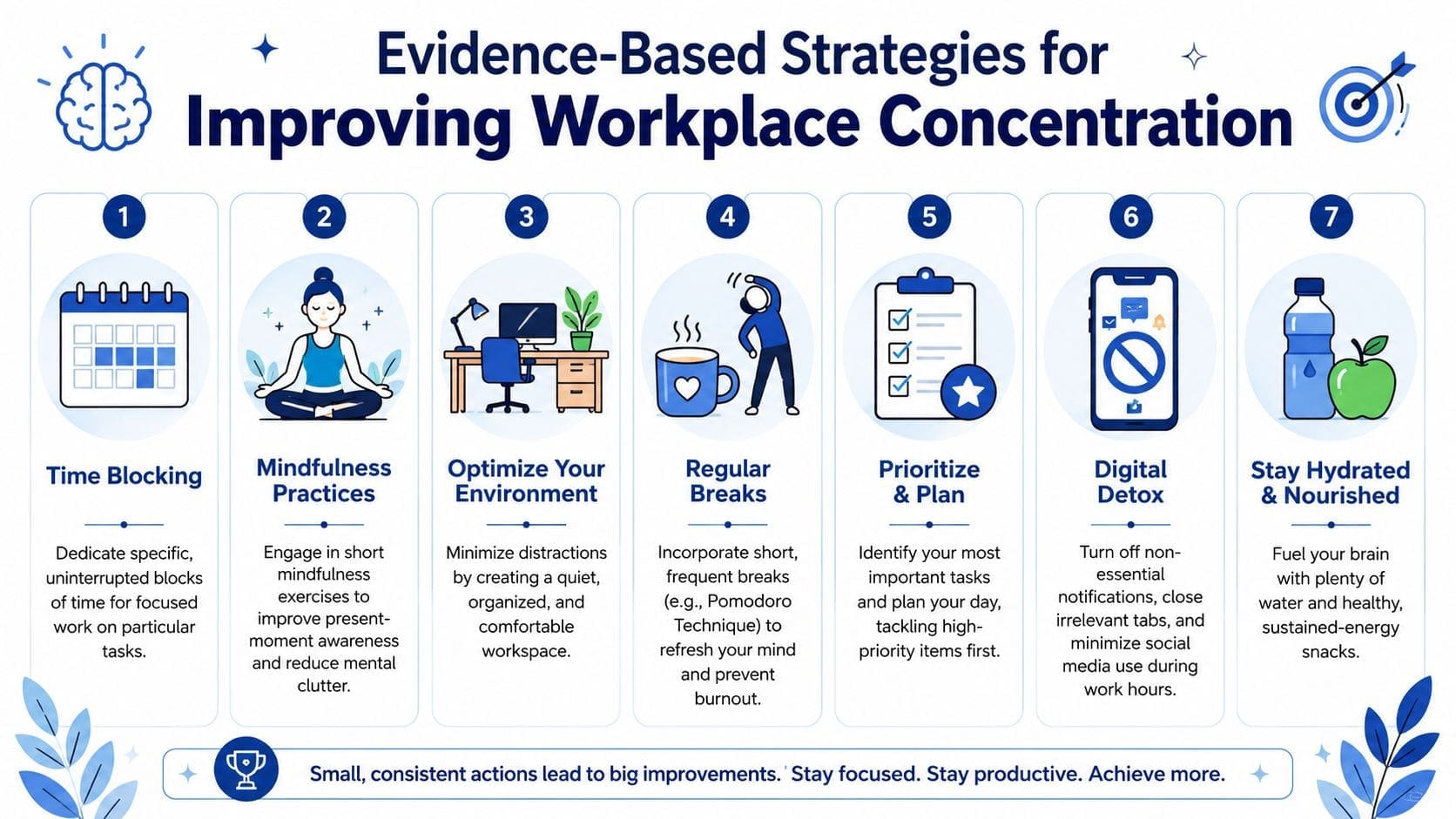
If your workday keeps sliding off track, the next step is to make focus easier to hold. In practice, that usually means changing the conditions around attention, then adding tools that match the actual problem.
Change the environment before you judge your effort
Workplace concentration often breaks down because the day is built for interruption. A recent systematic review on work-related factors and cognition found that predictable work periods and recovery opportunities support better cognitive performance and less fatigue. That lines up with what many clinicians see. People usually do better when their attention is not being pulled in five directions at once.
Start with the setup:
- Block one protected work session each day. Even 25 to 45 minutes of uninterrupted time can improve output.
- Check email and messaging on a schedule. Constant monitoring keeps the brain in scanning mode instead of task mode.
- Lower visual and sound clutter. Close extra tabs, silence nonurgent alerts, and use headphones if your space is noisy.
- Match the task to your energy. Put detailed or mentally heavy work where you are usually sharpest, not in the most depleted part of the day.
This sounds simple because it is. Simple changes often work better than complicated systems people abandon after three days.
Use structure that reduces decision fatigue
Poor concentration gets worse when every step requires a fresh decision. Structure helps by shrinking the number of choices your brain has to make.
A practical sequence looks like this:
- Choose the first priority before opening your inbox. Otherwise other people's urgency takes over the morning.
- Shrink the task until it is concrete. “Finish presentation” is too broad. “Write slide 1 headline” is a real starting point.
- Set a work interval. Timed focus periods help with starting, especially when a task feels vague or unpleasant.
- Pause briefly between blocks. Stand up, stretch, drink water, or walk for a few minutes before switching gears.
For adults who struggle with working memory, it helps to get the plan out of your head and onto paper or a screen. A basic daily checklist, paper planner, or notes app is often enough. The goal is not to build the perfect productivity system. The goal is to stop relying on memory when memory is already overloaded.
One rule matters here. If a tool takes too much effort to maintain, it will fail during a stressful week.
Support the brain systems that attention depends on
Concentration is not only a work habit. It depends on sleep, blood sugar stability, hydration, movement, and stress load. If those basics are off, focus usually drops first.
Helpful supports include:
- Consistent sleep and wake times
- Regular meals with enough protein and fluids
- Short movement breaks during the day
- Brief grounding or breathing exercises when your mind starts spinning
Some people also ask about supplements or combinations used for alertness with less jitteriness. This review of L-theanine paired with caffeine for focus support explains one common example. Supplement choices still need to fit the person. Anxiety symptoms, sleep problems, blood pressure concerns, other medical conditions, and current medications all matter.
Know when self-help is no longer enough
Productivity strategies help when the main issue is overload, poor workflow, or inconsistent routines. They help less when concentration problems show up across settings, keep returning despite good habits, or come with signs of ADHD, anxiety, depression, panic, or major sleep disruption.
That distinction matters. If you can build structure and still cannot hold attention, start tasks, organize your day, or quiet your mind long enough to work, the problem may need clinical assessment rather than another planner or focus app.
For patients in Pennsylvania who need more than self-help tools, Integrative Psychiatry of America offers virtual psychiatric evaluations, medication management, and evidence-informed treatment that can include lifestyle medicine approaches when clinically appropriate.
Your Path to a Diagnosis via Telehealth in Pennsylvania
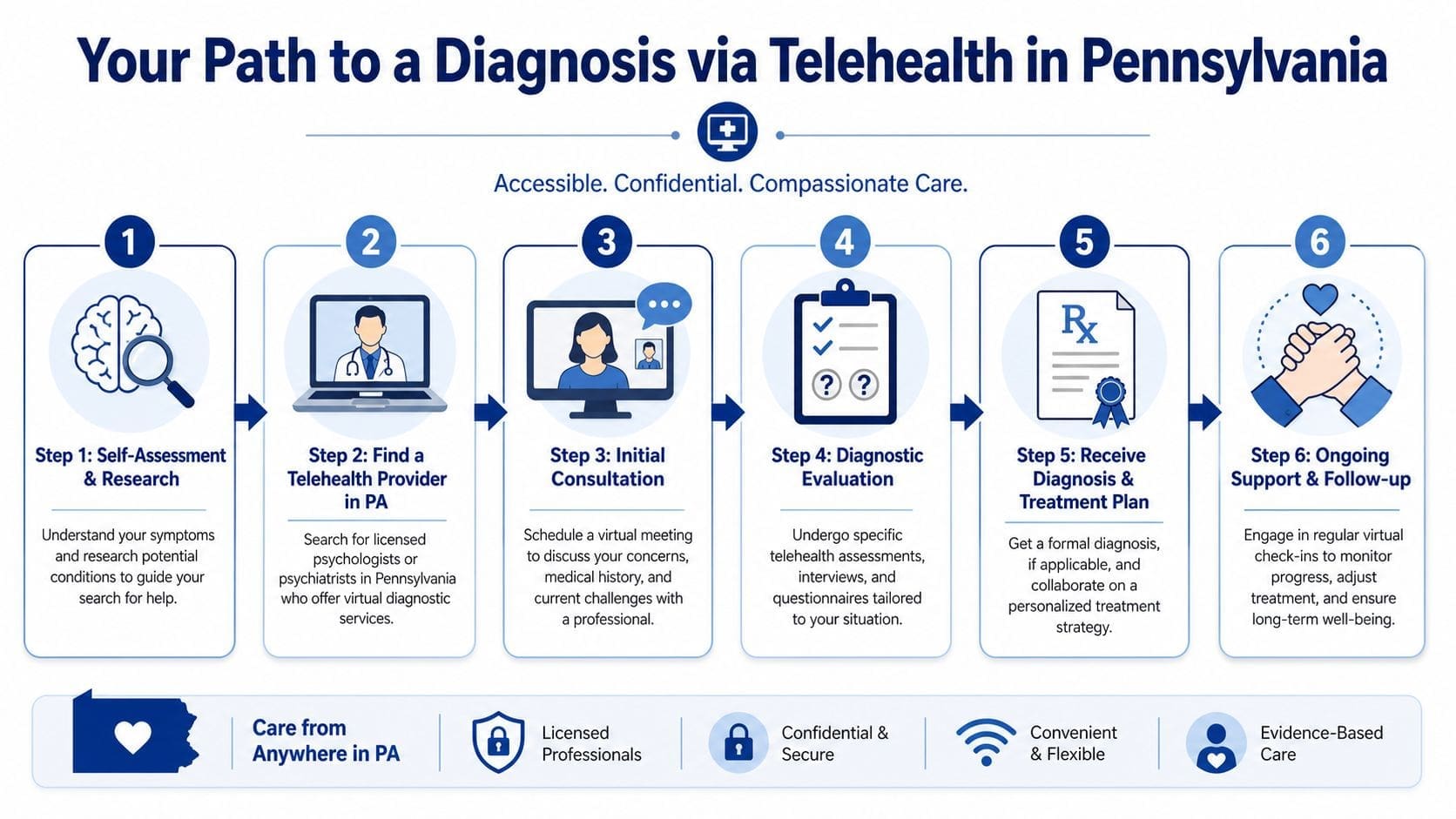
A lot of adults delay care because they assume the process will be complicated, expensive, or uncomfortable. It's often more straightforward than expected, especially when care is available virtually across Pennsylvania.
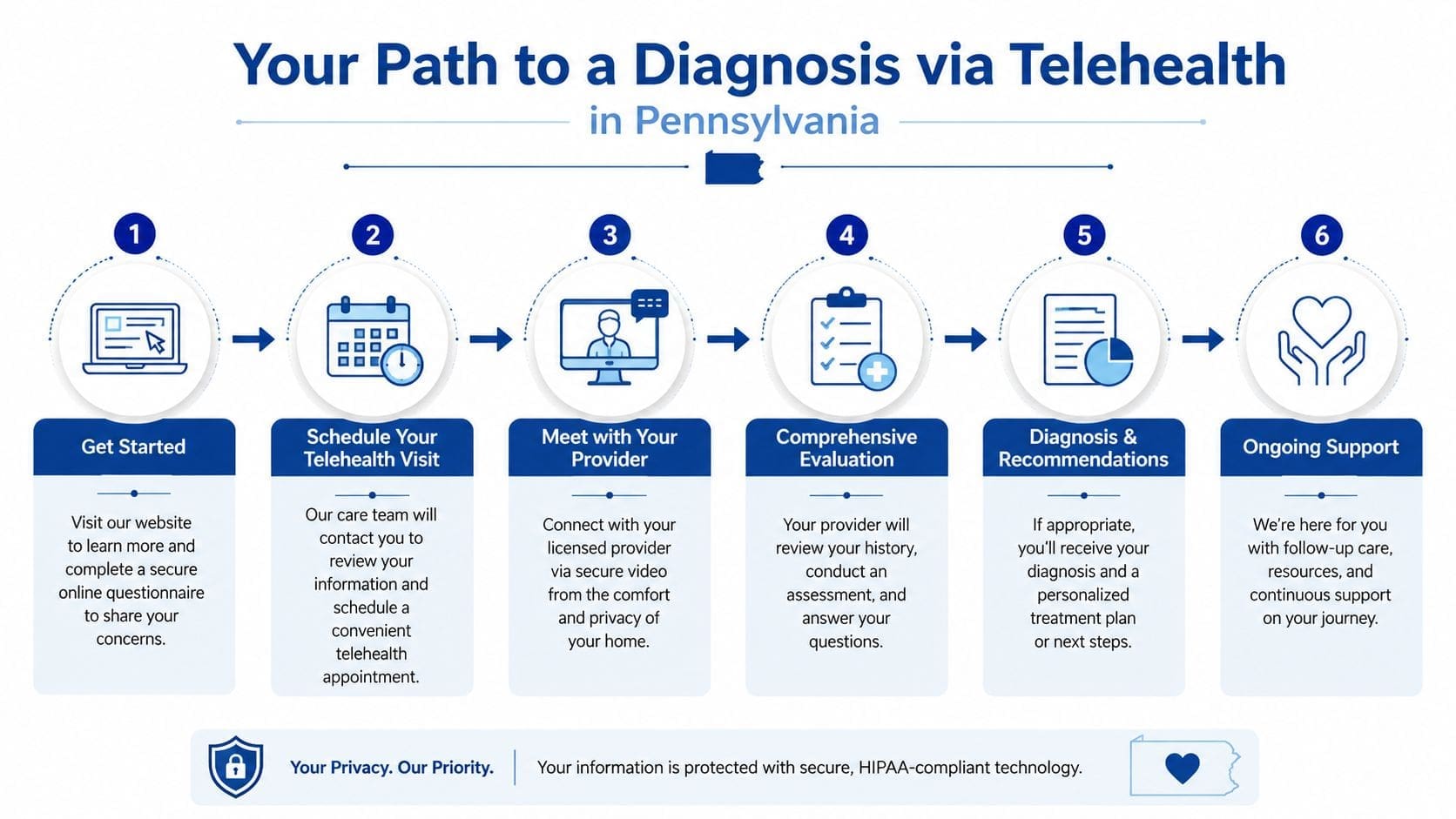
What a virtual evaluation usually includes
The first step is a detailed clinical conversation. That includes the current concentration problem, how long it has been happening, where it shows up, what makes it better or worse, and whether there are signs of ADHD, anxiety, depression, trauma, sleep disruption, or burnout.
A good evaluation also asks about functioning, not just symptoms. Work performance, home responsibilities, relationships, time management, organization, and emotional regulation all matter. For possible ADHD, childhood patterns are especially relevant because diagnosis depends partly on symptom history, not only current stress.
Telehealth can remove practical barriers that keep people stuck. That matters because a real treatment gap still exists. According to adult ADHD treatment statistics summarized here, 36.5% of U.S. adults with ADHD received no treatment, either medication or counseling, in the past 12 months.
For adults in Philadelphia, Pittsburgh, Erie, Scranton, Lancaster, Reading, Harrisburg, and Allentown, virtual care can make it easier to get evaluated without travel, waiting room logistics, or taking half a day off work. A focused telehealth ADHD evaluation can be a useful entry point when attention problems are the main concern.
What treatment can look like after diagnosis
Treatment depends on the cause. That's why diagnosis matters.
If ADHD is present, care may include medication management, behavioral strategies, and support for executive functioning. If anxiety is the main driver, treatment may focus on reducing excessive arousal, calming cognitive loops, and improving sleep. If depression is contributing, treatment may address mood symptoms, energy, motivation, and cognitive slowing.
A virtual treatment plan often includes some combination of:
- Medication review and management when clinically indicated
- Symptom monitoring to track improvements in focus
- Behavioral strategies suited to the person's work pattern
- Lifestyle support around sleep, exercise, and nutrition
- Follow-up visits to adjust treatment instead of leaving the patient to guess
Most adults don't need more shame. They need a careful assessment that separates bad habits from treatable symptoms.
Many patients also worry that virtual care will feel impersonal. In practice, it often works well for concentration concerns because the visit happens where the person lives and works. That context can make it easier to discuss routines, distractions, evening habits, and the day-to-day obstacles that are hard to explain in a rushed office visit.
Find Your Focus A Clear Path to Mental Health Care in PA
If it feels like the brain won't cooperate at work, that doesn't automatically mean something is seriously wrong. It also doesn't mean the problem should be dismissed. Concentration trouble sits at the intersection of environment, stress, sleep, mood, and neurodevelopmental conditions. The right response depends on the pattern.
For some adults, the answer is better boundaries around notifications, more structured work blocks, and more consistent recovery. For others, the concentration problem is the visible part of untreated ADHD, anxiety, or depression. Those patients usually don't need another productivity hack. They need a real evaluation.
Pennsylvania patients often wait too long because the symptom sounds too ordinary. “Can't concentrate at work” sounds small. It often isn't. When attention problems affect confidence, deadlines, organization, and emotional well-being, getting help is a reasonable next step.
A practical place to begin is a structured mental health screening, especially if the difficulty has been persistent or has spread beyond work. An online mental health evaluation can help clarify whether the issue looks more like stress overload, ADHD, anxiety, depression, or a combination.
Patients across Pennsylvania, including Philadelphia, Pittsburgh, Harrisburg, Erie, Scranton, Allentown, Lancaster, and Reading, can access virtual psychiatric care from home. That makes it easier to move from uncertainty to a treatment plan without adding another major obstacle to an already overloaded week.
The important point is simple. Trouble concentrating at work is not a moral failure. It's a signal. Once that signal is understood correctly, treatment gets much more effective.
If concentration problems are affecting work, mood, or daily functioning, Integrative Psychiatry of America offers virtual psychiatric evaluations, medication management, and evidence-informed treatment throughout Pennsylvania. Readers can learn more about treatment options, verify insurance coverage, schedule an appointment, or explore free tools such as the Adult ADHD Assessment, Anxiety Symptom Checker, Daily Agenda Planner, Feeling Journal, Exercise Routine Generator, and 5-4-3-2-1 Grounding Tool.