
A lot of adults ask the same question late at night after another frustrating workday. They sat through meetings but retained almost nothing. They bounced between tabs, forgot what they opened the laptop to do, then spent the evening replaying every unfinished task and worrying about what tomorrow will look like.
That internal experience can feel confusing because the symptoms overlap. Trouble concentrating, restlessness, sleep disruption, irritability, and overwhelm can show up in both conditions. It’s one of the most common diagnostic puzzles psychiatric nurse practitioners sort through.
The confusion is also understandable because ADHD and anxiety often occur together. Research summarized by Neurodivergent Insights on ADHD and anxiety overlap notes that up to 50% of adults with ADHD also experience an anxiety disorder, which is one reason people often wonder whether they have one condition, the other, or both.
For adults in Pennsylvania trying to decide whether it’s time to get evaluated, a practical next step is learning when to see a psychiatric provider for mental health concerns. The key isn’t guessing perfectly. The key is understanding how a clinician tells the difference.
Table of Contents
- The Constant Hum of 'What If' Meets 'I Can't Focus'
- Why ADHD and Anxiety Get Mistaken for Each Other
- A Deep Dive on Differentiating ADHD and Anxiety Symptoms
- The Chicken and Egg Problem of ADHD-Driven Anxiety
- How We Arrive at the Right Diagnosis in Pennsylvania
- Tailoring Treatment for ADHD Anxiety or Both
- Your Next Step to Clarity with Telepsychiatry in Pennsylvania
- Frequently Asked Questions About ADHD and Anxiety
The Constant Hum of 'What If' Meets 'I Can't Focus'
A Pennsylvania professional might start the day with every intention of catching up. The calendar is full. The inbox is growing. A simple task should take twenty minutes, but attention keeps slipping away to notifications, background noise, unrelated thoughts, or the urge to stand up and move.
At the same time, another track is running in the background. What if the deadline gets missed. What if the boss noticed the mistake. What if this keeps happening. That mix of distractibility and worry is exactly why people type do i have anxiety or add into a search bar.
What makes this hard is that the outside behavior can look similar. A person may seem scattered, tense, avoidant, late, forgetful, or overwhelmed in either condition. The difference usually shows up in the pattern underneath the behavior, not in one symptom by itself.
Clinical reality: A short symptom checklist rarely settles this question. Timing, context, childhood history, and the quality of the thoughts matter more than a single yes-or-no answer.
Some adults have had lifelong signs of attention dysregulation but only notice the problem when work gets more demanding. Others have a clear history of anxiety that began around stress, health fears, social pressure, or a major life transition. Some have both.
That’s why a strong evaluation doesn’t stop at “Do you have trouble focusing?” It asks what your mind is doing when focus drops, when the problem first started, whether the pattern shows up in calm settings, and whether worry is the driver or the consequence.
Why ADHD and Anxiety Get Mistaken for Each Other
From the outside, both conditions can produce a similar picture. Someone loses track of conversations, interrupts, can’t settle down, feels overstimulated, sleeps poorly, and procrastinates on important tasks. Friends, family, and even clinicians can mistake one for the other if they don’t dig deeper.

The overlap becomes clearer when looking at lived experience. Both ADHD and anxiety can create concentration problems. Both can make the body feel keyed up. Both can leave a person mentally exhausted by the end of the day. But the phenomenology, meaning the way the symptom feels, often differs in useful ways.
According to ADD.org’s explanation of ADHD versus anxiety, the presentation of shared symptoms is a major clue. ADHD restlessness often feels like an internal drive to move and fidget, while anxiety-related restlessness is more often nervous energy and somatic tension tied to apprehension.
Why the symptom list alone fails
A symptom list can flatten meaningful differences. “Racing thoughts” is a good example. In anxiety, thoughts often circle around a feared outcome. In ADHD, thoughts may jump rapidly between unrelated topics, ideas, reminders, sensory input, and unfinished tasks.
A few common areas of confusion include:
- Concentration problems that stem from worry loops in anxiety or distractibility across many settings in ADHD
- Restlessness that comes from physical tension in anxiety or hyperactivity and fidgeting in ADHD
- Sleep issues caused by rumination, fear, or anticipatory stress in anxiety, versus difficulty settling a busy mind in ADHD
- Feeling overwhelmed because everything seems threatening in anxiety, or because organizing and sequencing tasks feels chronically hard in ADHD
The pattern matters more than the label
Women in particular are often overlooked when attention symptoms are masked by perfectionism, worry, or overcompensation. Readers who recognize that pattern may find Refresh Psychiatry & Therapy insights useful because they describe how ADHD can be mistaken for anxiety when the presentation isn’t overtly hyperactive.
If a person says, “I can focus when I’m calm, but I lose it when I start worrying,” anxiety moves higher on the list. If they say, “I can’t hold focus even when nothing is wrong,” ADHD becomes harder to ignore.
A Deep Dive on Differentiating ADHD and Anxiety Symptoms
A side-by-side comparison helps more than another vague symptom list. The central question isn’t whether a person feels distracted or restless. The question is why.
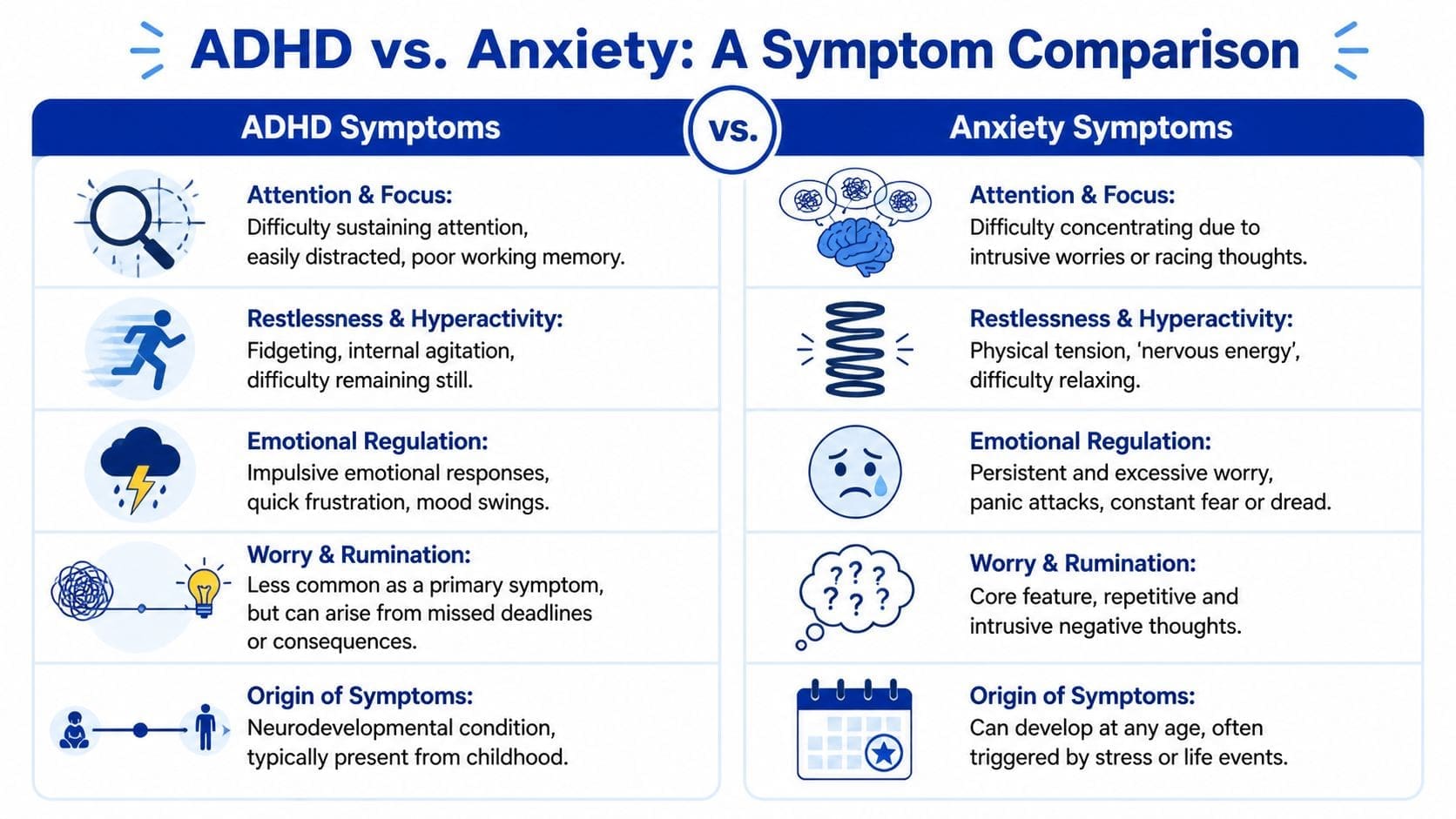
| Symptom Area | Typical in ADHD | Typical in Anxiety (GAD) |
|---|---|---|
| Attention | Attention drifts broadly, even during calm or low-stress tasks | Focus drops when worry, apprehension, or threat-based thinking takes over |
| Restlessness | Fidgeting, movement, internal urge to do something | Tension, pacing, shakiness, feeling on edge |
| Thought pattern | Rapid shifts between unrelated thoughts or stimuli | Repetitive worry around specific fears or outcomes |
| Emotional response | Frustration, impulsive reactions, impatience | Fear, dread, avoidance, reassurance-seeking |
| Trigger pattern | Persistent across settings | Often stronger in stress-heavy or evaluative situations |
The most important distinction is neurobiological. Good Health Psychology’s discussion of anxiety versus ADHD notes that adults with ADHD often struggle to concentrate even in calm environments because the issue is tied to brain-based attention regulation. Anxiety-related inattention is more state-dependent, meaning it tends to flare when anxious thought patterns take over.
Adults looking more specifically at longstanding attention symptoms may also want to review adult ADHD care and evaluation considerations in Philadelphia.
The nature of inattention
An anxious mind often narrows around threat. A person may reread the same email because they’re worrying about how it will be received. They may sit in a meeting but miss half of it because they’re mentally rehearsing a worst-case scenario.
ADHD inattention tends to be broader and less tied to a single fear. The person means to listen, but their mind drifts to a side thought, a sound in the hallway, a message preview, a random memory, and the urge to check one more thing.
The source of restlessness
Anxiety restlessness usually feels uneasy. The body may tighten. The chest may feel heavy. Muscles stay braced. Movement can look like pacing or difficulty relaxing.
ADHD restlessness usually feels activating rather than fearful. The person taps, shifts, gets up repeatedly, interrupts, or multitasks because stillness feels hard to maintain.
Emotional patterns and reactions
Anxiety often brings cautious behavior. A person may overprepare, avoid social risks, seek reassurance, or postpone decisions because they’re afraid of getting it wrong.
ADHD more often shows up as impulsive frustration. The person may blurt something out, become impatient, lose track of steps, or feel intense irritation when tasks require sustained organization.
How thoughts tend to move
Anxiety thoughts usually repeat. The same feared issue returns again and again. The content may change over time, but the style is repetitive and threat-focused.
ADHD thoughts often scatter. One idea triggers another, then another, with weak filtering. That can feel like “racing thoughts,” but it’s different from worry-based rumination.
A useful screening question is this. When the room is quiet, the deadline is distant, and nothing stressful is happening, does attention still fall apart? If yes, ADHD deserves careful consideration.
The Chicken and Egg Problem of ADHD-Driven Anxiety
Some adults don’t have a simple either-or picture. They have ADHD-driven anxiety, where years of missed deadlines, disorganization, forgotten details, and inconsistent follow-through create chronic worry about performance and consequences.

This distinction matters because the anxiety is real, but it may not be the original problem. A person can become anxious because life keeps punishing untreated ADHD. They start fearing email, bills, school portals, performance reviews, and routine tasks because those situations repeatedly expose executive function problems.
That pattern isn’t rare. WebMD’s review of the ADHD and anxiety link describes this bidirectional causality trap and notes that roughly 50% of adults with ADHD also have anxiety, while patients and clinicians may miss when anxiety is a secondary consequence of ADHD struggles.
Adults dealing with multiple overlapping symptoms can also explore co-occurring ADHD, anxiety, and depression patterns to understand how these conditions can stack together.
When anxiety is a consequence
Secondary anxiety often sounds like this:
- Task-based worry about forgetting something important
- Performance fear tied to deadlines, paperwork, school, or job expectations
- Shame-driven avoidance because repeated mistakes feel humiliating
- Anticipatory dread before situations that demand planning, time management, or sustained attention
That’s different from classic generalized anxiety, where worry spreads broadly and persists across many topics whether or not executive function demands are present.
A short explanation often helps:
Why treatment order matters
If the root problem is untreated ADHD, treating only anxiety can leave the person stuck. They may feel somewhat calmer but still miss deadlines, lose focus, and repeat the same stressful cycle. The anxiety then returns because the underlying trigger remains active.
Think clinically: If anxiety rises mainly around organization, follow-through, lateness, and underperformance, a provider should ask whether ADHD is feeding the whole system.
That doesn’t mean anxiety should be dismissed. It means the sequence of care matters. Sometimes stabilizing attention and executive function reduces a large share of the anxiety burden.
How We Arrive at the Right Diagnosis in Pennsylvania
A solid diagnosis doesn’t come from a five-minute impression. It comes from pattern recognition across history, symptoms, context, and medical factors. For telehealth patients in Pennsylvania, that process can still be thorough, structured, and highly personalized.

The clinical interview
The interview usually starts with the current complaint, but it doesn’t end there. A psychiatric nurse practitioner looks at when symptoms began, how they show up at work and home, whether similar patterns existed in childhood, what school was like, how relationships have been affected, and whether trauma, substance use, sleep problems, burnout, or depression could be complicating the picture.
Questions often focus on chronology. Did attention problems exist before the anxiety? Did worry start after repeated struggles with organization and follow-through? Does concentration improve when the person feels calm, or is it consistently hard?
Rating scales and pattern recognition
Standardized screening tools help organize the picture. The ASRS-v1.1 can help identify ADHD patterns, while anxiety screens can clarify how much worry, tension, and physical anxiety are present.
That matters because Powers Health’s coverage of ADHD traits and adult anxiety severity notes that ADHD traits are more strongly linked to the severity of adult anxiety and depression than autistic traits, and that tools like the ASRS-v1.1 are useful for separating ADHD-like symptoms from primary anxiety during assessment.
Some adults also benefit from more formal psychological testing for ADHD, especially when the history is complex, the presentation is mixed, or documentation is needed for work or school accommodations.
Medical and integrative screening
Psychiatric symptoms don’t exist in a vacuum. Good assessment also considers medical contributors that can mimic or worsen focus and anxiety problems. Depending on the case, clinicians may recommend lab work to look at relevant medical factors and discuss whether genetic testing could be useful for understanding medication response.
That integrative step is practical, not trendy. If sleep is poor, energy is low, nutrition is inconsistent, or the body is under chronic stress, treatment won’t work as well. A modern evaluation looks at the whole system.
The right diagnosis usually emerges from layered evidence. History, symptom quality, rating scales, and medical screening tell a more reliable story than a self-quiz ever will.
Tailoring Treatment for ADHD Anxiety or Both
Treatment works best when it follows the pattern of the diagnosis. ADHD care and anxiety care overlap in some ways, but they aren’t interchangeable. Using the wrong strategy can leave a person discouraged because they’re working hard without targeting the actual driver.
If ADHD is primary
When ADHD is the main issue, treatment often includes medication management with stimulant or non-stimulant options, plus practical structure. Calendars, reminders, task breakdown, environmental modification, and routine design matter because they reduce daily friction.
Lifestyle work also matters here. Regular exercise, consistent sleep timing, and nutrition support can improve steadiness and reduce the buildup of stress that follows disorganization. Mindfulness can help too, but by itself it usually won’t fix executive dysfunction.
If anxiety is primary
When anxiety is primary, treatment often centers on therapy strategies that target worry, avoidance, and threat sensitivity. Cognitive behavioral approaches can be useful because they help a person identify distortions, reduce reassurance-seeking, and tolerate uncertainty.
Medication may also play a role. Some patients benefit from antidepressant-class medications commonly used for anxiety, especially when worry is pervasive, sleep is disrupted, or panic symptoms are present.
If both are present
Comorbid care is where treatment becomes more nuanced. Sometimes the most impairing condition gets treated first. In other situations, a clinician may address both at the same time with a combination of medication management, psychotherapy, skills work, and behavior changes.
A practical integrative plan may include:
- Medication targeting based on whether inattention, worry, panic, or mood symptoms are driving impairment
- Therapy selection matched to the pattern, such as executive function coaching for ADHD traits and CBT-based work for generalized worry
- Body-based interventions like exercise, breathwork, and mindfulness for tension regulation
- Nutritional support to reduce chaos around energy, appetite, and daily functioning
- Sleep stabilization because both ADHD and anxiety worsen when sleep becomes irregular
For readers trying to understand how clinicians think about overlapping mood symptoms, Treating comorbid anxiety and depression offers a helpful therapy-centered perspective on co-occurring conditions.
What usually doesn’t work is treating symptoms in isolation. A person with ADHD-driven anxiety often won’t get lasting relief from reassurance alone. A person with primary anxiety usually won’t improve just by downloading a planner and trying harder to stay organized.
Your Next Step to Clarity with Telepsychiatry in Pennsylvania
If the question do i have anxiety or add has been following someone for months or years, more self-diagnosis usually isn’t the answer. Careful evaluation is. The point of an assessment isn’t to hand out a label. It’s to identify the pattern accurately enough that treatment finally starts making sense.
Telepsychiatry makes that process easier for adults across Pennsylvania, including people in Philadelphia, Pittsburgh, and smaller communities where specialty mental health access may be limited. Secure video visits allow patients to discuss symptoms privately, complete screening tools, review treatment options, and follow up without adding another difficult commute to an already overloaded week.
A strong telehealth evaluation is especially useful for adults who’ve delayed care because they felt embarrassed, too busy, or unsure whether their symptoms were “serious enough.” If concentration problems, restlessness, worry, procrastination, panic, sleep disruption, or chronic overwhelm are affecting work, relationships, or self-confidence, that’s enough reason to get clarity.
Adults ready to move forward can explore online psychiatric care in Pennsylvania and take the next step toward a more precise diagnosis and a treatment plan that fits real life.
Frequently Asked Questions About ADHD and Anxiety
Some questions come up repeatedly in evaluations, especially when symptoms have been mixed for a long time.
Quick Answers to Common Questions
| Question | Answer |
|---|---|
| Can a person have both ADD and anxiety? | Yes. Some adults clearly meet criteria for both, while others have anxiety that developed in response to untreated ADHD struggles. |
| Is trouble concentrating enough to diagnose ADHD? | No. Concentration problems happen in ADHD, anxiety, depression, sleep problems, and medical conditions. The pattern and history matter. |
| Does anxiety cause fidgeting? | It can. Anxiety-related restlessness usually feels tense and apprehensive, while ADHD-related movement often feels driven and hard to inhibit. |
| Can telehealth diagnose ADHD or anxiety? | Telehealth can support a thorough psychiatric evaluation when the assessment includes a detailed history, screening tools, and appropriate follow-up. |
| What does a PMHNP do in this process? | A psychiatric mental health nurse practitioner evaluates symptoms, develops differential diagnoses, orders or reviews appropriate screening steps, and provides medication management and treatment planning. |
| Will medication always be part of treatment? | Not always. Some people need medication, some benefit more from therapy and behavioral supports, and many do best with a combination approach. |
A few additional practical points often help:
- If symptoms started in childhood, ADHD moves higher on the list, especially if the pattern has shown up across school, work, and home settings.
- If focus collapses mostly during worry, anxiety deserves close attention as a primary driver.
- If treatment for anxiety helped only a little, it may be time to revisit whether attention dysregulation was missed.
- If shame has kept someone from seeking help, that reaction is common and doesn’t mean the symptoms are minor.
Clarity often changes more than a diagnosis. It changes self-blame into a treatment plan.
Integrative Psychiatry of America provides holistic online psychiatry across Pennsylvania with care from psychiatric nurse practitioners who evaluate ADHD, anxiety, depression, OCD, PTSD, and co-occurring conditions through secure telehealth. Patients can schedule online, verify insurance, use the patient portal, and receive personalized treatment that may include medication management, psychotherapy, lifestyle support, and integrative screening when clinically appropriate.