
A lot of women in Pennsylvania are functioning at a high level on the outside while feeling chronically behind on the inside. Bills get paid late even with reminders set. Laundry gets folded in half-finished batches. Work tasks pile up because starting feels harder than it “should.” Emotions run hot before a period, after a bad night of sleep, or during a stressful week, and the shame that follows can be worse than the symptoms themselves.
For many adults, that pattern isn’t laziness, lack of discipline, or a personality flaw. It can be ADHD, often the inattentive kind, often masked for years, and often made harder by hormonal shifts that standard treatment plans barely address. General mental health education from the National Institute of Mental Health can be a helpful starting point, but women usually need a more specific conversation than the standard ADHD overview provides.
Thoughtful add in women treatment is crucial. Effective care doesn't just ask whether someone is distracted. It asks when symptoms worsen, how anxiety and burnout fit into the picture, what the menstrual cycle changes, and which supports make daily life easier. Online treatment can make that process much more accessible, especially for women balancing work, caregiving, school, and long commutes across Pennsylvania.
Table of Contents
- The Hidden Struggle of ADHD in Women
- Why ADHD in Women Is So Often Missed
- The Path to an Accurate ADHD Diagnosis
- Building Your Treatment Plan Medication and Therapy
- Integrative Care Hormones Nutrition and Lifestyle
- Accessing ADHD Treatment Online in Pennsylvania
The Hidden Struggle of ADHD in Women
Many adult women don’t describe ADHD by saying, “I’m hyperactive.” They describe a life that feels harder than it looks. They talk about forgotten forms, unfinished projects, doom piles, irritability, racing thoughts, and the constant effort of trying to look organized enough that nobody notices the strain.
That hidden strain is one reason ADHD in women gets overlooked. A major gap in care is that women with ADHD experience unique hormonal fluctuations that can intensify symptoms, yet treatment guidelines rarely adjust for these cycles. A detailed review also noted that women are 30-50% less likely to be prescribed stimulants than men, even after diagnosis, which contributes to poorer outcomes, according to this review on ADHD in girls and women.
What this often looks like day to day
Some women feel mentally “on” all the time but can’t direct that energy where they want it to go. Others look calm and capable while internally cycling through worry, perfectionism, and task paralysis. Many have spent years being treated only for anxiety, depression, or stress, even when those problems sit on top of untreated ADHD.
A few common patterns show up repeatedly in clinical practice:
- Chronic overwhelm: Daily responsibilities feel manageable on paper but chaotic in real life.
- Internal restlessness: The body may not look hyperactive, but the mind rarely settles.
- Emotional whiplash: Small stressors trigger outsized frustration, tears, or shutdown.
- Masking: Women often create elaborate systems to avoid looking forgetful or disorganized.
ADHD in women often hides behind competence. A person can be smart, hardworking, and still have a nervous system that struggles with attention regulation and executive function.
Why this topic matters in Pennsylvania
Women seeking online ADHD treatment in Pennsylvania often need privacy, flexibility, and speed. A mother in Pittsburgh, a graduate student in Philadelphia, or a professional in a smaller town may all face the same barrier. It’s hard to get help when getting help requires more planning than the brain can comfortably manage.
That’s why a practical, compassionate approach to women’s ADHD treatment, adult ADHD care, telehealth psychiatry, and integrative mental health matters. Good care should reduce friction, not add to it.
Why ADHD in Women Is So Often Missed
The stereotype still gets in the way. Many people were taught to picture ADHD as a loud, impulsive boy who can’t stay seated in class. Women and girls often present differently. Their symptoms are more likely to be inward, quieter, and easier to misread as personality traits or stress.
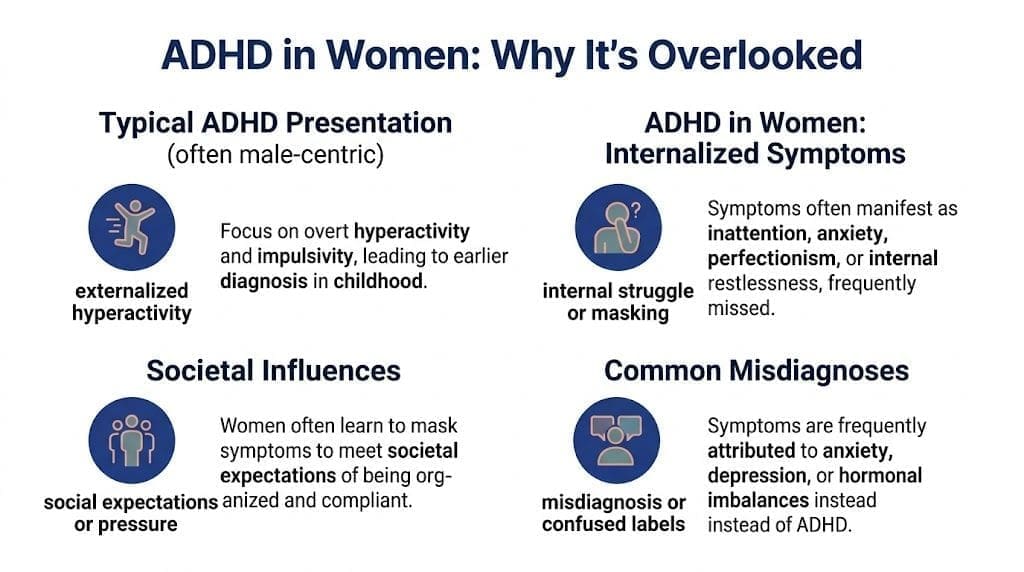
Recognition has improved, but the delay is still significant. The number of privately insured U.S. women ages 15 to 44 filling ADHD prescriptions increased by 344% between 2003 and 2015, and women are diagnosed on average 4 years later than men. The childhood diagnosis ratio of 3:1 or 4:1 boys-to-girls shifts to nearly 1:1 in adulthood, according to this summary of ADHD and women statistics.
Commonly missed signs
Women often don’t present with the version of ADHD that teachers, parents, and even clinicians were trained to spot first. Instead, the signs can look like this:
- Inattention that gets mislabeled: Frequent zoning out, losing track of steps, and needing extra time to start tasks may get called “scatterbrained” or “unmotivated.”
- Perfectionism as camouflage: Some women overcompensate by becoming intensely detail-focused in a few areas while other parts of life fall apart.
- Emotional sensitivity: Rejection, criticism, and interpersonal tension may hit hard and linger.
- Functional inconsistency: Performance can swing sharply depending on interest, urgency, sleep, or hormone changes.
- Anxiety layered over ADHD: Many women seek help for worry first because the anxiety is obvious, while the executive dysfunction underneath it gets missed.
Why masking matters
Masking is costly. A woman may use alarms, lists, sticky notes, late-night catch-up sessions, and constant self-monitoring just to stay even with daily demands. From the outside, that can look like she’s managing. Internally, she may be one disrupted routine away from collapse.
A side-by-side comparison helps:
| Pattern | More commonly recognized | More commonly missed in women |
|---|---|---|
| Activity level | Visible hyperactivity | Internal restlessness |
| Attention | Obvious classroom disruption | Daydreaming, drifting, mental overload |
| Social response | Impulsivity seen by others | People-pleasing, overexplaining, masking |
| Mislabeling | “Behavior problem” | “Anxious,” “too sensitive,” “disorganized” |
For readers who also relate to chronic worry, the overlap with anxiety can be important to sort through. Educational content on related concerns, such as online anxiety treatment in Pennsylvania, can help clarify where the symptoms intersect and where they don’t.
The Path to an Accurate ADHD Diagnosis
An accurate diagnosis is more than a checklist and more than an online quiz. Adult ADHD evaluation works best when it looks at the full picture, including attention, executive function, emotional regulation, sleep, hormone-related symptom changes, and conditions that can mimic or worsen ADHD.
Women are often relieved to learn that the evaluation process is collaborative. Their lived experience matters. Patterns from childhood matter. The timing of symptoms matters. So does the difference between “I can do this sometimes” and “I can only do this under pressure, panic, or last-minute urgency.”
What a thorough evaluation usually includes
A complete assessment commonly involves several pieces working together:
- Clinical interview: A psychiatric nurse practitioner reviews current symptoms, functional impact, medical history, and mental health history.
- Childhood pattern review: ADHD doesn’t begin in adulthood, even if it’s first recognized then.
- Structured screening tools: Self-report measures such as the ASRS can help organize symptom patterns, but they don’t replace clinical judgment.
- Rule-outs and overlap: Anxiety disorders, depression, sleep issues, trauma, thyroid problems, and other concerns can look similar or coexist.
- Hormonal context: Symptom worsening around the menstrual cycle, postpartum, or perimenopause can offer valuable diagnostic clues.
Women with undiagnosed ADHD often pay a steep price for delay. Due to masking and pressure to meet social expectations, women can face “high emotional and social costs” from delayed diagnosis, including higher risks of anxiety and depression, burnout, and internalized failure, as described by ADDA’s overview of ADHD in women.
Practical rule: A good ADHD assessment doesn’t just ask, “Are you distracted?” It asks, “What does distraction cost you in real life?”
A short educational video can also make the evaluation process feel less intimidating:
What helps before the first appointment
Patients don’t need perfect records, but a little preparation helps the visit go deeper faster.
- Write down patterns: Missed deadlines, chronic lateness, unfinished tasks, or emotional crashes are useful examples.
- Track timing: If symptoms worsen before a period or during hormonal transitions, note that.
- List past treatment: Prior therapy, antidepressants, stimulant trials, side effects, and sleep concerns all matter.
- Bring questions: Asking whether symptoms fit ADHD, anxiety, or both is appropriate and often necessary.
That process gives the clinician a better chance of building a diagnosis that fits real life, not just a symptom list.
Building Your Treatment Plan Medication and Therapy
Treatment works best when it solves functional problems, not just when it produces a label. For many women, the strongest plan includes both medication and therapy because each does a different job. Medication can improve attention regulation and impulse control. Therapy helps build systems, reduce shame, and change the daily patterns that keep symptoms active.
Women with ADHD also have higher rates of co-occurring conditions like anxiety (38%) and depression (25%). A combined approach using pharmacotherapy and CBT is considered critical, with benchmark outcomes including 75% symptom control and a 40% reduction in emotional lability, according to this PMC review on ADHD in women.

Medication Management
Medication isn’t a character upgrade. It’s a tool. The right medication can lower friction around starting tasks, sustaining focus, regulating emotion, and shifting between responsibilities.
In clinical care, the work usually isn’t “pick a pill and move on.” It’s more specific:
- Choosing the class: Stimulants and non-stimulants each have a role. The best option depends on symptoms, side effects, sleep, anxiety, medical history, and patient preference.
- Titrating carefully: Too little may do almost nothing. Too much may create jitters, irritability, appetite changes, or sleep problems.
- Watching the pattern, not one day: Medication should be judged by consistent function over time, not by a single unusually productive afternoon.
Medication alone has limits. It may improve attention, but it won’t automatically create planning habits, realistic scheduling, or a less self-critical inner voice. That’s why many adults benefit from structured medication follow-up such as ADHD medication management online.
Evidence-Based Psychotherapy
Cognitive behavioral therapy, ADHD-focused counseling, and practical coaching can make treatment stick. Therapy helps women identify bottlenecks like perfectionism, avoidance, overcommitment, and all-or-nothing thinking.
Some of the most useful therapy targets include:
- Time management: Building realistic plans instead of idealized ones.
- Task initiation: Using external cues and shorter starting steps.
- Emotional regulation: Recognizing overload earlier and recovering faster.
- Self-talk: Replacing “Why can’t I just do this?” with more accurate, less punishing language.
Women who juggle workstreams across home, school, and employment often benefit from simple project visibility tools. A practical example is this guide on how to keep track of multiple projects, which aligns well with ADHD treatment because it turns vague mental clutter into visible next actions.
Medication can help the brain engage. Therapy helps the person decide what to do once engagement is finally possible.
For broader patient-facing information on treatment options, the American Psychiatric Association patient education resources can also be useful.
Integrative Care Hormones Nutrition and Lifestyle
Women’s ADHD care often stalls when treatment ignores biology outside the brain. Symptoms don’t happen in a vacuum. They change with estrogen shifts, sleep disruption, inflammation, stress load, appetite patterns, and the practical realities of everyday life.
That’s why add in women treatment often works better when it’s integrative. Medication may still be central, but a more complete plan looks at what changes symptom intensity, what reduces resilience, and what makes the treatment response more stable.

Hormonal Considerations
Hormones can sharply affect attention and emotional control. According to CHADD’s review, low estrogen phases can heighten inattention and emotional dysregulation by 20-30%, and customized multimodal treatment that adjusts stimulant dosing to the menstrual cycle and integrates CBT can produce 70-80% symptom reduction, compared with 50% with medication alone in the cited evidence on treatment for ADHD in women and girls.
That matters in real treatment decisions. If a patient says, “My medication seems to stop working the week before my period,” that shouldn’t be brushed aside. It may be a treatment clue.
Hormone-aware care may involve:
- Cycle tracking: A simple symptom log can reveal predictable periods of worse focus or increased irritability.
- Medication review: Sometimes the issue isn’t that the medication “failed.” The issue is that symptom load changes across the month.
- Life-stage context: Pregnancy, postpartum, perimenopause, and menopause can all alter presentation and treatment needs.
For women navigating midlife changes, this discussion of menopause and ADHD interactions is a useful companion resource because it puts hormonal transition into practical language.
Holistic Supports
Integrative care doesn’t mean replacing evidence-based treatment with vague wellness advice. It means using supports that are concrete and sustainable.
A strong non-medication foundation often includes:
- Nutrition that supports consistency: Regular meals, adequate protein, and attention to iron or other deficiencies when clinically relevant can reduce the “crash and scramble” cycle.
- Sleep protection: ADHD symptoms get louder when sleep gets shorter or more fragmented.
- Movement: Exercise can improve regulation, mood, and restlessness.
- Mindfulness or meditation: These practices don’t cure ADHD, but they can help create a pause between impulse and action.
- Lab or genetic review when indicated: If response is inconsistent or side effects are unusual, deeper assessment can help personalize care.
A helpful general resource on food and mental well-being is Harvard Health’s nutrition coverage, especially for patients trying to connect eating patterns with focus and mood.
Treatment tends to hold better when daily routines support the brain instead of fighting it all day long.
The most effective plans are usually not the most extreme. They’re the ones a patient can keep doing.
Accessing ADHD Treatment Online in Pennsylvania
Online ADHD care has made treatment more reachable for adults who would otherwise delay it. That matters for women who are already stretched thin. Adding travel, waiting rooms, time off work, school pickups, or long drives across Pennsylvania can turn one appointment into a full-day obstacle.
Telehealth reduces that burden. A woman in Philadelphia, Pittsburgh, Harrisburg, Scranton, or a smaller community can meet with a psychiatric nurse practitioner from home, work, or any private space with a stable connection. For many patients, that privacy makes it easier to finally discuss symptoms they’ve hidden for years.
What the process usually looks like
Most online treatment starts with a few simple steps:
- Check logistics first: Review insurance or self-pay options before booking.
- Schedule online: Pick an appointment time that fits real life, not an ideal week that never comes.
- Complete intake forms: These give the clinician useful background on symptoms, history, and current concerns.
- Attend the evaluation virtually: The visit focuses on diagnosis, differential diagnosis, and treatment planning.
- Use the portal consistently: Messaging, refill requests, and follow-up coordination are easier when everything is in one place.
Patients looking for direct next steps can review the practice background on the About Us page, request care through the online scheduling page, or use the contact page for practical questions.
What makes online care helpful for women
Telehealth isn’t just about convenience. It can improve follow-through because the process asks less from an already overloaded brain. The woman who keeps meaning to call for help but never gets around to it may be much more likely to complete a secure online intake at night after the house is quiet.
That kind of access matters for adult ADHD treatment Pennsylvania, online ADHD diagnosis, telepsychiatry Pennsylvania, women’s mental health, executive dysfunction treatment, CBT for ADHD, medication management online, and holistic ADHD support. Effective care is available, and getting started doesn’t have to be complicated.
Integrative Psychiatry of America provides compassionate, whole-person online psychiatric care across Pennsylvania, including support for adult ADHD, anxiety, depression, OCD, PTSD, and related concerns. Adults looking for practical add in women treatment can learn more, verify insurance, and request an appointment through Integrative Psychiatry of America.