
A Pennsylvania professional may know that treatment could help, yet still postpone care because work, family responsibilities, transportation, and long office waits make regular in-person appointments difficult. Telepsychiatry medication management can solve part of that access problem, but it isn't just a video call followed by a prescription. Safe care requires a thorough evaluation, appropriate prescribing authority, symptom monitoring, side-effect review, and a clear plan for follow-up.
For adults seeking treatment for ADHD, anxiety, depression, OCD, PTSD, or other psychiatric conditions, virtual care can provide continuity without removing clinical safeguards. The key question isn't whether medication can be managed online. It's whether the provider has built a careful workflow around diagnosis, medication safety, regulation, and ongoing communication.
Table of Contents
- What Telepsychiatry Medication Management Actually Means
- How the Virtual Medication Management Workflow Operates
- Safety Rules and Prescribing Regulations in Pennsylvania
- Integrative Services That Support Medication Treatment
- Insurance Coverage and Payment Options for Virtual Care
- What to Expect During Your First Telepsychiatry Visit
- Common Questions About Telepsychiatry Medication Management
What Telepsychiatry Medication Management Actually Means
Consider a Pennsylvania employee whose anxiety has begun affecting sleep, concentration, and work performance. The person may want psychiatric medication but can't regularly travel to an office in Philadelphia or another nearby city. A secure video appointment can make the initial evaluation more practical, yet the clinical work remains substantial.
Telepsychiatry medication management is the ongoing process of assessing symptoms, establishing or reviewing a diagnosis, prescribing when appropriate, adjusting doses, monitoring response, and addressing side effects through secure telehealth visits. It differs from therapy-only care because medication decisions are part of the treatment plan. It also differs from a quick refill service because a responsible provider reassesses whether the medication remains appropriate.
The American Psychiatric Association describes telepsychiatry as a clinical channel that follows the same standards as in-person psychiatric care, including assessment, documentation, safety planning, and treatment follow-up in its telepsychiatry best-practices guidance. Medication management may involve psychiatric history, medical conditions, substance-use history, current medications, treatment goals, and a review of risk factors before a prescription is considered.
What virtual care can and cannot do
Telepsychiatry can support evaluation, medication initiation when legally and clinically appropriate, dose adjustments, education, and follow-up monitoring. It can be especially useful for adults managing chronic conditions who need regular contact but don't require an in-person procedure at every visit.
It isn't the right setting for every situation. A person with an immediate safety crisis, severe intoxication, rapidly worsening psychosis, or a medical emergency may need emergency or in-person assessment. Virtual care also can't replace laboratory testing, physical examination, or collaboration with another clinician when those steps are clinically necessary.
The field has a long history. The American Psychiatric Association notes that psychiatric videoconferencing began in the 1950s, with the Nebraska Psychiatric Institute using early videoconferencing by 1959 and Massachusetts General Hospital providing psychiatric consultations through an airport clinic by 1969 in its history of telepsychiatry. Telepsychiatry expanded through later decades and entered the 2000s as an evidence-based option supported by outcome research and practice guidance.
Practical rule: Convenience matters, but convenience never replaces diagnostic accuracy, medication monitoring, or a plan for urgent problems.
Patients researching whether a stimulant can be prescribed remotely may also encounter resources about Vyvanse prescription via telehealth. Such information should be treated as general education, not a substitute for an evaluation by a Pennsylvania-licensed clinician who can review the patient's history and current rules.
A plain-language overview of the care model is available through what telepsychiatry involves. The practical difference is that a virtual visit changes the setting, not the provider's responsibility to make careful clinical decisions.
How the Virtual Medication Management Workflow Operates
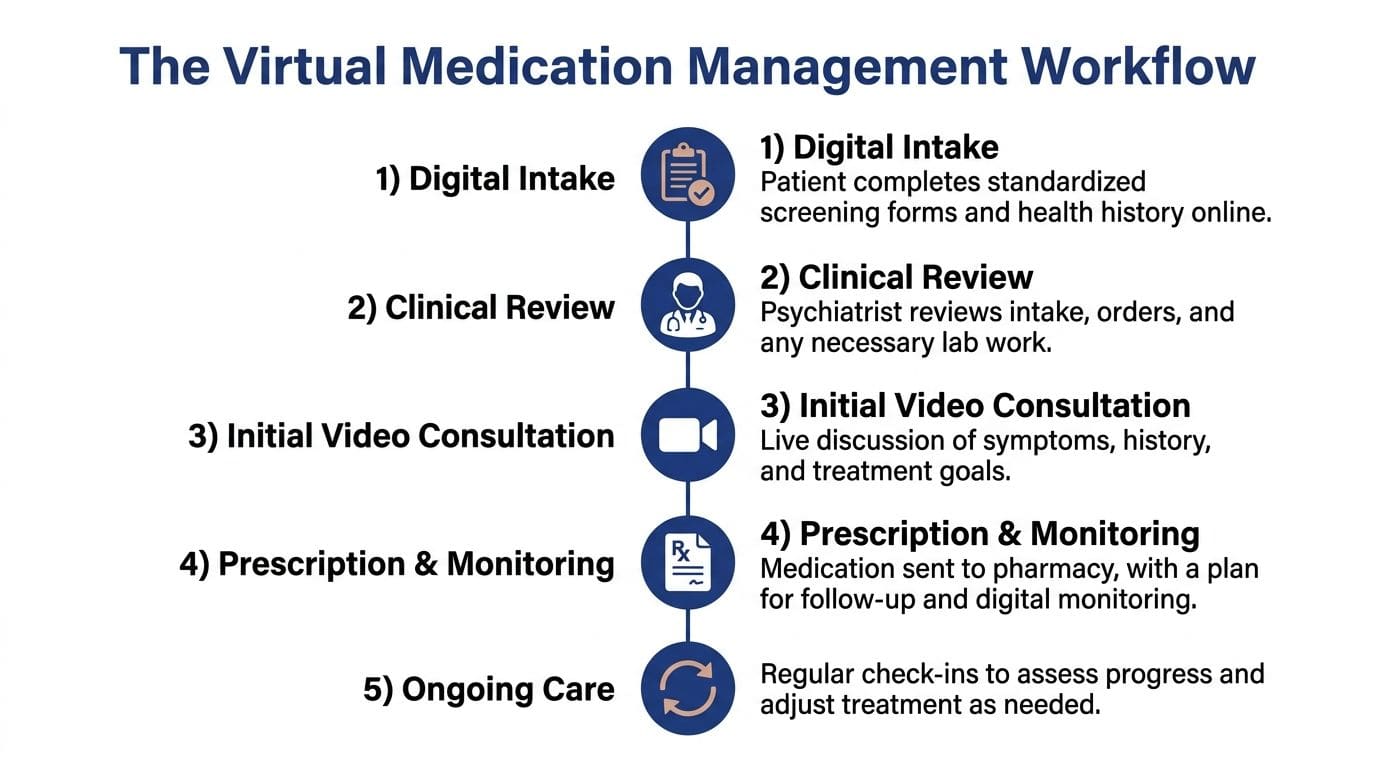
A well-run virtual appointment follows a predictable clinical sequence. Patients who understand the process can prepare better and use visit time for meaningful decisions rather than searching for basic records.
Digital intake comes first
Before the first video visit, patients commonly complete health history forms, medication lists, consent documents, and symptom questionnaires. Tools such as the PHQ-9 for depression, GAD-7 for anxiety, and ASRS for ADHD can organize symptoms for discussion. These questionnaires don't establish a diagnosis by themselves. They give the clinician a consistent starting point.
The provider also needs information about prior psychiatric treatment, medical conditions, allergies, family psychiatric history, substance use, sleep, and daily functioning. A symptom that looks like ADHD may require a different evaluation if anxiety, trauma, sleep loss, medication effects, or substance use could explain the same difficulty.
The initial video evaluation
The first appointment often involves a detailed psychiatric assessment. The clinician reviews symptom onset, severity, patterns, previous medication trials, benefits, side effects, and treatment preferences. The discussion may also include safety screening and the practical conditions that affect treatment, such as work demands, caregiving, pharmacy access, and support at home.
After reviewing the information, the provider develops a working diagnosis and treatment plan. That plan may include medication, therapy, behavioral changes, laboratory testing, or referral for in-person care. If medication is appropriate, the prescription may be sent electronically to the patient's preferred pharmacy, subject to clinical and legal requirements.
Follow-up and adjustment
Medication treatment is rarely a one-visit decision. Clinical guidance recommends follow-up every 2 to 4 weeks during initiation or titration, with slower titration and close review of response, adherence, and side effects, as described in clinical guidance for telepsychiatry medication management. Once a patient is stable, visits may become less frequent, depending on the medication, diagnosis, risk profile, and provider judgment.
At each follow-up, the clinician may ask:
- Response: Which symptoms improved, and which remain?
- Tolerability: Are there sleep changes, appetite changes, activation, sedation, gastrointestinal symptoms, or other concerns?
- Adherence: Are doses being taken as prescribed, and are cost or pharmacy barriers interfering?
- Function: Has work, school, parenting, or social functioning changed?
- Safety: Are there new risks, substance-use concerns, or signs that a higher level of care is needed?
The provider may order laboratory testing when a medication or medical history makes it relevant. Results can then be reviewed during a later video session. Pharmacogenetic testing may also be considered in selected cases, but it doesn't replace clinical judgment or guarantee that a medication will work.
The online medication management service describes this broader model of evaluation, prescribing when appropriate, adjustment, and follow-up rather than treating virtual care as a refill transaction.
Evidence supports structured workflows. In a randomized ADHD telehealth trial, telepsychiatrists followed medication algorithms with 91% fidelity, and 46.0% of participants reached the treat-to-target endpoint compared with 13.6% in the comparison arm, according to the published randomized telehealth trial. The lesson is operational. Algorithms, measurable targets, and close follow-up are more dependable than unstructured refill care.
Safety Rules and Prescribing Regulations in Pennsylvania
Virtual prescribing in Pennsylvania operates within several overlapping systems. The clinician must have appropriate Pennsylvania licensure and prescribing authority, the patient must be located where the provider can legally practice, and the medication must meet federal and state requirements.
Controlled substances require particular care. Federal telemedicine rules have changed over time, and the DEA and HHS temporary extension permits DEA-registered practitioners to prescribe Schedule II-V controlled substances through telemedicine without a prior in-person visit through December 31, 2026, under stated conditions. The same update preserves audio-video prescribing for DEA-registered providers and permits certain audio-only prescribing for mental health care and FDA-approved opioid use disorder maintenance or withdrawal management under specified conditions, as summarized in this 2025 to 2026 telepsychiatry regulatory update.
That flexibility doesn't mean every patient or medication follows the same path. Pennsylvania authority, documentation, pharmacy policies, clinical risk, and the medication's schedule can all affect the plan.
Pennsylvania requirements at a glance
| Regulation Area | Requirement Summary |
|---|---|
| Provider authority | The clinician needs an active Pennsylvania license and the applicable prescriptive authority for the medication being considered. |
| Controlled substances | Schedule II-V prescribing through telehealth remains subject to federal conditions, state requirements, documentation, and clinical monitoring. |
| Pennsylvania nurse practitioner authority | A Pennsylvania summary states that initiation of a Schedule II controlled substance prescribed by a nurse practitioner is limited to a 30-day supply, with physician notification within 24 hours. The same source describes Schedule III-V prescribing with physician delegation in applicable circumstances, as detailed in this Pennsylvania prescribing overview for nurse practitioners. |
| Diagnosis and medication category | Prescribers must establish a diagnosis before prescribing psychotropics online. Some medication categories may be allowed for a new video visit, while others may be limited to follow-up or prohibited online prescribing under the relevant operational framework. |
| Monitoring | The clinician may require medication agreements, laboratory testing, pharmacy coordination, or other monitoring based on the medication and patient history. |
| Consent and safety planning | Patients should understand telehealth limitations, emergency procedures, privacy expectations, and when in-person evaluation may become necessary. |
The Ryan Haight Act remains part of the federal background for controlled-substance prescribing, while temporary telehealth flexibilities modify how certain requirements apply during the current extension period. Because rules can change, patients shouldn't rely on old online articles or assume that a prescription issued in another state can be continued in Pennsylvania.
A provider may also check the Pennsylvania prescription drug monitoring system when controlled medications or substance-use risk make that review clinically or legally relevant. For a patient seeking online psychiatric medication, these guardrails are a safety feature. They help define what can be started, what can be continued, and when an in-person assessment or additional oversight is necessary.
Integrative Services That Support Medication Treatment
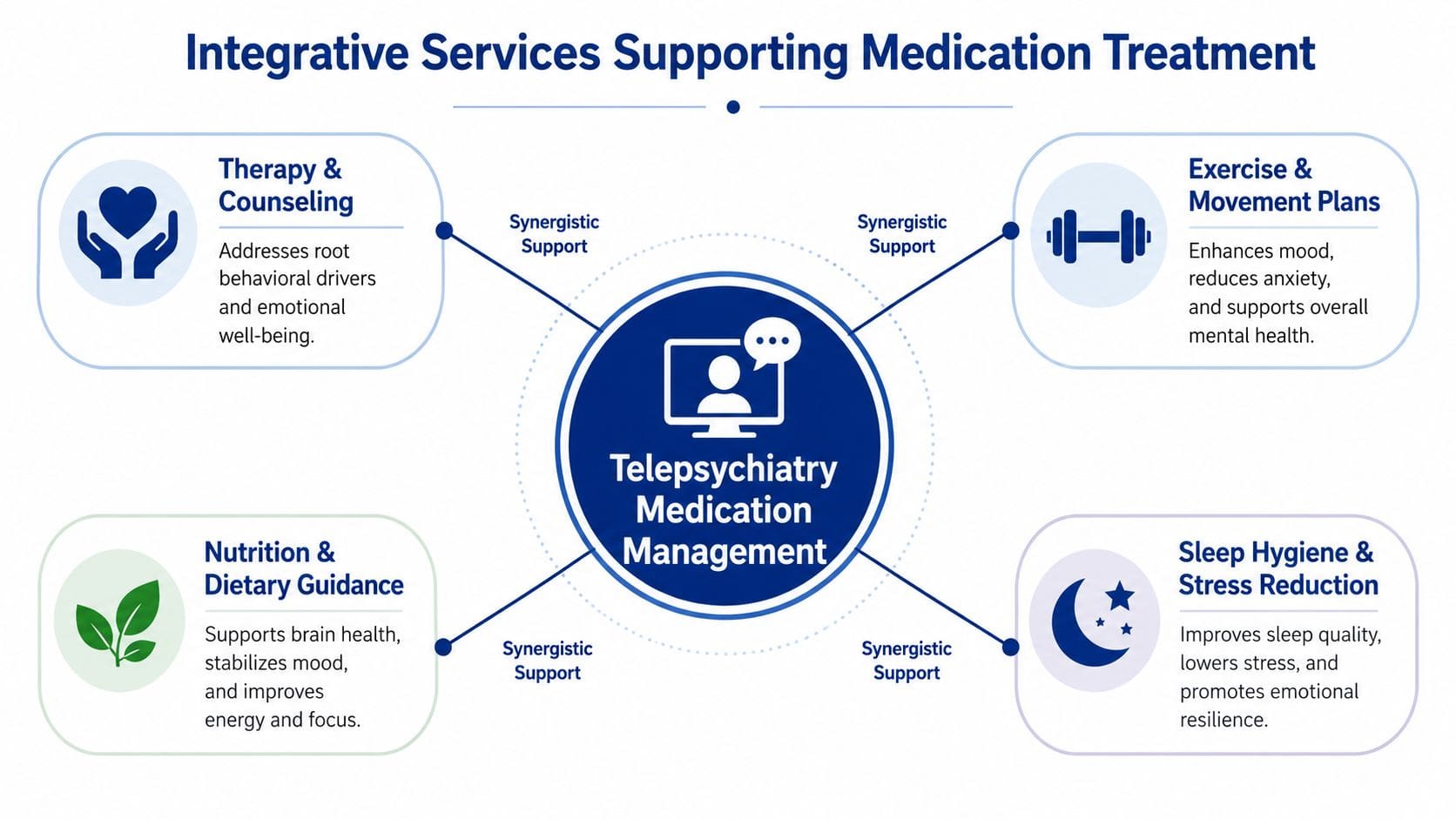
Medication can reduce symptoms, but the treatment plan also needs to address the conditions that keep symptoms active. Poor sleep, inconsistent meals, inactivity, chronic stress, trauma responses, and substance use can all affect how a patient feels and how consistently medication is taken.
Integrative psychiatry brings these factors into the same clinical conversation. A provider may recommend sleep-hygiene changes, exercise planning, nutrition education, mindfulness, therapy, or coordination with primary care while continuing to monitor medication response. These services don't make medication unnecessary for every patient. They can make the overall plan more realistic and sustainable.
Whole-person support around the prescription
A patient with depression may need medication review alongside a practical plan for restoring daily structure. Someone with ADHD may benefit from medication plus agenda planning, environmental supports, and exercise routines. A person with anxiety may need medication evaluation, therapy, breathing or grounding strategies, and attention to caffeine or sleep patterns.
Useful supports can include:
- Therapy and counseling: Psychotherapy can address thought patterns, trauma, relationships, and coping skills that medication doesn't directly teach.
- Movement planning: A manageable exercise routine can support daily structure and physical well-being.
- Nutrition guidance: Regular meals and attention to dietary patterns may help patients manage energy, appetite, and medication tolerability.
- Sleep and stress work: Consistent sleep habits and stress-reduction practices can make symptom tracking clearer.
Suboxone, or buprenorphine, may be part of treatment for opioid use disorder when clinically appropriate. Telehealth rules can permit remote support for certain opioid use disorder treatment services under stated conditions, but induction, monitoring, and coordination still require individualized judgment.
Testosterone replacement therapy is different. A patient with depressive symptoms and possible hypogonadism needs medical evaluation and laboratory assessment before treatment decisions. Psychiatric symptoms shouldn't automatically be attributed to low testosterone, and TRT requires monitoring by an appropriately qualified clinician.
Pharmacogenetic information may be considered in selected medication decisions. Patients can review the role of genetic testing for psychiatric medications with a provider who can explain what the results can and can't establish.
Evidence favors reducing friction between visits. A randomized study of adults with severe mental illness found that telephone and text-message support was associated with stronger medication adherence at six months, with an odds ratio of 4.11, as reported in the published adherence trial. The practical point is simple. Reminders, education, symptom tracking, and rapid communication can support the prescription between appointments.
Insurance Coverage and Payment Options for Virtual Care
Telepsychiatry coverage depends on the plan, the provider's network status, the service billed, and the patient's benefits. A plan may cover therapy but handle psychiatric evaluation and medication management differently. Medicaid managed-care plans, commercial insurance, Medicare Advantage, and self-pay arrangements each require separate verification.
Patients should ask the insurer:
- Is telepsychiatry medication management covered?
- Is the clinician in network?
- Does the plan require a referral or authorization?
- What cost-sharing applies to the initial evaluation and follow-ups?
- Are audio-only visits covered, or is video required?
- Can the patient submit a superbill for out-of-network reimbursement?
- Can an HSA or FSA be used for eligible services?
Comparing payment approaches
| Payment Method | Typical Patient Cost | Key Considerations |
|---|---|---|
| In-network insurance | Depends on the plan's deductible, copay, or coinsurance | Confirm network status and whether medication management uses a covered benefit. |
| Out-of-network insurance | Depends on the plan and reimbursement rules | The patient may pay upfront and submit a superbill. |
| Self-pay | Practice-specific | Ask about evaluation, follow-up, cancellation, refill, and laboratory-related charges before scheduling. |
| HSA or FSA | Depends on account rules and eligible expenses | Confirm eligibility with the plan administrator. |
| Sliding-scale arrangement | Practice-specific | Availability varies and should be discussed before the first appointment. |
The Mental Health Parity and Addiction Equity Act addresses unequal treatment limits for mental health and substance-use benefits, but parity doesn't mean every telehealth service is free or covered by every plan. Network participation and benefit design still matter.
A written estimate can prevent confusion. Patients should request the expected visit type, payment responsibility, refill policy, laboratory charges, and rules for missed appointments. The insurance verification process can help Pennsylvania patients gather these details before booking virtual care.
What to Expect During Your First Telepsychiatry Visit
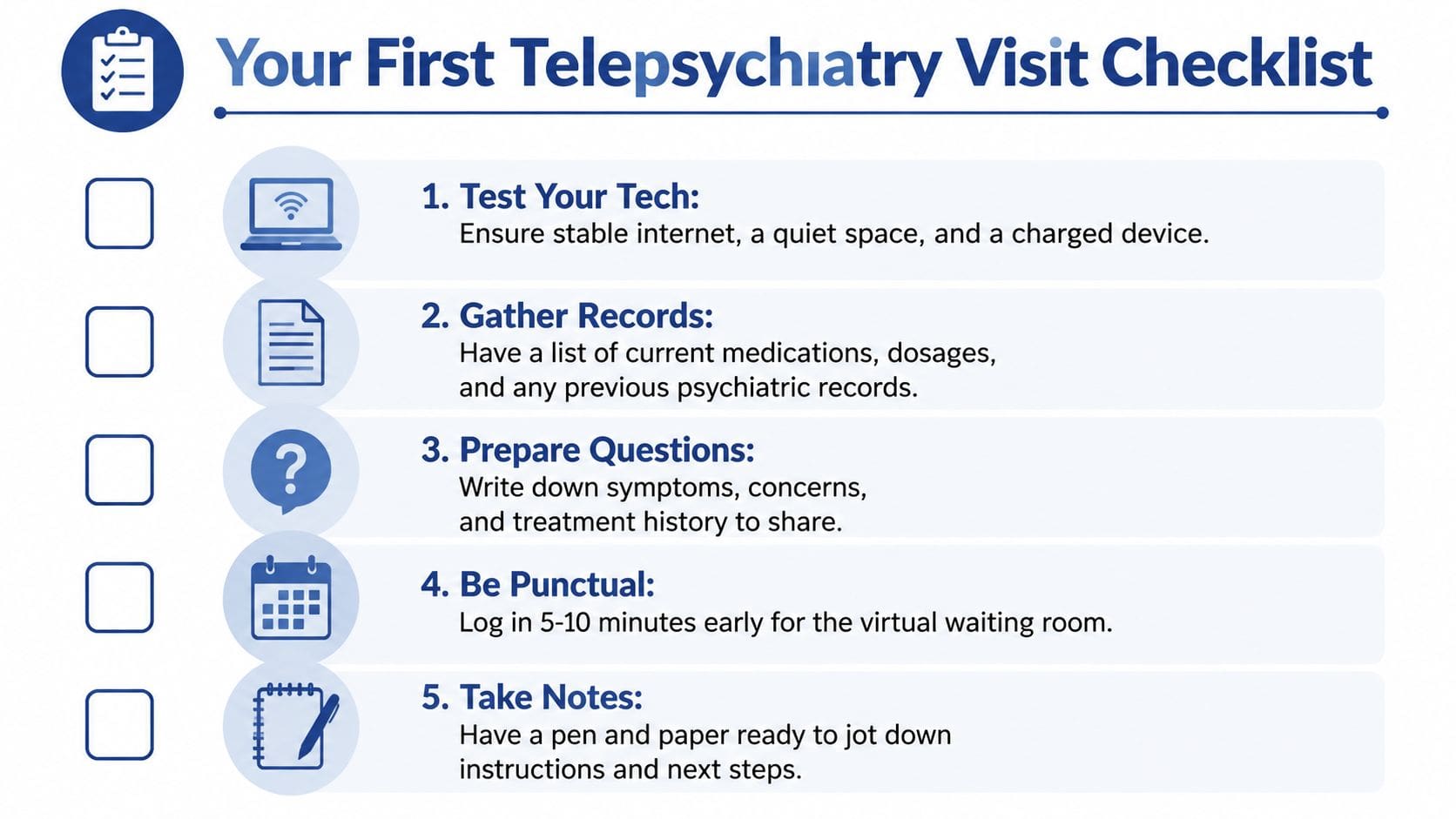
Preparation can make the first appointment more productive. A patient should choose a private location, test the camera and microphone, confirm a stable internet connection, and keep a charged device available. Logging in early can reduce technical delays and leave more time for clinical discussion.
A useful preparation checklist
- Bring medication details: List every prescription, over-the-counter product, supplement, dose, and schedule. Include medications that were stopped because of side effects.
- Collect records: Upload prior psychiatric evaluations, laboratory results, hospital discharge summaries, and relevant primary-care notes when available.
- Describe the problem clearly: Note when symptoms began, what worsens them, how they affect work or relationships, and what has already been tried.
- Prepare questions: Ask about benefits, side effects, interactions, expected monitoring, missed doses, and what to do if symptoms change.
- Keep emergency information available: The provider needs the patient's current location and a reliable emergency contact plan for safety purposes.
The initial evaluation may last 45 to 60 minutes, depending on the complexity of the history and the information available. The clinician may review mood, anxiety, attention, trauma, sleep, substance use, medical conditions, family history, current medications, and safety concerns before discussing options.
A prescription may not be finalized during the first visit. The provider could request baseline laboratory testing, additional records, a urine drug screen, or pharmacogenetic testing when clinically indicated. Controlled-substance treatment may also involve a signed agreement and pharmacy or prescription-monitoring review. These steps are intended to support safe prescribing, not to signal distrust.
A follow-up is commonly planned within 2 to 4 weeks after starting or changing medication, based on the clinical guidance cited earlier. Patients should contact the practice promptly if side effects become severe, symptoms worsen quickly, or safety concerns arise. Emergencies require emergency services rather than waiting for the next telehealth appointment.
The following video can help patients understand the practical rhythm of a virtual appointment:
Common Questions About Telepsychiatry Medication Management
Can virtual providers prescribe stimulants or benzodiazepines?
Sometimes, but not automatically. Controlled-substance prescribing depends on federal telehealth rules, Pennsylvania authority, the clinician's assessment, documentation, monitoring plan, and the medication itself. Temporary federal flexibilities currently extend certain remote prescribing permissions through December 31, 2026, under stated conditions, but patients should confirm the current requirements at the time of care.
Is telepsychiatry confidential?
A secure, HIPAA-compliant platform supports privacy, but patients also need a private room, headphones when appropriate, and a secure device. Providers should explain platform limitations and emergency procedures during informed consent.
What happens if virtual care isn't enough?
The provider may recommend laboratory work, primary-care coordination, an in-person examination, specialty referral, urgent evaluation, or a higher level of psychiatric care. Telepsychiatry isn't a promise that every clinical need can be handled remotely.
Is complex medication treatment possible online?
It can be, when the patient is clinically appropriate and the provider can obtain reliable history, records, monitoring, and follow-up. Multiple medications, substance-use concerns, pregnancy, significant medical illness, or unstable symptoms may increase the need for coordination or in-person care.
Does virtual care provide real monitoring?
Yes, when visits include symptom review, side-effect assessment, adherence questions, functional measures, and medication adjustments. A 2025 meta-analysis found an overall adherence benefit for telemedicine, with Hedges' g = 0.25, a 95% confidence interval of 0.12 to 0.38, and p < 0.01, as reported in the reviewed adherence evidence. The evidence also indicates that long-term implementation still needs further study, so clinicians should avoid promising identical results for every patient.
Integrative Psychiatry of America provides virtual psychiatric evaluations and medication management throughout Pennsylvania, including care for ADHD, anxiety, depression, OCD, PTSD, and opioid dependence when clinically appropriate. Patients can visit Integrative Psychiatry of America to review telehealth services and request an appointment.