
A lot of adults in Pennsylvania start the search for help the same way. They're up late, the house is finally quiet, and they're typing questions into a browser because getting mental health care has started to feel like another job on top of work, parenting, school, or all three.
For some, the question is anxiety. For others, it's depression, focus problems, sleep disruption, or the feeling that life has become harder to manage than it should be. The phrase Add Meds Online often shows up when someone wants a practical next step, but still wants care that's careful, legal, and grounded in real clinical judgment.
Table of Contents
- The Modern Way to Manage Your Mental Health in Pennsylvania
- Preparing for Your Online Medication Request
- Your Telehealth Evaluation What to Expect
- Managing Prescriptions and Refills Through the Portal
- Insurance Payments and Timelines for Your Care
- Frequently Asked Questions About Online Medication
The Modern Way to Manage Your Mental Health in Pennsylvania
In Pennsylvania, access isn't the same everywhere. Someone in Philadelphia may struggle with waitlists and traffic. Someone in a smaller town may struggle to find a psychiatric prescriber at all. In both situations, telepsychiatry changes the equation because care can happen privately at home, on a lunch break, or between family responsibilities instead of requiring half a day off.

That shift is no longer niche. Since March 2020, 30.5% of adults with ADHD have used telehealth to get a medication prescription, and 46.0% have used telehealth services for their condition, according to a National Center for Biotechnology Information review of U.S. adult ADHD care. For adults wondering whether online psychiatric medication management is a real part of modern care, the answer is yes.
What matters is how the process is done. Safe care isn't a click-and-send system. It's evaluation, diagnosis, medication review, follow-up, and adjustment over time. That's especially important when people are dealing with overlapping concerns such as ADHD and anxiety, depression and poor sleep, or trauma symptoms that look like inattention.
Practical rule: Convenience should reduce barriers, not reduce clinical standards.
Patients who are still sorting out what they're feeling often benefit from education before the first visit. A structured resource like this free anxiety education hub can help people put language to symptoms, triggers, and patterns so the appointment starts with clearer information.
For Pennsylvanians who want professional online psychiatric care, telepsychiatry services in Pennsylvania can provide a secure path to evaluation, treatment planning, and medication management without adding another commute to an already crowded week.
Preparing for Your Online Medication Request
Preparation makes online prescribing safer and more useful. A strong first appointment isn't built on perfect memory. It's built on records, medication history, and a clear picture of what has and hasn't helped before.
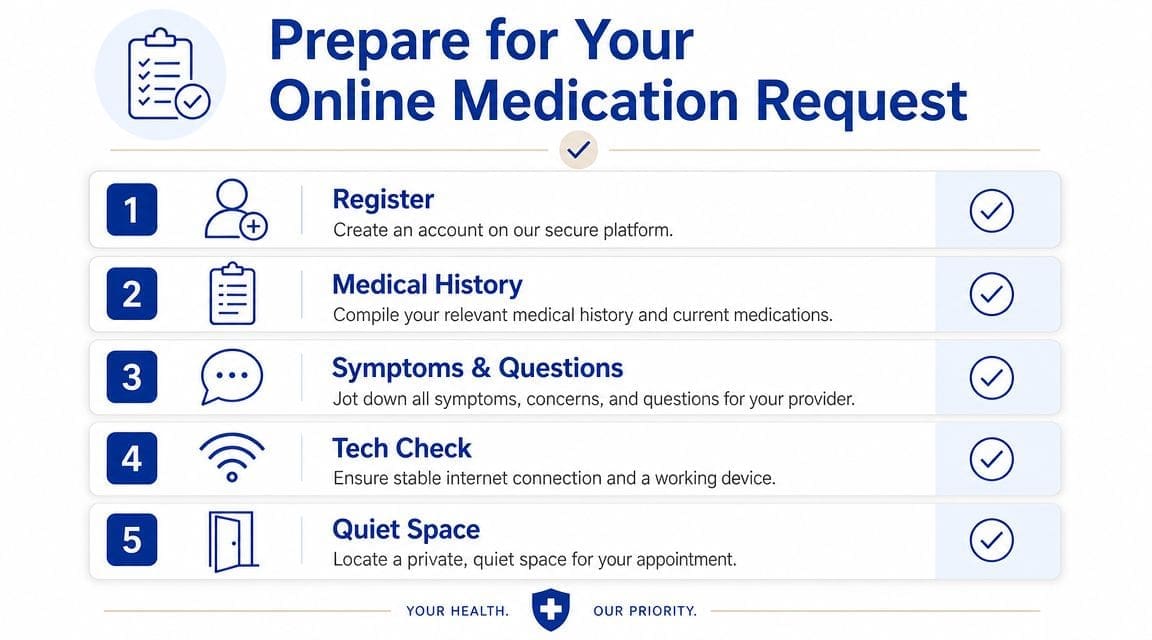
Before requesting to Add Meds Online, it helps to gather the basics in one place. The patient portal usually becomes the working hub for scheduling, forms, secure messages, refill requests, and document sharing. That makes it much easier to keep the treatment relationship organized, especially when changes happen between visits.
What to gather before the first visit
- Current medications: Include prescription medications, over-the-counter products, supplements, and anything taken only as needed.
- Past psychiatric medications: Write down the name, the dose if it's remembered, how long it was taken, and why it was stopped.
- Side effect history: Note what caused trouble. Common examples include insomnia, appetite changes, headaches, nausea, jitteriness, or emotional flattening.
- Personal mental health history: Prior diagnoses, therapy history, past hospitalizations, and any urgent safety concerns belong in the intake.
- Medical history that affects prescribing: Heart issues, thyroid problems, sleep disorders, concussion history, substance use concerns, pregnancy planning, and other major conditions all matter.
A short written symptom summary can also help. People often know they feel “off,” but the clinician needs specifics. Trouble starting tasks, panic before meetings, irritability, emotional crashes, poor sleep, and appetite changes all point the evaluation in a different direction.
Bring the story, not just the symptom list. “I can't focus” means more when paired with “I miss deadlines, reread the same page, and lose track of conversations.”
Small details that improve the visit
Some preparation is clinical. Some is practical.
- Check the tech first. A stable internet connection, charged phone or laptop, and working camera avoid a rushed start.
- Choose a private space. Medication decisions often involve sensitive questions about trauma, substance use, and family history.
- Write down questions. Patients often forget what they wanted to ask once the visit starts.
- Upload prior records if available. Old testing, discharge summaries, medication lists, or previous diagnoses can shorten the path to a cleaner plan.
Adults who aren't sure whether their symptoms call for medication, therapy, or both often find it useful to review when to see a psychiatric prescriber before booking. That kind of preparation doesn't lock anyone into treatment. It makes the first conversation more productive.
Your Telehealth Evaluation What to Expect
The first appointment should feel structured, not cold. A telehealth psychiatric evaluation is still a real clinical assessment. The screen changes the setting, but it doesn't remove the need for diagnostic accuracy, safety screening, and shared decision-making.
Adults often expect the conversation to focus only on symptoms. In reality, the evaluation usually moves across several areas of life because mental health symptoms don't exist in isolation. Work performance, relationships, sleep, appetite, substance use, medical history, and stress patterns all affect what treatment makes sense.
According to the CDC's ADHD treatment guidance, effective ADHD treatment for adults can involve medication, psychotherapy, or both, and a thorough evaluation is critical to screen for other conditions like anxiety or sleep disorders and to confirm that symptoms cause impairment across different areas of life.
What the visit is really assessing
The clinician isn't only deciding whether symptoms are present. The clinician is deciding what those symptoms most likely mean.
That usually includes questions such as:
- How long has this been happening? A lifelong pattern suggests something different from a recent change.
- Where does it show up? At work only, at home only, or across settings.
- What makes it worse or better? Caffeine, lack of sleep, shift work, grief, stress, alcohol, cannabis, or trauma cues can change the picture.
- What is the goal? Better focus, less panic, more stable mood, improved sleep, fewer obsessive thoughts, or reduced impulsivity.
A nurse-practitioner-led telepsychiatry visit also often takes a broader view. Sleep habits, exercise, nutrition, and stress regulation aren't side notes. They can change medication response, side effect burden, and even the diagnosis itself.
People looking for online psychiatric care in Pennsylvania should expect that kind of thorough interview rather than a fast prescription-only conversation.
Later in the process, many patients find it useful to review a plain-language overview like this:
When controlled medications require extra review
Requests to Add Meds Online sometimes involve controlled substances, including stimulant medications. Those visits require extra diligence. The prescriber may need prior records, rating scales, pharmacy history, and closer follow-up before deciding whether a stimulant is appropriate.
That caution isn't a barrier for its own sake. It helps separate ADHD from look-alike problems such as sleep deprivation, untreated anxiety, bipolar symptoms, concussion effects, thyroid problems, or substance-related concentration changes.
A good online evaluation doesn't try to prove a patient wrong. It tries to get the diagnosis right.
Some telehealth platforms prescribe stimulants, some focus on non-stimulants, and some don't manage ADHD medications at all. That's why patients in Pennsylvania should ask direct questions early about what medication classes are considered, what records may be needed, and what follow-up is required if treatment starts.
Managing Prescriptions and Refills Through the Portal
Starting medication is only the first step. The actual work is what happens afterward. A prescription may be sent to a preferred Pennsylvania pharmacy quickly, but responsible medication management doesn't stop at the transmission.
What happens after a medication is prescribed
Some medications work fast enough that the patient notices a change early. Others take longer and need patience. In both cases, the next decision usually depends on function, side effects, and consistency rather than on a single good or bad day.
The clinical standard is titration, which means small, supervised adjustments instead of abrupt jumps. The medication adjustment guidance summarized here emphasizes clinician-led dose titration and regular follow-ups to track symptoms and side effects. It also makes a key safety point clear: dose changes shouldn't be made without medical supervision.
Patients often assume a refill means “same medicine, same plan.” Sometimes that's true. Sometimes a refill request reveals that the timing is off, the benefit fades too early, side effects are getting in the way, or the diagnosis itself needs another look.
A portal works best when refill messages include a few useful details:
- Current response: Is the medication helping attention, mood, sleep, panic, or another target symptom?
- Problems since the last visit: Headaches, appetite loss, sedation, irritability, insomnia, nausea, or heightened anxiety should be reported.
- Pharmacy updates: A refill stalls quickly if the wrong pharmacy is still on file.
- Timing issues: If a refill is requested after the medication runs out, the process is usually more stressful than it needs to be.
For adults seeking online ADHD medication management, the portal can support refill requests, follow-up scheduling, and secure messaging, but it doesn't replace appointments when a medication needs reassessment.
Clinical note: “It worked at first” often means the plan needs adjustment, not abandonment.
Families dealing with neurodevelopmental medication questions may also appreciate a broader behavioral perspective such as Guiding Growth's overview of autism medication challenges, especially when medication response is only one part of the care plan.
Information for Safe Online Prescribing
| Requirement | Why We Need It | Examples |
|---|---|---|
| Identity and intake verification | Confirms the right patient is being evaluated and treated | Portal registration, intake forms, pharmacy details |
| Medication reconciliation | Prevents interactions, duplication, and confusion | Current prescriptions, supplements, recent medication changes |
| Prior treatment history | Helps avoid repeating medications that failed or caused harm | Past ADHD meds, antidepressants, sleep meds, side effect patterns |
| Diagnostic support | Improves accuracy before starting or changing treatment | Rating scales, prior records, school or work history when relevant |
| Medical safety review | Screens for conditions that affect medication choices | Cardiovascular history, sleep problems, thyroid issues, substance use concerns |
| Additional clinical documentation when indicated | Some medications need extra review before safe prescribing | Lab work, genetic screening, or EKG when clinically appropriate |
Insurance Payments and Timelines for Your Care
Mental health care gets harder when the financial side is vague. People don't just want treatment. They want to know whether the visit is covered, what they may owe, and how the process will unfold once they decide to start.
Planning the financial side without surprises
The cleanest first step is always insurance verification before the appointment. Patients who've never done that before may find a consumer guide such as these steps to verify your insurance useful because it explains what information to gather before calling a plan or submitting details online.
Cash-pay and membership options can also make sense, especially for patients who want predictable access, don't have strong out-of-network benefits, or prefer a simpler billing model. What matters most is transparency. Patients should know whether follow-up visits are expected, whether portal communication is part of the care model, and what happens if a medication requires closer monitoring.
Timelines vary by practice, by diagnosis, and by the medication under consideration. Some care plans move quickly. Others appropriately take longer because records need review or the clinician needs more information before prescribing.
A practical way to think about the timeline is this:
- Initial appointment: The point where diagnosis, symptom targets, and safety concerns are assessed.
- Prescription decision: Sometimes made at the first visit, sometimes delayed until records or screening are complete.
- Early follow-up: Often needed after a start or dose change to assess benefit and side effects.
- Ongoing maintenance: Refills are smoother when visits happen on schedule and the portal is used consistently.
Pennsylvania patients often feel better once they know the process is straightforward, even if it isn't instant. Clear expectations reduce anxiety and help people stick with care long enough to see whether the plan fits.
Frequently Asked Questions About Online Medication
Patients usually ask the most important questions near the end. These are often the questions tied to privacy, legality, and whether online care will still be available next year.
The legal piece matters. The policy analysis on telemedicine prescribing rules notes that the ability to prescribe controlled substances via telehealth without a prior in-person visit is based on temporary rules extended through December 31, 2026. For patients who may need continuity of ADHD treatment, that's worth tracking.
| Can medication really be prescribed online in Pennsylvania? | In many cases, yes. The exact medication depends on diagnosis, safety review, and current telehealth prescribing rules. |
| Are stimulants always available through telehealth? | No. Availability depends on the practice model, the clinician's assessment, and whether stimulant treatment is clinically appropriate. |
| What if the diagnosis isn't ADHD after all? | That's still a successful evaluation. Ruling out the wrong diagnosis prevents months of ineffective treatment. |
| Is a psychiatric nurse practitioner qualified to manage this care? | Yes. Many patients compare roles before starting, and this guide on a psychiatric NP versus psychiatrist can help clarify training and scope. |
| What if the medication doesn't feel right? | The next step is follow-up, not self-adjustment. A poor fit may mean the dose, timing, formulation, or even the medication class needs review. |
Online medication care works best when the patient expects a relationship, not a transaction. Good telepsychiatry is careful, collaborative, and willing to slow down when safety or diagnostic clarity requires it.
If you're in Pennsylvania and want a practical next step, Integrative Psychiatry of America offers secure online psychiatric care with evaluation, medication management, and follow-up built around safety, privacy, and whole-person treatment planning.