
A Pennsylvania adult schedules a virtual psychiatric intake after seeing that the practice “accepts” the person's insurance company. The appointment appears straightforward until the explanation of benefits arrives. The policy was active, but the specific telepsychiatry service wasn't confirmed, and the patient is left with an unexpected bill while trying to begin care.
That situation illustrates the central problem with the insurance verification process. An accepted insurance brand doesn't automatically mean that every provider, service, diagnosis, place of service, or appointment type is covered. A careful review can clarify likely costs and authorization requirements, but it can't guarantee that an insurer will pay a claim after the visit.
Table of Contents
- Why Insurance Verification Matters Before Your Telepsychiatry Visit
- Gathering the Right Documents and Details
- Understanding Your Telehealth Psychiatric Benefits
- Why a Single Verification Check Is Not Enough
- Common Verification Problems and How to Fix Them
- When Cash Pay or Membership Options Make Sense
- Your Next Steps for a Smooth Verification Experience
Why Insurance Verification Matters Before Your Telepsychiatry Visit
Insurance verification is more than checking whether a policy appears active. Medicare's HIPAA Eligibility Transaction System, or HETS, was created so providers, suppliers, and authorized billing agents could electronically release eligibility information for accurate claim preparation, beneficiary liability checks, and service-specific eligibility determinations. That history shows why verification belongs in the claims workflow, not just at the front desk. (Historical overview of third-party insurance verification)
Telepsychiatry adds details that can change the answer. The insurer may need to confirm that the individual clinician is in-network, that psychiatric care is covered through video, and that the applicable place-of-service and procedure coding match a remote visit. Audio-only care may follow different rules from a video appointment. A plan can also apply different benefits to behavioral health, medication management, or an initial psychiatric evaluation.
Practical rule: “Insurance accepted” describes a starting point. It doesn't prove that a specific telehealth visit is covered.
A complete review helps identify active eligibility, service-level benefits, network status, cost sharing, and prior authorization requirements before the appointment. It also creates a record of the source, date, and outcome of the check, which can support a cost estimate and later claim review. Patients comparing administrative safeguards may also find a BAA checklist for medical practices useful when evaluating how a practice handles protected health information.
For Pennsylvania residents seeking virtual care, the practice's insurance and fees information can provide a useful starting point. Still, the insurer's response for the patient's exact plan and planned service matters most. Skipping that step can lead to a denied claim, an unexpected balance, or a delay in starting psychiatric treatment.
Gathering the Right Documents and Details
The verification call or portal request is only as accurate as the information supplied. Before starting, the patient should collect the front and back of the insurance card, a photo ID, and the plan documents available through the insurer's member portal.
The insurer and practice may need the full legal name, date of birth, address, member ID, group number, plan name, and policyholder information. A middle initial, surname, or address that differs from the payer's record can create a mismatch. Patients should also identify whether another plan, Medicare coverage, or a spouse's policy may be primary.
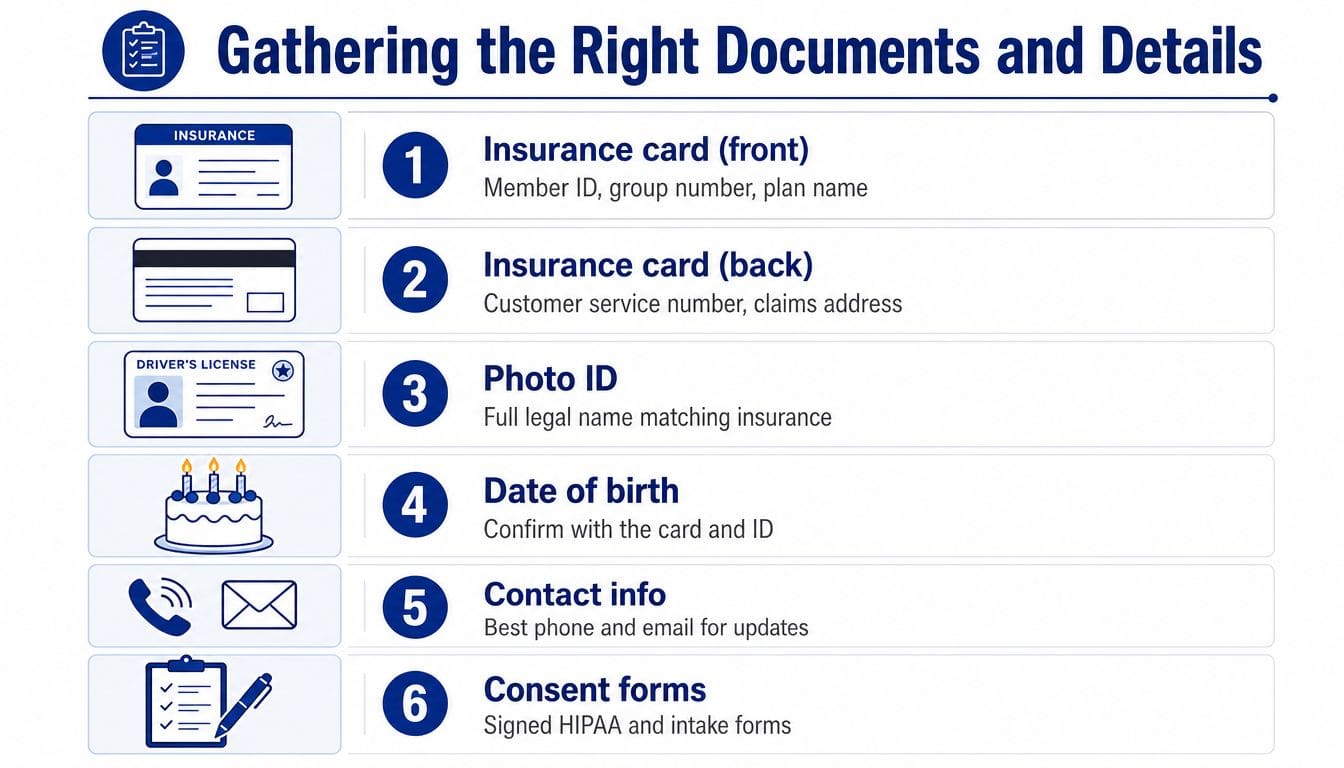
What to keep beside the card
- Insurance card: Keep both sides available. The back often lists the customer service number, claims address, or instructions for behavioral health benefits.
- Summary of Benefits and Coverage: The SBC can explain deductibles, copayments, coinsurance, and out-of-pocket responsibilities. It may not answer every telehealth question, so the insurer still needs to confirm the exact service.
- Photo identification: Use the legal name shown on the insurance record, not a nickname.
- Secondary policy details: Provide every active policy and explain which insurer has been billed first.
- Contact information: Confirm the phone number and email address the practice should use for follow-up.
- Verification notes: Record the representative's name or identification, call date, reference number, and the answers provided.
This preparation prevents small data-entry mistakes from spreading through registration, scheduling, authorization, and billing. Patients considering remote medication care can also review the practice's information about adding medications online while gathering their records.
Understanding Your Telehealth Psychiatric Benefits
A useful benefits check answers a narrower question than “Does this plan cover mental health?” It asks whether this provider can deliver this psychiatric service by telehealth on the intended date, under the patient's specific plan.
Network status comes first. The individual clinician may have a different network relationship from the practice entity, so the insurer should verify the provider's name and credentials directly. The patient should then ask whether video-based psychiatric evaluation and medication management are covered, and whether audio-only care follows separate rules.
Cost sharing needs equally careful wording. A plan may apply a specialist copay, coinsurance, or the deductible before payment begins. For example, a patient might be told that a psychiatric visit has a $50 specialist copay after a $1,500 deductible. That example describes how benefits can be structured, not a prediction of any patient's cost. The insurer should explain which rule applies to the planned visit.
| Benefit component | What to ask the insurer | Why it matters |
|---|---|---|
| Network status | Is the individual clinician in-network for this exact plan? | A practice listing alone may not establish provider-level network status. |
| Telehealth coverage | Is video psychiatric care covered, and are audio-only visits treated differently? | Remote and in-person benefits may not match. |
| Cost sharing | Does the visit use a copay, coinsurance, or deductible-first benefit? | The patient's responsibility depends on the plan design. |
| Prior authorization | Does this evaluation or medication management service require pre-approval? | Eligibility does not equal authorization. |
| Visit limits | Are there limits for behavioral health or telehealth services? | A plan may impose service-specific conditions. |
Prior authorization deserves special attention. Medicare defines it as a request for provisional affirmation of coverage made before an item or service is furnished, with a response based on supporting documentation. (CMS explanation of prior authorization and pre-claim review) A verified policy can still deny payment when required approval is missing, expired, or unrelated to the final service.
Patients arranging online psychiatric care in Pennsylvania should ask the insurer to document the service category, provider status, telehealth modality, and authorization answer. That level of detail is more useful than a general statement that the insurance company is accepted.
Why a Single Verification Check Is Not Enough
Coverage is a moving target. A patient may verify an active plan during scheduling, then experience a job change, dependent coverage change, policy-number update, or network change before the appointment. A plan amendment can also alter telehealth rules or authorization requirements.
The safest approach is to treat verification as time-limited information, not a permanent approval. A check made too far ahead may become outdated, while a check made at the last moment may leave no time to correct demographics, obtain an authorization, or clarify coordination of benefits.
A practical re-check rhythm
For a new intake, the practice can confirm benefits during scheduling and review unresolved questions before the appointment. A re-check close to the date of service is especially useful when coverage is changing or the patient schedules recurring visits. Patients should ask how long the insurer considers the information current and whether a reference number applies only to the call or also to a particular service date.
Federal reporting has made prior authorization more visible across major markets. Insurers reported standard-request denial rates of 12% for Medicare Advantage, 14% for Medicaid managed care, and 18% for ACA Marketplace plans in the cited KFF analysis. (KFF prior-authorization metrics) Those figures aren't a prediction for an individual claim, but they show why a clean eligibility result shouldn't end the review.
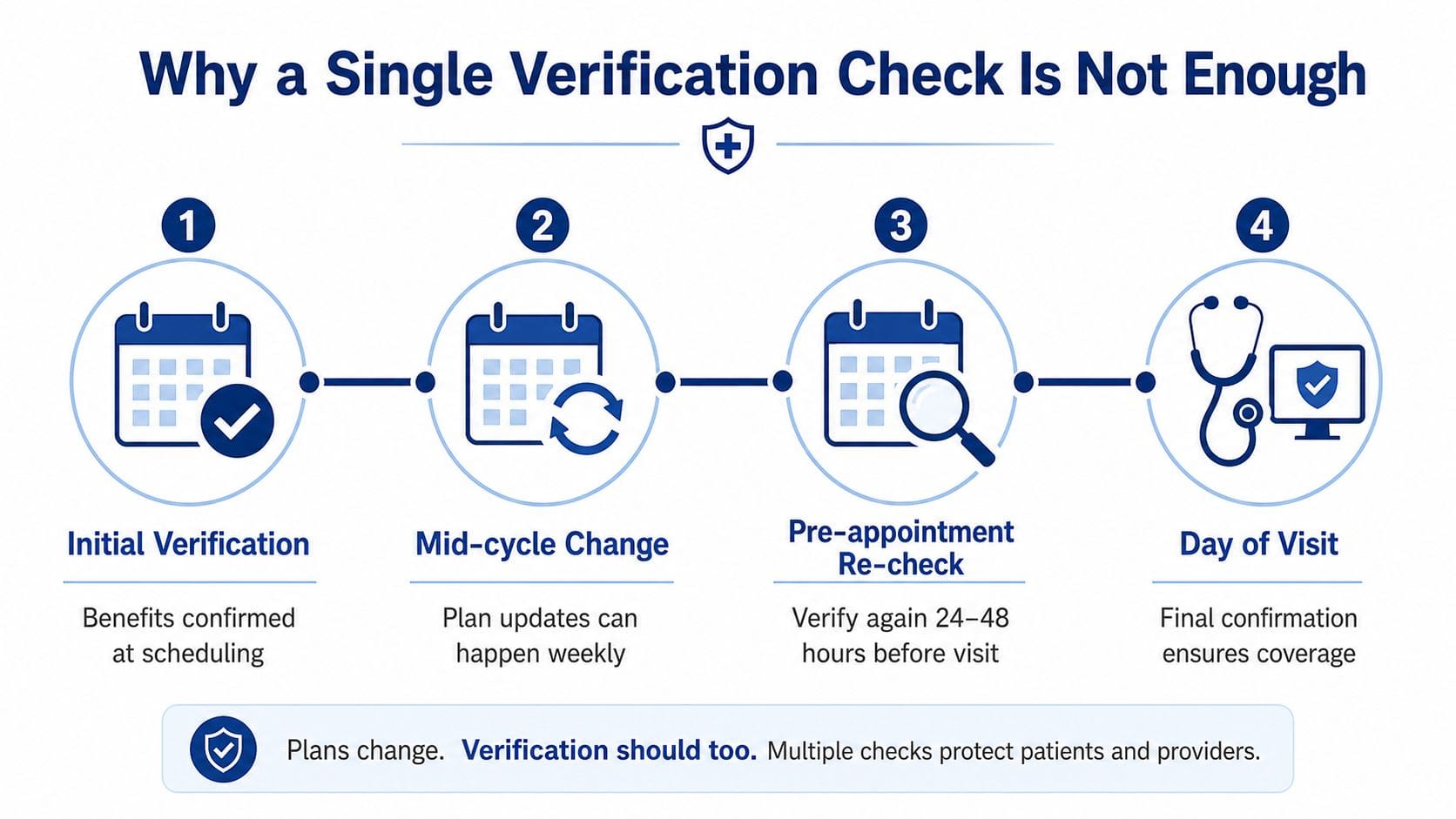
A final confirmation doesn't eliminate payer errors. It does give the patient and practice a clearer record of what was checked, when it was checked, and which questions remain unresolved. Patients seeking ongoing online medication management should make re-verification part of the scheduling conversation rather than assuming prior visits establish future coverage.
Common Verification Problems and How to Fix Them
A denial after active eligibility has been confirmed usually means the review stopped too early or the claim details didn't match the authorization. The patient should request the explanation of benefits, identify the denial reason code, and compare it with the verification notes.
| Problem | Likely cause | How to fix it |
|---|---|---|
| Active policy, denied visit | Missing prior authorization, expired approval, or service mismatch | Ask for the utilization management or behavioral health department. Request the exact authorization rule and document the call reference. |
| Telehealth claim processed incorrectly | Procedure code, place of service, or telehealth modifier didn't match payer requirements | Ask the billing team to review the submitted claim and request a corrected claim when appropriate. |
| Secondary insurance confusion | Coordination of benefits information is missing or outdated | Ask the insurer which policy is primary and update the coordination record before resubmission. |
| Demographic rejection | Legal name, date of birth, address, or member ID differs from payer records | Correct the patient file and ask the insurer to confirm the exact demographic information on record. |
| Out-of-network result | The clinician or plan was checked incorrectly | Request provider-level network verification and ask whether an in-network exception or corrected processing review is available. |
A patient calling the insurer can say: “The policy shows active, but the psychiatric telehealth claim denied. Which department can confirm whether authorization was required for this provider, service, and date?” That phrasing directs the call toward the actual failure point instead of another general eligibility response.
Authorization-related denials can also occur when the approved code doesn't match the final billed CPT, ICD-10, or place of service. The industry KPI guidance for insurance verification recommends tracking denial rate, auditing recent verifications, and tracing denied claims back to the workflow step that failed. Patients shouldn't have to solve payer coding alone, but they should keep every reference number, explanation of benefits, and written notice. If an employer plan is involved, the HR benefits administrator may help clarify plan documents or escalation options.
When Cash Pay or Membership Options Make Sense
Insurance isn't always the simplest route for telepsychiatry. A high-deductible plan may leave a patient paying most of the allowed amount until the deductible is met. Other patients may value predictable pricing, scheduling flexibility, or keeping a particular service outside the insurance claims process.
Cash pay can also make sense when authorization requirements create delays or when a preferred clinician isn't in-network. The trade-off is that the patient assumes responsibility for payment and should confirm whether the expense qualifies for an HSA or FSA under the account rules and applicable tax guidance.
A membership arrangement may offer recurring access or defined services for a predictable fee, but the patient should ask exactly what the membership includes, whether medications and laboratory work are separate, and whether insurance is billed. The practice's pricing information can help patients compare the available structure with their plan's deductible, copay, and coinsurance obligations.
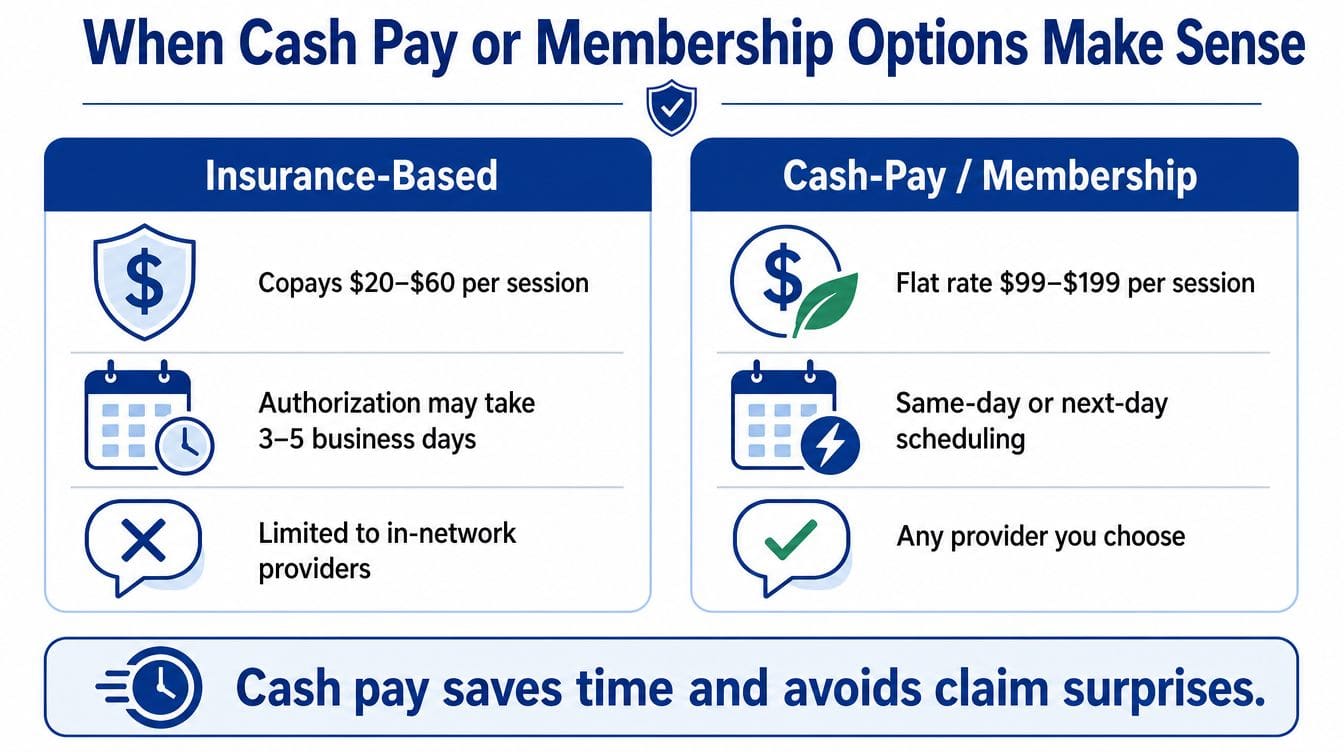
The comparison should include more than the advertised visit price. Patients should weigh authorization time, network restrictions, privacy preferences, appointment availability, and the chance of a later claim dispute. No payment route guarantees a particular clinical outcome, so the decision should focus on access, transparency, and fit.
Your Next Steps for a Smooth Verification Experience
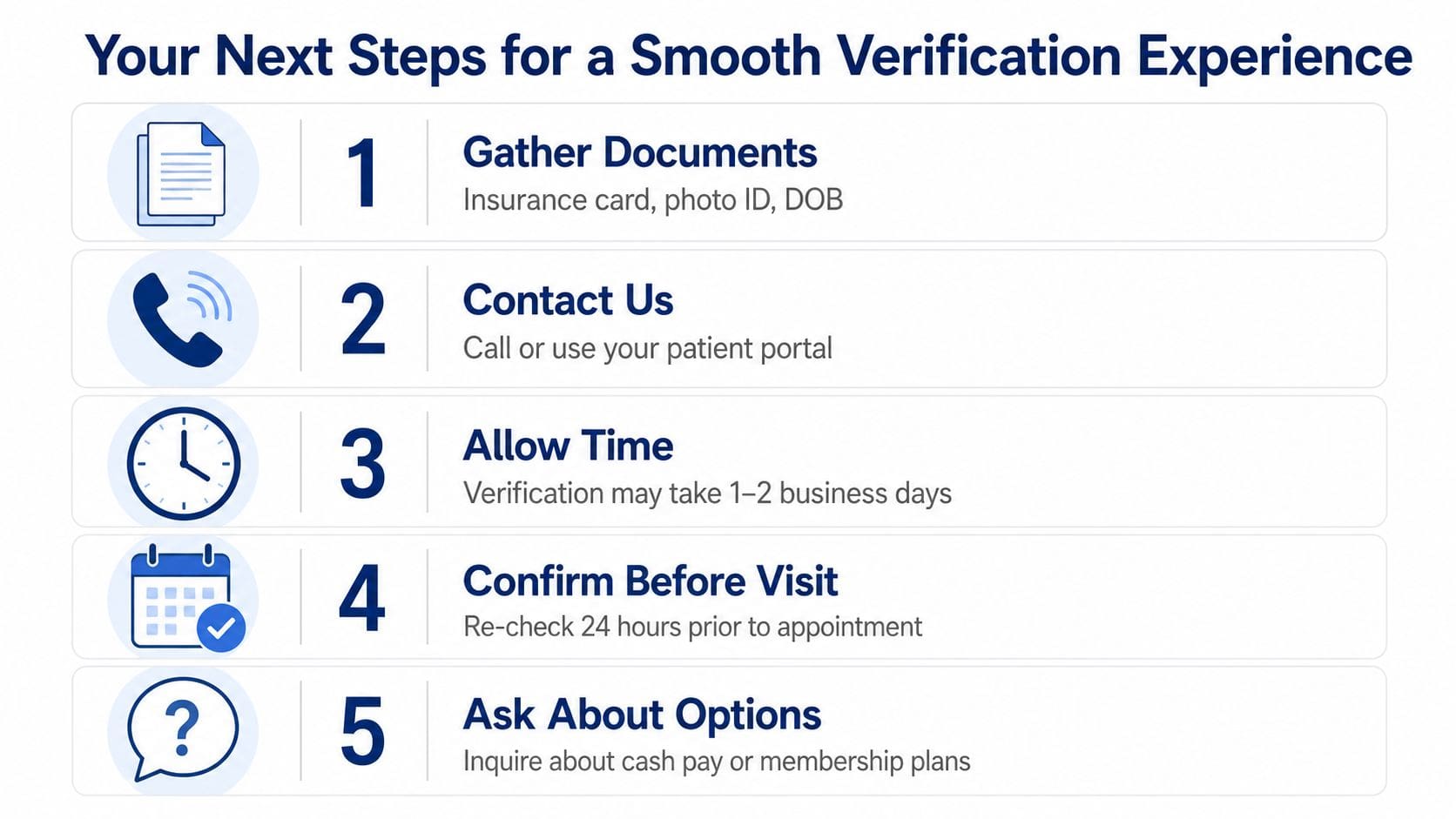
A reliable process leaves a paper trail and answers the visit-level questions before care begins. Patients can use this checklist:
- Gather documents: Have the insurance card, photo ID, date of birth, policyholder details, and secondary coverage information ready.
- Submit accurate information: Use the legal name and demographic details shown in the payer's record.
- Confirm the exact benefit: Ask about telehealth psychiatric care, provider network status, cost sharing, visit limits, and authorization.
- Document the interaction: Save the representative's name, date, reference number, and stated conditions.
- Re-check close to the appointment: Confirm that eligibility and authorization still apply to the planned date and service.
Patients should also ask what happens if the insurer's answer changes. A practice can explain expected patient responsibility, but the payer controls the final adjudication of a submitted claim. If insurance proves incompatible with the needed care, a cash-pay or membership discussion can prevent the patient from feeling trapped by an unclear authorization process.
Submitting complete information through a patient portal gives the billing team a better starting point than a partial card image or an outdated demographic form. A personalized review can identify questions that still need an insurer's direct answer before the first telepsychiatry appointment.
Integrative Psychiatry of America provides virtual psychiatric evaluations, medication management, and integrative mental health treatment throughout Pennsylvania. Patients can visit Integrative Psychiatry of America to submit insurance information, ask about telepsychiatry benefits, and schedule care with fewer avoidable billing surprises.