
A lot of adults in Pennsylvania start looking into genetic testing for psych meds after a familiar pattern. The first medication causes fatigue, nausea, or emotional blunting. The second seems promising for a few weeks, then doesn't help enough. The third brings a new side effect, or no clear benefit at all. By that point, it's normal to wonder whether the problem is the diagnosis, the dose, or the way the body handles the medication.
That question comes up often for people dealing with anxiety, depression, OCD, PTSD, or ADHD symptoms in Philadelphia, Pittsburgh, Harrisburg, Erie, Scranton, Allentown, Lancaster, Reading, and throughout the state. Patients want something more personalized than guesswork. They want to know whether a test can help shorten the path to a better medication plan.
Genetic testing can help in some cases. It can also be misunderstood. The most useful way to think about it is as one tool that may clarify how a person metabolizes certain psychiatric medications. It is not a guarantee, not a shortcut to a perfect prescription, and not a replacement for careful medication management.
Table of Contents
- The Search for Answers Beyond Trial and Error
- What Is Pharmacogenetic Testing Exactly
- How Genetic Test Results Guide Medication Choices
- The Clinical Evidence and Its Limitations
- Who Is a Good Candidate for This Testing
- Cost Insurance and Privacy in Pennsylvania
- How to Get Tested via Telepsychiatry in PA
The Search for Answers Beyond Trial and Error
A common Pennsylvania patient story sounds like this. An adult in Philadelphia starts an SSRI for anxiety and depression. The medication causes uncomfortable side effects. A switch is made. The next option is easier to tolerate, but symptoms still linger. Months pass, and the patient starts asking a practical question: Is there a better way to choose medications than trying one after another?
That frustration is real. It also makes sense. Psychiatric medications often require dose adjustments, time, and close follow-up. But when someone has already had a rough experience with multiple options, the standard approach can feel exhausting.
Why people start searching for a different approach
Patients in Pittsburgh, Erie, and smaller communities across Pennsylvania often search for more individualized care after:
- Several medication trials that didn't give enough relief
- Side effects that made it hard to stay on treatment
- Uncertainty about whether another prescription will lead to the same outcome
- Complex treatment histories involving more than one diagnosis or more than one medication
In that setting, genetic testing becomes appealing because it sounds more precise. Sometimes it is helpful. Sometimes it adds less than patients expect.
Practical rule: Genetic testing is most useful when it answers a specific prescribing question, not when it's used as a promise that the next medication will be the perfect one.
The value is in narrowing possibilities and helping a clinician think more carefully about metabolism, dosing, and tolerability. For adults exploring care through virtual psychiatric treatment in Pennsylvania, that can be part of a broader, evidence-based medication strategy rather than a stand-alone solution.
What Is Pharmacogenetic Testing Exactly
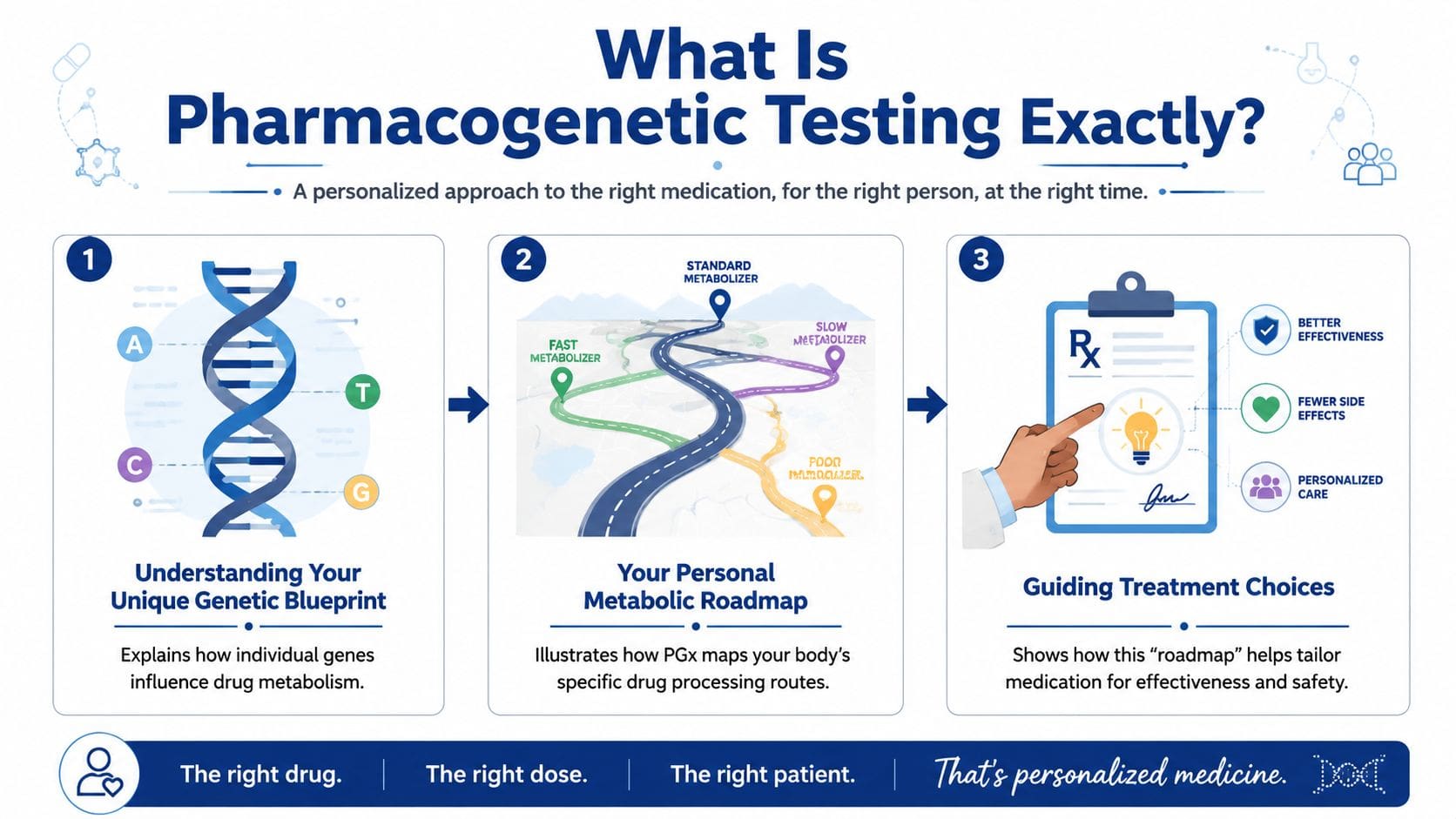
Pharmacogenetic testing looks at how certain genes may affect the way the body processes medications. For psychiatric treatment, the most clinically established genes are tied to drug metabolism, especially the cytochrome P450 system.
A metabolic roadmap, not a crystal ball
The simplest analogy is this: genetic testing for psych meds provides a metabolic roadmap. It does not predict the future. It doesn't tell a patient which medication will definitely fix anxiety or depression. It gives clues about how the body may break down certain medications.
One of the clearest descriptions is that pharmacogenomic testing for psychiatric medications analyzes specific genetic polymorphisms in cytochrome P450 enzymes, particularly CYP2D6 and CYP2C19, which directly determine an individual's drug metabolizer status (NCBI Bookshelf overview of pharmacogenomic testing).
That metabolizer status matters in very practical ways:
- Poor metabolizer means the body may process a medication more slowly, so drug levels can rise higher than expected.
- Rapid metabolizer means the body may clear a medication more quickly, so the drug may not reach a helpful level.
- Intermediate or normal metabolizer falls somewhere closer to expected medication handling.
For readers who want a broader genetics refresher, the idea that human traits differ because of inherited variation connects to the larger drivers of evolution and genetic diversity seen across populations.
A closer look at the depression-related testing process is available in this guide to a depression genetic test.
After the basic concept clicks, the video below makes the topic easier to visualize.
Why these genes matter
When a medication depends heavily on a pathway such as CYP2D6 or CYP2C19, inherited variation in those genes can affect whether a standard dose feels too strong, too weak, or hard to tolerate.
That's why the test can be clinically relevant for some adults with anxiety or depression. It doesn't diagnose the condition. It doesn't replace a mental health evaluation. It helps answer a narrower question: How might this person's body process specific medications?
The most accurate expectation is that the test may improve medication selection and dosing decisions. It won't tell anyone how much symptom relief to expect from a medication by itself.
How Genetic Test Results Guide Medication Choices
A report matters only if it changes a real prescribing decision. In Pennsylvania, that often happens during a telehealth follow-up after someone has already had one or two frustrating medication trials for anxiety or depression. The patient has heard that a genetic test might “tell them what works.” My job is to slow that down and explain what the report can and cannot do.
What the colors usually mean
Many commercial reports sort medications into color categories so the results are easier to review during a visit. GeneSight describes these groups as green for "use as directed," yellow for "moderate gene-drug interaction," and red for "significant gene-drug interaction," as shown on the GeneSight sample report and result overview.
The categories are useful, but they are not automatic instructions.
| Result Category | What It Means | Potential Clinical Action |
|---|---|---|
| Green | The test did not identify a major gene-based concern for that medication | It may move higher on the option list if it also fits the diagnosis, symptom pattern, and past response |
| Yellow | The report suggests a gene-drug interaction that could affect dosing or tolerability | A clinician may choose it with a lower starting dose, slower titration, or closer follow-up |
| Red | The report suggests a stronger gene-drug interaction | A clinician may look for an alternative first, or use it only if there is a clear reason and a monitoring plan |
In practice, the useful question is not “Which box is green?” The useful question is “Does this result help explain what happened before, and does it help us choose a safer or more sensible next step?”
How this changes a treatment plan
Consider a patient in Harrisburg who starts telepsychiatry care after stopping two antidepressants because of nausea, agitation, and insomnia. If the report shows slower metabolism in a pathway tied to one of those medications, that finding can support what the patient already experienced. It does not prove the medication was wrong for every person. It helps explain why a standard dose may have hit this patient too hard.
That changes the conversation.
A green medication may become a more reasonable next trial. A yellow medication may still be acceptable, but I may start lower and check in sooner. A red medication may stay on the backup list unless there is a strong clinical reason to use it anyway.
Sometimes the report affects drug selection. Sometimes it affects dosing. Sometimes it mainly helps us avoid repeating a bad experience.
That distinction matters for patients who expect the test to produce one perfect answer.
What the results actually mean for a Pennsylvania patient
For depression, the report may help narrow choices among SSRIs, SNRIs, or other antidepressants after side effects or poor response. For anxiety, it may help explain why one medication felt activating, sedating, or hard to tolerate at a usual dose. If serotonin-related treatment is part of the discussion, some patients also want a clearer explanation of how serotonin, including 5-HT pathways, relates to mood and treatment.
The report still has to be matched to the full clinical picture. That includes current symptoms, sleep, trauma history, bipolar screening, substance use, medical conditions, and other prescriptions. A medication can look favorable on a genetic report and still be a poor fit for the person sitting in front of me.
In telehealth care, I usually review the report alongside the patient's timeline. What happened on sertraline? Was escitalopram helpful but too sedating? Did bupropion worsen panic? That step is where the results become useful. The genetics add context. The treatment plan still comes from the combination of history, diagnosis, and follow-up.
What patients should and should not assume
Patients often read the colors as a scorecard. That creates problems.
- Green does not mean the medication will work well. It means the tested genes did not raise a major concern about how the body may process that drug.
- Yellow does not mean “bad choice.” It often means the prescriber should be more thoughtful about dose, pace, and monitoring.
- Red does not mean banned. It means there is a stronger reason to pause and justify the choice.
- The report does not replace clinical judgment. Prior benefit, side effects, family history, and diagnosis still matter.
The best use of pharmacogenetic testing is practical. It can reduce some guesswork, help explain prior medication problems, and support a more individualized plan. For many adults in Pennsylvania trying to get better care through telepsychiatry, that is valuable, even when the report does not provide a simple answer.
The Clinical Evidence and Its Limitations
A common Pennsylvania telepsychiatry visit goes like this. A patient has already tried two or three medications for depression or anxiety, a friend mentions genetic testing, and the next question is simple: does this test improve the odds of finding a better medication?
The honest answer is that the evidence is encouraging, but mixed. Some studies suggest that pharmacogenetic testing can help certain patients reach a reasonable medication plan faster, especially after prior side effects or unsuccessful trials. Other reviews have found that the overall benefit is modest, and not every commercial panel adds information that changes care in a meaningful way.

Where the evidence is strongest
The most useful part of the science is also the most practical. Genetic results can help identify whether a person may process certain medications more slowly or more quickly than expected, particularly through enzymes such as CYP2D6 and CYP2C19. That matters because blood levels, side effects, and dose tolerance often depend on metabolism.
In real practice, this can clarify a confusing history. If someone in Pennsylvania tells me they felt overly sedated on a low dose of one SSRI, or had side effects almost immediately on a medication that usually starts gently, a pharmacogenetic result may help explain why. It does not confirm that the medication was wrong. It helps explain whether the body may have handled it differently than expected.
Professional guidance is strongest for a narrower group of gene-drug pairs than many commercial reports imply. The Clinical Pharmacogenetics Implementation Consortium publishes prescribing guidance for selected antidepressants and other psychotropic medications when there is enough evidence to support genotype-based dosing considerations, particularly for CYP2D6 and CYP2C19 (CPIC guidance for gene-drug pairs in psychiatry). That is the part of testing I consider most actionable.
Where the limits become clear
A broader commercial report can look more certain than it really is.
These tests do not predict who will feel happier, calmer, or more motivated on a medication. They do not diagnose depression, anxiety, bipolar disorder, ADHD, or trauma-related symptoms. They do not replace the work of matching the medication to the actual condition being treated.
They also do not answer one of the biggest patient questions: "Will this medication work for me?" A report may suggest that a drug is more likely to be tolerated at a usual dose, or that extra caution is reasonable because of metabolism. Response is still shaped by diagnosis, symptom pattern, medical history, sleep, substance use, other prescriptions, and follow-up.
The FDA has also urged caution about using unreviewed pharmacogenetic claims to predict medication response. Its safety communication explains that many genetic tests have not been reviewed by the agency for specific prescribing claims, and changing treatment based on unsupported claims can create problems for patients (FDA safety communication on genetic tests and medication response claims). For patients, the practical takeaway is straightforward. A test result can inform prescribing, but it should not overrule a careful psychiatric assessment.
What this means in actual treatment planning
For adults receiving telehealth psychiatric care in Pennsylvania, the value of testing is usually greatest after the results are translated into a medication plan. That may mean choosing between two reasonable antidepressants, starting at a lower dose, avoiding a drug that fits poorly with prior side effects, or explaining why a past medication experience was rougher than expected.
It may also mean deciding that the report does not change much.
That is a useful outcome too. If the test does not reveal a meaningful metabolism issue, the next step is often to focus on diagnosis, adherence, sleep, psychotherapy, medical contributors, or whether the current symptoms point to a different medication class. Patients who want more context on serotonin-related terms they may see while discussing antidepressants can review what 5-HT means in psychiatric treatment.
The best use of pharmacogenetic testing is measured and specific. It can improve prescribing decisions for some patients. It cannot replace careful follow-up, and it should never be presented as a shortcut around thoughtful psychiatric care.
Who Is a Good Candidate for This Testing
Genetic testing for psych meds is most appropriate for adults with a complex medication history. In Pennsylvania, that often means someone who has already spent months trying to feel better, heard about testing from a friend or online, and now wants to know whether it is worth bringing up in a telehealth appointment.
The conversation is usually most useful when treatment has been frustrating rather than straightforward. In my practice, the patients who tend to get the most value from testing are the ones who have had unclear results from prior medication trials, side effects that showed up early, or a medication list that is getting harder to sort through safely.
Patients most likely to benefit
A good candidate often has one or more of these patterns:
- Repeated nonresponse to antidepressants for anxiety or depression
- Early intolerable side effects that make it hard to stay on treatment
- Polypharmacy concerns when multiple prescriptions make medication management more complicated
- A complicated diagnosis mix, such as depression plus ADHD, or PTSD plus insomnia and anxiety
- Past treatment resistance where prior medication trials have already taken a lot of time and energy
This does not mean the test picks the perfect medication. It means the results may help narrow choices, explain past problems, or make a prescribing plan more precise.
That distinction matters.
For example, a Pennsylvania patient might come into a telepsychiatry visit after stopping two antidepressants, one because of nausea and one because of agitation, and ask whether a genetic test can finally tell them what will work. The more realistic answer is that the report may show how they metabolize certain medications, whether some options deserve more caution, and which next steps make more sense in light of their history. That is often enough to make the next trial more thoughtful and less discouraging.
For adults who are still sorting out whether inattention is part of anxiety, depression, burnout, or ADHD, tools such as the Adult ADHD Assessment can help organize symptoms before medication decisions become more complex. Questions about evaluation costs also come up in the same stage of care, and this guide to ADHD testing costs and related evaluation expenses can help patients compare the bigger picture.
When testing usually is not the first step
Someone starting a first medication, with no history of unusual side effects and no complicated prescribing issues, often does well with standard medication selection and close follow-up. In that situation, testing may add little.
Testing also calls for caution in younger patients. Professional groups have advised against routine pharmacogenetic testing in children and adolescents because the evidence is still limited for broad use in that age group.
A simple way to judge fit is to look at the treatment story so far. If the story is short and uncomplicated, testing is less likely to change care. If the story includes failed trials, side effects, several medications, or uncertainty about the best next move, the discussion becomes much more reasonable.
Cost can shape that decision too. Some patients want to discuss testing but are still working to find affordable health insurance in PA, which can affect whether it makes sense to order the test now or wait until coverage is clearer.
Cost Insurance and Privacy in Pennsylvania
A common Pennsylvania scenario goes like this. A patient has heard that genetic testing might help with antidepressant or anxiety medication choices, then the next question comes fast. What will this cost me, and who will see the results?
What patients usually pay
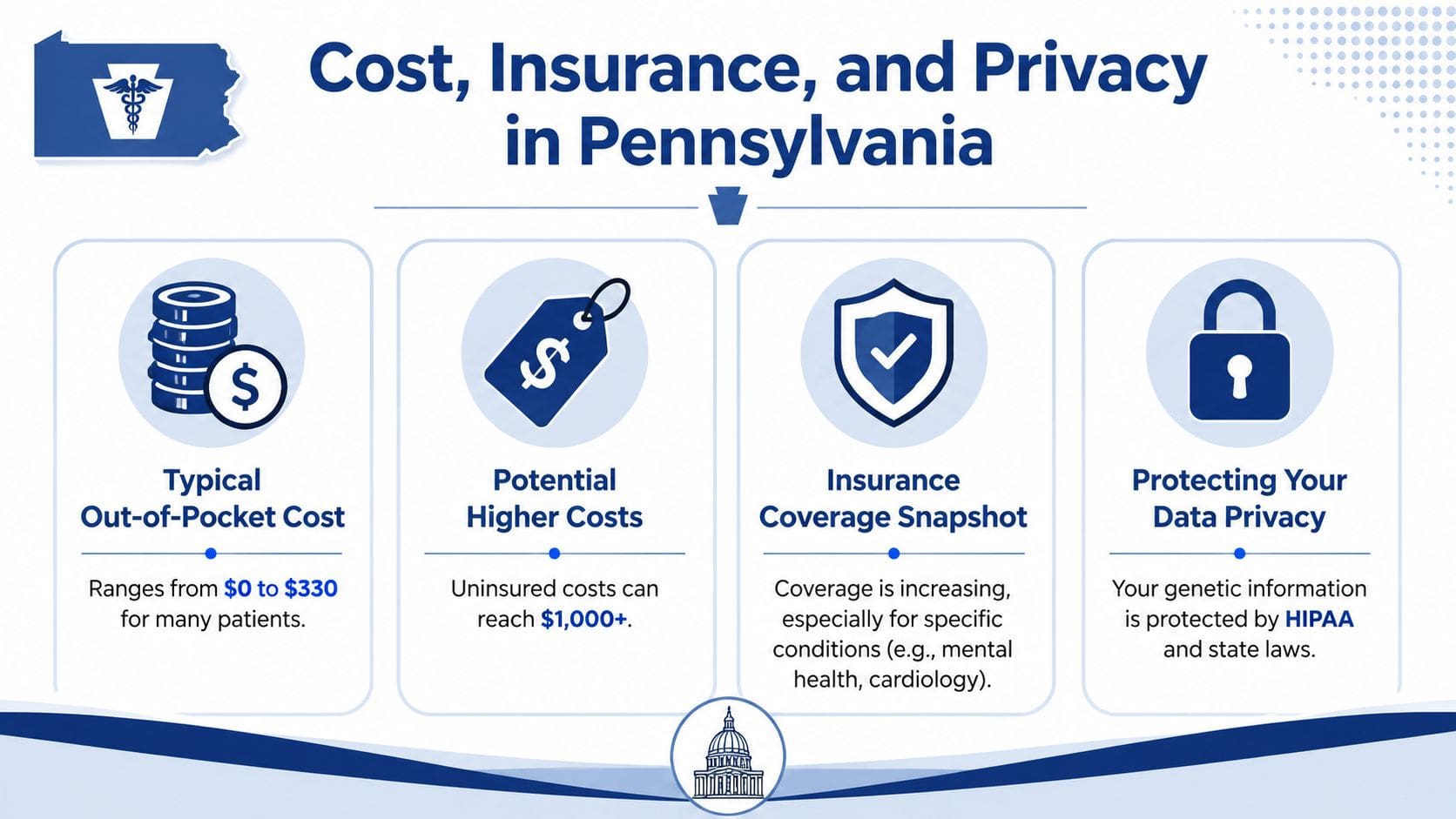
The honest answer is that cost varies a lot by plan, by medical history, and by whether the insurer agrees that testing is justified. In practice, I tell patients not to assume the test will be fully covered and not to assume they will owe the full list price either.
For the GeneSight Psychotropic test, the manufacturer says Medicare pays a set amount for covered testing, and many insured patients may owe less than the full charge depending on benefits and financial assistance. The company also states that some patients may pay between $0 and $330 out of pocket, but that figure is not a guarantee and depends on the insurance review process and individual eligibility (GeneSight billing and insurance information).
That is why the right question is not only, “Is it covered?” The better question is, “What will my plan require before the lab processes the test?”
Some Pennsylvania plans are more open to coverage than others. Prior authorization may be required. The insurer may ask for a history of side effects, failed medication trials, or a clear reason the result could change prescribing. For a patient discussing depression or anxiety treatment in a telehealth visit, that paperwork can matter as much as the swab itself.
Patients who are comparing plans or trying to find affordable health insurance in PA should look closely at behavioral health benefits, lab coverage, deductibles, and preauthorization rules before ordering a specialized test.
A separate budgeting question often comes up at the same stage of care. If someone is weighing medication guidance against other diagnostic expenses, this overview of ADHD testing costs and related evaluation expenses can help put the numbers in context.
Privacy questions that come up often
Privacy concerns are reasonable. Genetic information feels personal because it is personal.
In medical care, pharmacogenetic testing is handled differently from a consumer DNA kit. The sample goes to a clinical lab, and the results are usually returned to the ordering clinician and placed in the medical record used for treatment. That can help future prescribing, but it also means patients should know where the information will live and who may be able to access it.
Federal law offers some protection. The Genetic Information Nondiscrimination Act, explained by the U.S. Equal Employment Opportunity Commission, limits the use of genetic information in health insurance and employment decisions, although it does not cover every insurance category such as life, disability, or long term care insurance (EEOC overview of GINA protections).
Before agreeing to testing, ask these practical questions:
- Who will receive the report
- Whether the lab keeps the sample after testing
- Whether the result becomes part of the regular chart
- What information is sent to the insurer for authorization
- What your estimated out-of-pocket cost is before the kit is shipped
I recommend one more step. Ask the prescriber to state the clinical reason for ordering the test in plain language. If the answer is specific, such as repeated side effects with antidepressants or unusual reactions to standard doses, the test may have a clear role. If the answer is vague, it is worth slowing down before you consent.
How to Get Tested via Telepsychiatry in PA
For adults using telepsychiatry in Pennsylvania, the process is usually straightforward. The convenience matters for people in large cities and smaller communities alike, especially when access to specialized medication management is limited locally.
A simple step by step process
Most telehealth-based psychiatric genetic testing follows a sequence like this:
Schedule a virtual evaluation. A licensed provider reviews symptoms, past diagnoses, treatment history, and current medications. This is the right time to discuss whether testing fits anxiety, depression, OCD, PTSD, ADHD, or another concern. Patients can start with an online mental health evaluation.
Review the medication story carefully. The key question isn't whether the test sounds modern. The key question is whether it will influence prescribing. Prior side effects, failed trials, and medication interactions matter here.
Receive an at-home cheek swab kit if testing is appropriate. The collection process is simple and noninvasive.
Mail the sample back. Most kits include the materials needed to return the swab to the lab.
Book a follow-up visit to review results. The report becomes useful during this visit. The provider interprets the result in the context of symptoms, diagnoses, other medications, and treatment goals.
For patients in Philadelphia, Pittsburgh, Harrisburg, Erie, Scranton, Allentown, Lancaster, Reading, and statewide, the biggest advantage of telepsychiatry is access. The test itself is only one part of care. The primary value comes from having a thoughtful medication plan after the results return.
Adults across Pennsylvania who are tired of medication guesswork can learn more about evidence-based virtual treatment through Integrative Psychiatry of America. The practice offers online psychiatric evaluations, medication management, and individualized care for anxiety, depression, ADHD, OCD, PTSD, and related concerns. Patients can explore treatment options, verify insurance, and schedule a confidential telehealth appointment from anywhere in the state.