
Does the format of a visit change how well depression treatment works, or only how convenient it feels?
Patients often pick one answer and book accordingly, and the assumptions on both sides are shaky. In 2024, 42.4% of U.S. adults who had a past-year major depressive episode received mental health care through telehealth, according to a summary of National Survey on Drug Use and Health data. Care delivered through a screen is now ordinary. Matching the right delivery channel to the right person is not.
That mismatch is the gap worth closing. A live video call, a phone visit, a portal message and a hybrid schedule are four different clinical tools. They fit different symptoms, different homes and different safety profiles. Getting that match right matters more than getting an appointment fast.
Table of Contents
- How Telehealth for Depression Works
- Whether Online Care Matches In-Person Results
- What Happens During a First Telepsychiatry Visit
- Preparing for a Virtual Depression Visit
- Limits, Access Barriers and When to Seek In-Person Care
- Privacy and HIPAA Protections for Virtual Visits
- Insurance, Costs and Access in Pennsylvania
- Choose a Provider and Book Your Virtual Visit
How Telehealth for Depression Works
How can depression care fit into a video call, a phone conversation, or a mix of online and in-person visits? Telehealth uses remote communication to deliver psychiatric care. The format can change, while care may include evaluation, medication management, psychotherapy, lab review, and follow-up.

The term telepsychiatry and how it works covers care delivered remotely, but the channel matters. Video, phone, messaging, and hybrid care each suit different needs.
| Format | How it works | Best fit | Main limit |
|---|---|---|---|
| Live video | Real-time visit with camera and audio over a secure platform | Psychiatric evaluations and medication reviews when you have a private room and stable connection | Poor connections can interrupt the visit, and video offers fewer visual cues than being in person |
| Audio-only phone | Real-time voice visit without video | People without reliable broadband or a private space for video | The clinician has less visual context about mood and appearance |
| Patient portal messaging | Written check-ins, refill requests, and questions between visits | Routine updates and side-effect questions between scheduled visits | Not suited to new symptoms, a crisis, or urgent safety concerns |
| Hybrid care | Video visits combined with scheduled in-person labs or exams | Medication monitoring that requires blood work or a physical assessment | The in-person portion requires travel |
Why the Format Matters More Than the Label
A systematic review of telehealth modalities found modestly better depression outcomes with in-person care than with videoconferencing, based on low-quality evidence (standardized mean difference 0.28). The same review found that telephone-delivered evidence-based treatment outperformed treatment as usual (standardized mean difference -0.47), based on very low-quality evidence. These findings describe different comparisons, so they do not establish that one remote format works best for everyone.
If video feels awkward, tiring, or impractical at home, phone-based care may be another option to discuss with a clinician. The aim is to match the channel to your symptoms, privacy, and internet access, not to assume that every kind of telehealth works the same way.
What Drives the Choice
A clinician can help weigh several practical factors:
- Symptom severity and suicidal thinking. Higher risk may call for real-time contact and a clear plan for getting urgent help.
- Concentration and cognitive fog. If screens are hard to follow, shorter sessions or phone visits may feel more manageable.
- Privacy at home. A shared apartment or a busy household can make it difficult to speak openly.
- Broadband and device reliability. A video connection that keeps freezing can interrupt the conversation.
- Need for an exam or lab work. Some assessments require an in-person visit.
The treatment plan is the destination; the format is the route. Ask before booking: “Which format fits my symptoms and circumstances, and what might prompt a change?”
Whether Online Care Matches In-Person Results
For many adults with depression, telehealth psychotherapy performs about as well as in-person therapy. That's the short answer, and it arrives with real conditions attached.
A systematic review and meta-analysis of 9 trials involving 1,268 patients found that psychological interventions delivered through telehealth produced depression outcomes comparable to face-to-face treatment. Symptom differences were neither statistically nor clinically significant right after treatment (standardized mean difference -0.04; 95% CI -0.21 to 0.13), at 3 months (SMD 0.10; 95% CI -0.08 to 0.28), or at 6 months (SMD 0.05; 95% CI -0.56 to 0.66). That 6-month interval is wide, so the estimate there is loose.
A second meta-analysis of 12 studies with 1,876 participants landed in the same place from a different angle, reporting a standardized mean difference of -0.03 (95% CI -0.15 to 0.09) when telehealth was compared with in-person depression treatment.
What the Trials Actually Measured
Virtual care also beats nothing at all. A review of virtual interventions for mild-to-moderate depressive disorders reported higher odds of remission than waitlist controls (odds ratio 10.30; 95% CI 5.70 to 18.60; 619 participants) and than treatment as usual or attention controls (odds ratio 2.27; 95% CI 1.10 to 3.35; 512 participants). Post-treatment symptom severity fell as well.
Those numbers describe structured programs, not the mere existence of a camera. Most trials tested organized psychotherapy with a set protocol, a fixed number of sessions and a clinician tracking progress. Many excluded people with severe depression, active suicidality or psychosis. Follow-up ran in months, not years.
The active ingredient isn't video. It's structure, frequency and a working alliance with a consistent clinician. A weekly video session nobody follows up on isn't equivalent to in-person care just because the platform is encrypted.
Where Measurement Fits
Progress needs a number attached to it. A validated scale such as the PHQ-9 tracks symptom severity over time and shows whether treatment is working. It's a screening and monitoring instrument. A score is not a diagnosis, and a falling score is not a cure.
What This Means for a Pennsylvania Patient
Telehealth removes travel time, cuts missed visits for people juggling work, childcare or mobility limits, and keeps one clinician in charge of follow-up instead of a rotating cast. Those gains hold when the visit protocol and the follow-up schedule match what an office would provide. They're conditions, not guarantees.
What Happens During a First Telepsychiatry Visit
What does a first telepsychiatry appointment decide? It gives the clinician time to understand your symptoms and history, then discuss a treatment plan. The plan may change as you and the clinician see how care is working.
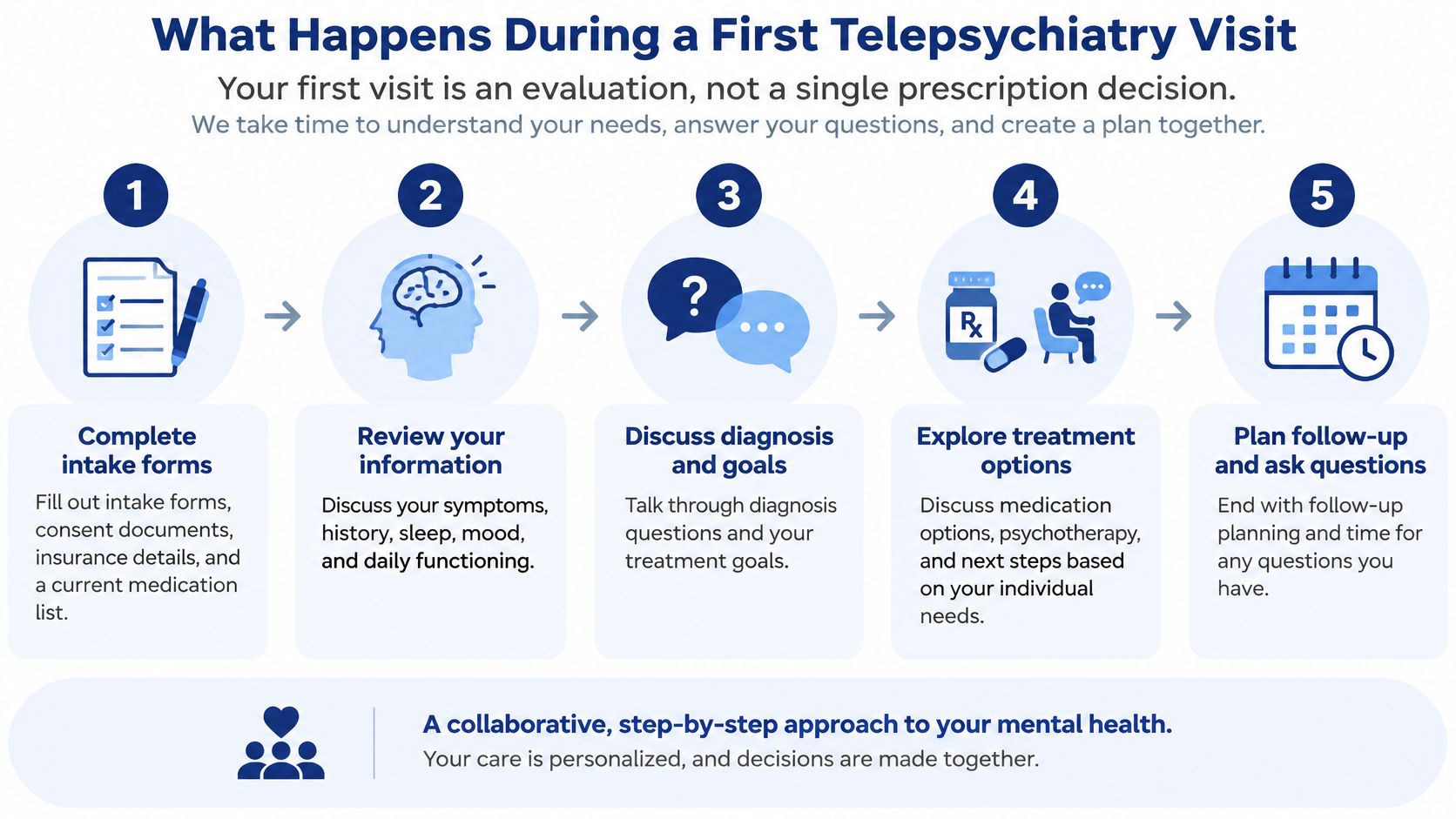
A virtual visit follows much the same clinical steps as an office evaluation. The format can vary: live video supports a direct conversation, while phone or messaging may be considered when privacy, symptoms, or internet access affect what is practical. The clinician can explain which format fits the visit.
- Intake and consent. You complete forms covering your history, medications, and consent to care. This gives the clinician more time to focus on your concerns during the appointment.
- Identity and location. The clinician confirms who is joining and where you are during the visit. Knowing your location helps the care team respond if an urgent safety concern arises.
- Clinical history. Expect questions about when symptoms began, how they affect daily life, sleep, appetite, energy, concentration, substance use, previous treatment, and family history. A questionnaire may help organize your answers.
- Safety and mood screening. The clinician may ask directly about suicidal thoughts and past periods of unusually high or irritable mood. This helps distinguish depression from other conditions that can affect treatment choices.
- Checking other possible causes. Some health conditions, medications, sleep problems, or substance use can contribute to depression-like symptoms. If your history suggests further testing, the clinician can discuss appropriate next steps.
- Clinical assessment. The clinician considers your history and interview together. A questionnaire can support that assessment, but its score alone does not establish a diagnosis.
- A treatment plan you can discuss. Options may include psychotherapy, FDA-approved medication, lifestyle changes, or a combination. You should understand the reason for the proposed plan and what symptoms or side effects to report.
- Follow-up planning. Early medication adjustments are typically reviewed at short intervals during the first months, so side effects and non-response are caught before much time passes. The format and timing of follow-up can be discussed with your clinician.
Screening, Evaluation, Diagnosis, Treatment
These terms describe different steps. Screening uses brief questions to flag possible concerns. Evaluation brings together a fuller interview and history. Diagnosis is the clinician's judgment based on that information. Treatment is the agreed plan, with follow-up to review how it is working.
Integrative Psychiatry of America provides psychiatric evaluations, personalized treatment plans, medication optimization, and collaborative care coordination through secure virtual visits. New patients can schedule an online mental health evaluation.
Preparing for a Virtual Depression Visit
Preparation changes what a visit can accomplish. A clinician who can see two weeks of mood data asks sharper questions than one working from memory alone.
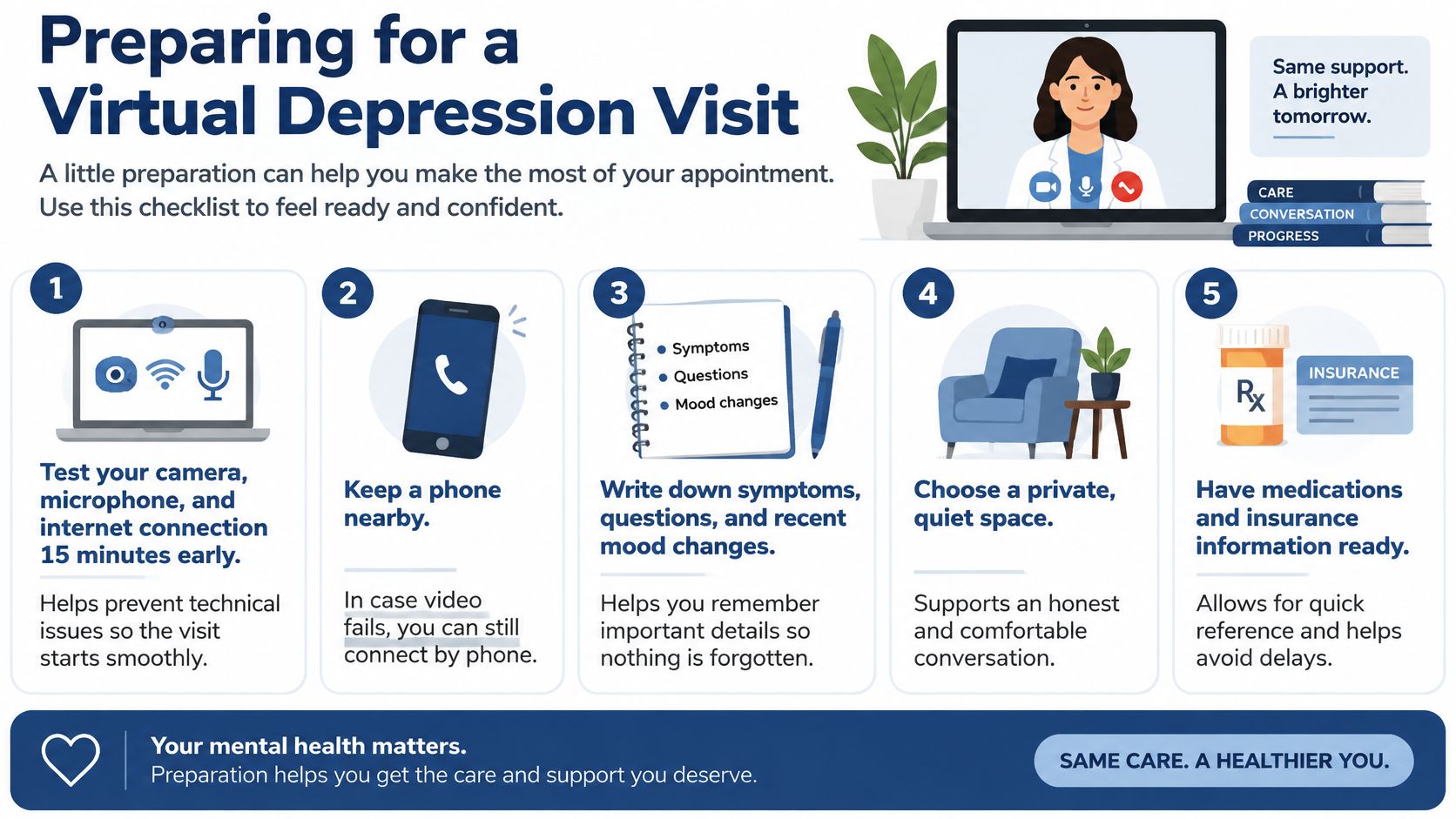
Setup, Documents, Notes and Safety
- Test the tech early. Check camera, microphone and connection 15 minutes before the start, and keep a phone number handy as backup. A five-minute fix beats losing half a session.
- Pick a private room. Quiet, well lit, door closed, device charged. Honest answers need a space where nobody overhears.
- Gather documents. Current medications with doses, pharmacy name, insurance card, photo ID, and a list of past medications with what happened on each. Prior failures narrow the search fast.
- Write symptom notes. Note when symptoms started, what makes them better or worse, and how sleep, appetite, energy, concentration and alcohol or substance use have shifted.
- Track mood daily. A simple 0 to 10 rating each day for one to two weeks surfaces patterns that memory flattens.
- Name three goals. Three priority questions at the top of the page keep the visit on what matters most.
- Keep safety contacts close. A written safety plan and the 988 number for calls or texts belong within reach, not in a drawer.
Sharing those tracking notes through the patient portal before the visit gives the clinician time to read them. Virtual visits happen in the comfort of the patient's own home, which also means the appointment can be prepared in the same familiar setting where the week unfolded.
This short video walks through what a virtual appointment looks like.
Integrative Psychiatry of America publishes free tools that fit these steps, including a mood and emotion tracker for the daily 0 to 10 log and a 5-4-3-2-1 grounding exercise for moments of distress before an appointment.
Limits, Access Barriers and When to Seek In-Person Care
Virtual care has a hard edge. Some presentations need a room, a monitor or a team, and saying so is part of practicing.
| Situation | Why it matters | Next step |
|---|---|---|
| Thoughts of suicide or self-harm | Needs immediate risk assessment | Call or text 988, or call 911 if there's immediate danger |
| Psychosis, mania or severe confusion | Often needs emergency or hospital-level evaluation | Go to an emergency department or call 911 |
| Symptoms worsen despite treatment | May signal a need for more intensive care | Contact the provider the same day and discuss a higher level of care |
| Blood tests or a physical exam needed | Lab results can change diagnosis or medication safety | Arrange a hybrid visit with a local lab or clinic |
| Unreliable broadband or no private space | Can interrupt sessions and compromise privacy | Request a phone visit or use a nearby clinic |
Who Gets Left Out of the Video Model
Telehealth is sold as an access fix. A Johns Hopkins-led analysis of Maryland patients with depression from mid-2021 through mid-2024 found that residents of high-wealth, low-deprivation neighborhoods had 1.67 times the odds of using telehealth rather than in-person psychiatry compared with residents of low-wealth, high-deprivation neighborhoods. For primary care the gap was 1.62.
Broadband isn't distributed evenly either. Across U.S. mental health visits from 2021 through 2023, 26.3% of visits in nonmetropolitan areas happened via telehealth, against 48.9% in metropolitan areas, according to the Agency for Healthcare Research and Quality's 2025 Statistical Brief.
The lesson isn't that online depression care fails poor or rural patients. It's that the video-only version of it can.
Safeguards a Patient Can Request
- A phone fallback for days when the connection drops or the house is loud.
- Low-bandwidth options, including audio-only visits and shorter sessions.
- Interpreter and accessibility support arranged before the appointment, not during it.
- Portal help, because a confusing login screen shouldn't be the reason someone stops treatment.
- Written costs before the first visit, so a surprise bill doesn't end care at week three.
- A local plan naming the nearest emergency department and the after-hours number.
Rural Pennsylvanians, low-income patients, older adults and anyone whose depression makes multi-step technology tasks feel impossible carry the heaviest load here. When a virtual visit goes wrong, the emergency mental health services pathway explains what to do instead of waiting for the next appointment.
Privacy and HIPAA Protections for Virtual Visits
HIPAA sets the federal rulebook for how providers and health plans handle health information. A platform used for care should be HIPAA-compliant, and the practice should hold a written agreement with the platform vendor that covers protected health information.
Encryption is simpler than it sounds. Video and audio travel over a secure connection, so someone on the same network can't casually read or listen in. Encryption protects the transmission. It doesn't protect against a roommate walking in.
What to Confirm Before the Camera Turns On
- Ask about compliance and encryption. "Is this platform HIPAA-compliant, and are sessions encrypted?" is a fair question with a short answer.
- Use a private room with a closed door. Household members, shared walls and open floor plans all change what gets said.
- Skip public Wi-Fi. A password-protected network at home beats a coffee shop connection on every measure.
- Guard the login. Keep portal credentials private and turn on two-step verification where it's offered.
- Know your exact address. If emergency services need to be sent, a vague neighborhood isn't enough.
- Ask about recording. Sessions shouldn't be recorded without a written agreement from both sides.
If mood tracking happens between visits, read the data protection terms for mood tracking in whatever app holds those entries, because a diary app isn't a covered entity and follows different rules.
The Honest Limits
Privacy at home depends on people who aren't in the room. Notifications that flash a portal message across a shared screen, a partner reading over a shoulder, a teenager borrowing the laptop: none of that is a HIPAA violation, and all of it affects disclosure.
Confidentiality has legal limits too. Clinicians disclose when there's serious risk of harm to the patient or someone else, and when reporting is required by law.
Integrative Psychiatry of America sees patients virtually using secure, HIPAA-compliant telehealth technology, and every appointment runs through it. Before the first visit, a patient can confirm a clinician's Pennsylvania license through the state licensing board. Patients who want the platform details in writing can read how HIPAA compliance works in telehealth before the first appointment.
Insurance, Costs and Access in Pennsylvania
A virtual appointment can remove the need to travel, but it does not guarantee insurance coverage. Benefits, copays, deductibles, network status and authorization requirements vary by plan. Your plan documents and insurer can clarify what you will owe.
| Item | Why it matters | Question to ask |
|---|---|---|
| Telehealth copay | May differ from an in-person copay | Is a telehealth visit billed the same as an office visit? |
| Network status | Out-of-network care can cost more or may not be covered | Is this provider in network for my plan? |
| Deductible | Some services are paid only after you meet it | Has my deductible been met this year? |
| Prior authorization | Some evaluations or medications need approval | Does the evaluation or prescription need authorization? |
| Pharmacy coverage | Medications may have formulary limits or step requirements | Is the prescribed medication covered, and what is the cost? |
| Self-pay rate | Applies when insurance is not used or a service is not covered | What is the total cash price for the evaluation and follow-up visits? |
Medicare Rules That Affect Home-Based Care
Medicare rules for home-based telehealth include temporary provisions and requirements that depend on the service and provider. CMS guidance says patients may receive telehealth from home without geographic restrictions through December 31, 2027. This addresses where a visit can take place, not whether Medicare will pay for a particular appointment. Coverage still depends on eligibility, provider enrollment, service type and payer rules.
For Medicare beneficiaries receiving mental health telehealth at home, an in-person, non-telehealth mental health visit generally must occur within six months before the first telehealth service, followed by at least one in-person visit every 12 months while home-based care continues. The requirement does not take effect for the relevant services until after December 31, 2027. Exceptions may apply when the patient and clinician agree that travel risks or burdens outweigh the benefits and document the reasoning. Check the effective date and provider requirements with Medicare or the clinician before relying on an exception.
Federally qualified health centers and rural health clinics have a related in-person visit requirement for mental health care delivered by telecommunications: generally, a visit within six months before telehealth begins and at least once every 12 months afterward. Documented exceptions may apply when an in-person visit could worsen the condition, create undue hardship or lead the patient to stop treatment.
Before Booking
Pennsylvania patients may have plans from Cigna, Aetna, UnitedHealthcare or Blue Cross Blue Shield (BCBS/IBX), but the company name alone does not establish coverage. Network status and authorization rules can differ by plan and plan year. Check the specific plan.
Ask the provider and insurer for the expected total cost in writing, including any self-pay rate, before booking. The guide to insurance coverage for online psychiatry can help you prepare questions for that call.
Choose a Provider and Book Your Virtual Visit
Before booking, check whether the clinician's role matches the care you need. A psychiatrist is a physician who can prescribe medication and provide psychiatric care. A board-certified psychiatric mental health nurse practitioner can evaluate and manage medication. Psychologists, social workers, and counselors provide psychotherapy, and some also offer testing or case coordination.
If you may need both medication and therapy, ask how those parts of care will be coordinated, especially if different clinicians provide them.
Six Questions Worth Asking First
- Is this clinician licensed in Pennsylvania?
- Can this clinician prescribe and manage medication, or will I be referred elsewhere?
- How are emergencies and after-hours concerns handled?
- How often are follow-up visits, and how is progress reviewed?
- Does the practice provide psychotherapy, or refer patients elsewhere?
- What will my expected cost be after insurance is applied?
Ask for a clear process for urgent concerns before care begins. You should know whom to contact and what steps to take.
Integrative Psychiatry of America is a fully licensed Pennsylvania telehealth practice based in Philadelphia and serving patients throughout Pennsylvania. Its board-certified psychiatric nurse practitioners provide care through secure virtual visits. New patients can schedule a full psychiatric evaluation on the website.
Check your insurance coverage and expected costs, then request an appointment online. During the evaluation, you can discuss your symptoms, treatment preferences, privacy, and whether video visits work with your internet access. Clinical review by Christopher Clark, MSN, PMHNP-BC, board-certified psychiatric mental health nurse practitioner.
Depression care works best when the visit format fits your needs. Integrative Psychiatry of America provides virtual psychiatric evaluations and ongoing medication management across Pennsylvania. Visit Integrative Psychiatry of America to check insurance or request an appointment.