
A Pennsylvania resident might be sitting at home in Philadelphia, Pittsburgh, Harrisburg, Erie, Scranton, Allentown, Lancaster, Reading, or a smaller town, finally ready to get help for anxiety, ADHD, depression, OCD, or PTSD. Telepsychiatry feels practical. No commute, no waiting room, no need to take half a day off work. But one question often lingers before booking: will highly personal mental health information stay private?
That concern is reasonable. Psychiatric care can include diagnoses, medication discussions, trauma history, sleep patterns, substance use, lab results, and messages sent through a portal. Patients deserve more than a video app that appears secure on the surface. They deserve a practice that treats privacy as part of clinical care, not as an afterthought.
In Pennsylvania, that matters even more now because the pandemic-era flexibility is over. Virtual care is still widely available, but the rules are stricter again. For patients considering statewide telepsychiatry services, including virtual mental health services in Pennsylvania, the key question isn't just whether a provider offers telehealth. It's whether that provider runs a secure telehealth practice from end to end.
Table of Contents
- Your Privacy in Telepsychiatry A Pennsylvania Guide
- What HIPAA Means for Your Mental Health Records
- Our HIPAA Safeguards for Secure Virtual Care
- Common Telehealth Privacy Mistakes to Avoid
- A Patient Checklist for Vetting Telehealth Providers
- Choose a Partner Committed to Your Privacy
Your Privacy in Telepsychiatry A Pennsylvania Guide
A patient in rural Pennsylvania might prefer virtual care because the nearest in-person mental health clinic is far away. A patient in Philadelphia might want discreet treatment between work meetings. Another patient in Pittsburgh might need medication management for ADHD and would rather not sit in traffic before every follow-up. Different situations, same concern: no one wants a private psychiatric visit to feel exposed.

The legal backdrop changed in an important way. As of May 2023, following the end of the federal COVID-19 Public Health Emergency, HHS reinstated full enforcement of HIPAA Privacy and Security Rules for telehealth, and the 90-day transition period ended on August 9, 2023 according to the American Academy of Allergy, Asthma & Immunology summary of OCR telehealth enforcement. That means providers can't rely on the looser pandemic standard anymore.
Why that change matters to patients
During the waiver period, many clinicians used everyday communication tools in good faith. That made access easier, but it also blurred the line between convenience and compliance. Today, a telepsychiatry visit should run through a platform and workflow designed for protected health information.
Patients don't need to memorize regulations. They do need to know what a serious practice does differently:
- Uses a HIPAA-compliant platform: Not a casual video app chosen for convenience alone.
- Builds privacy into the visit: Identity checks, consent documentation, and secure messaging matter.
- Protects more than the video call: Scheduling, refill requests, intake forms, and records all count.
Practical rule: A secure visit isn't just a camera and microphone. It's the full path your information takes before, during, and after the appointment.
What privacy should feel like
Good hipaa compliance telehealth should feel calm, organized, and predictable. Patients should know where messages go, who can access records, how medication questions are handled, and what happens if technology fails during a sensitive conversation.
That's especially relevant in psychiatric care. Mental health records often contain information patients wouldn't share widely with employers, friends, or even extended family. A well-run virtual practice respects that from the first intake form to the last follow-up note.
What HIPAA Means for Your Mental Health Records
HIPAA can sound abstract, but for patients it works like a digital bank vault for health information. The vault isn't only the video visit. It includes the records created around that visit, the systems storing them, and the rules controlling who gets access.
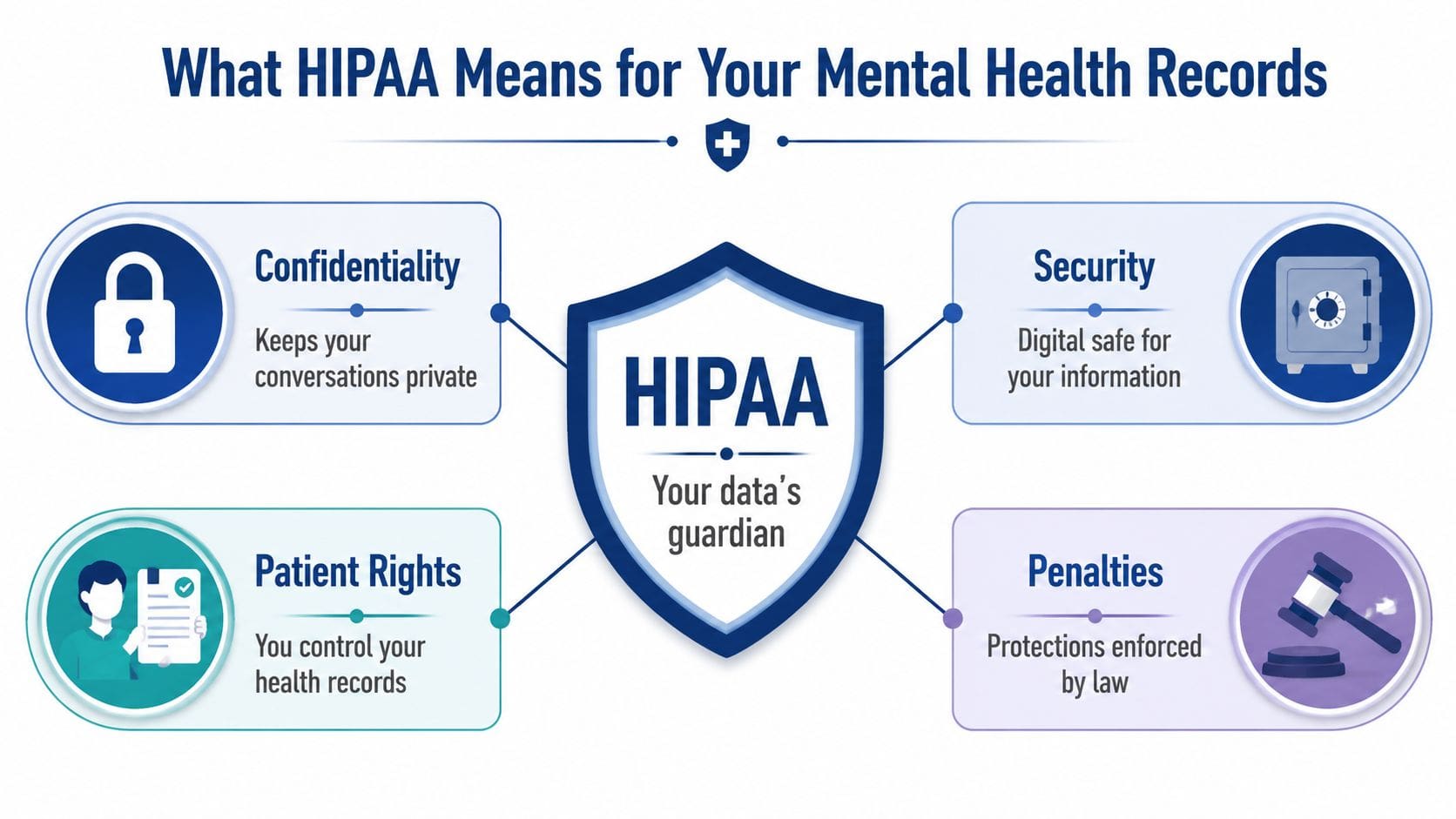
In mental health care, protected health information, often shortened to PHI, can include a diagnosis of anxiety, depression, OCD, PTSD, or ADHD. It can also include medication lists, refill requests, appointment history, treatment plans, symptom questionnaires, and secure messages about side effects, sleep, panic attacks, or concentration problems.
A patient might complete an online self-screening before booking. If that information becomes part of care, it deserves protection too. For people reflecting on symptoms before scheduling, tools like an Anxiety Symptom Checker can help start the conversation, and any information shared directly with a provider should then be handled as protected data.
What counts as protected information
Psychiatric records often contain details that are both medically important and highly personal. Common examples include:
- Diagnostic information: Depression, ADHD, OCD, PTSD, or another mental health condition.
- Medication management records: Dose changes, refill requests, benefits, side effects, and treatment response.
- Clinical history: Trauma exposure, past treatment, substance use concerns, and sleep or mood patterns.
- Administrative data: Appointment dates, billing details, consent forms, and portal messages.
A practical way to think about it is this: if a piece of information identifies the patient and relates to care, payment, or health status, it likely belongs inside that protected vault.
How telepsychiatry protects that information
The technology side matters. HIPAA-compliant telehealth for psychiatry requires end-to-end encryption meeting AES-256 standards and multi-factor authentication to prevent unauthorized access to ePHI during virtual consultations, as described by Paubox on HIPAA compliance in video conferencing and telehealth platforms.
That sentence sounds technical, but the patient meaning is simple. Encryption helps keep outsiders from reading the information, and multi-factor authentication adds another layer so the wrong person can't easily get into the account.
Your provider should protect mental health records the way a bank protects account access. Strong locks, limited entry, and clear accountability.
Privacy also includes what happens when devices are retired or replaced. In healthcare and other industries that handle sensitive records, proper destruction of old storage media matters. For readers curious how secure disposal works in practice, Reworx Recycling data destruction offers a useful example of why secure handling doesn't end when a device stops being used.
Our HIPAA Safeguards for Secure Virtual Care
A patient can join a polished video session and still have no idea whether the practice behind it is handling data responsibly. That's why hipaa compliance telehealth has to be judged as a system, not as a software badge.
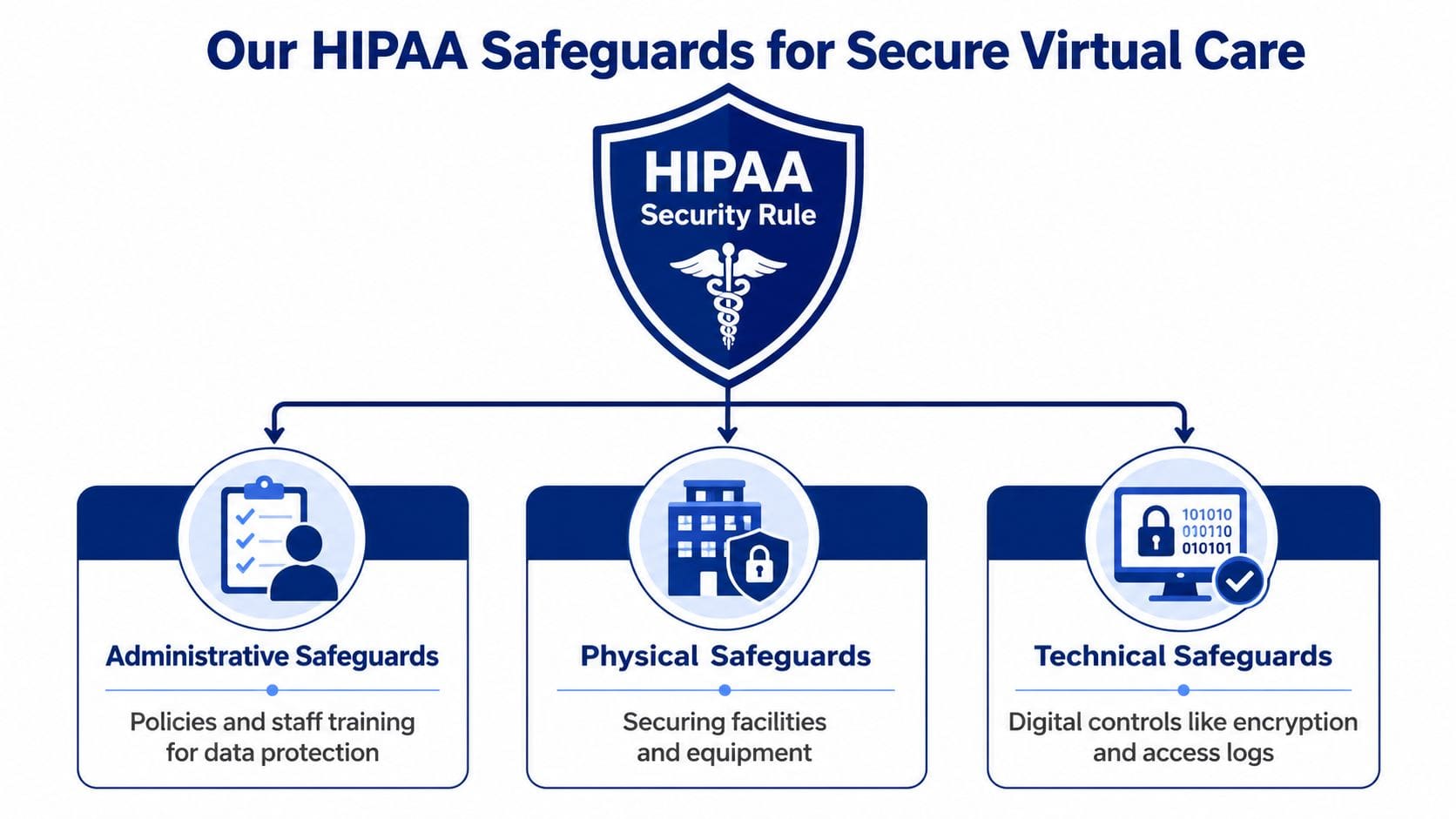
Telehealth providers must conduct a formal HIPAA Security Rule risk analysis and sign a Business Associate Agreement with third-party platform vendors. Failure to complete this analysis or secure a BAA invalidates compliance, even if encryption is used, according to Compliancy Group's telehealth HIPAA guidance. That point is easy to miss. Encryption alone isn't enough.
Technical safeguards patients can feel
Some protections are visible to patients, even if the code behind them isn't.
| Safeguard | What patients notice | Why it matters |
|---|---|---|
| Secure login | Extra login step or verification process | Helps keep unauthorized users out |
| Encrypted sessions | Private visit link and protected connection | Reduces exposure during the visit |
| Access controls | Limited staff involvement | Restricts record access to appropriate roles |
These controls help support secure virtual psychiatric evaluations, follow-up visits, and online medication management when handled through a compliant workflow.
Administrative safeguards that matter just as much
The strongest telehealth practices pay close attention to policy, training, and vendor oversight.
- Risk analysis: The practice reviews where information is created, received, stored, and transmitted.
- Business Associate Agreements: Vendors that handle protected data sign contracts accepting legal responsibility for their part.
- Staff training: Team members learn how to use systems correctly, protect privacy, and respond to potential incidents.
- Consent and documentation: The practice documents what patients were told and how care was delivered.
Many patients never ask about these steps. They should. Administrative safeguards often determine whether a practice handles a difficult situation carefully or casually.
Clinical reality: A video platform can be secure, but a poorly trained workflow can still expose private information.
Physical safeguards still matter in virtual care
Telehealth sounds entirely digital, but physical security still counts. Devices used for care need to be controlled, access to workspaces needs limits, and old hardware needs secure disposal. That issue comes up when offices replace laptops, phones, drives, or other equipment that may have touched sensitive information. For an example of how organizations think through that problem, HIPAA compliant electronics recycling Georgia shows why disposal practices deserve attention alongside software settings.
Only one practice name belongs in this conversation because the uniform standard should apply across the field. Integrative Psychiatry of America provides virtual psychiatric evaluations, medication management, and telepsychiatry across Pennsylvania, and the privacy question should be assessed the same way patients should assess any provider: platform security, workflow discipline, vendor agreements, documentation, and staff handling of records.
Common Telehealth Privacy Mistakes to Avoid
The most common patient assumption is understandable and often wrong. If a provider says the platform is HIPAA-compliant, patients may assume the whole practice is secure.
That isn't how privacy failures usually happen. Research cited by MATRC reports that 68% of telehealth breaches originate from provider-side errors, and a 2025 study found that 42% of small practices skip annual risk assessments according to MATRC telehealth HIPAA guidance. The weak point is often the workflow, not the brand name of the video tool.
A secure platform can still be used insecurely
Here are mistakes patients should recognize quickly when choosing telepsychiatry:
- Personal devices used casually: A clinician shouldn't be running visits from an unencrypted personal device with mixed personal and work use.
- Shared or exposed environments: Family computers, visible screens, or conversations in nonprivate spaces can create avoidable risk.
- Weak login habits: Accounts without multi-factor authentication are harder to defend.
- Missing privacy advisements: If consent and privacy limitations aren't explained and documented, that signals a process problem.
For adults seeking help with concentration or stimulant treatment, this matters during every step of online ADHD medication care, not just during the appointment itself.
The hidden risk in labs messaging and add-on tools
Psychiatric care can extend beyond the visit itself. Some practices coordinate with pharmacies, e-prescribing systems, labs, or other services. Integrative care may involve additional health information such as bloodwork, screening results, or medication monitoring. If those handoffs are handled through insecure messaging or through vendors without appropriate controls, privacy can break down outside the video room.
Patients don't need to audit every vendor themselves. They do need to notice warning signs:
- Texting sensitive information through ordinary SMS
- Sending records through unsecured email
- Using separate intake or payment tools with unclear privacy practices
- Offering no clear answer about how labs or prescriptions are handled
The safest telehealth practice doesn't just pick a secure video app. It audits the full ecosystem around the patient.
A careful provider thinks about the whole patient journey. Intake, consent, evaluation, medication management, portal messages, labs, refill communication, and records access all need the same level of discipline.
A Patient Checklist for Vetting Telehealth Providers
Patients don't need a law degree to ask smart privacy questions. They just need a short list and the confidence to use it.
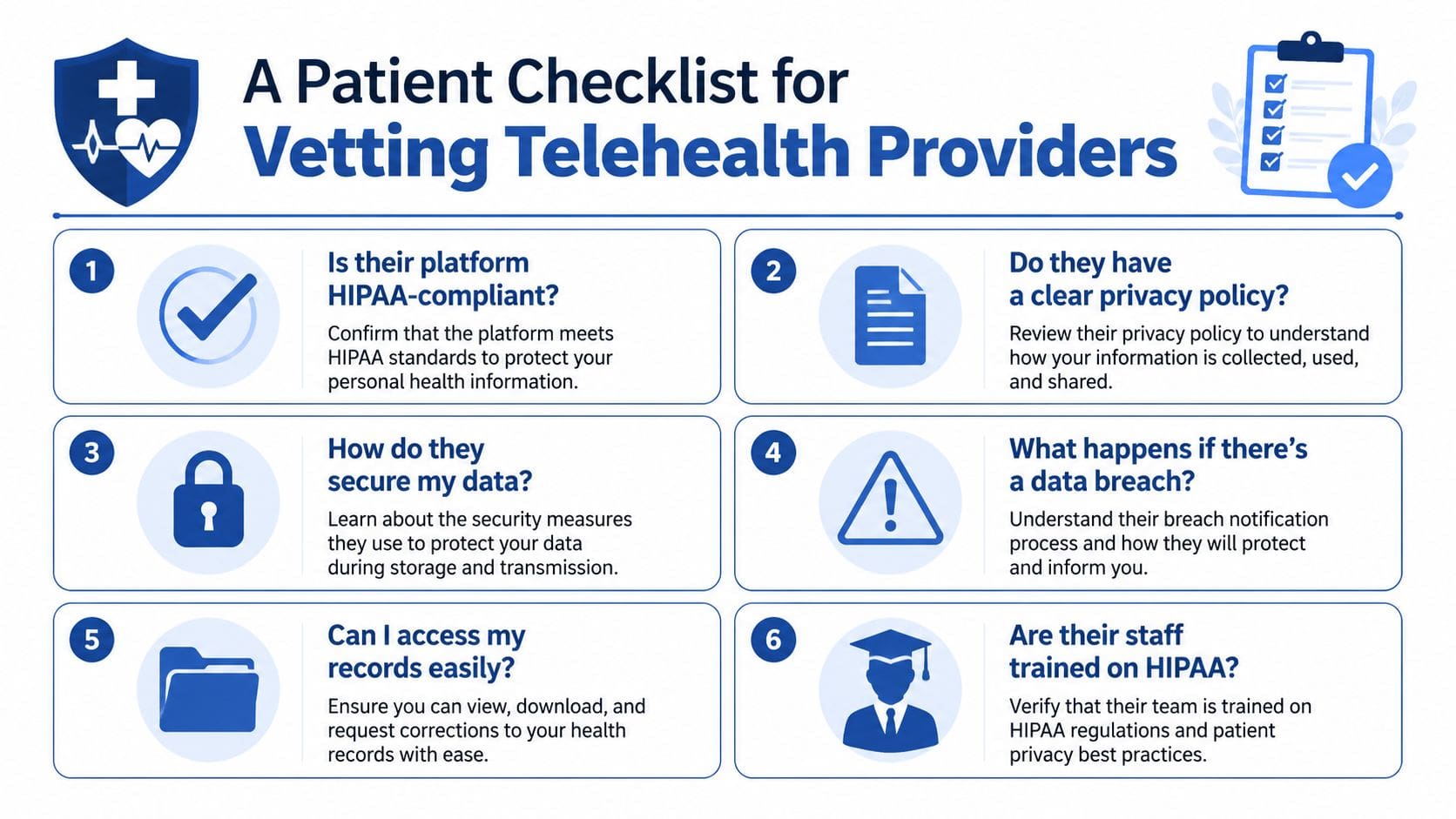
A brief overview can help before those questions are asked face to face:
Questions worth asking before the first visit
In Pennsylvania, HIPAA-compliant telehealth requires a formal risk analysis under §164.308(a)(1)(ii)(A) encompassing the full telehealth technology stack, including communication platforms, e-prescribing services, and lab interfaces, based on Pennsylvania telehealth HIPAA guidance. Patients can turn that requirement into simple questions:
- What platform do you use for visits, and is it HIPAA-compliant?
- Do you have Business Associate Agreements with vendors that handle my information?
- How do you protect portal messages, refill requests, and intake forms?
- How do you secure information sent to pharmacies, labs, or e-prescribing tools?
- Do staff receive HIPAA training for telehealth workflows?
- How is access to my record limited inside the practice?
- What happens if technology fails during a visit?
- How can I review your privacy policies before I begin care?
Patients starting with attention concerns can also use an online Pennsylvania mental health provider page to understand how virtual evaluation and treatment are typically structured before booking.
Pennsylvania details patients should hear clearly
Pennsylvania has practical consent expectations for telehealth care. Patients should hear how consent is obtained, how telehealth use is documented in the record, and what happens if a session is ever recorded by agreement. A provider shouldn't sound annoyed by these questions. A careful practice should be ready for them.
A helpful answer usually sounds organized, not evasive. It should explain the process in plain language, identify the systems involved, and describe who can access the information.
What to listen for: Clear policies, specific systems, and direct answers. Vague reassurance without details isn't enough.
Choose a Partner Committed to Your Privacy
The biggest takeaway is simple. Hipaa compliance telehealth isn't a logo, a checkbox, or a software subscription. It's a daily practice standard that includes secure technology, careful policies, staff training, documented consent, vendor oversight, and thoughtful handling of every record connected to care.
That matters whether a patient lives in Philadelphia, Pittsburgh, Harrisburg, Erie, Scranton, Allentown, Lancaster, Reading, or anywhere else in Pennsylvania. Patients seeking virtual treatment for anxiety, depression, ADHD, OCD, PTSD, or medication management should expect privacy protections that hold up across the whole care process.
Telepsychiatry can be both convenient and confidential. The right provider won't ask patients to trade one for the other. A strong virtual practice should be able to explain how records are protected, how communication is secured, and how problems are prevented before they affect care.
If private, evidence-informed virtual mental health care in Pennsylvania is the next step, Integrative Psychiatry of America offers telepsychiatry, medication management, and whole-person treatment options designed for adults across the state. Patients can learn about care options, verify insurance, schedule an appointment, or explore free support tools such as the Adult ADHD Assessment, Feeling Journal, Daily Agenda Planner, Exercise Routine Generator, and 5-4-3-2-1 Grounding Tool.