
If someone is in immediate danger or has a medical emergency, call 911. For suicidal thoughts or an emotional crisis without immediate danger, call or text 988, which is free and available 24 hours a day, seven days a week across Pennsylvania.
Most guides stop once a number is dialed. A counselor can steady the next hour, yet that contact doesn't refill a medicine, rewrite a safety plan, or book the visit that keeps the following week safer. The open question is what should happen after the first contact, and who takes that next step.
Emergency mental health services handle the urgent assessment. The handoff into ongoing care is a separate task, and families often leave without it written down.
Table of Contents
- Which Number or Door to Use First
- Signs That Call for Urgent Help Now
- What to Do in the First Hour of a Crisis
- Emergency Services Compared Side by Side
- Pennsylvania Holds, Coverage and Telehealth Limits
- What Happens After a Crisis Ends
- Emergency Mental Health Questions Answered
Which Number or Door to Use First
Call 911 or go to the nearest emergency department when someone faces immediate danger or a medical emergency. Call or text 988 for suicidal thoughts, emotional distress, or a substance-use crisis when there isn't immediate danger.
Emergency mental health services are urgent assessment and support for acute psychological distress. They run through crisis lines, in-person response teams, and hospital care, and they stay open at all hours.
| Situation | First Contact | Why It Fits |
|---|---|---|
| Immediate danger to self or others, or a medical emergency | 911 or nearest emergency department | Needs an in-person response right away |
| Suicidal thoughts, emotional crisis, or substance-use crisis without immediate danger | Call or text 988 | Free, confidential, 24/7 counselor support in Pennsylvania |
| Crisis that may need someone to come in person | Ask 988 or the county crisis program about a mobile crisis team | Team can respond where the person is, a familiar setting |
| Existing patient with an urgent medication question during office hours | Provider office or patient portal | Coordinated routine response, not an active emergency |
| Symptoms getting worse but no danger right now | Request the earliest evaluation, and call 988 if unsure | Non-emergency needs can be scheduled, and 988 can help decide next steps |
Pennsylvania's 988 Suicide & Crisis Lifeline gives free, confidential support around the clock. People can call, text, or use online chat. The state routes those contacts to counselors in 14 crisis call centers, who offer phone support and links to local resources. Life-threatening medical emergencies still belong with emergency services, not a crisis line.
Say an existing patient in Bucks County can't reach a refill before a weekend trip, feels irritable, and isn't thinking about self-harm. That person should message the office or patient portal during business hours. A crisis counselor can't see the chart or send the pharmacy a routine refill.
Practical rule: If the right door isn't obvious, call 988 and ask the counselor whether an in-person response is needed.
Signs That Call for Urgent Help Now
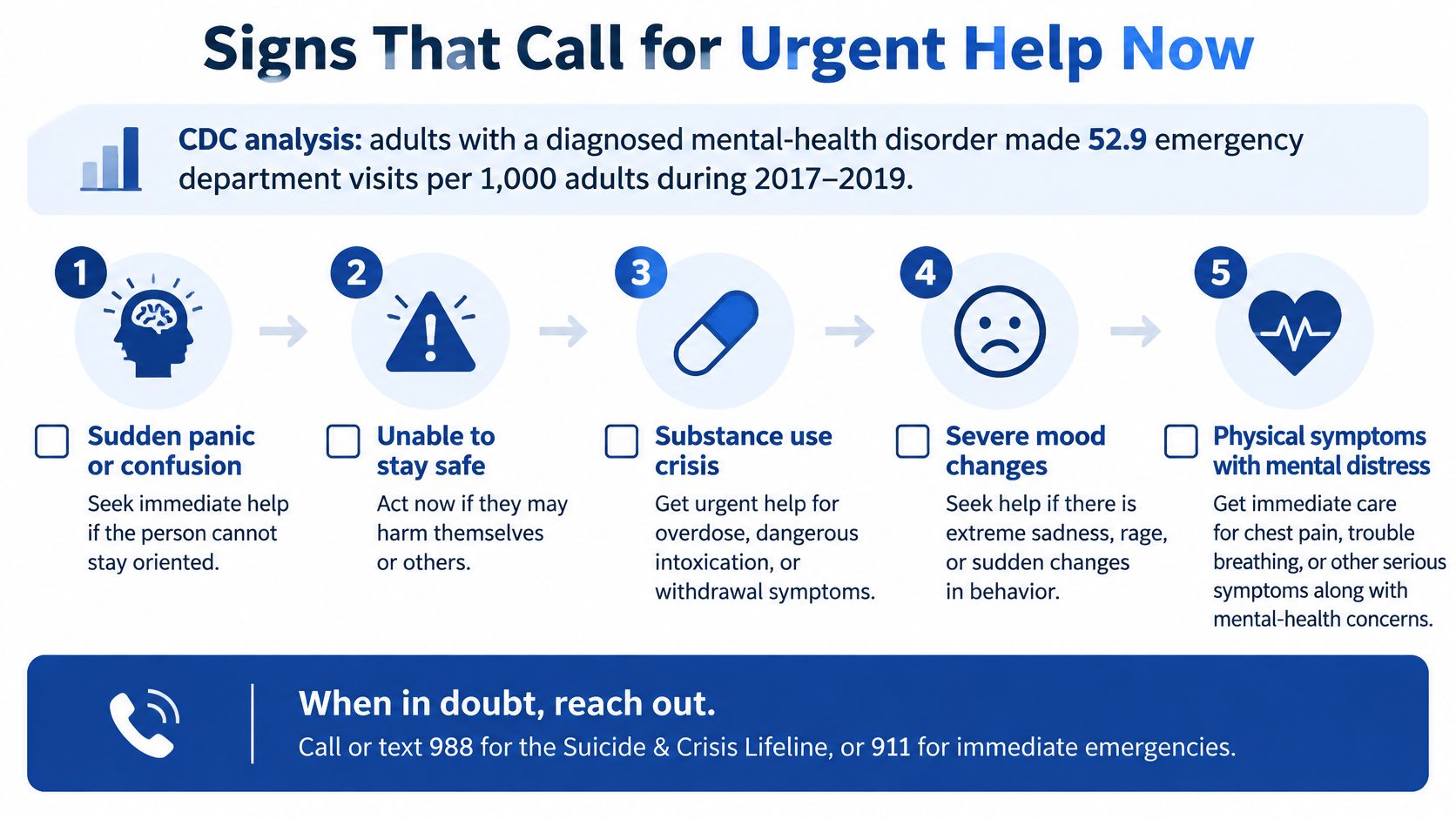
Adults with a diagnosed mental-health disorder made 52.9 emergency department visits per 1,000 adults during 2017–2019, according to a CDC analysis. The rate was highest among adults aged 18–44, at 64.9 visits per 1,000. Needing emergency care is common. It isn't a personal failure.
A mental health emergency means symptoms put someone, or other people, at risk of harm, or leave a person unable to stay safe or meet basic needs. Urgent but non-dangerous symptoms are different. Those need an appointment within days, not a siren.
Run this checklist
- Suicidal thoughts with a plan, intent, or access to means: One of these details raises the response from worry to an immediate call.
- Recent self-harm: Treat a new injury or attempt as urgent even if the person says they're fine now.
- Confusion with hearing or seeing things that aren't there: The person may not be able to judge safety.
- Severe agitation or aggression: People nearby can get hurt while everyone waits to see if it passes.
- Overdose or mixing substances: Breathing, consciousness, and heart rhythm can change fast.
- Can't eat, drink, sleep, or handle basic care for more than a short period: The body is now part of the crisis.
- Threats to harm others: Call for an in-person response rather than trying to talk it down alone.
Say a nurse in the Lehigh Valley stops sleeping for four nights, then starts writing that she doesn't want to wake up. That writing is suicidal thinking. It calls for 988 even if she has no weapon in hand. If she says she has pills set aside and won't stay on the phone, that is immediate danger, and someone should call 911.
One sign of suicidal thinking is enough for 988. Any sign of immediate danger is enough for 911. This checklist helps a family recognize urgency. It doesn't diagnose a condition, and it doesn't replace a full evaluation when symptoms keep returning. Ongoing problems such as panic, low mood, or trauma symptoms are a reason to look at when it's time to see a psychiatric provider once the person is safe.
What to Do in the First Hour of a Crisis
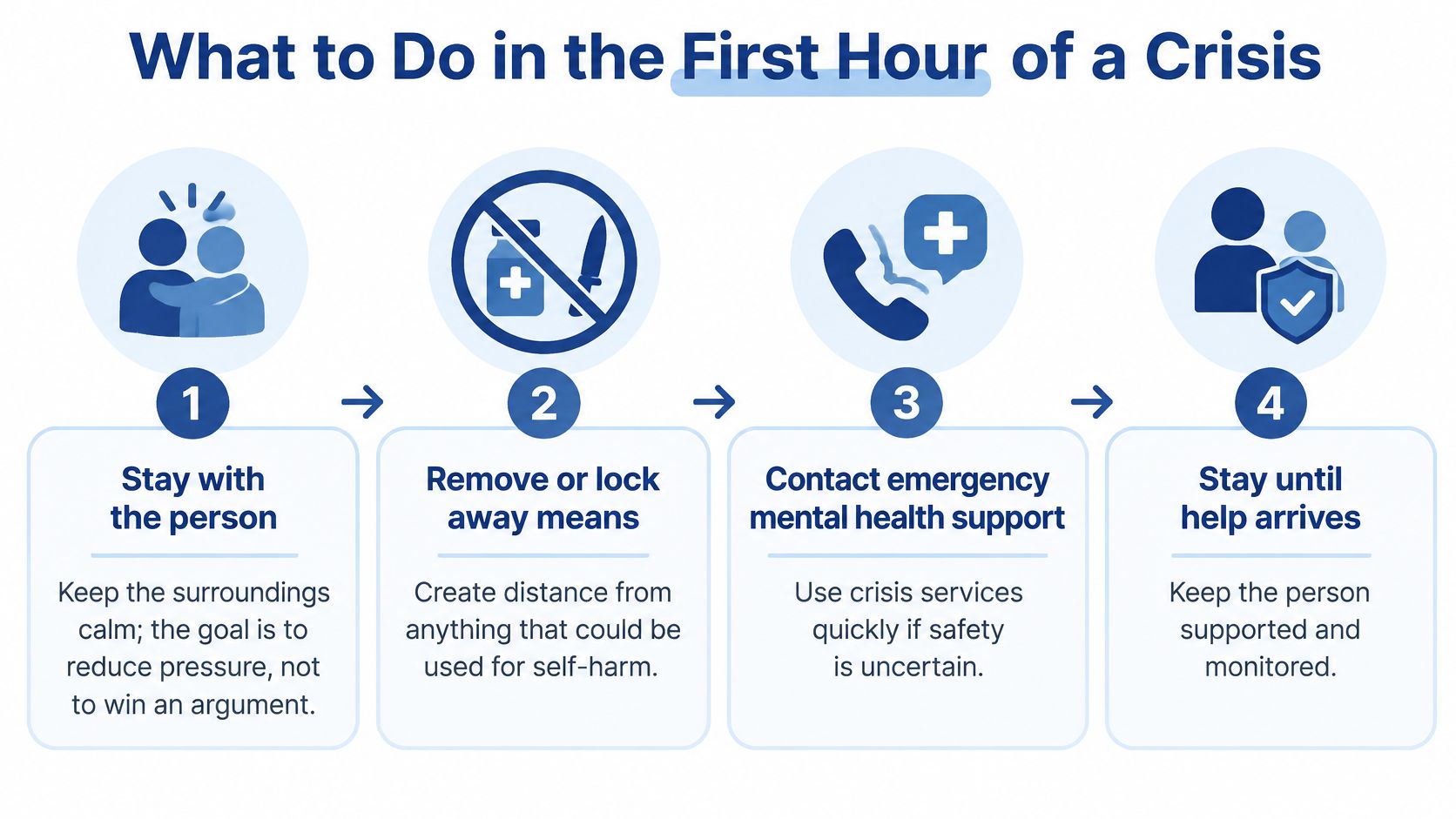
Work in order. Skipping ahead to advice while means of harm are still in reach leaves the danger in the room.
- Stay with the person and keep the room calm. Sit nearby, lower voices, and turn off extra noise. The aim is less pressure, not a debate about whether the feelings are reasonable.
- Remove or lock away means of harm. Put firearms, medications, alcohol, and sharp objects out of reach. Access raises immediate risk even when someone says they won't use them.
- Call 911 for immediate danger. Use it if there's a weapon, an unresponsive person, an overdose, bleeding, or another medical injury. Don't drive someone who may jump from the car.
- Call or text 988 when the danger isn't immediate. Ask which local services can respond and whether a team can come to the home.
- Ask direct questions about suicide. Use plain words, then listen without correcting the person. Asking doesn't put the idea in someone's head.
- Build or review a written safety plan. Keep five parts on one page: warning signs, coping steps the person can do alone, people and places that offer distraction, people to ask for help, and professional plus crisis contacts. Add the steps that make the home safer.
Store that page on a phone and send a copy to one trusted person. Short phrases work better than goals like "stay positive." Write "text Jordan, then walk to the corner store" instead of "use coping skills."
If someone is alone, the same order still applies. Contact one trusted person, call 988, and go to an emergency department if they can't keep themselves safe. While waiting, slow breathing and a simple sensory exercise can lower panic. The grounding techniques for anxiety page walks through a few that don't need equipment. For a friend who is shaking, sweating, and convinced they're dying, calming techniques for panic attacks from reVIBE Mental Health explain how to stay beside them without arguing with the fear.
A usable plan names people and numbers. It doesn't depend on the person remembering a speech when they're terrified.
Emergency Services Compared Side by Side
An effective system matches the response to the level of need. It doesn't send every crisis to an emergency room.
| Service | Who Provides It | How to Reach It | Best Fit |
|---|---|---|---|
| 988 Suicide and Crisis Lifeline | Trained crisis counselors at 14 Pennsylvania call centers | Call or text 988, or use online chat | Suicidal thoughts, emotional or substance-use crisis, phone-based support |
| Mobile crisis team | County crisis programs | Request through 988 or the county crisis line | Crisis that needs an in-person response in a familiar place |
| Psychiatric emergency services | Hospital emergency departments with psychiatric staff | Walk in or arrive by ambulance | Acute risk that needs on-site medical or psychiatric assessment |
| Crisis stabilization unit | Community crisis programs | Referral from a crisis line, mobile team, or emergency department | Short-term supervised support when home isn't yet safe |
| Emergency department | Hospital emergency room | Walk in, ambulance, or 911 | Medical emergencies, overdose, and situations that may need admission |
| 911 | Police, EMS, and fire services | Call 911 | Immediate danger or medical emergency; police may respond |
SAMHSA's model treats crisis access as a continuum that accepts people at any hour, including walk-ins and arrivals with emergency medical services or law enforcement. The same guidance describes mobile crisis teams as a way to bring trauma-informed care into a familiar setting. That visit can cut unnecessary law-enforcement involvement, emergency-department use, and hospitalization when the person can be assessed safely at home.
A hospital psychiatric emergency service is the on-site exam. Staff decide whether the person can go home with support, needs a stabilization program, or needs admission. A crisis stabilization unit is the middle option, a short supervised stay when a phone call isn't enough and a hospital bed isn't required. Admission rules and open beds differ by county, so ask before assuming a bed is waiting.
What stays open after business hours
Pennsylvania counties must keep emergency mental-health services available 24 hours a day, seven days a week, under the state's crisis-intervention framework. Office hours limit routine appointments. They don't limit emergency access.
Before accepting a disposition, ask four questions. What happens after this visit? Who calls tomorrow? What will this cost? Is this facility in network? Those answers decide whether the night ends with a plan or with another crisis.
Pennsylvania Holds, Coverage and Telehealth Limits
Under Pennsylvania's Section 302 process, an involuntary emergency psychiatric evaluation may start when a person is believed to be a danger to themselves or others because of mental illness. Once authorized, police or an ambulance may take the person to an emergency room. A physician then decides whether inpatient psychiatric treatment is needed. If the person is admitted under that emergency commitment, the stay may last no longer than 120 hours unless the hospital files a petition for extended treatment under Section 303, according to Erie County's explanation of voluntary and involuntary commitment. This process is separate from voluntary treatment, and it isn't limited to one age group.
Families should ask the hospital social worker to put the patient's rights, the legal status, and the timeline in writing. Verbal updates during a shift change are easy to lose.
What a plan may or may not pay
Benefits, copays, deductibles, network status, and prior authorization differ by plan. No practice can guarantee coverage. Check the insurer before a planned visit when there's time. Never delay emergency care to verify benefits.
Integrative Psychiatry of America is a fully licensed Pennsylvania telehealth practice, and visits use HIPAA-compliant video. For out-of-network mental health benefits, the practice supplies bills, diagnoses, and other information the carrier requests, but reimbursement isn't guaranteed. A secure video visit also doesn't replace 911, 988, or an emergency department. People comparing routine virtual counseling options outside a crisis can read about online care with therapist matching from Vancouver Counselling Clinic, then confirm any Pennsylvania prescriber is licensed in this state.
Before a planned visit, ask the insurer whether psychiatric evaluation, medication management, and telehealth visits are covered, what the copay and deductible are, whether the provider is in network, and whether prior authorization applies. Plan-specific questions belong on the insurance and online psychiatry page. Coverage still depends on the individual plan.
What Happens After a Crisis Ends
A crisis contact can reduce immediate danger, but it may not resolve the clinical need that led to the crisis. Washington State's 988 data reported that about 61% of contacts were resolved by crisis centers without immediate face-to-face intervention, approximately 15.6% ended with an outpatient mental-health or substance-use referral, and 22% involved consensual follow-up, according to its legislative report on 988. Those figures describe Washington State, not the entire country.
After an emergency visit, a person may be tired, distressed, or trying to absorb new instructions. A written plan helps keep the next steps clear.

Five stages, not one phone call
Immediate stabilization reduces danger in the moment. Safety planning identifies warning signs and actions to take if symptoms worsen. Follow-up outreach checks how the person is doing. Medication continuity prevents confusion about prescriptions or missed doses. Ongoing treatment addresses the condition over time.
These steps connect like links in a chain: if a follow-up appointment or medication plan is missing, the handoff can break. Before leaving, ask who will arrange follow-up, what to do if symptoms return, and whom to contact about medication questions.
For example, an adult leaving a Harrisburg emergency department with a new prescription and no appointment can bring the discharge summary and medication list to a psychiatric evaluation. Integrative Psychiatry of America offers outpatient psychiatric care through secure telehealth, including evaluations, personalized treatment plans, medication optimization, and care coordination. New patients can schedule an evaluation through the website. Telehealth supports ongoing care, but it does not replace emergency services when someone cannot stay safe or needs immediate in-person assessment.
If trauma symptoms remain part of the picture, PTSD treatment options can help explain what ongoing psychiatric care may involve. For some people, addressing the impact of relational trauma is also part of understanding patterns that continue to affect their well-being.
Aftercare checklist
- Arrange follow-up before leaving if the emergency setting can help schedule it.
- Review the safety plan and add warning signs from this episode.
- Check medication instructions and ask the prescriber what to do if a dose or refill is missed.
- Tell one trusted person what changes or warning signs to watch for.
- Track mood and routines with a grounding tool or self-care tracker. Integrative Psychiatry of America offers 15 free mental health tools, including a 5-4-3-2-1 Grounding Tool and My Self-Care Tracker. They can support self-monitoring, but they do not diagnose a condition.
For a Pennsylvania adult or parent whose symptoms continue after a crisis, a psychiatric evaluation can help clarify what care is needed next. Bring the medication list and safety plan to the appointment.
Emergency Mental Health Questions Answered
988 is for suicidal thoughts, emotional distress, and substance-use crises. 911 is for immediate danger or a medical emergency.
Can a family member call 988 for someone else? Yes. A family member or friend can call or text 988 and ask what the next step should be.
Does a telehealth visit replace emergency care? No. An active emergency needs 911, 988, or an emergency department. What telepsychiatry is describes scheduled virtual care, not a crisis dispatch line.
Do I need a referral to go to an emergency department? No. Emergency departments accept people who arrive on their own, by ambulance, or with police.
Should I call 988 for a prescription refill? No. Use the provider's office or patient portal during business hours. Call 988 if the situation becomes a crisis.
What if I'm unsure whether it's an emergency? Call 988 and ask whether an in-person response is needed.
Four-step decision aid
- Is anyone in immediate danger, unresponsive, overdosing, or badly injured? Call 911.
- Are there suicidal thoughts, self-harm, or a crisis without immediate danger? Call or text 988.
- Can the person not stay safe at home, or do they need someone in person? Ask 988 about a mobile crisis team, or go to an emergency department.
- Are symptoms worsening without danger, or is a routine medication question pending? Request the earliest appointment with the provider.
This aid helps choose a first contact. It doesn't diagnose a condition or replace a clinical evaluation.
Integrative Psychiatry of America provides statewide virtual psychiatric care for Pennsylvania adults and families once a crisis has passed and ongoing evaluation or medication follow-up is the right next step. Patients can request a psychiatric evaluation, verify benefits, and bring a discharge summary, medication list, and safety plan to a secure telehealth visit. Visit Integrative Psychiatry of America to request an appointment or check insurance before the first visit.