
Yes, most Pennsylvania commercial plans cover online psychiatry when behavioral-health benefits include telehealth and the provider is in-network. What a patient pays still depends on the plan's copay, deductible, coinsurance, prior-authorization rules, network status, and the specific service billed.
A patient in Philadelphia may find a virtual psychiatric provider after work, while a family in the Lehigh Valley may need an ADHD evaluation without a long drive. In both situations, the insurance card alone doesn't answer the practical question. The plan may cover the visit, yet the claim can still process differently if the provider is out of network, the deductible hasn't been met, or the appointment uses a modality the plan treats differently.
For Pennsylvania patients, the useful question isn't only “Does insurance cover online psychiatry?” It's also, “Will this plan pay for this provider, this service, this setting, and this type of telehealth visit?” The steps below address those details before an appointment is scheduled.
Table of Contents
- Does Insurance Cover Online Psychiatry in Pennsylvania
- What Online Psychiatry Insurance Actually Covers
- How Telehealth and In-Person Psychiatry Coverage Compare
- What You May Pay for an Online Psychiatry Visit
- Prior Authorization Referrals and Network Rules for Telepsychiatry
- How IPA Helps Pennsylvania Patients Verify Telehealth Benefits
- Choosing Covered Online Psychiatry and Starting Care With IPA
Does Insurance Cover Online Psychiatry in Pennsylvania
A Pennsylvania patient checking benefits should generally expect online psychiatry to be covered when the plan includes behavioral-health telehealth and the clinician participates in the network. Coverage doesn't guarantee a specific payment amount, and it doesn't remove requirements such as medical necessity, referrals, prior authorization, or eligible telehealth technology.
The federal Mental Health Parity and Addiction Equity Act of 2008 helped establish the principle that behavioral-health coverage shouldn't be more restrictive than medical and surgical coverage. Medicare now explicitly covers outpatient psychotherapy and other behavioral-health telehealth services, including home-based access through December 31, 2027, under current policy. These developments show how online mental healthcare has moved from a limited benefit toward a mainstream covered service. The historical market also included insurer-paid telehealth claims between 2009 and 2013, when 13,480 mental-health and substance-use telehealth provider claims appeared among 3,986,159 total claims, with average telehealth reimbursement declining from $54.61 in 2009 to $43.28 in 2013. Those figures come from the peer-reviewed telehealth claims analysis.
A patient comparing a virtual visit with an office visit should review four questions:
- Is the provider in network?
- Does the behavioral-health benefit include telehealth?
- Does the plan require a referral or prior authorization?
- Will the deductible, copay, or coinsurance apply to the billed service?
Federal parity enforcement has continued to develop. The 2026 mental health parity rules provide useful background, but a patient still needs plan-specific confirmation. Pennsylvania parity guidance also treats prior authorization and network criteria as relevant, not just deductibles or visit limits.
Online psychiatric care across Pennsylvania can be practical for adults and families who need evaluation, medication management, or continuing care from home. The same insurance checks apply whether the patient lives in Philadelphia, Pittsburgh, Harrisburg, Scranton, Erie, or a rural community.
What Online Psychiatry Insurance Actually Covers
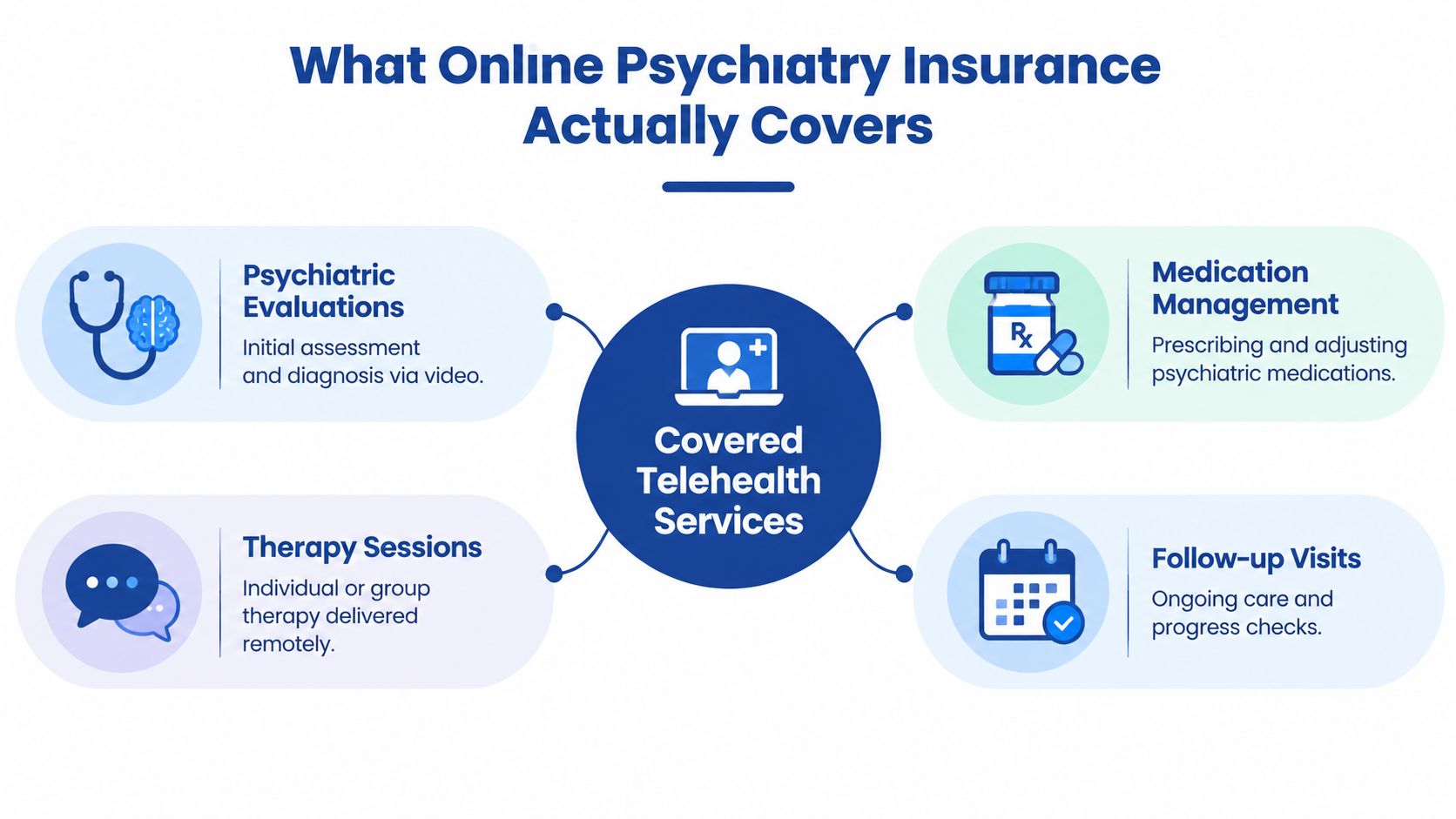
Insurance usually covers online psychiatry when the plan covers the corresponding behavioral-health service and permits that service through telehealth. Common covered services include psychiatric evaluations, medication-management appointments, and follow-up visits, but the exact claim depends on the service code, provider credentials, network participation, modality, and plan rules.
Covered service versus payable claim
A benefit description may say that telehealth is covered. The insurer still processes each claim using administrative and clinical criteria. A psychiatric evaluation may be covered, while a particular follow-up requires authorization. A medication-management visit may qualify through video but face different rules if conducted audio-only.
Patients should ask whether the plan covers:
- Psychiatric evaluation: An initial assessment, diagnostic formulation, and treatment planning.
- Medication management: Prescribing, monitoring, and adjusting psychiatric medication when clinically appropriate.
- Follow-up care: Ongoing review of symptoms, response, side effects, safety, and treatment goals.
- Therapy services: Individual or group psychotherapy when the clinician and service meet plan requirements.
The online medication-management service should be checked against the patient's behavioral-health benefit rather than assumed to have the same rules as every other telehealth service.
Video, phone, and home-based care
Video appointments are often the clearest match for a telehealth benefit, but audio-only coverage isn't automatically identical. Medicare policy includes mental-health telehealth services, yet some billing rules are service-specific and modality-specific. For certain programs, audio-only mental-health care may receive a reduced payment percentage compared with in-person care.
Home-based access also requires attention to the plan and program rules. Medicare permits beneficiaries to receive telehealth anywhere in the United States and its territories through December 31, 2027, while some behavioral-health services may still carry visit-history or setting requirements. A patient with limited broadband, privacy concerns, or disability access needs should ask specifically whether a phone-only or home-based appointment is reimbursable.
How Telehealth and In-Person Psychiatry Coverage Compare
Telehealth and in-person psychiatry often use the same behavioral-health benefit when the service is equivalent and the provider is in network. Parity limits unequal treatment, but it doesn't make every virtual appointment identical to an office appointment. Modality, network status, authorization, and payment rules can still change the patient's responsibility.
| Coverage Criterion | In-Person Psychiatry | Online Psychiatry Telehealth |
|---|---|---|
| Behavioral-health benefit | Usually processed under the plan's behavioral-health benefit | Often processed under the same benefit when telehealth is allowed |
| Network status | In-network and out-of-network rates may differ | The virtual provider must still be checked against the plan network |
| Copay or coinsurance | Determined by the plan and service billed | May match in-person care, but patients shouldn't assume it will |
| Deductible | May apply before the plan shares costs | May apply to a virtual visit as well |
| Prior authorization | Required by some plans or services | May apply even when the service itself is covered |
| Referral | Required by some plan designs | Can remain necessary for virtual specialty care |
| Visit limits and network rules | Subject to parity-sensitive plan rules | Subject to the same principle, with telehealth-specific conditions possible |
| Audio-only visits | Not applicable | May have separate reimbursement or eligibility rules |
What parity does and doesn't mean
Federal parity rules require mental-health and substance-use benefits to be no more restrictive than medical and surgical benefits. The 2024 final federal parity rules treat financial requirements and non-quantitative limits, including prior authorization, visit caps, and network rules, as parity-sensitive. For employer and group plans, many provisions generally apply beginning January 1, 2025, with some delayed until January 1, 2026. For individual and Marketplace plans, the new protections generally begin January 1, 2026, as described by the American Psychiatric Association's parity guidance.
Pennsylvania adopted its parity framework in 2010. State guidance says parity can apply to qualitative limits such as prior authorization and network criteria, not only to visit caps or deductibles.
A practical explanation of telepsychiatry and how it works can help patients decide whether remote care fits their needs. An in-person alternative may be more appropriate when a clinician needs services that can't be delivered safely or effectively through the available telehealth format.
What You May Pay for an Online Psychiatry Visit
A covered online psychiatry visit can still produce an out-of-pocket bill. The amount depends on whether the plan uses a copay, requires the patient to satisfy a deductible, applies coinsurance, treats the provider as in network, and authorizes the specific service.
The three cost terms that matter
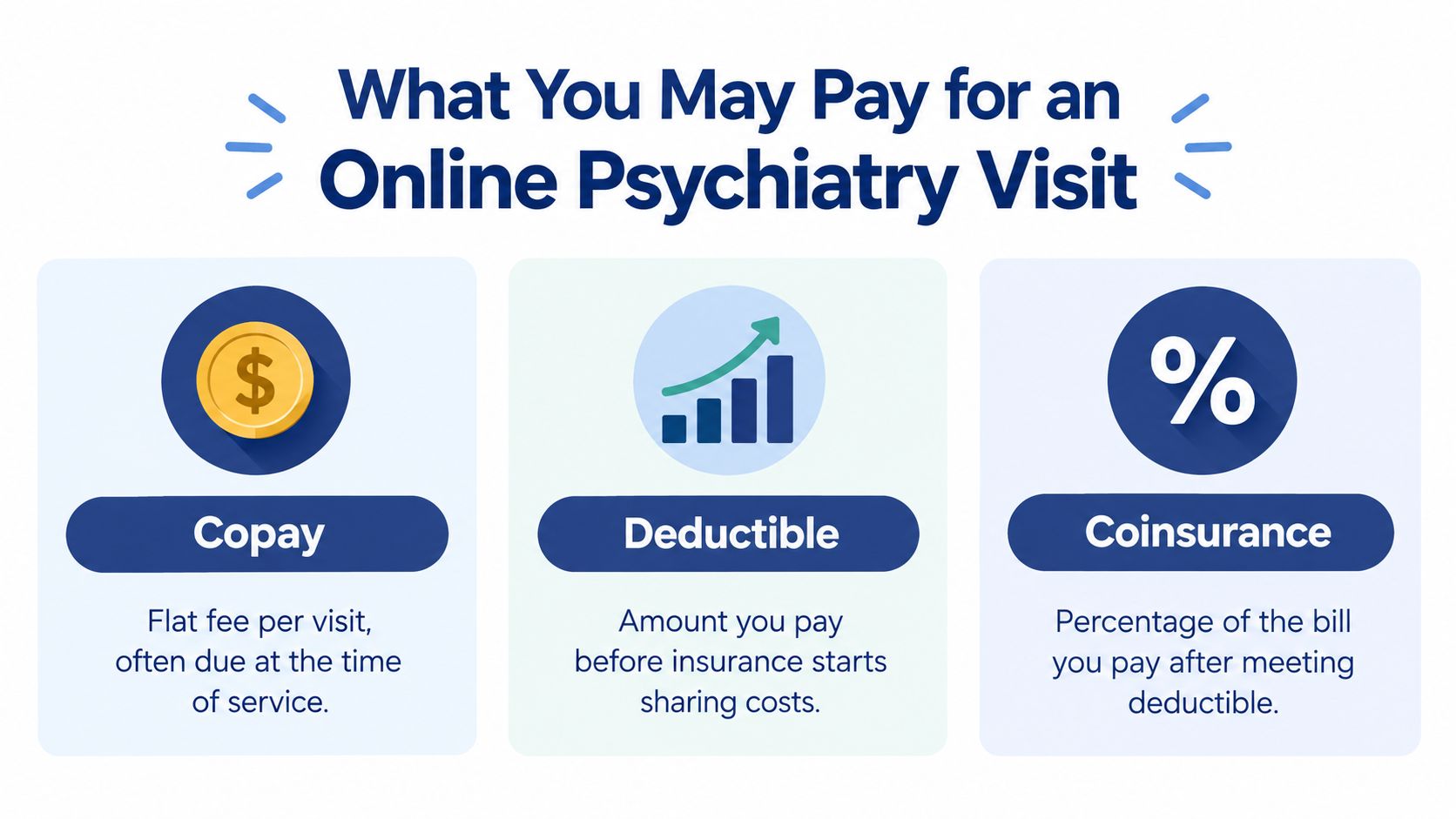
- Copay: A fixed amount assigned to a covered visit under the plan.
- Deductible: The amount the patient may need to pay before the plan begins sharing eligible costs.
- Coinsurance: The patient's percentage of the allowed charge after the deductible rules are satisfied.
Some patients owe a copay for an in-network visit. Others pay toward a deductible or owe coinsurance. A plan can also apply different cost-sharing to out-of-network care, even when the service itself is included in the benefits package.
Practical rule: “Covered” describes eligibility. It doesn't tell a patient the final amount owed.
Why Pennsylvania patients shouldn't assume matching rates
Telehealth payment parity isn't uniform across the country. As of November 2025, 23 states had implemented payment parity, 5 states had parity with caveats, and 22 states had no payment-parity requirement, according to the telehealth payment-parity policy analysis. A Pennsylvania patient therefore shouldn't assume that a virtual visit will always carry the same reimbursement or cost-sharing as an office appointment.
The gap matters most for out-of-network services, Medicaid managed-care plans, and visits conducted under special modality rules. A patient should request the allowed amount and expected responsibility for the exact appointment type, not rely on a general statement that telehealth is covered.
Before booking, the patient can ask the insurer:
- Is the provider in network for this specific plan?
- Does the behavioral-health benefit cover psychiatric evaluation and medication management by video?
- Has the deductible been met?
- Is coinsurance applied?
- Does audio-only care have separate rules?
- Is prior authorization required?
Prior Authorization Referrals and Network Rules for Telepsychiatry
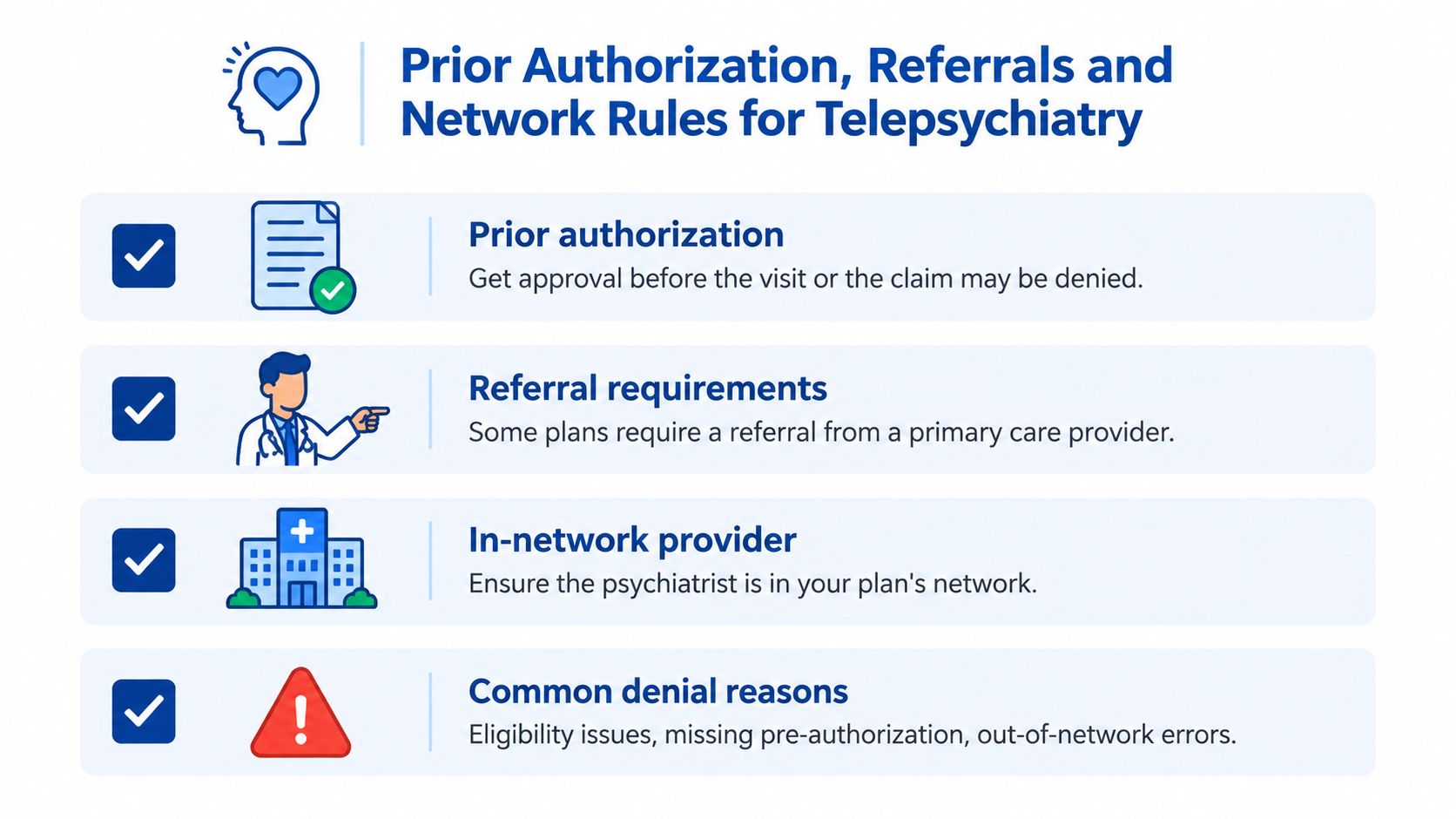
Prior authorization, referrals, and network status can determine whether a claim pays at all. A patient may have behavioral-health coverage and still receive a denial because the plan required approval, the provider was listed incorrectly, or the claim used a telehealth format the plan didn't recognize.
A pre-visit insurance checklist
Start with eligibility. The insurance card may be active while a particular behavioral-health benefit is administered by a separate network. The insurer should confirm active coverage on the expected date of service.
Verify the provider listing. IPA accepts multiple major plans, including Aetna, Cigna, UnitedHealthcare and Optum, Independence Blue Cross, Highmark, and other participating plans. Participation can vary by product, employer group, state network, and clinician, so patients should verify the exact member plan rather than rely on the company name alone.
Ask about the service. The patient should confirm coverage for a psychiatric evaluation, ADHD evaluation, medication-management follow-up, or another intended service. A plan may apply different authorization rules to evaluation and ongoing care.
Check referrals. Some plan designs require a primary-care referral before specialty behavioral-health care. The insurer should state whether a referral is required, who must issue it, and whether it must be received before the appointment.
Confirm authorization. Prior authorization may be required for a service even when telehealth is listed as a covered benefit. The patient should ask who submits the request and whether approval must be documented before care begins.
Why claims get denied
Common administrative causes include eligibility problems, network errors, missing authorization, coding issues, and plan-specific telehealth rules. IPA can provide appropriate documentation or correct administrative information when applicable, but the insurer determines whether the claim is approved.
Patients should save the representative's name or reference number when available, note the date of the call, and request written benefit information when the plan offers it. That record can help if the claim later needs correction or appeal.
How IPA Helps Pennsylvania Patients Verify Telehealth Benefits
The most useful insurance step happens before the first appointment. A Pennsylvania patient should verify behavioral-health and telehealth benefits, provider network status, psychiatric evaluation coverage, medication-management coverage, deductible status, and authorization requirements before care begins.
What the verification process can clarify
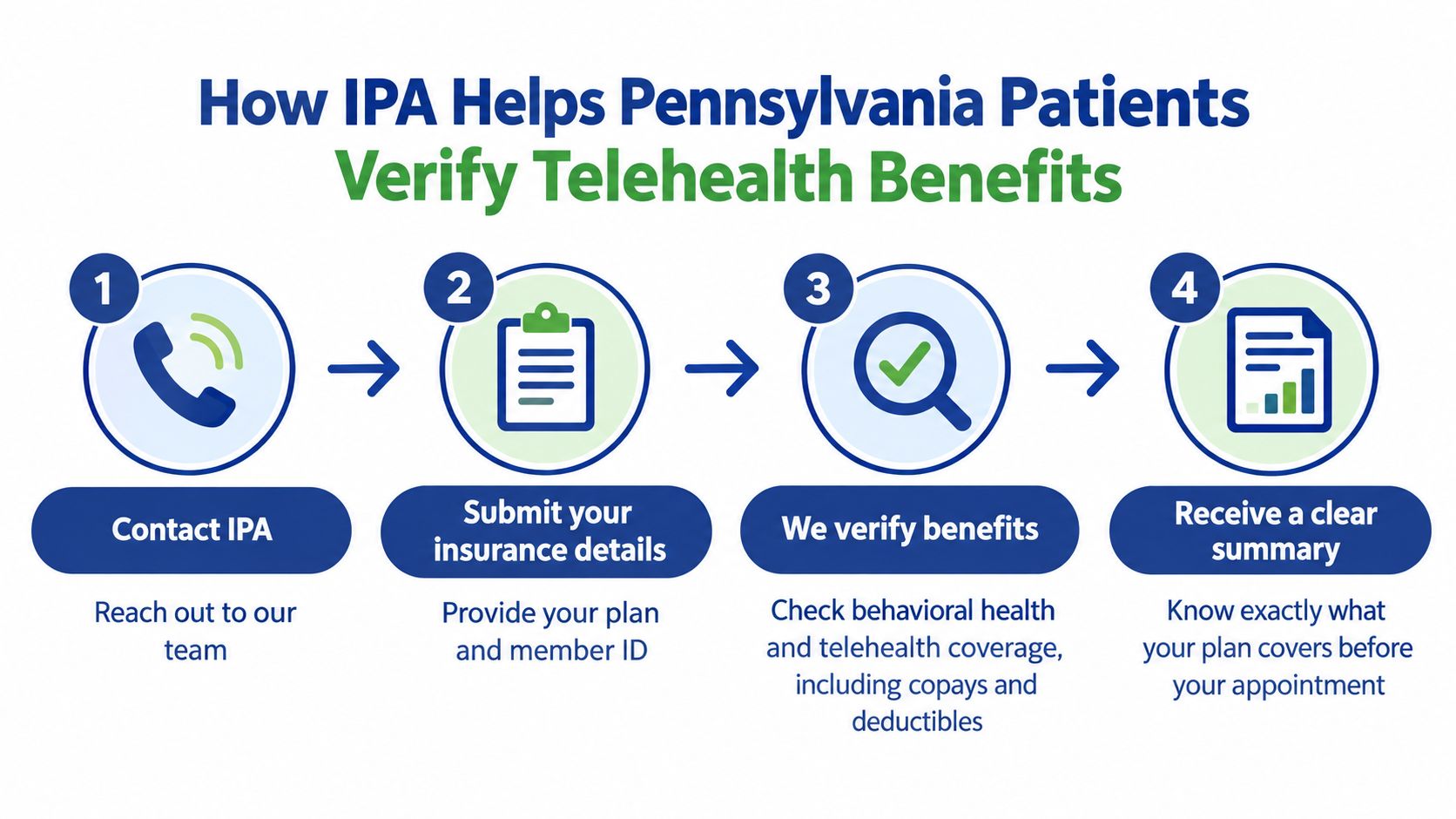
IPA's insurance verification process can help patients submit plan details and identify the benefit information needed for scheduling. The process may examine whether the plan recognizes the provider, whether telehealth is included under behavioral health, and whether cost-sharing or authorization conditions apply.
A patient seeking an ADHD evaluation may need to confirm evaluation benefits and any plan-specific rules before the appointment. Someone receiving anxiety or depression follow-up care may need to check medication-management coverage and whether the deductible applies. The same questions support patients in Philadelphia, Pittsburgh, Harrisburg, Allentown, Lancaster, Reading, Scranton, Wilkes-Barre, Erie, and other Pennsylvania communities.
What patients should provide
Patients can make verification more efficient by supplying:
- Insurance information: The plan name, member identification, group information when listed, and a current insurance card.
- Visit purpose: ADHD evaluation, psychiatric evaluation, medication management, or follow-up care.
- Preferred format: Video access from home, or a question about audio-only availability.
- Timing concerns: Whether an appointment is needed soon or whether authorization may delay scheduling.
Benefit verification is helpful, but it isn't a promise of payment. Eligibility can change, the plan can process a claim differently, and the insurer's final adjudication controls the patient responsibility. Patients should still review the explanation of benefits after the claim processes.
The clearest answer comes from matching the exact plan, provider, service, and telehealth format before the appointment.
Choosing Covered Online Psychiatry and Starting Care With IPA
Online psychiatry can suit Pennsylvania adults and families who need care without repeated travel. It can also support ADHD evaluation, adult ADHD treatment, medication management, and ongoing care for anxiety, depression, OCD, or PTSD when the patient has a private setting, reliable technology, and a clinically appropriate telehealth plan.
A virtual appointment may be especially practical for a patient in Philadelphia with a demanding work schedule, a parent arranging care for a child or adolescent, or an adult in Pittsburgh or Erie who has limited access to a nearby psychiatric provider. Secure video care can reduce travel burdens, but it isn't the right format for every clinical situation. An in-person evaluation may be preferable when safety concerns, examination needs, technology limitations, or the nature of symptoms require it.
Match the care to the need
Patients considering online care should compare:
- Clinical fit: Can the concern be evaluated and treated safely through telehealth?
- Continuity: Can the patient attend follow-ups consistently and communicate about medication effects?
- Privacy: Is there a confidential place for appointments?
- Insurance fit: Is the provider in network, and are telehealth benefits confirmed?
- Access needs: Can the patient reliably use video, or does the plan address another modality?
Integrative Psychiatry of America provides statewide virtual care through board-certified psychiatric mental health nurse practitioners using secure, HIPAA-compliant telehealth. The practice offers psychiatric evaluation and medication management for conditions including ADHD, anxiety, depression, OCD, and PTSD. Patients who want a regional point of reference can review Philadelphia integrative psychiatry services, then confirm whether the available care and insurance pathway fit their needs.
The appropriate next step is practical rather than complicated. Patients can gather their insurance card, identify the reason for care, confirm whether a private telehealth setting is available, and request benefit verification before scheduling.
Integrative Psychiatry of America provides virtual psychiatric care across Pennsylvania, including ADHD evaluation, medication management, and treatment for anxiety, depression, OCD, and PTSD. Patients can verify their insurance details and explore an appropriate appointment pathway by visiting Integrative Psychiatry of America.