
It's often late when this search happens. Someone in Philadelphia has finished answering work emails, or someone in Scranton has finally gotten the house quiet, and the mind won't slow down. Sleep feels off. Focus has been slipping. Anxiety keeps circling. The search bar gets a simple question: online mental health evaluation.
The desired outcome in that moment isn't a vague wellness article. What's sought are answers about what happens next, whether it's private, whether it works, whether insurance might help, and whether a real clinician can understand what's going on through a screen. A manageable path is also needed, accessible from anywhere in Pennsylvania, whether that's Pittsburgh, Harrisburg, Erie, Allentown, Lancaster, Reading, or a smaller town where local options may be limited.
An online mental health evaluation is meant to provide that next step. It's a structured, confidential clinical visit by secure video with a licensed psychiatric provider who listens carefully, asks focused questions, and helps turn a confusing set of symptoms into an actionable plan.
Table of Contents
- Your First Step to Mental Wellness in Pennsylvania
- Understanding the Online Evaluation Process
- A Step-by-Step Walkthrough of Your First Virtual Visit
- Conditions We Commonly Evaluate and Treat Online
- How to Prepare for a Successful Evaluation
- Navigating Privacy Insurance and State Rules in PA
- Take the Next Step with Our Pennsylvania Practice
Your First Step to Mental Wellness in Pennsylvania
A late-night search usually starts after weeks or months of trying to push through. A person in Harrisburg may be wondering whether constant worry is anxiety or burnout. A parent in Lancaster may be thinking about adult ADHD after years of missed deadlines and mental clutter. Someone in Pittsburgh may feel flat, disconnected, and exhausted but still unsure whether depression is the right word.
That uncertainty is common. It also keeps many people stuck.
In Pennsylvania, 24.7% of adults with a mental illness did not receive adequate treatment, and 54.6% of youth with depression received no mental health services at all, according to this Pennsylvania mental health access summary. Virtual psychiatry exists partly to close that gap by making evaluation and treatment easier to access across the state.
What an online evaluation actually is
An online mental health evaluation isn't a chatbot, a personality test, or a quick quiz that labels someone in five minutes. It's a real medical appointment conducted through secure telehealth. The purpose is clarity. The provider reviews symptoms, asks about patterns over time, looks at daily functioning, and considers medical, psychological, and lifestyle factors together.
That matters because many symptoms overlap. Trouble concentrating can point toward ADHD, anxiety, depression, poor sleep, trauma, substance use, or several factors at once. Irritability can come from stress, panic, depression, medication effects, or sleep disruption. A proper evaluation sorts that out.
Many patients don't need instant certainty. They need a careful starting point and a clinician who can help make sense of the full picture.
For people wondering whether now is the right time to book, this guide on when to see a psychiatric provider can help frame that decision.
Why telehealth fits Pennsylvania
Pennsylvania is large, and access isn't evenly distributed. Virtual care helps reduce the strain of travel, time off work, traffic, parking, and long drives from smaller communities into major cities. It also gives people more privacy when they'd rather not sit in a waiting room near home.
For many adults, that convenience makes the difference between putting off care and starting it.
Understanding the Online Evaluation Process
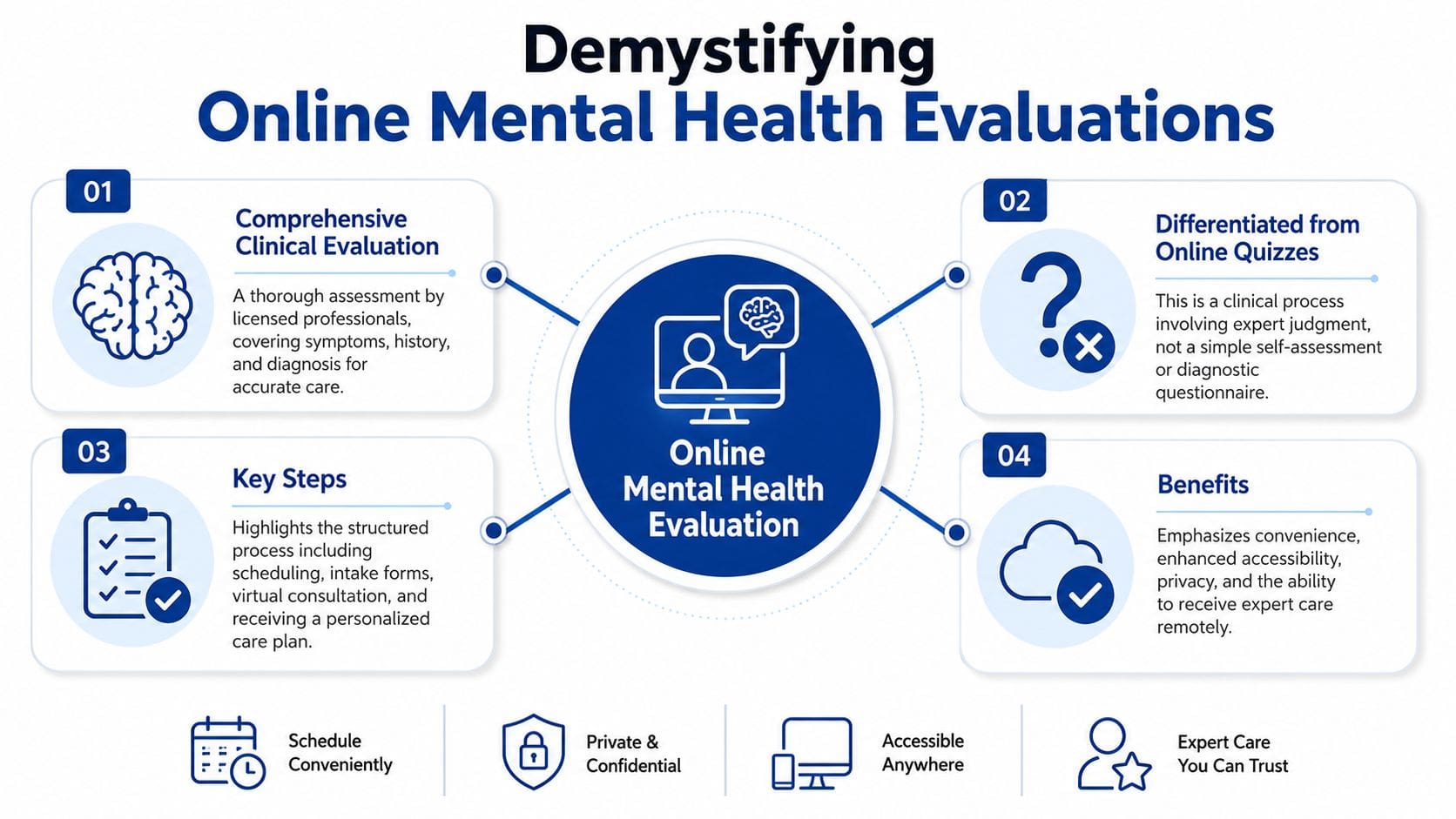
An online mental health evaluation should feel organized, not mysterious. The strongest evaluations combine clinical conversation with structured intake information, then use that information to decide what's most likely going on and what should happen next.
More than an online quiz
A quiz can be helpful for self-reflection, but it can't diagnose. It doesn't ask follow-up questions in real time. It can't notice when symptoms began after a trauma, changed with a medication, or worsen only in certain situations. It also can't weigh overlapping conditions.
A clinical evaluation does that. The provider looks at symptom severity, time course, context, medical history, family history, sleep, substance use, past treatment, and current goals. Some digital psychiatry settings also use broader tools such as self-report questionnaires, cognitive tasks, sensor-based information, and cross-cutting symptom measures, as described in this review of digital mental health assessment methods.
What clinicians are trying to answer
The appointment usually centers on a few practical questions:
- What symptoms are present: low mood, panic, intrusive thoughts, poor focus, mood swings, trauma responses, sleep changes, or something else.
- How much those symptoms interfere: work, relationships, school, parenting, motivation, routines.
- What may be contributing: stress, medical issues, prior diagnoses, medications, alcohol or substance use, grief, hormonal changes, or chronic burnout.
- What kind of plan fits best: medication management, therapy referral, lifestyle changes, further assessment, or a combination.
Practical rule: If an evaluation leaves a patient with more confusion than clarity, it probably wasn't thorough enough.
Virtual care can work well when the process is done thoughtfully. During the first year of virtual care programs, up to 20% more people received help for common mental health conditions, and 82% of substance use disorder patients in telehealth reported that virtual visits met their needs “equally well” or “better” than in-person visits, according to virtual mental healthcare findings summarized here.
For patients looking specifically for statewide telehealth care, virtual mental health services in Pennsylvania show what this type of appointment typically includes.
What works and what doesn't
What works is honesty, structure, and enough time to understand the person behind the symptom list. What doesn't work is trying to rush to a diagnosis based only on a checklist.
A good online evaluation also acknowledges nuance. Some patients need medication. Some don't. Some need trauma-focused therapy before medication changes make sense. Some need a sleep and routine reset because scattered attention is being driven by exhaustion, not ADHD. Real care is less about speed and more about accuracy.
A Step-by-Step Walkthrough of Your First Virtual Visit
The first appointment feels easier when each stage is predictable. Most online mental health evaluations follow the same general rhythm: preparation, secure login, clinical interview, then a care plan with next steps.
Before the appointment
Before the visit, patients usually complete intake forms. These often include symptom history, current medications, allergies, past treatment, medical history, and insurance details. It helps to be accurate rather than polished. Short, honest answers are more useful than trying to say things the “right” way.
Many practices also ask patients to choose a quiet place, confirm internet access, and log in a few minutes early. A laptop, tablet, or phone can work as long as the camera and microphone are functioning.
Here's a simple overview.
| Stage | What to Expect |
|---|---|
| Scheduling | Choose a time, provide basic contact information, and receive portal instructions |
| Intake forms | Complete history forms, medication lists, symptom questions, and insurance details |
| Pre-visit setup | Test device, camera, audio, and internet connection in a private space |
| Secure login | Enter the telehealth portal and wait for the provider to join |
| Clinical interview | Review symptoms, history, goals, and day-to-day functioning |
| Initial plan | Discuss impressions, treatment options, follow-up, and any needed referrals |
During the visit
Once the session begins, the provider usually starts with the patient's main reason for seeking care now. That question matters because timing gives context. A person may have had anxiety for years but only recently reached a point where work performance dropped or sleep became unsustainable.
The conversation often includes:
- Current concerns: what feels hardest right now
- Symptom timeline: when it started, whether it comes in waves, and what has changed
- Daily impact: concentration, appetite, motivation, relationships, routines
- Past care: therapy, medications, hospitalizations, and what helped or didn't
- Background factors: trauma history, medical conditions, family patterns, substance use, and stressors
The tone should feel collaborative. A strong provider asks direct questions without making the patient feel cross-examined.
Patients don't need to prepare a perfect story. They just need to describe what life has been like lately, as honestly as they can.
At this point, medication may come up, but not every first visit ends with a prescription. Sometimes the most appropriate next step is gathering more history, reviewing prior records, or starting with a non-medication plan. When medication management is part of care, patients can learn more about online medication management and what ongoing follow-up usually looks like.
After the evaluation
The visit typically ends with a summary. The provider explains the current clinical impression, discusses possible diagnoses if appropriate, and outlines a care plan. That plan may include medication options, therapy recommendations, lifestyle support, labs or screenings when indicated, follow-up timing, and safety planning if symptoms are severe.
The key question at the end isn't “Was everything solved today?” It's “Is there now a clear next step?” A good evaluation should answer yes.
Conditions We Commonly Evaluate and Treat Online
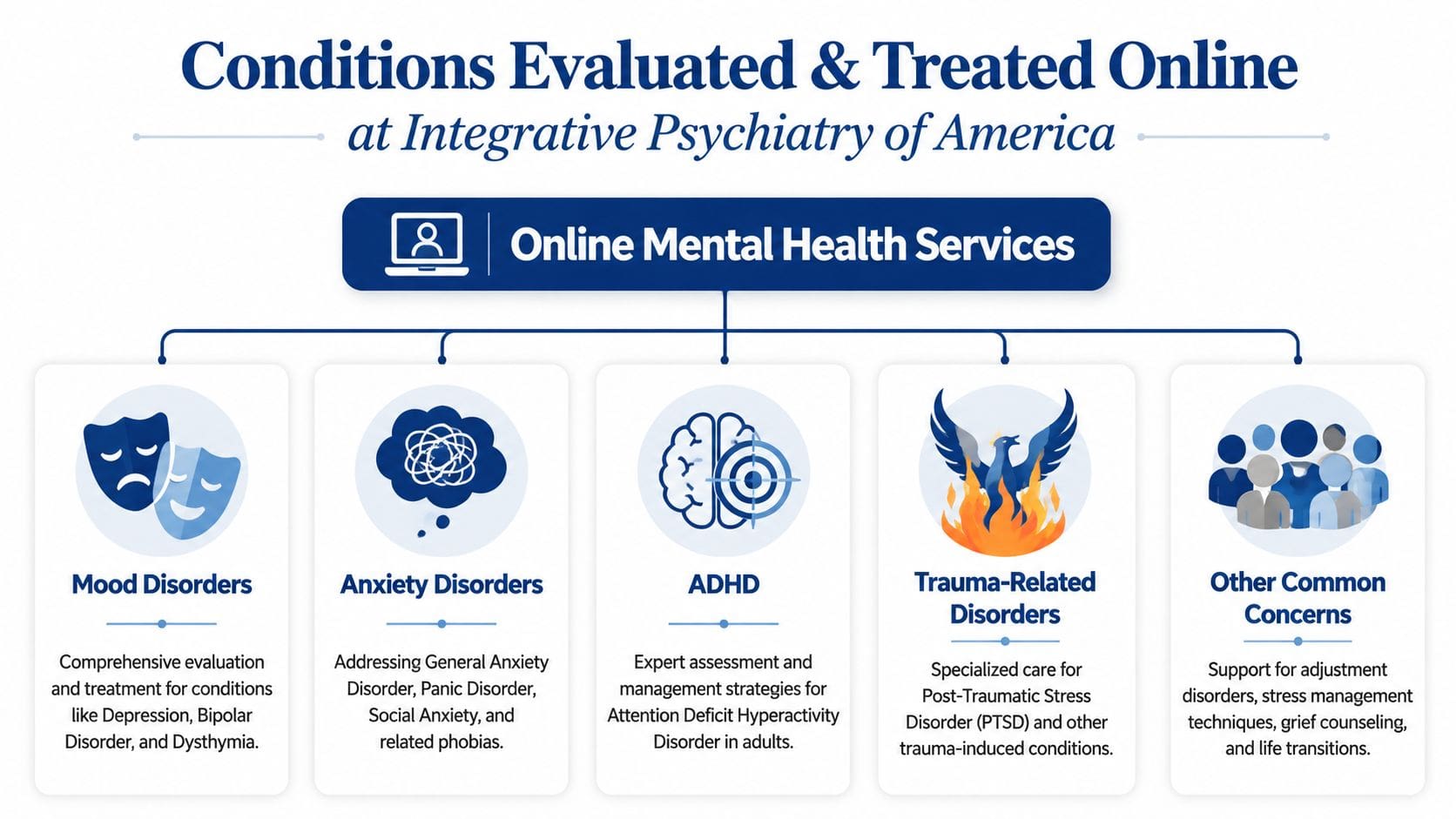
Online evaluations work best when they're matched to the right clinical questions. Many of the concerns adults bring to telehealth are well suited to thoughtful video-based assessment because the most important information comes from history, pattern recognition, and functional impact.
ADHD anxiety and depression
ADHD in adults often shows up as disorganization, chronic procrastination, impulsive spending, unfinished tasks, time blindness, or a lifelong sense of underperforming despite effort. A careful evaluation looks beyond “can't focus” and asks whether problems began early, whether they appear across settings, and whether anxiety, depression, sleep deprivation, or substance use might be driving similar symptoms.
Patients who want a starting point before booking can use an Adult ADHD Assessment to organize concerns before the formal visit.
Anxiety disorders require a similar level of detail. The provider wants to know whether worry is constant or situational, whether panic attacks occur, whether physical symptoms dominate, and whether avoidance has started shrinking daily life. Social anxiety, generalized anxiety, panic, health anxiety, and obsessive fear can feel similar from the inside but need different treatment planning.
An Anxiety Symptom Checker can help patients describe the pattern more clearly before the appointment.
Depression isn't just sadness. It can look like low motivation, numbness, irritability, guilt, sleep disruption, appetite changes, or feeling detached from life. Online evaluation is often effective here because the provider can explore mood, energy, concentration, and functioning together instead of treating each symptom in isolation. For patients considering treatment pathways, online depression treatment is one example of how virtual psychiatric care may be structured.
PTSD OCD and related concerns
PTSD and trauma-related symptoms can also be evaluated online when the pace is careful and the environment feels safe. Some patients speak more openly from home than they would in an office. The provider looks for intrusive memories, hypervigilance, nightmares, avoidance, irritability, and the ways trauma may affect trust, sleep, or emotional regulation.
OCD needs a distinct approach because intrusive thoughts are often misread as general anxiety. The evaluation should clarify whether repetitive behaviors, reassurance seeking, checking, contamination fears, moral scrupulosity, or mental rituals are present.
Other concerns commonly addressed online include adjustment problems, grief-related distress, stress overload, mood instability, and substance-related issues. In some settings, clinicians also use language patterns and speech features as part of broader digital assessment. Reviews of online psychiatric evaluation note that natural language processing and vocal markers may help support early detection and triage in conditions such as depression, psychosis, and cognitive impairment, as described in this overview of online psychiatric evaluations.
How to Prepare for a Successful Evaluation
Preparation doesn't need to be elaborate. A few simple steps can make the visit feel calmer, more productive, and more accurate.

What to do before logging in
Start with privacy. Choose a room where other people won't overhear. If home isn't ideal, a parked car or private office can be better than a shared kitchen table. Headphones help.
Then focus on the practical basics:
- Test the technology: confirm battery life, camera, microphone, and internet before the appointment starts.
- Write down symptoms: note what has changed in mood, focus, sleep, appetite, motivation, energy, or anxiety.
- List medications and supplements: include psychiatric medications, primary care prescriptions, over-the-counter products, and anything used for sleep.
- Think about goals: maybe the goal is fewer panic attacks, better focus at work, less irritability, or a second opinion about medication.
A short symptom log can be surprisingly useful. The Feeling Journal is one practical way to track patterns before the visit. Patients who struggle with follow-through may also benefit from a Daily Agenda Planner or an Exercise Routine Generator if routine, movement, and energy are part of the clinical picture.
A useful appointment doesn't depend on saying everything perfectly. It depends on bringing enough detail for the provider to see the pattern.
For moments when anxiety spikes right before a visit, some patients like to keep a grounding exercise nearby, such as the 5-4-3-2-1 Grounding Tool.
Good questions to bring to the visit
Many patients feel put on the spot and forget what they wanted to ask. A short list solves that problem. Good questions include:
- What diagnoses are you considering, and why?
- What symptoms matter most in sorting this out?
- Do you think medication makes sense right now, or should treatment start elsewhere?
- What side effects or trade-offs should be discussed if medication is recommended?
- How will progress be measured over time?
This short video can also help patients feel more comfortable with the process before the appointment.
Telehealth can support meaningful treatment engagement, not just brief check-ins. In one study of Partial Hospitalization Program care, patients receiving telehealth treatment stayed an average of 2.8 days longer than those in in-person PHP groups, with no significant difference in discharge symptom scores, according to this study on telehealth PHP outcomes. That doesn't mean every online setting is identical, but it does reassure patients who worry that remote care is automatically less effective.
Navigating Privacy Insurance and State Rules in PA
Privacy concerns are one of the biggest reasons people hesitate. That hesitation makes sense. Mental health care is personal, and patients want to know who can see what.
Privacy and secure care
A legitimate online mental health evaluation should use a secure, HIPAA-compliant telehealth platform. In plain language, that means the technology is designed to protect personal health information during messaging, scheduling, and video visits. Patients should expect a private portal, secure documentation, and clear communication about how records are handled.
People who want a plain-English example of how digital platforms explain data handling can review how Dreamscape protects your information. It's a helpful model for the kind of transparency patients should look for whenever they share personal health details online.
Insurance and Pennsylvania access
Insurance questions matter just as much. “In network” generally means a provider has a contracted relationship with a health plan, which can affect out-of-pocket costs. Patients should still verify benefits because deductibles, copays, and mental health coverage rules vary by plan.
For adults in Philadelphia, Reading, Allentown, Erie, or anywhere else in the Commonwealth, another practical concern is whether care can legally be provided across the state. The answer depends on licensure and prescribing rules. When the provider is appropriately licensed for Pennsylvania and the visit is conducted through compliant telehealth systems, statewide care is possible.
Patients looking for a Pennsylvania telehealth provider can review online psychiatric care across Pennsylvania to understand how statewide access typically works.
Take the Next Step with Our Pennsylvania Practice
The hardest part is often getting from searching to scheduling. Once that step is taken, the process becomes much more concrete. Symptoms get organized. Questions get answered. A treatment path starts to take shape.
That matters as the mental health burden keeps rising. In 2021, the global incidence of mental disorders reached 444,397,716 new cases, representing a 15.23% increase in the Age-Standardized Incidence Rate from 1990, according to this global analysis of mental disorder incidence. The need for accessible psychiatric evaluation is only growing.
For adults in Pennsylvania, virtual care can turn a late-night search into a real plan without adding a long commute or another logistical barrier. One option is Integrative Psychiatry of America, a Pennsylvania-based virtual psychiatry practice that provides psychiatric evaluations, medication management, and evidence-informed treatment through telehealth. The practice is led by Christopher Clark, MSN, PMHNP-BC, and uses a whole-person approach that considers symptoms, daily habits, stress, sleep, and broader lifestyle factors alongside standard psychiatric treatment.
A good first step is the one with the least friction. That may mean reviewing treatment options, checking insurance, or using a free tool before booking. What matters is moving from uncertainty to action.
If it's time to stop guessing and get a clear plan, Integrative Psychiatry of America offers virtual psychiatric evaluations and ongoing telehealth treatment across Pennsylvania. Patients can learn about care options, verify insurance coverage, schedule an appointment, or explore free tools for ADHD, anxiety, grounding, journaling, exercise, and daily planning.