
A phone lights up during dinner, a relative asks for one more favour, and a manager expects an instant reply at night. Saying yes feels easier in the moment, then resentment builds for days. Learning How to Set Boundaries means designing a limit that fits real life, not copying a slogan that collapses under pressure.
Table of Contents
- Why Most Boundary Advice Fails in Real Life
- What a Boundary Actually Is and What It Is Not
- A Six-Stage Protocol for Setting Boundaries That Stick
- Matching Boundaries to Your Style and Situation
- Handling Pushback, Guilt, and Violations
- Digital and After-Hours Limits That Actually Hold
- Maintaining Boundaries Over Time and When to Seek Help
Why Most Boundary Advice Fails in Real Life
A Pennsylvania parent drives children, helps an ageing relative, answers messages, and rarely declines anything. Sleep shrinks, patience disappears, and even kind requests start to feel intrusive. Guilt keeps the pattern going because refusal feels selfish.
Another adult takes the opposite route. After reading generic advice, that person announces a rigid rule, refuses all evening contact, and offers no alternative. A valued relationship cools, not because a limit existed, but because the design ignored context and repair.
Two Failures With One Cause
Both examples miss the same structure. The first person has no stated limit. The second has a limit without flexibility, explanation, or a workable next step.
A sound approach treats a boundary as a structure, not a personality trait. Confident people still struggle when a limit is vague or impossible to enforce. Anxious people can succeed when the wording is short and rehearsed.
- No boundary: Resentment grows while other people assume constant availability is acceptable.
- Rigid boundary: Other people hear rejection because no alternative path for contact exists.
- Workable boundary: The speaker names a limit and describes a personal action that can happen.
A boundary does not require the other person to agree. It requires the speaker to know what personal action comes next.
That structure matters because a healthy boundary contains the limit and the action taken if it is crossed, such as not taking work calls after 7 p.m. and responding the next morning instead. The focus stays on personal choices rather than controlling someone else.
Readers need three tools, not motivation alone. A matching framework helps choose firmness and flexibility. Ready scripts reduce improvisation during stress. A maintenance plan handles the predictable second and third conversations.
Family pressure, work demands, anxiety, depression, trauma responses, and poor sleep can all weaken follow-through. Advice that says "just say no" offers no help when hands shake or guilt spikes. A better method anticipates those moments and prepares the words, timing, and consequence in advance.
What a Boundary Actually Is and What It Is Not
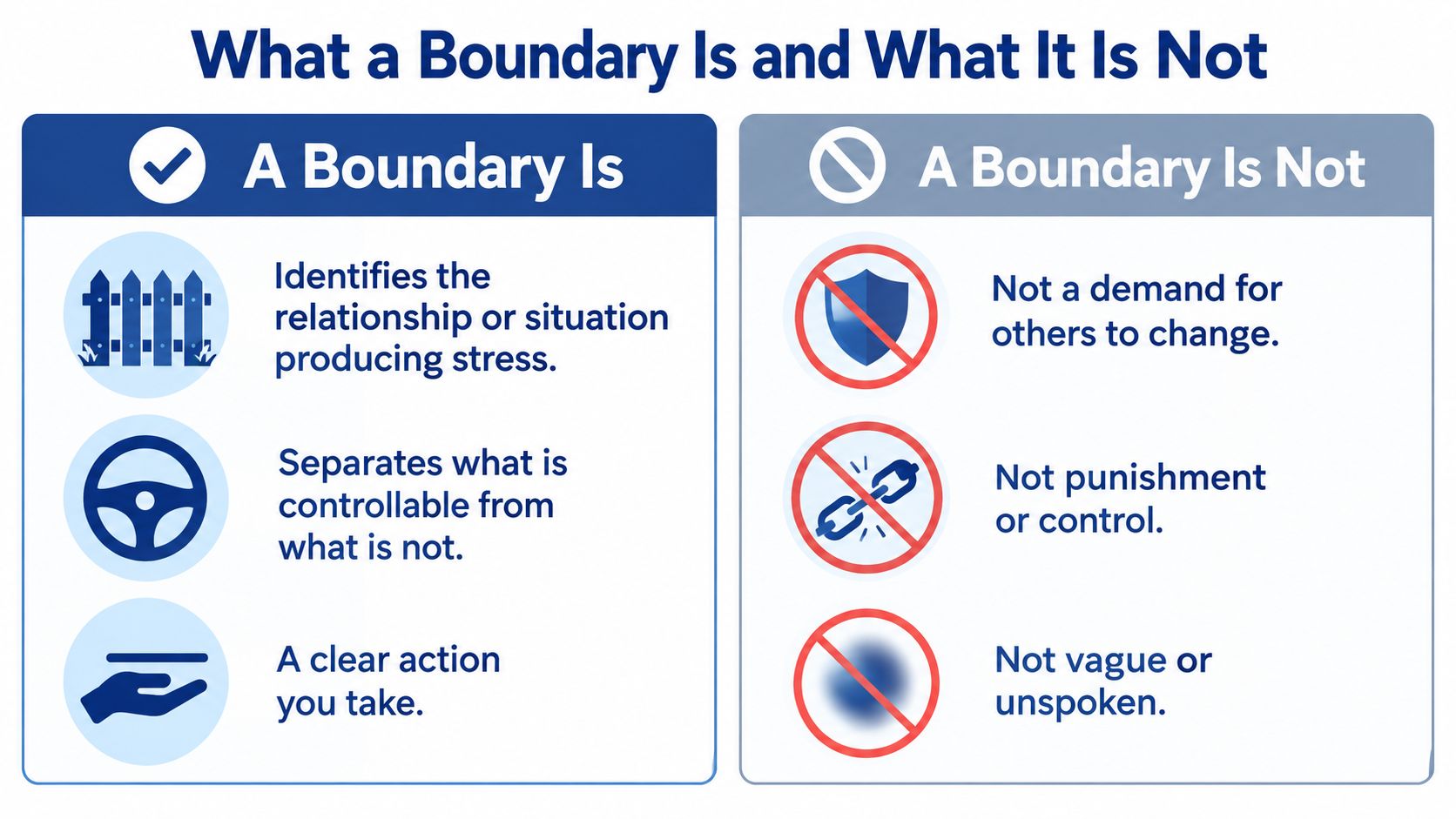
A boundary identifies a stressful situation, separates controllable choices from uncontrollable behaviour, and sets out what the speaker will do next. That definition is practical enough to test before any difficult conversation begins.
Mayo Clinic Health System guidance on identifying stressful relationships and control asks which relationships create stress or anxiety and whether someone tries to control another person's emotions, thoughts, or behaviour. The resulting plan may include saying no firmly but kindly, ending a conversation, or declining further interaction.
Four Qualities to Check
- Specific: Name the behaviour, time, place, or type of access involved.
- Observable: Use conduct both people can recognise, such as raised voices or unannounced visits.
- Proportionate: Match the response to the problem instead of escalating to total withdrawal.
- Controllable: Choose an action the speaker can complete without the other person's cooperation.
"If voices are raised, the call will pause and resume tomorrow" meets those tests. "You must never upset anyone" doesn't, because feelings can't be guaranteed and the demand tries to control another adult.
Three mistakes commonly derail the conversation. A demand requires agreement, punishment aims to make someone suffer, and an unrealistic consequence invites an empty threat. Each version shifts attention from behaviour to character and defensiveness.
Readers who feel drained after contact sometimes explore reflective practices, including energetic shielding techniques, alongside clinical coping skills. Such practices don't replace a clear sentence and follow-through. People affected by earlier coercion may also benefit from trauma-informed mental health care principles that prioritise choice, pacing, and safety.
A quick self-check helps. Can the limit be said in one sentence? Can the speaker carry out the response tonight, next week, and during a stressful month? If not, the boundary needs revision before delivery.
A Six-Stage Protocol for Setting Boundaries That Stick
A usable protocol starts before anyone speaks. Preparation prevents the common pattern of hinting, exploding, apologising, and returning to the original arrangement.
The Six Stages
- Define the issue: Name the specific behaviour or access, such as calls after bedtime or repeated weekend requests.
- Identify the cost: State the personal consequence briefly, such as lost sleep, missed medication routines, or reduced focus.
- Write one sentence: Keep the limit direct and free of a long defence.
- Add the action: Specify what will happen if the limit is not respected.
- Rehearse aloud: Practice with a trusted person until the sentence sounds ordinary.
- Deliver and repeat: Speak calmly, then repeat the same wording when challenged.
This sequence reflects boundary communication research describing negotiation of privacy and disclosure rules, where misunderstandings signal tension while rules change. Conversations should therefore be iterative rather than one-time declarations.
A hypothetical Philadelphia employee might say, "Project messages after 7 p.m. interrupt family time. Responses will begin at 8 a.m. on the next workday." That script uses observable facts, brief impact, and a clear alternative. It doesn't accuse colleagues of disrespect.
A Bucks County caregiver might need a different version. "Sunday visits work with a day of notice. Without notice, the door won't be answered, and another time can be arranged Monday." The structure is identical, but the timing and access reflect caregiving demands.
Practical rule: One boundary, one sentence, one action. Extra justification gives other people more material to debate.
The National Alliance on Mental Illness stepwise boundary guide recommends starting with one boundary rather than changing every problematic interaction at once. It also supports "I" statements that describe feelings and needs without blame. Anticipating challenges makes the first attempt more manageable.
Strong emotion during rehearsal isn't failure. Pausing, breathing, and learning how to self soothe during difficult conversations can keep the delivery steady. The goal isn't perfect calm. The goal is a clear sentence followed by the promised action.
Matching Boundaries to Your Style and Situation
Not everyone wants the same degree of separation between work, family, friendship, and rest. A limit fails when it copies another person's preference. Fit matters as much as firmness.
A 2025 work and family boundary fit study found that alignment between boundary preferences and actual enactment was associated with higher job satisfaction and well-being. Boundary enactment also correlated negatively with work and family conflict at r = −0.50, while conflict mediated the relationships studied.
Segmentation vs Integration Boundary Styles
| Dimension | Segmentation Preference | Integration Preference |
|---|---|---|
| Role separation | Keeps work and home mostly apart | Allows planned overlap between roles |
| Availability | Firm windows and predictable cutoffs | Flexible windows with stated exceptions |
| Contact style | Scheduled check-ins and separate channels | Shared calendars and brief updates across settings |
| Main risk | Feels rigid during genuine emergencies | Exceptions expand until rest disappears |
| Useful safeguard | Define a real crisis exception | Define protected periods that stay closed |
A segmentation script might be, "Work messages are checked at 9 a.m. and 4 p.m. Urgent safety matters can use a phone call." An integration script might allow a short family call during lunch but protect the final hour before sleep.
Neither style is morally superior. Trouble starts when someone who prefers integration adopts an all-or-nothing ban, then abandons it and feels inconsistent. Trouble also starts when someone who needs separation keeps making "small" exceptions that erase recovery time.
Situation changes the design. Adults with ADHD may need visible timers, written response windows, and fewer open-ended commitments because time can pass unnoticed. Caregivers may need backup contacts and planned respite rather than a simple refusal. Remote workers may need physical cues, such as closing a laptop and changing rooms. Culturally shaped family obligations may call for predictable availability instead of reduced contact that feels like rejection.
Anxiety can make any version feel risky, especially when someone anticipates anger or abandonment. Learning how to manage social anxiety in everyday interactions can support practice, but the boundary still needs a purpose, firmness level, exception, and review date.
A review date prevents temporary limits from becoming permanent rules. Capacity changes during illness, busy periods, grief, and recovery. Adjusting a limit deliberately is not inconsistency. Abandoning it after pressure usually creates confusion.
Handling Pushback, Guilt, and Violations
Pushback often arrives as argument, joking, topic changes, tears, silence, or repeated testing. Guilt can appear even when the boundary is reasonable. Neither reaction automatically proves the limit was wrong.
The image below reflects the serious, ordinary setting where many of these conversations happen, across a table rather than in a dramatic confrontation.

A Sequential Response
SANE guidance on responding when an agreed boundary is broken describes pausing, stating that the boundary was broken, explaining impact, and giving an action, response, and outcome statement. The next steps are to restate or renegotiate the limit and implement the consequence.
The broken record technique helps when debate starts. The speaker repeats the same calm sentence without adding new reasons. Repetition feels awkward, but fresh explanations often become fresh arguments.
A partner protests a phone-free evening and says work might call. The response can stay narrow. "Phones stay in the kitchen from 6 to 8 p.m. Calls can be checked at 8." Repeating that sentence avoids a wider fight about commitment or respect.
A parent protests reduced holiday availability. "Christmas Eve works, and Christmas Day is at home this year. A call can happen that morning." The alternative shows connection without surrendering the limit.
In workplaces, pushback may involve criticism rather than a direct request. The LeaveWizard feedback guide can help readers separate useful feedback from pressure to abandon a stated limit. Responding to the work issue doesn't require reopening personal availability.
The video below offers another way to hear these responses practised in ordinary language.
Mindfulness skills can reduce impulsive replies during these exchanges. Approaches such as mindfulness based cognitive therapy for recurring negative thought patterns may help someone notice guilt without obeying it immediately.
Persistent fear, coercion, threats, stalking, or retaliation changes the task. That's not a cue for stronger confrontation. Safety planning and professional assessment come first, particularly when someone punishes every refusal or ignores physical boundaries.
Digital and After-Hours Limits That Actually Hold
After-hours messages create a design problem. A person can announce limited availability, then hear notifications all evening and check "just one" thread. The environment defeats the intention.
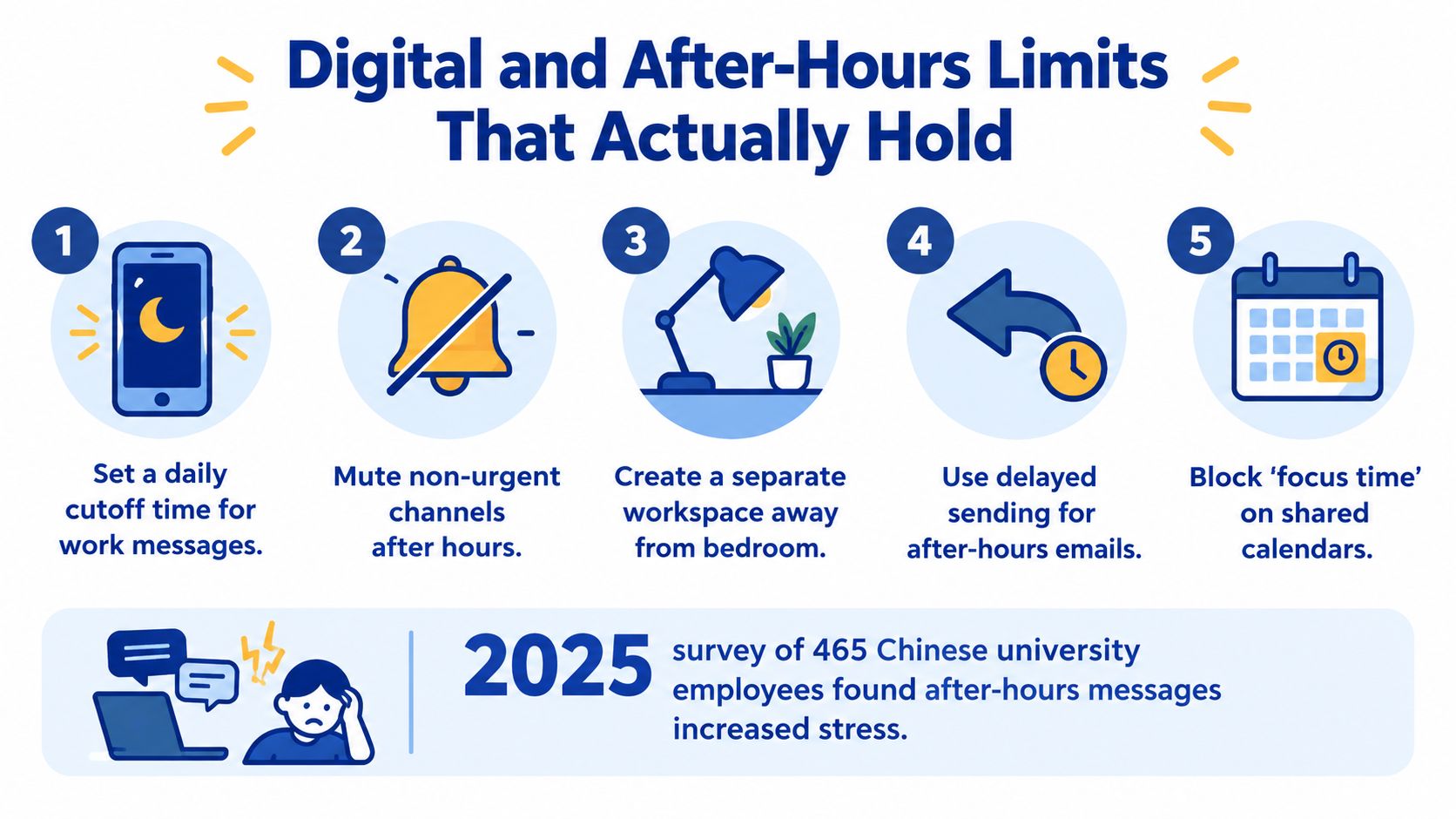
A 2025 survey of 465 university employees in China found perceived after-hours electronic communication invasion increased relative deprivation and emotional exhaustion, which contributed to work withdrawal. Self-efficacy weakened those effects. The finding points beyond confidence toward systems and expectations.
Build the System
- Mute non-essential channels: Silence group chats and apps that rarely carry urgent information.
- Separate accounts: Keep work mail off a personal home screen where employment rules allow it.
- Use delayed delivery: Write a late message if needed, but schedule it for work hours.
- Publish response windows: Put expected reply times in an email signature, shared document, or team agreement.
- Document repeated violations: Save dates and patterns before asking a supervisor or human resources team to intervene.
Wording still matters. "Messages received after 6 p.m. will be answered the next workday" governs the speaker's behaviour. "You may not message after 6 p.m." tries to govern everyone else and can create a power struggle, especially across time zones.
Power differences require judgement. A junior employee may not safely ignore a supervisor in the same way a senior leader can decline a peer request. Documentation, agreed escalation routes, and a narrow emergency definition provide protection when direct refusal carries risk.
Family group chats need similar clarity. Muting a thread is an action within personal control. Announcing one daily check-in time gives relatives a predictable route without requiring constant monitoring. Medical emergencies can use a phone call rather than dozens of messages.
Sleep protection is the practical test. If a device remains beside the bed and every alert stays active, the stated boundary exists mainly as a wish. Charging the phone outside the bedroom, using focus modes, and closing shared calendars after a set hour make the limit visible and enforceable.
Maintaining Boundaries Over Time and When to Seek Help
One successful conversation rarely creates a stable pattern. Maintenance means recording what happened, reviewing several interactions, and revising any consequence that proves unsafe or impractical.
Assertiveness can be learned, but the evidence has limits. In a randomized trial of 32 high school girls receiving six sessions, mean self-esteem scores rose from 25.2 to 29.9 and a distress symptom score fell from 27.67 to 19.0. The small adolescent sample, short follow-up, and combined intervention prevent treating those changes as a universal adult success rate.
A 90-Day Rhythm
- Week 1: Choose one boundary and write the sentence, action, exception, and review date.
- Weeks 2 to 4: Rehearse, deliver, and record the situation, wording, response, and follow-through.
- Weeks 5 to 8: Expect testing and use the same response unless safety requires a change.
- Weeks 9 to 12: Review patterns, keep what worked, and revise wording or consequences that failed.
Parents may face a different maintenance problem when a child's anxiety drives repeated requests for reassurance or avoidance. Learning about SPACE therapy from Uptown Psychology can clarify how caregivers adjust their own responses while still offering support. That approach targets family accommodation, not every adult boundary problem.
Professional help becomes appropriate when boundary attempts trigger persistent panic, depressed mood, trauma reactions, insomnia, or collapse in self-worth. It also matters when ADHD, anxiety, depression, OCD, or PTSD makes planning and follow-through unusually difficult. Guidance on when to see a psychiatric provider for evaluation can help distinguish a skills problem from symptoms that need treatment.
A board-certified psychiatric mental health nurse practitioner can assess symptoms, review safety, and discuss therapy, medication management, and practical follow-up when clinically appropriate. Pennsylvania readers using telehealth should verify coverage directly because benefits, copays, deductibles, network status, and authorisation requirements vary by plan.
Progress looks ordinary from the outside. A call ends on time, a message waits until morning, and guilt passes without reversing the decision. Repeated ordinary actions, reviewed over months, turn a sentence into a reliable boundary.
Pennsylvania adults who find that anxiety, depression, ADHD, trauma symptoms, or chronic guilt keep undermining boundary work can seek an integrative psychiatric evaluation, medication management, and follow-up through secure statewide telehealth. Visit Integrative Psychiatry of America to verify insurance, review care options, and request an appointment when professional support feels like the next step.