
A familiar warning sign can appear before depression feels severe: sleep becomes less restorative, small tasks take more effort, and self-critical thoughts start sounding convincing again. An adult in Pennsylvania who has been through therapy or medication may recognize that pattern and wonder how to stay well this time, not just feel better for now.
Mindfulness-based cognitive therapy (MBCT) is a structured approach designed to help people with recurrent depression notice those mental habits and respond differently. It isn't a cure, a substitute for every other treatment, or meditation with a clinical label. It's a relapse-prevention skill set, and its usefulness depends on who it's for, how it's delivered, and whether the practices fit into daily life.
Table of Contents
- Why Someone Searching for MBCT Right Now Already Knows the Pattern
- What MBCT Actually Is Beyond the Buzzword
- How the Eight-Week MBCT Program Is Structured
- The Evidence for Depression Relapse Prevention
- MBCT Versus Antidepressants and Other Therapies
- Who MBCT Is For and How It Fits With Other Care
- Why MBCT Is Not an Eight-Week Fix
- Accessing MBCT in Pennsylvania and Next Steps
Why Someone Searching for MBCT Right Now Already Knows the Pattern
Someone who searches for MBCT may already know how depression returns for them. Perhaps a missed deadline brings a familiar rush of self-blame, or a quiet weekend turns into hours of replaying past mistakes. They may have found talk therapy helpful, taken medication, or used relaxation apps, yet still worry about what happens after the immediate crisis passes.
That worry makes sense. Feeling better and staying well aren't identical goals. For people who have had repeated depressive episodes, early signs can feel loaded with meaning: “Is this starting again?” MBCT offers a way to notice those thoughts and the feelings around them without automatically treating them as facts or instructions.
Unlike general mindfulness content, MBCT is a structured program that combines mindfulness exercises with cognitive-behavioral techniques. It asks participants to practise noticing thoughts, emotions, and body sensations, then to choose a response rather than getting pulled into a familiar spiral. It doesn't promise that symptoms won't return. It aims to help people recognize patterns earlier and build ways to relate to them differently.
A calming routine may be a useful addition to a demanding day, but it isn't the same as a depression treatment plan. For a small, practical pause between work and caregiving, some people might explore shower steamers for busy professionals as a sensory ritual. That kind of routine can support a moment of self-care, but it shouldn't be confused with MBCT or clinical care.
What MBCT Actually Is Beyond the Buzzword
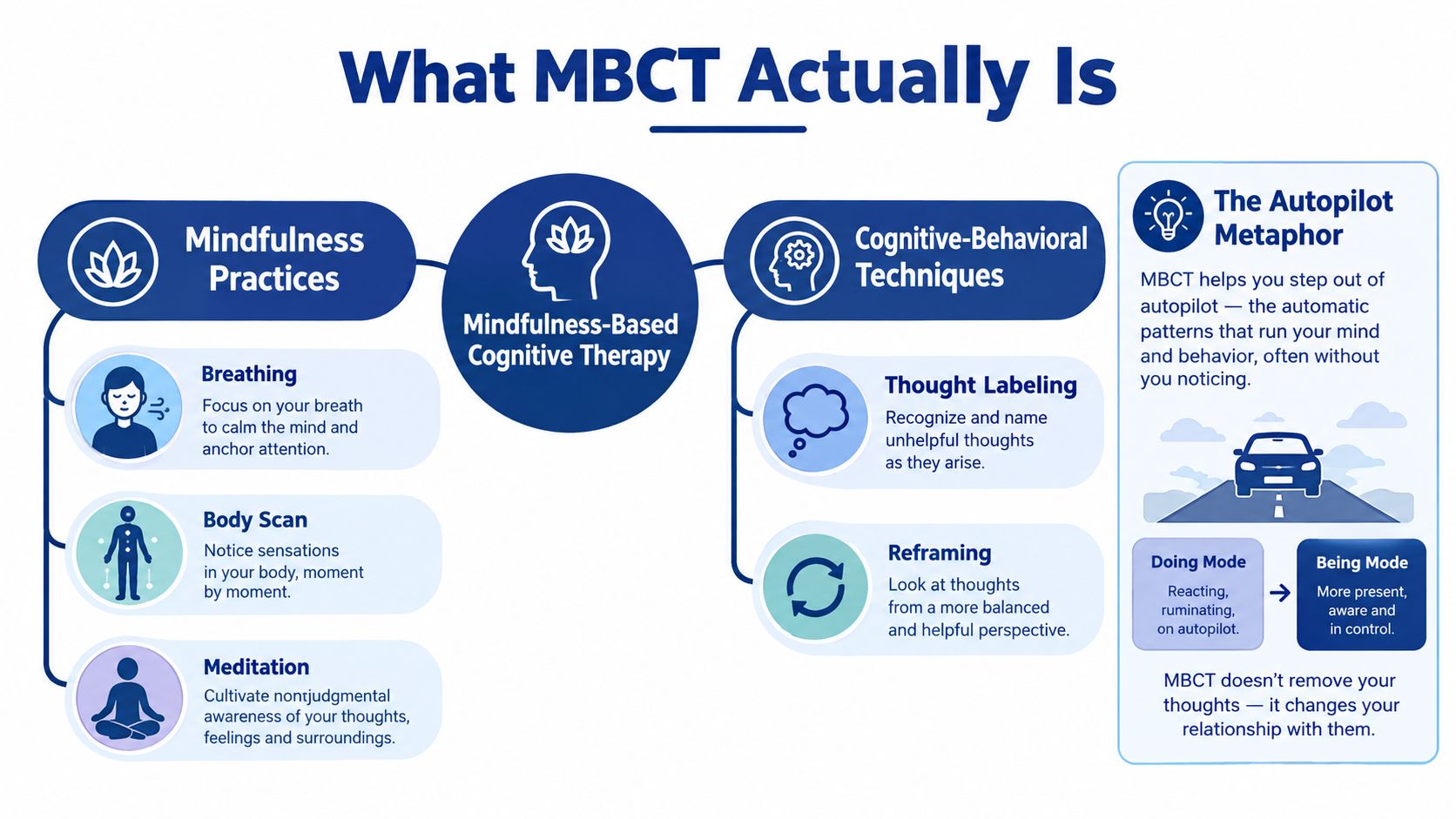
MBCT combines mindfulness practices with selected cognitive-behavioral techniques. Its purpose is to help people notice the link between thoughts, feelings, and behavior, then step out of automatic reactions when possible.
The “autopilot” metaphor describes how familiar habits can take over attention. A person may feel low, think “nothing will ever improve,” and withdraw from an activity that might otherwise help. In MBCT, participants practise noticing that chain as it unfolds instead of accepting every thought as a verdict.
From doing mode to being mode
A “doing mode” tries to solve discomfort by analyzing, fixing, or pushing it away. That problem-solving ability can be useful, but it may also keep someone stuck in rumination when the mind treats every painful thought as a problem that must be settled immediately.
A “being mode” means noticing what's happening in the present without demanding an instant solution. Participants practise directing attention to breathing, body sensations, or sounds. When attention wanders, they bring it back. The exercise isn't about clearing the mind. It's about recognizing distraction and returning without self-criticism.
The cognitive component supports this shift. Participants learn to identify automatic thoughts and see them as mental events, not necessarily facts. That's different from standard CBT, which often focuses on examining or testing thoughts and beliefs directly. MBCT may include cognitive techniques, but mindfulness and a changed relationship to thoughts are central.
A meditation app can guide a practice, but it doesn't necessarily provide a structured group course, clinical context, or support in connecting experiences to depression patterns. For people interested in related mind-body approaches, yoga and integrative psychiatry in Philadelphia describes another way mindfulness practices may sit alongside mental health care. A quiet setting can help support practice too, and mindful meditation room inspiration may offer ideas for creating a space that feels comfortable.
How the Eight-Week MBCT Program Is Structured
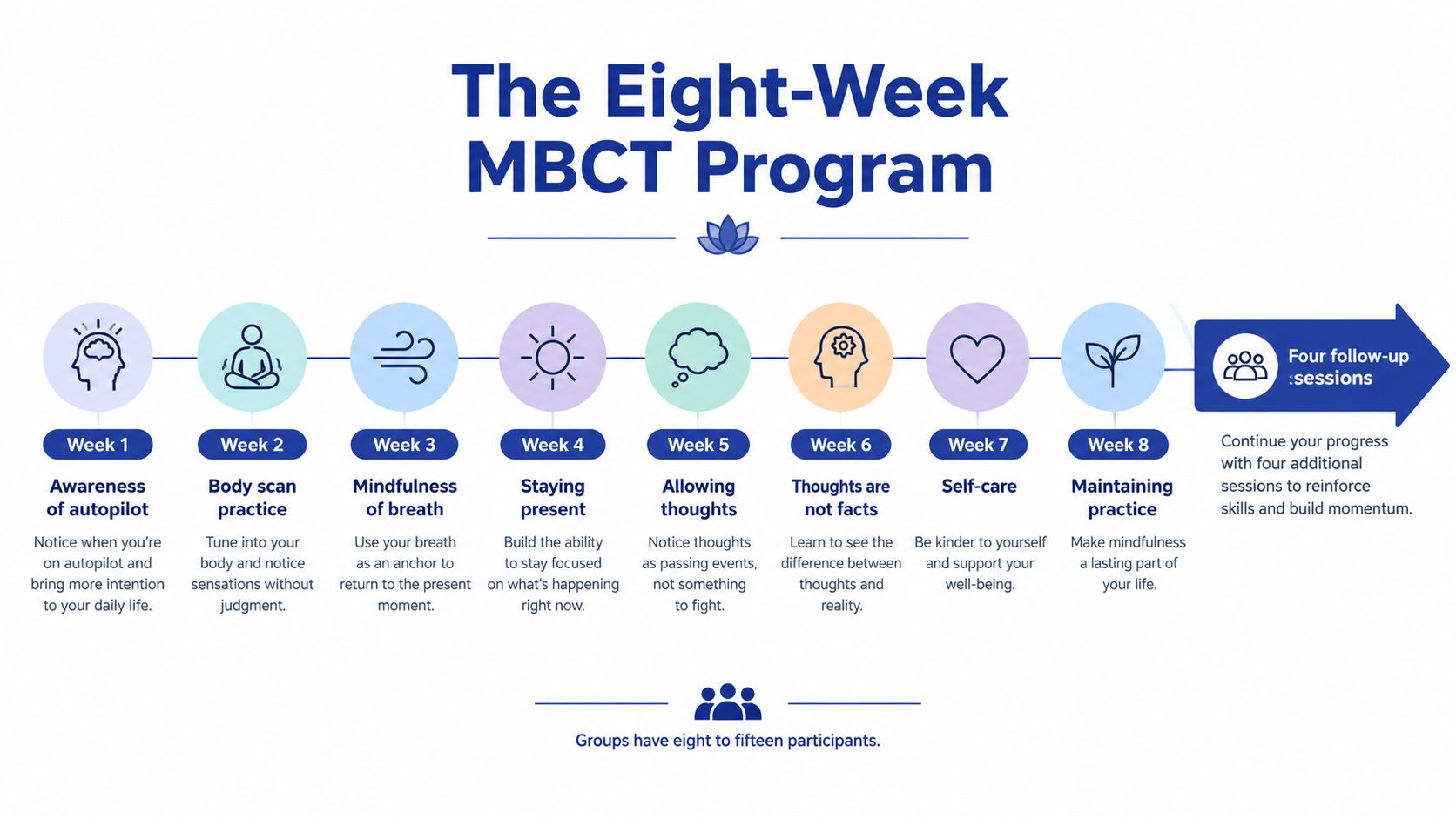
An MBCT course asks you to make room for regular sessions and daily practice. NICE guidance describes eight weekly two-hour sessions, typically with eight to 15 participants, plus four follow-up sessions during the next 12 months. That schedule matters when deciding whether the course fits your work, family responsibilities, and ongoing treatment.
The group provides a consistent place to practise and discuss difficulties. Early sessions introduce awareness of routines and autopilot, alongside body-scan and breathing exercises. Later work involves staying present with difficult experiences and recognizing recurring thought patterns. Closing sessions focus on self-care and maintaining the skills as part of relapse prevention.
What happens between sessions
Home practice is part of the treatment.
Guided exercises and everyday activities help you notice shifts in attention, bodily responses, and familiar patterns before they dominate your day. The exercise may vary, but the repeated task is to notice distraction and return without self-criticism. Feeling calm is not the measure of success. Restlessness, anxiety, or discomfort deserve discussion with the facilitator, especially when they make practice harder to sustain.
For someone with recurrent depression, the practical goal is a usable relapse-prevention routine, rather than a promise that symptoms will disappear. Residual anxiety or ADHD-related attention difficulties are reasons to discuss how practice will fit daily life, without assuming MBCT will treat every symptom. If you take medication, keep medication-management appointments alongside the course.
Follow-up sessions offer space to review difficulties and adjust practice as circumstances change. Telehealth should retain regular attendance, guided home practice, discussion of reactions to thoughts, and a continuation plan. Attending from home still requires protected time and participation.
The Evidence for Depression Relapse Prevention
MBCT has evidence for reducing the risk of depressive relapse, particularly for people with recurrent depression, but the findings don't mean every person will benefit equally. The research supports considering MBCT as part of continuing care, not treating it as a guaranteed safeguard.
A 2011 systematic review and meta-analysis combined six randomized trials involving 593 participants. Compared with treatment as usual or placebo controls, MBCT had a risk ratio of 0.66, equivalent to a 34% relative reduction in depressive relapse or recurrence (2011 review and meta-analysis). The benefit was concentrated among people with a history of at least three depressive episodes, for whom the relative risk reduction was 43%. The analysis found no significant risk reduction among people with only two previous episodes.
A later individual-participant-data meta-analysis pooled nine trials and 1,258 participants followed for up to 60 weeks. During follow-up, 38% of those receiving MBCT relapsed, compared with 49% in comparison conditions. Accounting for when relapse occurred, researchers reported a hazard ratio of 0.69, with a 95% confidence interval of 0.58 to 0.82, representing an approximately 31% lower relative hazard during the observation period (individual-participant-data meta-analysis).
What the numbers don't settle
These findings describe groups, not an individual's future. They don't predict with certainty whether MBCT will prevent a particular person's relapse, and they don't establish that participants can stop other treatment.
Evidence reviews also highlight limitations. Recent research has found that relatively few studies measure long-term outcomes, while risk-of-bias concerns make results harder to interpret with confidence. Sample sizes, measures, and reporting of other conditions can vary, so the evidence is promising but conditional. A clinician should consider a person's history, current symptoms, preferences, and other care before recommending MBCT.
MBCT Versus Antidepressants and Other Therapies
If medication has helped you recover, choosing MBCT means weighing another commitment: regular skills practice.
MBCT isn't proven to be universally better than maintenance antidepressants or other active treatments. It offers a relapse-prevention skill set, not a depression cure. The decision depends on what has kept you well, medication tolerability, and whether daily practice is realistic.
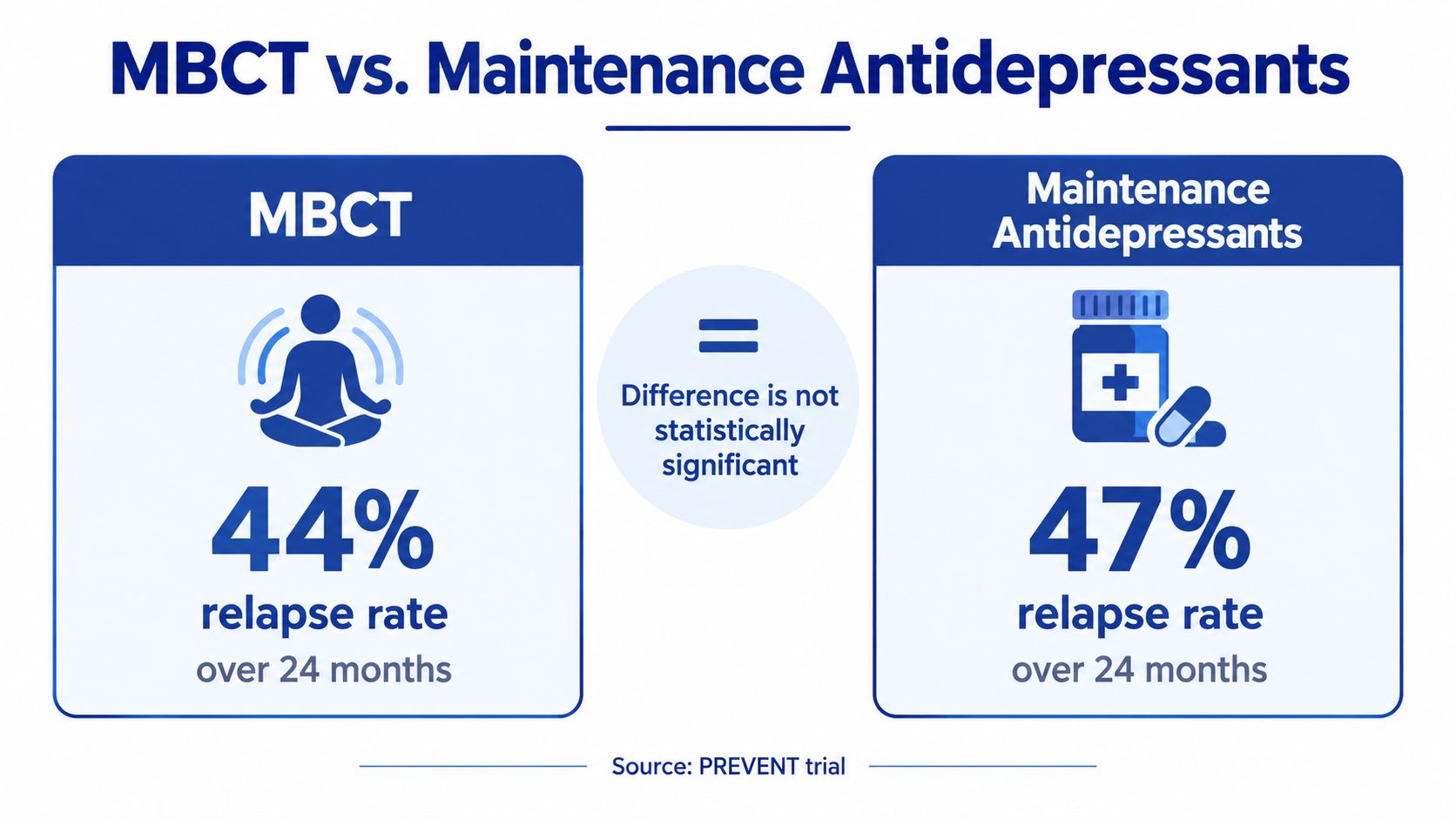
In the PREVENT trial, 44% of participants assigned to MBCT with support to taper antidepressants relapsed or experienced recurrence over 24 months, compared with 47% assigned to maintenance antidepressants; the difference wasn't statistically significant, with a hazard ratio of 0.89 and a 95% confidence interval of 0.67 to 1.18 (PREVENT trial62222-4/fulltext)). These results leave room for MBCT as an option for some patients, while leaving uncertainty about how the approaches compare. The tapering support matters. Course attendance alone is no reason to stop medication.
A network meta-analysis of 14 randomized trials involving 2,077 participants found lower relapse risk and longer time to relapse with MBCT than with treatment as usual, but did not establish statistically significant superiority over active treatments (NICE evidence review). That limits any claim that MBCT should replace an effective therapy or medication plan.
For someone with recurrent depression, the practical comparison includes both treatment burden and relapse risk. Residual anxiety or comorbid ADHD also belongs in that discussion, rather than assuming the depression findings establish benefits for those conditions. Through online depression medication management, a patient can discuss medication decisions and symptom monitoring by telehealth. Ask separately how MBCT sessions and home practice would fit alongside that care.
The following video offers an introduction; treatment decisions still need an individual clinical discussion.
Who MBCT Is For and How It Fits With Other Care
MBCT is most directly supported as a relapse-prevention option for adults with recurrent depression who are currently well or in remission. A history of multiple episodes may make it more relevant, but suitability still depends on the person's current symptoms and broader treatment needs.
One randomized study illustrates why history matters. Among recovered participants with three or more previous episodes, relapse was 36% with MBCT plus usual care, compared with 78% with usual care alone. Among participants with only two recent episodes, the rates were 50% with MBCT and 20% with usual care (randomized study). Those results don't establish what any individual will experience, but they show why a clinician shouldn't describe MBCT as equally suited to everyone.
Medication management can continue alongside MBCT. A prescriber can review whether medication remains appropriate and help monitor symptoms; medication changes should be planned with a qualified clinician, not triggered by course attendance alone. People with residual anxiety may find that noticing thoughts and body signals is relevant to their wider care, but MBCT isn't a stand-alone treatment for every anxiety condition.
Comorbid ADHD can affect how someone manages group attendance, sustained attention, or home practice. That doesn't automatically rule out MBCT. It may mean the practice plan needs to be realistic, structured, and adapted to the person's needs. Adults considering depression care can explore depression treatment options with a provider who can discuss how therapy and medication management might fit together.
What telehealth should preserve
Remote delivery can make participation more accessible across Pennsylvania, but it should still include the core features of the program: regular sessions, guided practice between meetings, attention to thought patterns, and a plan for continued skill use. If telehealth reduces the course to occasional relaxation exercises without structured teaching or follow-up, it no longer reflects the same program.
Why MBCT Is Not an Eight-Week Fix
Completing the course doesn't permanently remove relapse risk. MBCT teaches skills that participants may need to continue using, especially when early warning signs return or daily pressures make practice harder.
A long-term study reported that gains remained significant across follow-up periods extending to roughly 34 months and concluded that continued use of MBCT skills and practice may matter for relapse prevention (long-term follow-up study). That doesn't mean everyone must meditate for a fixed amount of time or follow the same routine indefinitely. Long-term evidence remains limited, and clinicians still need to tailor recommendations to the person.

Adjust practice instead of abandoning it
If motivation drops, a shorter practice may be more realistic than an all-or-nothing plan. Guided audio, mindful movement, or clinician-supported home practice can offer alternatives to sitting meditation. Difficulty meditating doesn't automatically mean treatment has failed; it can be a reason to discuss what feels difficult and whether the practice should change.
Movement and exercise may also fit into a broader depression-care plan. Exercise as part of integrative depression treatment describes one approach to including activity in care. Exercise and mindfulness may support well-being, but neither should be used to dismiss significant or worsening symptoms.
Prompt clinical reassessment matters if mood worsens, trauma-related distress intensifies, or symptoms become severe. In those situations, increasing self-guided practice isn't a substitute for reaching a qualified provider. Any concern about immediate safety calls for urgent local support.
Accessing MBCT in Pennsylvania and Next Steps
Pennsylvania residents can start by asking a prospective clinician about MBCT training, whether the program is offered in a group or individual format, what home practice involves, and how follow-up works. A clinician should also discuss whether the person's current symptoms and treatment history make relapse-prevention therapy an appropriate fit.
Before enrolling, ask the insurer about behavioral-health benefits, network status, copays, deductibles, and any authorization requirements. Coverage varies by plan, and the course format may affect benefits. For a practical overview of remote care, online therapy in Pennsylvania and what to expect explains how telehealth visits may work.
A board-certified psychiatric mental health nurse practitioner can coordinate medication management alongside therapy when clinically appropriate. Integrative Psychiatry of America provides virtual psychiatric care across Pennsylvania, including medication management and psychotherapy through secure, HIPAA-compliant telehealth. People considering MBCT can ask whether their current care plan supports it and what provider options are available.
Pennsylvania adults considering MBCT can request an appointment with Integrative Psychiatry of America to discuss how therapy and medication management may fit their depression-care plan. The practice also offers insurance verification so prospective patients can ask about benefits before moving forward.