
You know the feeling. A meeting starts in ten minutes, your chest tightens, and you're already rehearsing what to say, what not to say, and how to hide the fact that your hands are shaking. For many adults in Pennsylvania, that moment isn't occasional nerves, it's the daily reality of social anxiety.
How to manage social anxiety starts with naming what's happening, not dismissing it as shyness. Social anxiety can show up at work, in dating, during phone calls, or even while eating lunch in a shared break room, and it can be common enough to need structured care. The U.S. National Institute of Mental Health estimates that 7.1% of U.S. adults had social anxiety disorder in the past year and 12.1% experience it at some point in their lives, with 9.1% of adolescents ages 13 to 18 affected and 1.3% experiencing severe impairment (NIMH statistics). Those numbers matter because they show this is not a niche problem, and they explain why evidence-based treatment is often a better fit than well-meaning advice alone.
Table of Contents
- Recognizing Social Anxiety Symptoms and Triggers
- Immediate Techniques to Reduce Anxiety in Social Moments
- Building a Graded Exposure Plan That Actually Works
- Lifestyle Factors That Amplify or Reduce Social Anxiety
- Treatment Options Including Medication and Telehealth CBT
- When to Seek Professional Care and How to Get Started
Recognizing Social Anxiety Symptoms and Triggers
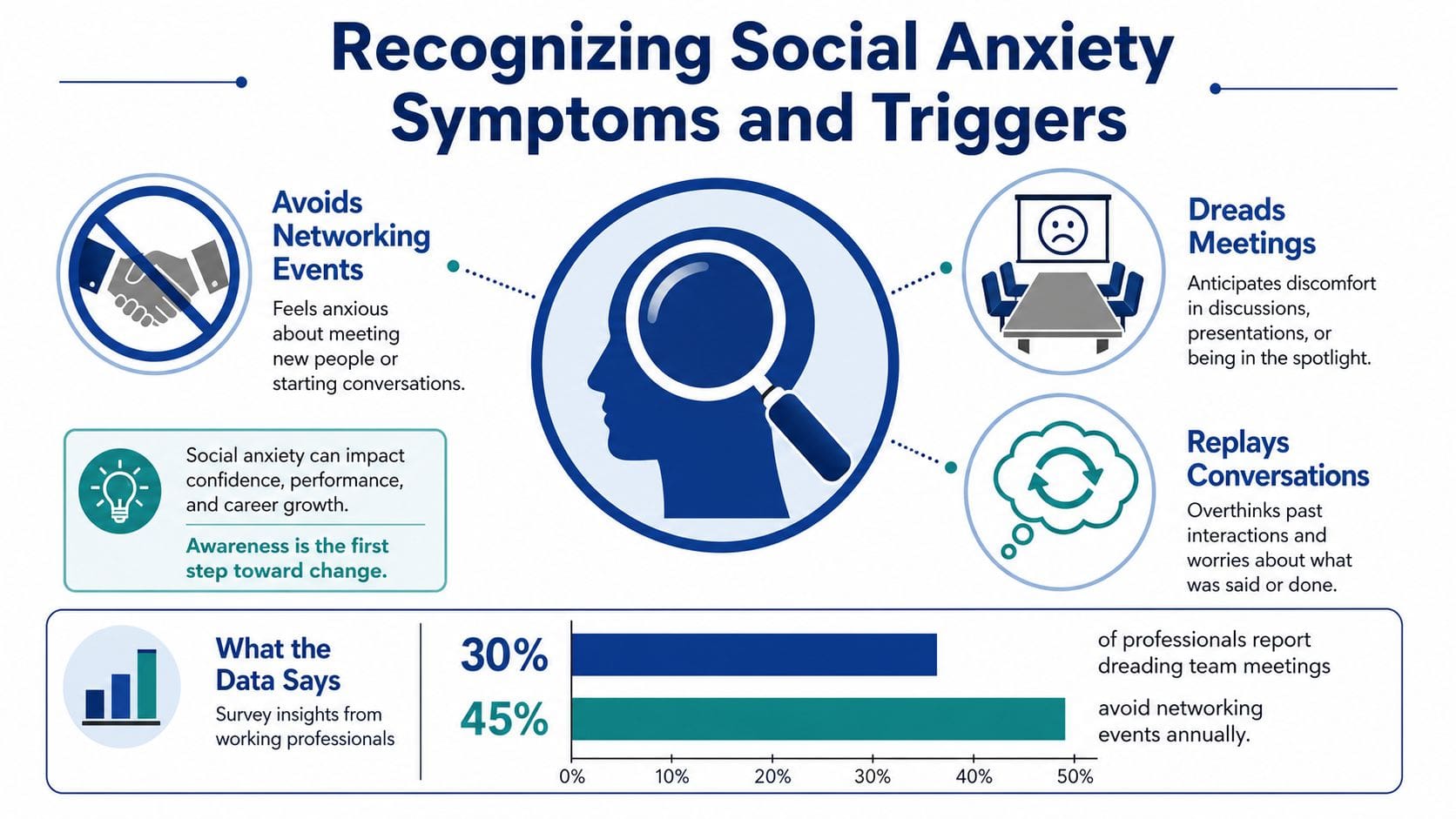
A Pittsburgh professional may look fine on the outside, answer emails on time, and show up for work, but still dread the weekly staff meeting for hours beforehand. The struggle often starts long before the event, then continues afterward with replayed conversations, second-guessing, and a harsh inner script about what others supposedly noticed. That pattern points away from simple shyness and toward social anxiety disorder, especially when avoidance starts shaping work, relationships, and daily routines.
What social anxiety looks like in real life
The body usually speaks first. A racing heart, sweating, blushing, stomach upset, or a shaky voice often show up when a person has to speak, eat, or be observed. The mind often joins in with fear of judgment, fear of embarrassment, or a constant sense that everyone is noticing every mistake.
Behavior matters too. Some people avoid networking events, skip phone calls, keep the camera off in virtual meetings, or leave gatherings early. Others over-prepare, rehearse every sentence, or stay quiet to avoid drawing attention. Those behaviors may reduce discomfort in the moment, but they also keep the fear alive.
Practical rule: if a social situation keeps leading to avoidance, distress, or hours of rumination afterward, it deserves more than reassurance from friends.
Why early recognition matters
Social anxiety often begins early. The Anxiety and Depression Association of America reports that 36% of people with social anxiety disorder have symptoms for 10 or more years before seeking treatment, and more than 75% first notice symptoms in childhood or early adolescence, with typical onset around age 13 (ADAA social anxiety overview). The American Psychiatric Association also notes a median onset of 13 years old in the same source. In practical terms, that means many adults have spent years building avoidance habits before they ever sit down with a clinician.
A few triggers come up often in Pennsylvania workplaces and social settings. Presentations, performance reviews, speaking in hybrid meetings, eating in public, and making small talk at conferences or church events can all set off symptoms. For some people, even social hobbies like dance classes or group fitness feel intimidating at first. A useful outside resource for gentle social practice is Danza Academy's discussion of how dance lessons can support mental health for adults, especially for readers who want a structured, low-pressure way to be around people.
For a quick self-check, a structured tool can help separate ordinary nerves from a broader pattern. The Anxiety Symptom Checker can be a practical starting point if the pattern is starting to affect work, family life, or confidence.
Immediate Techniques to Reduce Anxiety in Social Moments
When anxiety spikes in the middle of a conversation, the goal is not to become perfectly calm. The goal is to keep the nervous system from taking over the whole interaction. Short, discreet skills can help someone get through a meeting, job interview, or dinner without escalating into panic or shutdown.
Breathing and grounding that fit into real situations
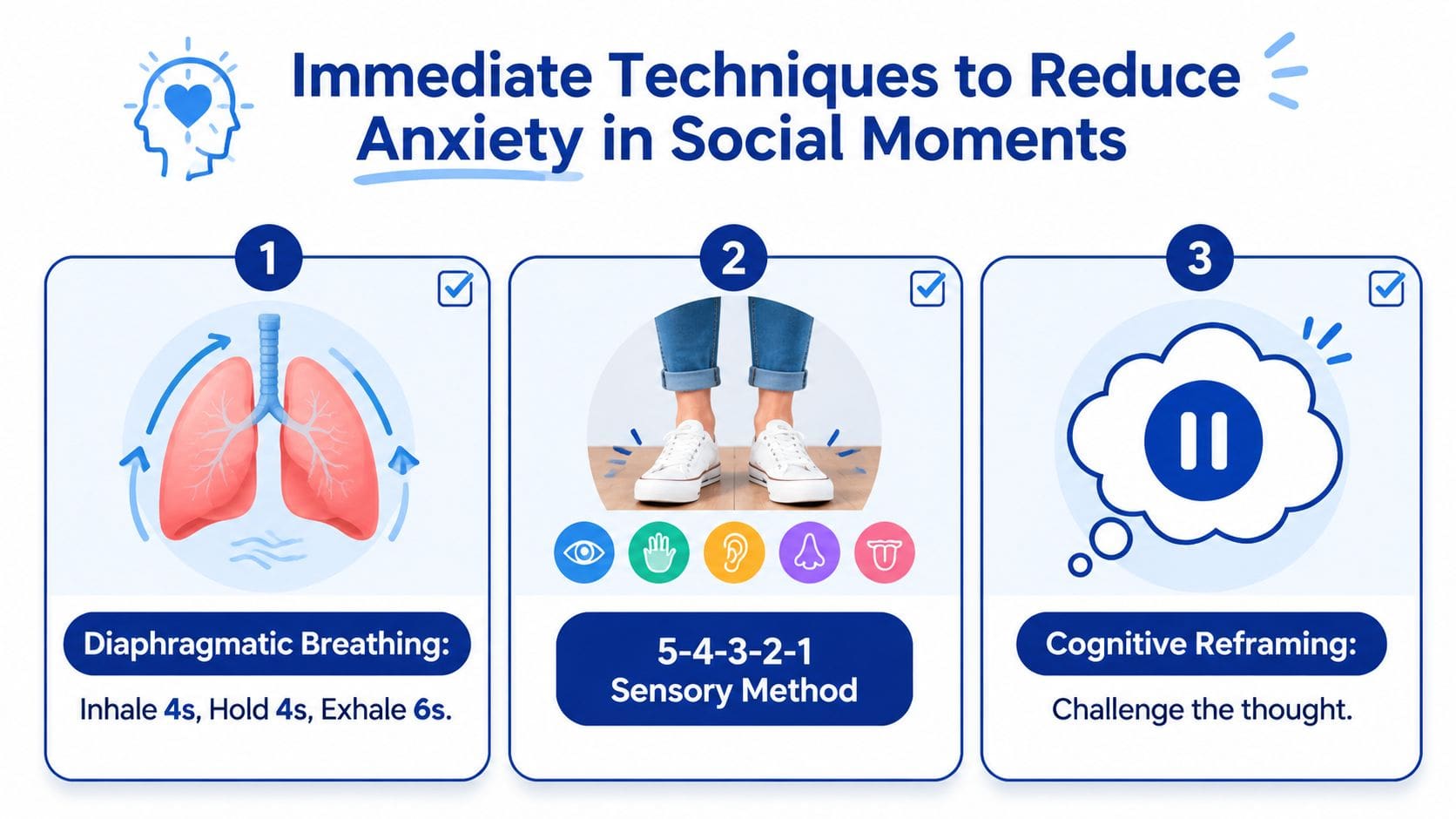
The 5-4-3-2-1 grounding method works because it pulls attention outward. A person waiting to speak in a team meeting can name 5 things seen, 4 things felt, 3 things heard, 2 things smelled, and 1 thing tasted. That shift matters because social anxiety thrives on self-monitoring, the internal scan of “How am I coming across right now?”
The 5-4-3-2-1 Grounding Tool is useful when anxiety starts to spiral during a call or while standing in line. It's not about distraction for its own sake. It's about moving attention away from the anxious internal loop long enough for the person to stay present.
A second option is diaphragmatic breathing. A simple 4-7-8 rhythm can be used before a job interview or after stepping into a crowded room, inhale for 4, hold for 7, exhale for 8. The pace of the exhale is the part that often helps the body settle, especially when breath has become shallow from tension.
How to use these skills without drawing attention
Progressive muscle relaxation can also be adapted for public use. Instead of obvious full-body tensing, the person can gently press feet into the floor, relax the jaw, lower the shoulders, and soften the hands inside a pocket or lap. Those small changes reduce physical guarding without announcing that anxiety is happening.
Anxiety gets louder when attention stays trapped inside the body. Skills work best when they redirect attention outward while the person keeps participating.
The important trade-off is this. These tools are bridges, not cures. They help someone stay in the situation long enough to practice the next step, which is how real treatment starts to work. Used alone, they often bring temporary relief. Used alongside exposure and therapy, they help the person tolerate the learning process.
Building a Graded Exposure Plan That Actually Works
Generic advice like “face your fears” usually fails because it skips the structure that makes exposure work. The method is slower, more specific, and much less dramatic. A person in Allentown who panics at office lunches doesn't need to start by giving a speech, they need a ladder of manageable steps that teaches the brain repeated, non-catastrophic experiences.
How a fear hierarchy gets built
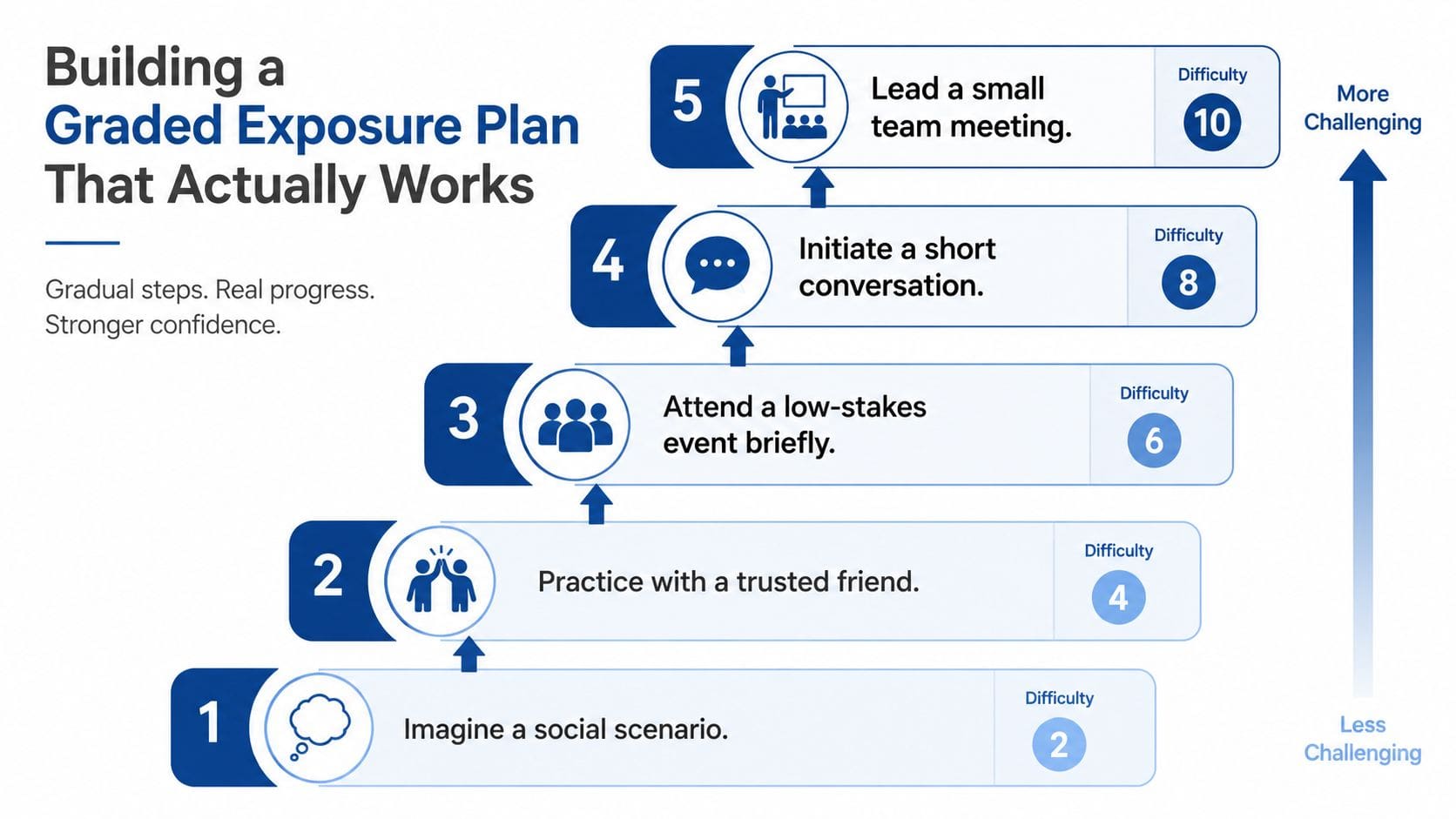
The first step is rating feared situations on a 0-to-10 difficulty score. The NHS Inform self-help guide recommends starting with the lowest-ranked item, repeating it until anxiety reduces, then moving to the next item (NHS Inform social anxiety guide). That is much more actionable than telling someone to just “be braver.”
A working hierarchy might look like this. It could begin with making eye contact with a cashier, then asking a simple question, then speaking briefly to a colleague, then attending a small gathering for a short time, and finally leading a team meeting. The order matters more than the exact items. The person is teaching the brain that a social situation can be uncomfortable without being dangerous.
What real exposure is, and what it is not
Exposure is not the same as white-knuckling a trigger while secretly doing everything possible to feel safe. The CBT protocol for social anxiety in the NCBI Bookshelf emphasizes a sequence of psychoeducation, cognitive restructuring, graduated exposure, core-belief work, and relapse prevention, with at least one 90-minute exposure session and typically 15 to 16 weekly 60-minute sessions over about 4 months (NCBI CBT protocol). The mechanics matter. Clinicians use a fear hierarchy, track distress during exposure with repeated ratings, and assign homework between sessions so learning carries into daily life.
Safety behaviors are the trap. Rehearsing every sentence, avoiding eye contact, hiding behind a phone, or asking for constant reassurance can prevent real belief change. The person may get through the event, but the brain never gets the chance to learn that the feared outcome usually doesn't happen, or that it's tolerable if discomfort shows up.
Useful distinction: tolerating anxiety is not the same as treating it. Treatment asks for repeated, planned practice without the crutches that keep fear credible.
For workplace-specific exposure, the hierarchy should include hybrid meetings, brief check-ins with a manager, asking one question in a group call, or staying for the first 15 minutes of a networking event. Those are the exact situations many self-help pages skip, even though they matter most for adult functioning.
Lifestyle Factors That Amplify or Reduce Social Anxiety
People often do the obvious things, they breathe, they read self-help content, they try exposure, and the anxiety still feels stubborn. That's usually the point where sleep, caffeine, alcohol, and movement deserve a closer look. These aren't side issues, they change the baseline level of arousal that the nervous system brings into social situations.
Which habits matter first
Harvard notes that poor sleep is linked to worsening anxiety, and that alcohol may feel helpful short term but tends to worsen anxiety in the long run; it also reports that aerobic exercise may be even more beneficial for social phobia when combined with CBT (Harvard health guidance). Mayo Clinic recommends regular physical activity, enough sleep, a healthy, well-balanced diet, avoiding alcohol, and limiting caffeine (Mayo Clinic treatment guidance). The order of priorities is practical. Sleep and substance habits usually affect anxiety more immediately than a perfect exercise plan does.
Caffeine can be especially relevant for people who already feel keyed up before work. A Philadelphia professional who drinks a large coffee before a presentation may find the physical symptoms, such as a racing heart or shaky voice, feel more intense. Alcohol can create the opposite problem, temporary relief followed by worse anxiety later, which is why it often becomes part of the cycle instead of a solution.
A better way to prioritize changes
A consistent sleep schedule is often the first lever worth tightening, because poor sleep makes every other intervention harder. Exercise comes next, but it doesn't need to be extreme. A Pittsburgh remote worker who spends most of the day at a desk may get more benefit from a daily walk or short workout than from trying to overhaul the entire routine at once.
Clinical takeaway: the goal is not a perfect wellness routine. The goal is lowering the background load so exposure and CBT have a fair chance to work.
For a practical way to track patterns, the Feeling Journal can help connect sleep, caffeine, and social triggers to mood shifts over time. A related discussion of confidence, dating, and social worry also appears in BetterDatingAI's confidence-building techniques, which may help readers who notice social anxiety showing up most strongly in one-to-one interactions.
Treatment Options Including Medication and Telehealth CBT
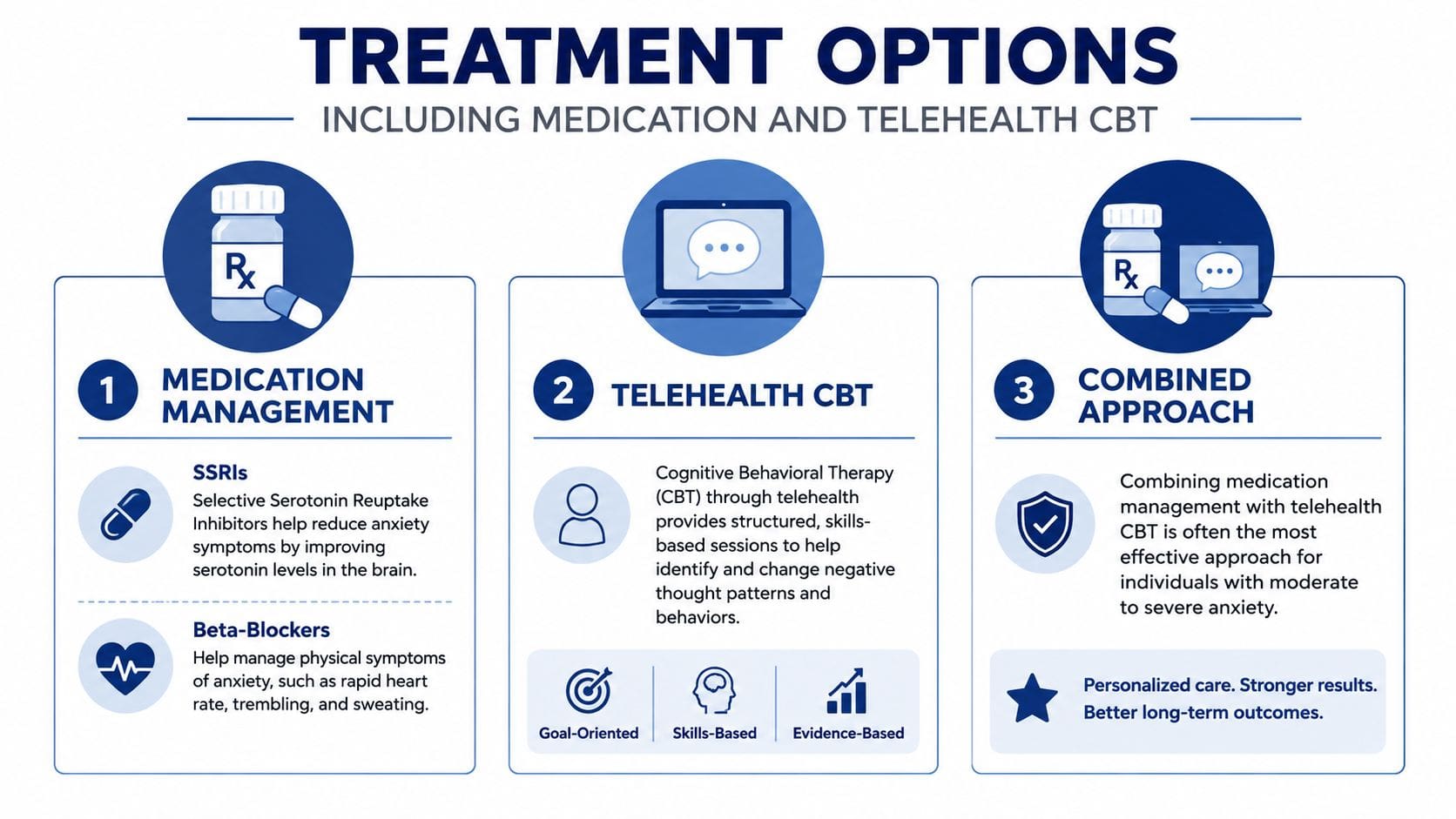
When self-management isn't enough, treatment choices usually fall into three lanes. Some people need medication support, some need structured therapy, and many do best with both. The right option depends on severity, access, and how much the anxiety is interfering with daily life.
Medication, therapy, and combined care
Medication management often includes SSRIs or, in selected situations, beta-blockers for performance-related symptoms. Medication can lower the intensity of the physical alarm response, which may make it easier to participate in therapy or tolerate exposures. It does not teach new coping skills by itself.
Telehealth CBT is a strong option for adults who want structured care from home. Remote CBT protocols still use the core mechanisms that matter, a personalized cognitive model, experiments that show the cost of self-focused attention and safety behaviors, video or photo feedback to correct distorted self-image, attention training, and behavioral experiments in real social settings (remote cognitive therapy trial). That matters because online care can still be active, specific, and skill-based rather than generic check-ins.
For a broader care model, integrative psychiatry can combine medication with lifestyle counseling, nutrition guidance, and behavioral treatment. In Pennsylvania, that kind of care can be delivered statewide through secure telehealth, including to patients in Philadelphia, Harrisburg, Erie, and smaller communities. Integrative Psychiatry of America provides virtual psychiatric evaluations, medication management, and evidence-informed treatment for anxiety, including social anxiety, as part of its broader telepsychiatry services.
Choosing the right level of care
A practical way to think about it is this. Mild symptoms with clear triggers may respond to CBT and lifestyle changes. More persistent or impairing symptoms often need a combined approach, especially if avoidance has become a habit for years. That same pattern can affect dating, and readers who want a separate, disability-aware social option may find Special Bridge useful as a place to think about connection with fewer assumptions built in.
Treatment works best when it matches the problem, not when it tries to be everything at once.
The decision point is not whether someone is “bad enough” for care. It's whether the anxiety is making work, relationships, or basic participation smaller than they should be. If it is, treatment is reasonable.
When to Seek Professional Care and How to Get Started
Professional care becomes the next step when social anxiety keeps interfering with work performance, relationships, or daily functioning despite real effort. A person may still go to work, answer texts, and show up for obligations, yet spend most of the day bracing for embarrassment or replaying every interaction afterward. That kind of pattern is exhausting, and it tends to grow stronger when left alone.
What a telepsychiatry evaluation looks like
A virtual evaluation usually covers current symptoms, triggers, avoidance patterns, sleep, substance use, medical history, and treatment goals. A good clinician also asks how anxiety shows up at work, at home, and in social settings, because the context matters. For readers who want a sense of readiness before booking, the When to See a Psychiatrist page can help frame that decision.
Preparation is simple. It helps to write down the situations that trigger the most distress, the physical symptoms that show up, and any coping strategies already tried. It also helps to note whether the fear is mostly about speaking, being observed, being judged, or making mistakes, because those details guide treatment planning.
How to talk about it without overexplaining
A short script can be enough: “Social situations make me tense, I avoid some things, and it's affecting my work and confidence.” Another option is, “I've tried self-help steps, but I'm still stuck.” Those phrases are direct, which makes it easier for the clinician to understand the severity quickly.
Insurance concerns and stigma keep many adults from reaching out. Some worry they'll be dismissed, but a careful evaluation should feel collaborative, not minimizing. Adults who want to start tracking their patterns right away can use the Anxiety Symptom Checker and the Daily Agenda Planner from Integrative Psychiatry of America to notice triggers, plan exposures, and watch progress more clearly.
If social anxiety has been running the schedule, it's time to change the schedule. Verify insurance, schedule a virtual evaluation, and use the free tools to start mapping symptoms before they map your day.
Integrative Psychiatry of America offers virtual psychiatric evaluations, medication management, and evidence-informed treatment for social anxiety across Pennsylvania. If meetings, networking, dating, or everyday conversations have started to feel harder than they should, visit Integrative Psychiatry of America to explore telehealth care, verify coverage, and take the next step toward steadier support.