
A person often looks up how to self soothe when the day has already gone sideways. It may be late at night in Philadelphia, after a tense text exchange, a near-panic moment, or a workday that never stopped pulling in five directions at once. It may be a college student in Pittsburgh who can't settle after an exam, or a parent in Harrisburg whose mind won't slow down after everyone else is asleep.
That search is not overreacting. It's a practical response to distress.
Self-soothing isn't about pretending everything is fine. It's a set of concrete skills that helps the body and mind come down from overload. For some people, that means calming anxiety. For others, it means managing ADHD overwhelm, trauma-related activation, irritability, or the restless feeling that comes when the nervous system is stuck in high gear. Some people also like to support stress reduction with daily routines such as hydration, regular meals, and calming beverages. For readers interested in lifestyle-based stress support, this guide to natural stress reduction with kombucha offers one example of how people build gentle rituals around calming habits.
The key point is simple. Self-soothing works best when it is specific, repeatable, and matched to the kind of distress a person is having. Generic advice can help, but only if it fits the moment.
Table of Contents
- That Overwhelming Moment and the Search for Calm
- Understanding How Soothing Calms Your Nervous System
- Foundational Soothing Techniques for Immediate Relief
- Tailoring Techniques for Anxiety ADHD and PTSD
- Building a Personal Soothing Plan for Lasting Resilience
- When to Seek Professional Support in Pennsylvania
That Overwhelming Moment and the Search for Calm
A person in Scranton might feel it while sitting in a parked car before going into work. A person in Allentown might feel it while trying to answer one more email and suddenly noticing a tight chest, clenched jaw, and a mind that can't track a single thought to the end. Someone with ADHD may not even describe it as anxiety at first. It may feel more like internal static, agitation, or the sense that everything is too much at once.
That moment matters because it's usually when people are given bad advice. They're told to relax, think positive, or stop overthinking. None of those directions tell the nervous system what to do next.
Self-soothing is more useful than that. It gives the body a sequence. Pause. Reduce stimulation. Add one calming input. Repeat until the level of distress comes down enough to think clearly again. That's a skill, not a personality trait.
Self-soothing works best when it's treated like a tool kit, not a test of willpower.
It also helps to say something plainly. Some techniques work well for one condition and poorly for another. A person with panic may need stronger sensory interruption than a person with mild stress. A person with PTSD may find certain calming exercises too activating. A person with ADHD may feel worse if the method demands stillness and silence too early.
That doesn't mean the person is doing it wrong. It means the method needs to fit the brain and body using it.
Understanding How Soothing Calms Your Nervous System
When distress spikes, the nervous system shifts into protection mode. Heart rate rises. Breathing changes. Muscles tighten. Attention narrows. The body is trying to help, but in everyday life that alarm response can become too strong or last too long.
Self-soothing helps because it gives the body a cue that the immediate danger has passed. That cue usually comes through the body first, not through debate or reassurance.
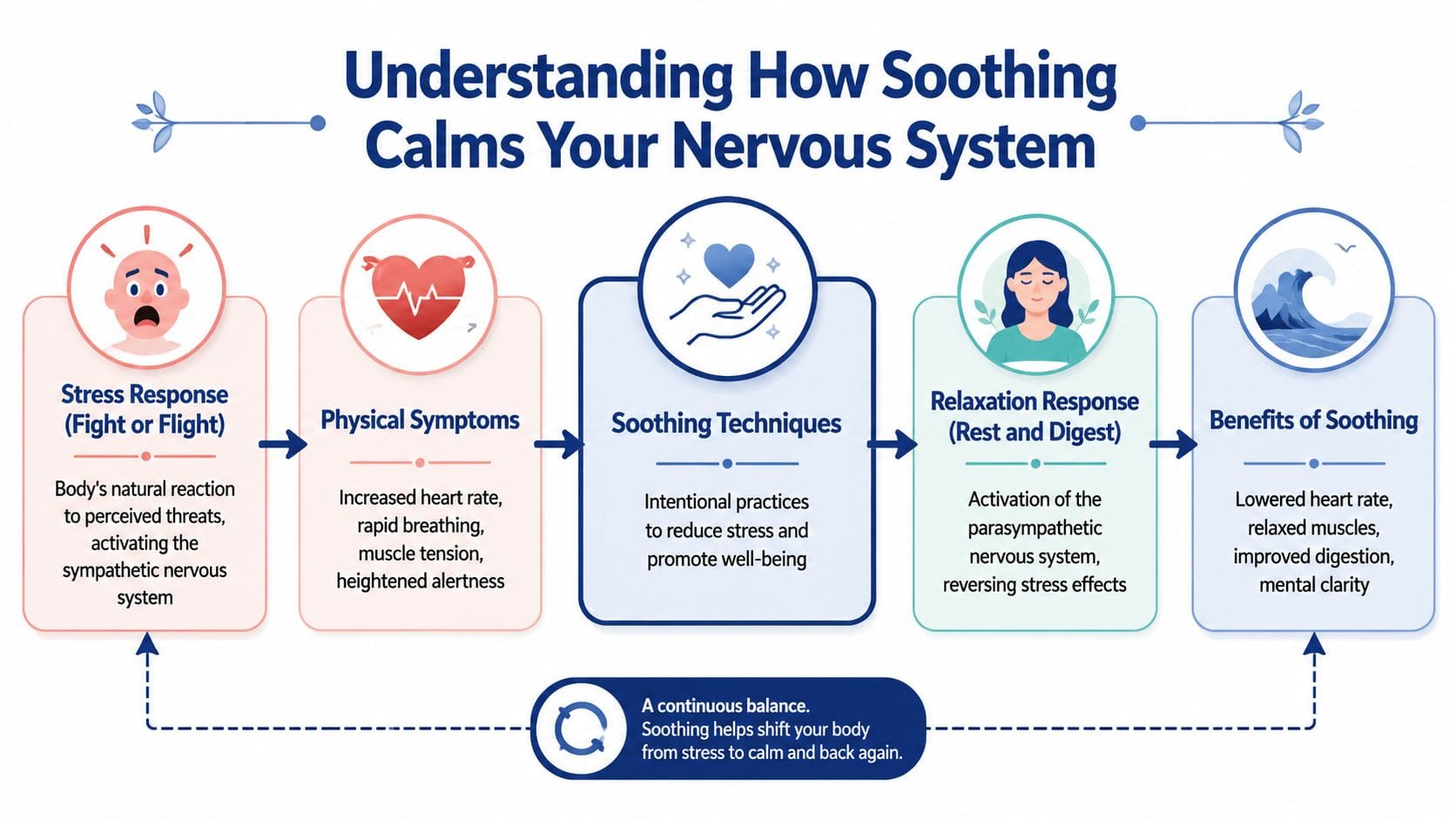
Why thinking alone often does not work
A clinically usable self-soothing protocol can be built around physiological down-regulation. The sequence is to use a neutral time-out cue, step away from the trigger, then do deep, regular breathing, guided imagery, and progressive muscle relaxation in order until arousal drops, as described in this Gottman overview of physiological self-soothing. The practical lesson is important. If a person stays in the triggering interaction, flooding can keep the stress response activated, and self-talk becomes much less effective.
That's why many people say, “I know what I should tell myself, but I can't get there.” The problem often isn't insight. The problem is timing.
A person who is flooded usually needs distance from the trigger before any reflective coping skill will land. That might mean leaving the room, putting the phone down, stepping outside, muting notifications, or pausing a difficult conversation until the body is less activated.
Practical rule: If the stressor is still hitting the nervous system, calming thoughts usually won't stick.
What the body needs first
Once the trigger is interrupted, the body tends to respond better to methods that are repetitive and low demand. Slow, regular breathing helps. Progressive muscle relaxation helps because it gives tight muscles a job and then a release. Guided imagery can help if it feels safe and not overstimulating.
A useful way to think about this is as a brake pedal. Self-soothing doesn't erase the situation. It reduces the speed of the nervous system so a person can steer again.
Some people are also curious about the biology behind stress, mood, and calming systems. For a plain-language overview of one brain chemical involved in mood regulation, this article on 5-HT and mental health can add context without turning self-soothing into a chemistry lecture.
Foundational Soothing Techniques for Immediate Relief
The most effective immediate tools are usually the simplest ones. In operational guidance, self-soothing often uses box breathing with 4-4-4-4 counts, 4-7-8 breathing, or a 5-4-3-2-1 sensory scan, sometimes paired with a warm drink, a calming sound, or a tactile object. The same guidance also notes that it helps to choose one or two inputs and repeat them, rather than stacking too many techniques at once, as outlined in this Talkspace self-soothing guide.
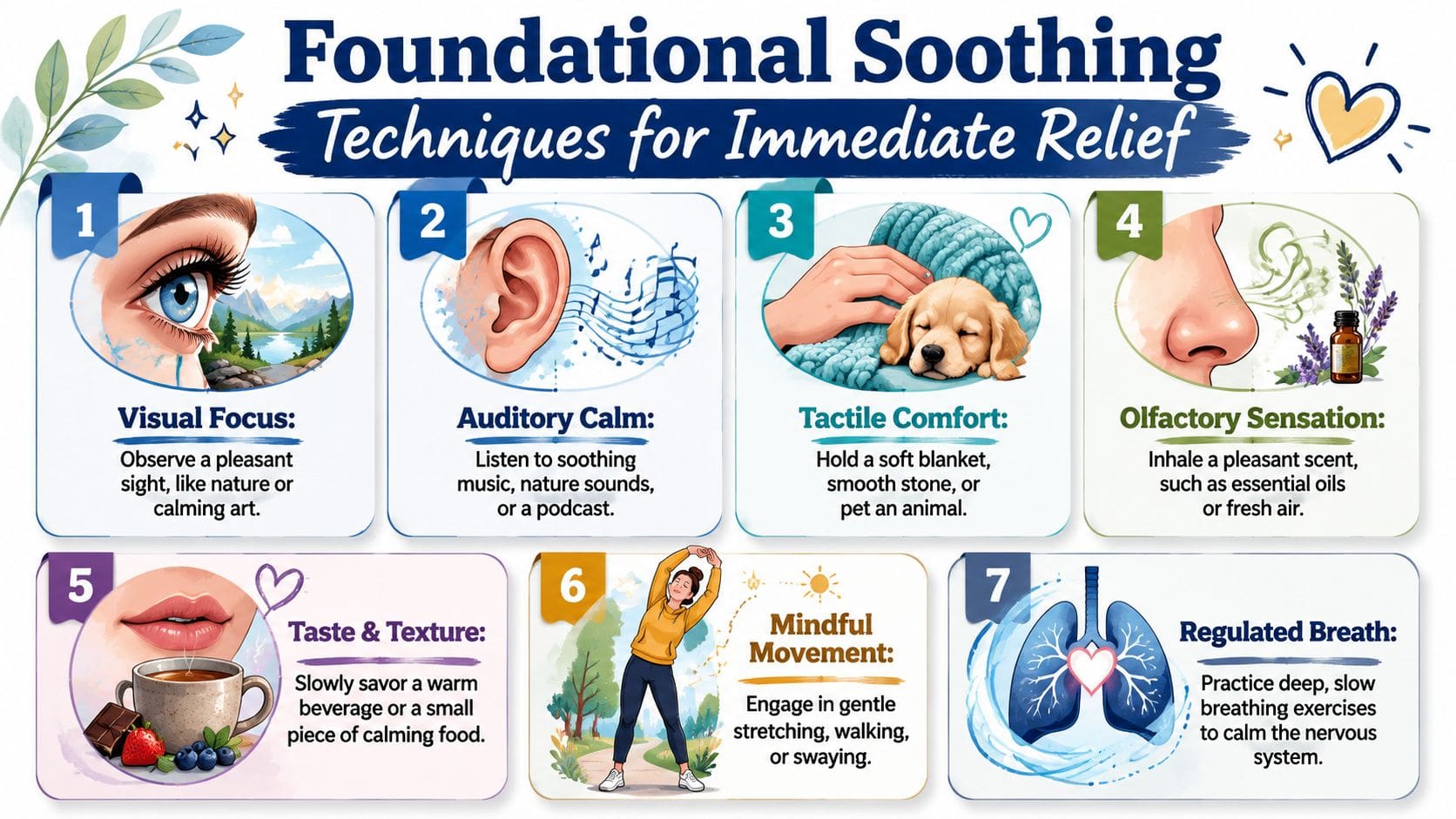
Breathing methods that are easy to repeat
Breathing exercises work best when they are simple enough to do while upset.
Box breathing
Breathe in for 4, hold for 4, breathe out for 4, hold for 4. Repeat several rounds. This can help when the mind is scattered and a person needs a clean pattern to follow.4-7-8 breathing
Breathe in for 4, hold for 7, breathe out for 8. This often feels better when the goal is slowing down and lengthening the exhale.
A person doesn't need to decide which method is “best.” It's enough to notice which one feels easier to continue when distressed. If a breathing exercise creates air hunger or frustration, it may not be the right fit for that moment.
A grounding method for racing thoughts
The 5-4-3-2-1 method is useful when thoughts are looping or the environment feels unreal.
- 5 things seen. Name visible objects slowly.
- 4 things felt. Notice feet on the floor, clothing, chair pressure, or air on the skin.
- 3 things heard. Listen for near and far sounds.
- 2 things smelled. If nothing stands out, use a lotion, tea, or clean fabric.
- 1 thing tasted. A mint, gum, or sip of water works.
This method helps by moving attention outward in an organized way. That can be especially useful during stress spikes, dissociation, or overwhelm. A guided option is available through this 5-4-3-2-1 grounding tool in the Zen Room.
The goal isn't to feel perfect after one round. The goal is to feel a little more present, then repeat.
Building a small sensory kit
A soothing kit doesn't need to be elaborate. It works best when it can be reached quickly.
A practical kit might include:
- A tactile item such as a smooth stone, soft fabric, or fidget object.
- A calming sound such as one song, one playlist, or one steady ambient track.
- A warm drink that is familiar and easy to prepare.
- A grounding scent if scent is helpful. People interested in scent-based calming can review ArtNaturals' aromatherapy guide for examples of how aromatherapy is used in stress-relief routines.
The main mistake is overloading the moment. Too many choices can increase cognitive strain. One breath pattern plus one sensory anchor is often enough.
Tailoring Techniques for Anxiety ADHD and PTSD
Not every nervous system responds to calm the same way. That matters most when standard advice backfires.
Guidance on self-soothing increasingly points out an important gap. What helps one person may intensify distress for another, especially in panic, PTSD, ADHD, or other high-arousal states. It also emphasizes that effective self-soothing is highly individualized and that people should test strategies and pay attention to what proves effective for them, as discussed in this Charlie Health article on self-soothing techniques.
For anxiety and panic
During panic, subtle methods may feel too weak at first. A person may need a stronger interrupting signal before quieter tools help.
Useful options can include:
- Cold sensory input such as cool water on the face or holding something cold
- Short verbal orientation such as naming the room, date, or current location
- Structured breathing once the initial surge begins to settle
The point isn't to force deep insight during a panic spike. It's to interrupt the escalation loop and bring the body down enough to regain control.
For ADHD overwhelm
Stillness can be a poor first-line choice for ADHD. When attention is already fragmented, being told to sit and breathe may feel irritating or impossible.
A better starting point is often regulated movement. That might look like pacing, rocking in a chair, stretching, walking a hallway, squeezing a therapy putty, or using a fidget while doing counted breathing. Rhythmic input gives the nervous system something to organize around.
People who suspect attention symptoms are adding to emotional dysregulation may benefit from a broader evaluation, such as this adult ADHD assessment resource when trauma and concentration problems overlap in daily life. Because symptoms can overlap, external grounding remains a safer default when the picture isn't fully clear.
A short skills demonstration can also help when words are hard to hold onto in the moment.
For PTSD and trauma-related distress
With trauma, some classic techniques need modification. Closing the eyes for guided imagery may feel unsafe. Focusing on internal body sensations can sometimes intensify distress rather than reduce it.
Safer options often focus on external orientation:
| Situation | Better choice | Why it may help |
|---|---|---|
| Internal sensations feel intense | Name objects in the room | Attention shifts outward |
| Closing eyes feels unsafe | Keep eyes open and scan for neutral details | Supports present-moment orientation |
| Silence feels activating | Use a steady sound or spoken guidance | Adds predictable structure |
For trauma-related symptoms, many people do better with concrete grounding than with abstract relaxation. This collection of PTSD grounding techniques offers examples that keep the focus on present safety.
Building a Personal Soothing Plan for Lasting Resilience
A good soothing plan is short enough to remember and specific enough to use when thinking is harder. It should fit the person's triggers, energy level, and diagnosis pattern.
A simple plan that is easier to use under stress
A practical plan can fit on one note in a phone or on an index card:
- Known triggers such as conflict, overstimulation, deadlines, lack of sleep, or trauma reminders
- Early signs like chest tightness, irritability, mental fog, racing thoughts, or the urge to escape
- Two primary tools that usually help
- One backup tool for days when the first option fails
- One support step such as texting a safe person, taking a short walk, or logging symptoms
This works better than a long list because distress narrows attention. A person usually won't sort through ten ideas in a high-stress moment.
A soothing plan should be realistic on a bad day, not impressive on a good day.
How to test what actually helps
Pattern tracking matters. A person with ADHD may discover that movement plus a tactile object works far better than seated breathing. A person with PTSD may learn that external grounding works but imagery does not. A person with anxiety may notice that a warm drink and one repeated breath pattern bring the fastest shift.
Helpful tracking questions include:
- What triggered the spike
- What level of distress it felt like
- Which tool was used first
- Whether distress dropped, stayed the same, or increased
- What might be tried next time
Daily routines also shape how well self-soothing works under pressure. Readers who want structure around small, repeatable habits may find this guide to consistent self-care useful as a framework for everyday regulation. Nutrition can matter too, especially when irregular eating worsens irritability or shakiness. This overview of how nutrition affects mental health explains that connection in practical terms.
When to Seek Professional Support in Pennsylvania
Self-soothing is a valuable skill. It is not a complete treatment plan for every problem.
A person should think about professional support when distress keeps returning, disrupts work or school, affects relationships, interferes with sleep, or starts shaping daily choices around avoidance. The same is true when symptoms involve trauma, panic, depression, obsessive thinking, or attention problems that keep pulling life off course.
Signs self-soothing is not enough
The shift from self-help to treatment often becomes clear when one or more of these patterns show up:
- Symptoms are frequent and not limited to isolated stressful days
- Techniques stop working or only help briefly
- The person avoids normal activities because of fear, overwhelm, or exhaustion
- Mood symptoms deepen into hopelessness, shutdown, or loss of interest
- Trauma reactions appear such as intense triggering, hypervigilance, or feeling chronically unsafe
These aren't signs of weakness. They usually mean the nervous system needs more support than a coping skill can provide on its own.

Virtual mental health care across Pennsylvania
For adults in Pennsylvania, getting help doesn't have to mean traveling across the state or waiting until symptoms become severe. Virtual psychiatric care can make evaluation and treatment more accessible in Philadelphia, Pittsburgh, Harrisburg, Erie, Scranton, Allentown, Lancaster, Reading, and smaller communities statewide.
When a person is unsure whether it's time for an evaluation, this article on when to see a psychiatric provider can help clarify the next step. Treatment may include a diagnostic assessment, medication management, therapy recommendations, lifestyle strategies, or a combination of approaches depending on the symptom pattern.
A careful evaluation is especially helpful when anxiety, ADHD, PTSD, depression, OCD, or sleep problems overlap. Those conditions can look similar on the surface but respond differently to treatment. A personalized plan often makes self-soothing more effective because the underlying condition is being treated, not just the moment of distress.
If self-soothing helps sometimes but not enough, Integrative Psychiatry of America offers virtual psychiatric evaluations, medication management, and evidence-informed mental health treatment for adults across Pennsylvania. Readers can learn about treatment options, verify insurance, and explore care from home.