
A Pennsylvania adult may reach the same point after a long day at work, missed deadlines, unfinished household tasks, and another pharmacy call that goes nowhere. A parent in Pittsburgh may be searching late at night after struggling to find an evaluation for a child, while a professional in Philadelphia may type “get a prescription for Vyvanse online” because local specialist appointments are difficult to secure.
The search is understandable, but Vyvanse isn't an ordinary online purchase. It contains lisdexamfetamine, a prescription stimulant, and access requires a clinical evaluation, appropriate monitoring, pharmacy coordination, and compliance with federal and Pennsylvania rules. In CDC data collected during October and November 2023, 46.0% of adults with current ADHD reported ever receiving telehealth services for the condition, which shows how common remote ADHD care has become, not that a specific medication is guaranteed (CDC data on telehealth and adult ADHD care).
Table of Contents
- Navigating the Search for Online ADHD Care
- Understanding Legal Requirements and Schedule II Rules
- Preparing for the Clinical Evaluation Process
- Identifying Legitimate Providers Versus Scams
- Navigating Insurance and Follow-Up Care
- Moving Forward with Integrative ADHD Management
Navigating the Search for Online ADHD Care
A parent in Pittsburgh may start with a simple goal: find a clinician who can assess ADHD without requiring repeated travel across the state. An adult in Philadelphia may have already tried primary care, waited for a specialist, and searched online because work, childcare, or transportation made conventional appointments difficult. Both patients are looking for convenience, but the right outcome isn't a fast transaction. It's a safe and lawful treatment relationship.
An online search should lead to questions about the quality of care. Does the provider evaluate symptoms across settings? Will the clinician review prior records, current medicines, cardiovascular history, and mental health symptoms? Does the practice offer follow-up after medication starts, or does it only advertise access to a named drug?
Practical rule: A legitimate telehealth visit can make care easier to access, but it can't bypass diagnosis, risk assessment, or clinical judgment.
Telehealth may be appropriate for ADHD assessment and medication management when the patient and clinician meet the applicable requirements. The clinician still needs to confirm the patient's identity and location, understand the functional impact of symptoms, and decide whether stimulant treatment is clinically appropriate. A request for Vyvanse may lead to a prescription, a non-stimulant recommendation, therapy, additional records, or no medication.
Patients preparing for a psychiatric visit may also benefit from organized documentation. Clear symptom timelines, previous evaluations, and treatment responses help the clinician make a better decision. Resources such as medical notes for psychiatrists can help organize clinically relevant information before an appointment, although personal notes can't replace a diagnostic assessment.
Pennsylvania patients seeking a structured starting point can review online ADHD treatment in Pennsylvania and compare the evaluation, follow-up, and medication-management services offered. The important shift is from searching for a product to arranging care with a qualified provider.
Understanding Legal Requirements and Schedule II Rules
A Pennsylvania patient may be able to receive Vyvanse through telehealth without a prior in-person examination in 2026. The result depends on the clinician's authority, the patient's location, the technology used, the clinical purpose, and the applicable federal and state rules. Lisdexamfetamine is a Schedule II controlled substance, so an online form or medication request cannot create a valid prescription.
The FDA identifies Vyvanse as lisdexamfetamine dimesylate, a central nervous system stimulant indicated for ADHD and moderate-to-severe binge-eating disorder. FDA labeling records its initial U.S. approval in 2007 (FDA Vyvanse prescribing information). The prescriber must determine that treatment serves a legitimate medical purpose and falls within ordinary professional practice.
What the federal telehealth extension changes
A temporary federal telemedicine extension applies from January 1 through December 31, 2026. During that period, a DEA-registered practitioner may prescribe Schedule II through Schedule V controlled substances by telemedicine without first completing an in-person examination, provided the required conditions are satisfied. Those conditions include interactive audio-visual communication, valid authorization, and a legitimate medical purpose (HHS information on the 2026 DEA telemedicine extension).
Federal flexibility does not replace Pennsylvania requirements. The clinician must be authorized to practice where the patient is located, and the visit must comply with the laws that apply to that encounter. Location must be confirmed at the time of care. A patient who lives in Pennsylvania may be temporarily elsewhere during the appointment, which can change the rules the clinician must follow.
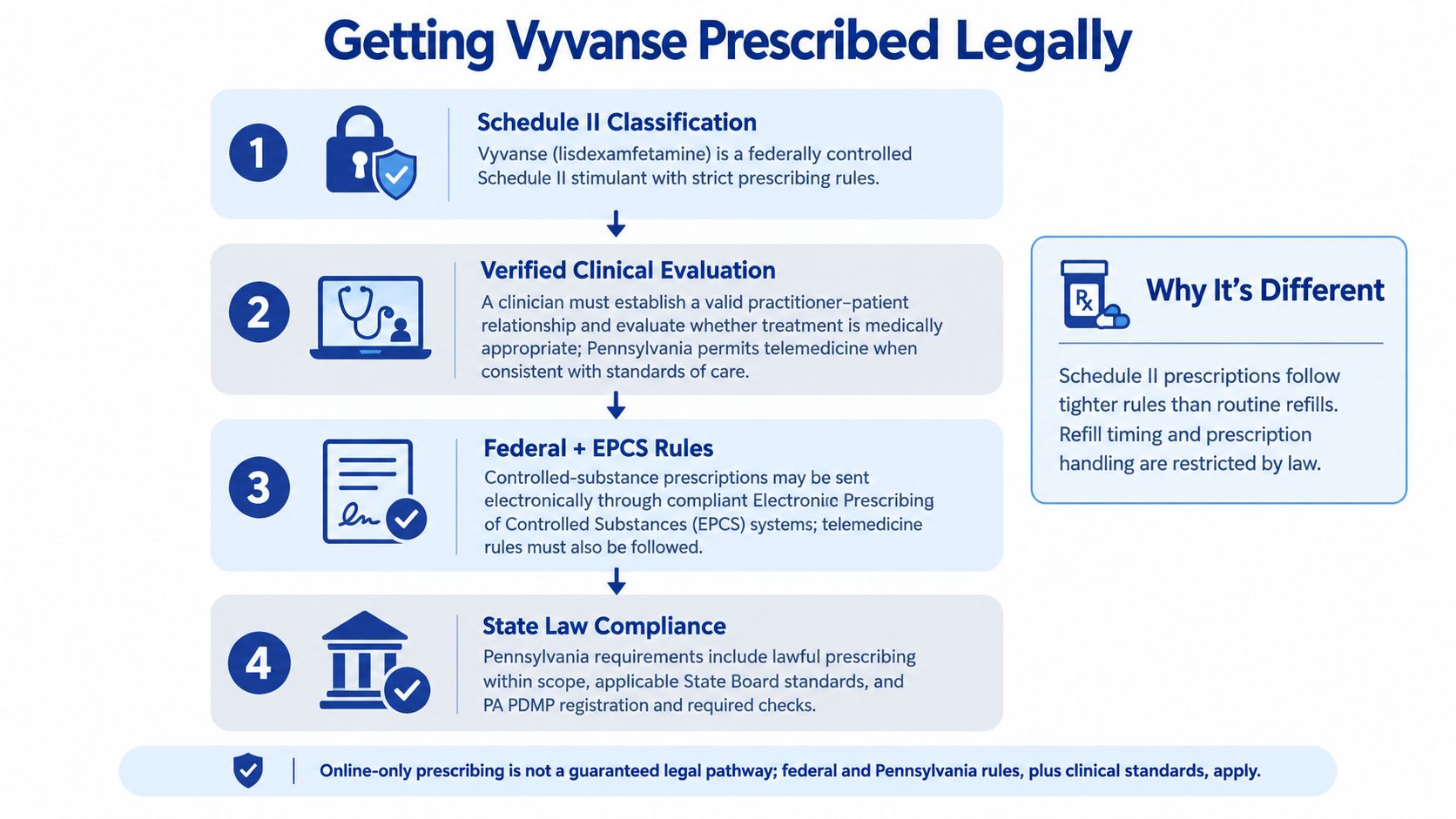
A lawful telehealth process connects an authorized clinician, clinical evaluation, compliant communication, a prescription issued for a legitimate purpose, and pharmacy dispensing. A service that promises Vyvanse before evaluation is not a lawful shortcut. It may be advertising prescription-only treatment or exposing patients to unsafe care.
For ongoing treatment, online medication management explains why prescribing decisions, monitoring, and follow-up should remain part of one treatment plan.
Preparing for the Clinical Evaluation Process
A productive online ADHD evaluation begins before the video visit. Gather enough information for the clinician to distinguish ADHD from sleep problems, anxiety, depression, trauma-related symptoms, substance effects, medication side effects, and other medical conditions. This preparation helps the appointment focus on clinical judgment rather than a rushed medication request.
What the clinician needs to establish
The clinician will review your symptoms, when they began, how consistently they occur, and whether they impair work, school, relationships, home responsibilities, or other areas of functioning. Identity, age, and Pennsylvania location may also need to be confirmed as part of the visit.
Have the following information ready:
- Prior assessments: Bring ADHD evaluations, psychological testing, school records when relevant, and previous treatment notes.
- Medication history: List current and past prescriptions, dose changes, benefits, adverse effects, supplements, and over-the-counter products.
- Cardiovascular information: Report heart disease, arrhythmia, fainting, chest symptoms, blood pressure concerns, and family cardiac history.
- Psychiatric symptoms: Describe anxiety, depression, bipolar symptoms, psychosis, tics, irritability, sleep changes, and suicidal thoughts when present.
- Substance-use history: Give accurate information about alcohol, cannabis, prescription medicines, illicit substances, and any prior concerns about misuse or diversion.
- Practical details: Keep recent vital signs available when possible, along with pharmacy, insurance, and preferred contact information.
These questions determine whether Vyvanse is medically appropriate and how treatment should be monitored. The evaluation should address potential effects on blood pressure and pulse, misuse or dependence, psychiatric reactions, medication interactions, and relevant cardiovascular history. Patients should also disclose monoamine oxidase inhibitor use, because Vyvanse must not be taken during MAOI treatment or for 14 days after the last dose.
Why a questionnaire isn't enough
An online symptom checklist can support screening, but it does not establish a diagnosis. The clinician must interpret the history, assess impairment, consider alternative explanations, and decide whether medication fits the patient's risks and goals. A short form cannot reliably make those judgments on its own.
Dosing must be individualized according to therapeutic need and response. FDA labeling directs clinicians to use the lowest effective dosage, and doses above 70 mg per day have not been studied (FDA Vyvanse dosage labeling). Complete records and accurate answers give the clinician a stronger basis for safe decisions. They do not guarantee approval or a particular prescription.
Patients seeking a formal assessment can review online ADHD evaluation services before scheduling. The relevant question is whether the service produces a clinically defensible evaluation, not whether an online form accepts a medication request.
Identifying Legitimate Providers Versus Scams
The clearest difference between legitimate telehealth and a questionable prescription service is what happens before and after the medication request. A responsible provider may prescribe Vyvanse when appropriate, but the provider must also be willing to recommend another treatment or no stimulant when the clinical evidence doesn't support lisdexamfetamine.
A trustworthy practice explains who provides care, where that clinician is licensed, how records are reviewed, how follow-up works, and what happens if a pharmacy can't fill the prescription. It also communicates that controlled-substance prescribing depends on clinical findings. Marketing that guarantees a named medication signals the opposite approach.
A practical comparison
| Feature | Legitimate Telehealth | Questionable Service |
|---|---|---|
| Evaluation | Reviews symptoms, impairment, records, medical history, and mental health risks | Relies mainly on a short questionnaire or medication request |
| Medication decision | May recommend Vyvanse, another treatment, or no stimulant based on findings | Suggests that a named drug is the expected result |
| Safety screening | Assesses cardiovascular history, blood pressure, pulse, substance-use risk, psychiatric symptoms, and interactions | Gives little attention to contraindications or current medicines |
| Clinician information | Identifies the treating clinician and explains authorization and follow-up | Makes licensing and clinical responsibility difficult to verify |
| Monitoring | Schedules reassessment and tracks benefit, adverse effects, sleep, appetite, and vital signs | Treats refills as an automatic continuation |
| Pharmacy problems | Helps the patient discuss supply or treatment alternatives with the prescriber | Leaves the patient to solve fulfillment problems alone |
| Advertising | Describes an evaluation and treatment pathway | Promises speed, certainty, or a specific controlled substance |
A provider who can say “not Vyvanse” when the risk profile or diagnostic picture calls for another plan is demonstrating clinical independence, not poor service.
Patients should also be cautious when a service asks for inaccurate vital signs, ignores a history of substance use, or doesn't request prior records. Those shortcuts can create safety problems and may result in a prescription that a pharmacy or another clinician later questions.
The title of a clinician also deserves careful attention. A psychiatric mental health nurse practitioner and a physician psychiatrist are different professional roles, although both may provide psychiatric care within their authority. Information about psychiatrist and psychiatric nurse practitioner roles can help patients evaluate credentials without assuming that every online provider has the same training or scope of practice.
A legitimate visit may feel slower than a medication-only service because it includes history-taking, record review, risk assessment, and follow-up planning. That additional work is precisely what separates medical care from a purchase flow.
Navigating Insurance and Follow-Up Care
Insurance and pharmacy planning can determine whether an appropriate treatment plan starts on time. Patients should verify telehealth and medication-management benefits before the initial appointment. The insurance verification process can help confirm network status and authorization requirements. Network status, copays, deductibles, and authorization requirements vary by plan, so patients with Cigna, Aetna, UnitedHealthcare, or BCBS and IBX should confirm coverage with both the insurer and the practice.
Handling coverage and pharmacy logistics
Use a clear sequence to reduce avoidable delays:
- Verify the visit benefit. Ask whether the clinician and service are in network, and whether an ADHD evaluation or medication-management visit requires authorization.
- Ask about pharmacy coverage. A plan may treat generic lisdexamfetamine and brand Vyvanse differently. The formulary can also determine whether prior authorization is needed.
- Confirm stock before transmission. Pharmacy availability changes. Contact the preferred pharmacy before the prescription is sent when possible.
- Report problems early. If the medication is unavailable, the prescriber can discuss an appropriate alternative or another treatment plan. Do not ration doses, borrow medication, or change the dose independently.
A coverage problem or supply issue does not necessarily mean the clinical plan was inappropriate. Among adults taking stimulant medication, 71.5% reported difficulty filling prescriptions because the medication was unavailable, according to federal information on stimulant availability and telemedicine prescribing.
Monitoring makes treatment safer
Follow-up visits should review baseline symptoms, attention-related functioning, sleep, appetite, blood pressure, pulse, and adverse effects. These findings give the clinician a basis for deciding whether benefits outweigh risks and whether the treatment plan requires adjustment.
A review of lisdexamfetamine pharmacotherapy reported an approximate 58% response rate, with a 95% confidence interval of 55% to 61%. A separate meta-review reported a placebo-controlled standardized mean difference of -0.97, with a 95% confidence interval from -1.15 to -0.78 (review of lisdexamfetamine response and effect estimates). These are population estimates, not a personal guarantee. They also do not establish that lisdexamfetamine has an efficacy or safety advantage over every other amphetamine formulation.
Moving Forward with Integrative ADHD Management
The most useful outcome isn't just obtaining Vyvanse. It's building a treatment plan that improves attention and daily functioning while addressing sleep, appetite, anxiety, depression, stress, and other factors that can affect symptoms.
Medication may be one part of that plan. Behavioral strategies can support planning, task initiation, time management, and follow-through. Patients may also benefit from structured routines, environmental changes, therapy, exercise planning, and treatment for co-occurring conditions. The clinician can use follow-up visits to determine which approaches are helping and whether the medication's benefits justify its risks.
A sustainable plan is measurable: it tracks functioning and safety, not just whether a prescription was sent.
Pennsylvania patients should look for a virtual psychiatric provider who offers evaluation, medication management, and ongoing reassessment rather than a one-time transaction. That approach respects the urgency behind an online search while keeping diagnosis, legal compliance, and whole-person care connected.
Integrative Psychiatry of America provides secure virtual psychiatric care across Pennsylvania, including ADHD evaluation, medication management, and follow-up when treatment is clinically appropriate. Pennsylvania patients can review services, verify insurance, and request an appointment through Integrative Psychiatry of America.