
Online psychiatric medication management usually starts with a full psychiatric evaluation, followed by shared medication decisions when clinically appropriate and ongoing virtual monitoring. Both psychiatrists and psychiatric mental health nurse practitioners, or PMHNPs, may provide this care within their scope, so qualifications, condition-specific experience, access, communication and continuity matter more than a title alone.
For Pennsylvania adults and parents, the practical question is often less about finding a universal winner in Online Psychiatrist vs. Psychiatric Nurse Practitioner: What's the Difference? and more about understanding what happens after scheduling. The usual path includes intake, insurance verification when applicable, an initial evaluation, discussion of treatment options, prescribing when clinically appropriate, pharmacy coordination, and follow-up to review effectiveness, side effects and needed adjustments.
Medication isn't automatic. A specific medication, including a controlled substance, is never guaranteed. A clinician must consider symptoms, diagnosis, medical and psychiatric history, current medications, treatment goals, safety factors and applicable prescribing rules.
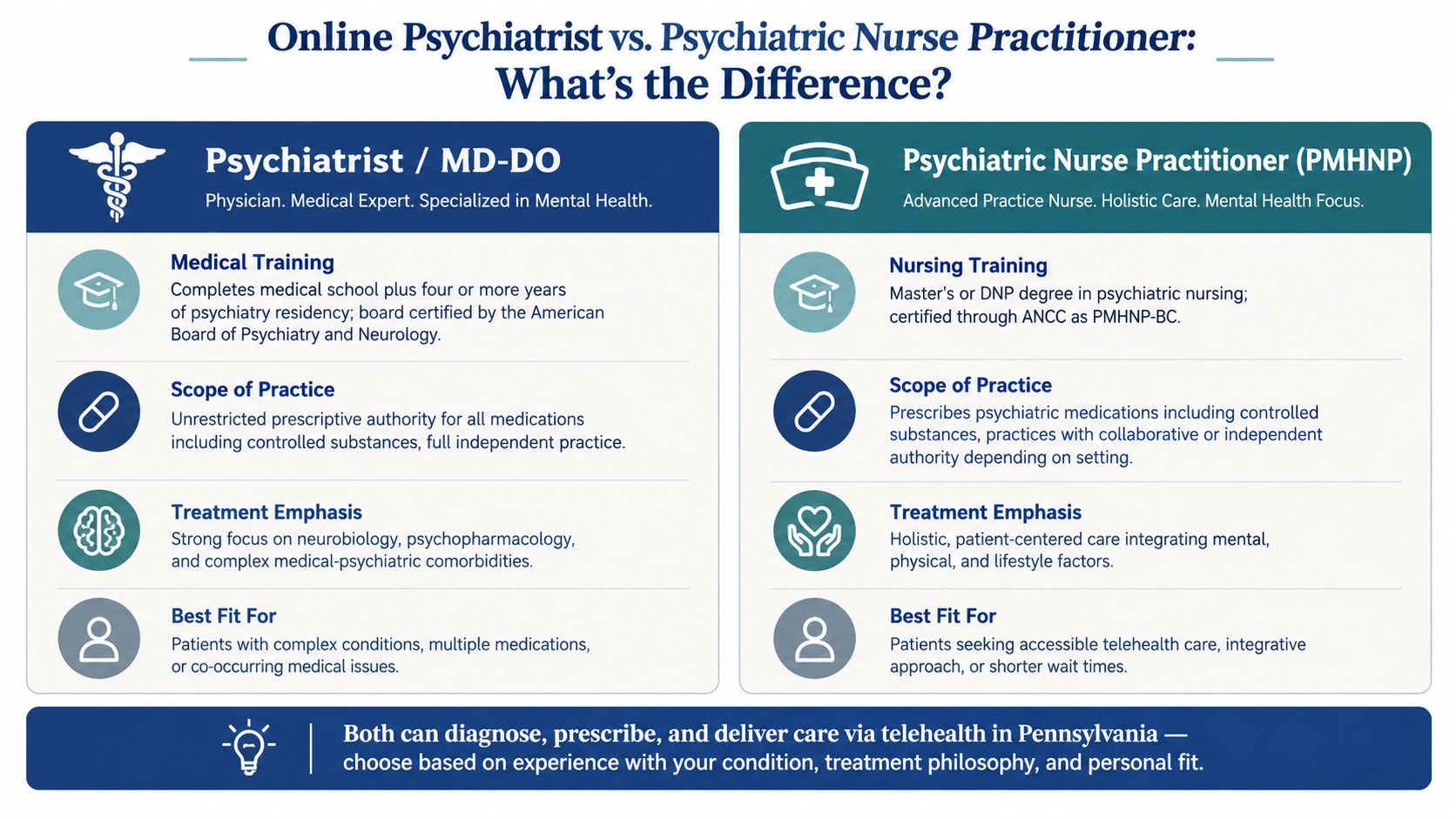
A psychiatrist is an MD or DO physician specializing in psychiatry. A PMHNP is an advanced practice registered nurse with graduate-level psychiatric education and board certification. Both professionals can diagnose mental health conditions and prescribe medication within the authority granted by applicable law. Integrative Psychiatry of America provides virtual psychiatric care throughout Pennsylvania through board-certified PMHNPs, with a whole-person approach that may include attention to sleep, exercise, nutrition, psychotherapy and other clinically relevant factors.
Table of Contents
- 1. What can psychiatrists and PMHNPs treat
- 2. How statewide Pennsylvania telehealth changes access
- 3. How insurance affects online medication management
- 4. How treatment philosophy shapes psychiatric care
- 5. Why condition-specific experience matters
- 6. Why continuity matters after the first prescription
- 7. How Pennsylvania scope and prescribing rules affect care
- 8. How communication style affects therapeutic fit
- What to bring to the first online psychiatric appointment
- When telehealth isn't enough
- 8-Point Comparison: Online Psychiatrist vs Psychiatric Nurse Practitioner
- Your Next Step in Pennsylvania Telehealth Care
1. What can psychiatrists and PMHNPs treat
Psychiatrists and PMHNPs can evaluate psychiatric symptoms, establish diagnoses within their scope, develop treatment plans and prescribe medication when clinically appropriate. Their training pathways differ, but the patient still needs the same core process, a careful assessment followed by a treatment plan that fits the person's symptoms, history and goals.
PMHNP preparation typically involves about 6 to 8 years of postsecondary education, while the psychiatrist pathway usually takes about 11 to 13 years. The comparison source explains these different educational routes in more detail in its overview of psychiatric nurse practitioners and psychiatrists. The longer medical pathway gives psychiatrists broader physician training. PMHNPs bring nursing expertise together with advanced psychiatric assessment, psychopharmacology and clinical care.
Neither credential automatically guarantees better prescribing. A provider's experience with adult ADHD, child and adolescent ADHD, depression, anxiety, OCD, PTSD, medication interactions or complex medical conditions may matter more for a particular patient.
Scope depends on Pennsylvania law
A PMHNP's independence depends on state law. Some states grant full practice authority, while others require physician collaboration or supervision, as explained in this overview of psychiatrist and nurse practitioner practice differences. Pennsylvania patients should ask how the clinician's practice operates and whether collaboration requirements affect prescribing.
Christopher Clark, PMHNP-BC, brings nursing experience alongside advanced psychiatric training. That background supports an assessment that considers psychiatric symptoms with medical history, current medications, sleep, lifestyle, functioning, substance use and other clinically relevant factors. Treatment decisions vary by patient and provider, not by whether the clinician is a psychiatrist or PMHNP.
Patients comparing credentials can ask:
- Condition experience: Does the provider regularly evaluate and treat the relevant condition?
- Medication approach: How does the provider discuss benefits, risks, alternatives and monitoring?
- Whole-person assessment: Will medical conditions, sleep, substance use and daily functioning be considered?
- Care coordination: How does the practice communicate with primary care clinicians, therapists or pharmacies?
For a more detailed role comparison, patients can review psychiatric nurse practitioner versus psychiatrist care and learn about practical prescription faxing to a pharmacy.
2. How statewide Pennsylvania telehealth changes access
Could a patient in Pittsburgh receive care from a clinician based near Philadelphia? Often, yes, if the clinician is authorized to treat someone who is physically located in Pennsylvania. Telehealth licensure generally follows the patient's location during the appointment, rather than only the location of the clinician's office, as explained in this overview of telehealth licensure and cross-state practice.
That statewide reach can help patients in Philadelphia, Bucks County, the Lehigh Valley, Lancaster, Harrisburg, Scranton, Pittsburgh and other communities compare available providers without making every visit an office trip. Video appointments may reduce transportation and geographic barriers. They still require secure technology, appropriate documentation, privacy protections and a workable plan for follow-up.
Telepsychiatry became more common during the COVID-19 era. In U.S. behavioral health outpatient settings, telehealth accounted for less than 1% of visits before the pandemic, then reached 40% of all visits from March 2020 through August 2020. By January 2021, 61% of outpatient behavioral health facilities offered telehealth, including 68% of mental health facilities and 57% of substance use disorder facilities, according to this peer-reviewed telepsychiatry review.
For a patient, access is more than finding an open appointment. The clinician must be able to complete an intake, evaluate symptoms, prescribe when appropriate, coordinate with the pharmacy, monitor response and side effects, and explain what happens if the situation requires in-person or urgent care.
PMHNPs and rural access
PMHNPs are an important part of that online care pathway. An American Psychiatric Nurses Association workforce survey reported that 85% of PMH-APRNs provide mental health services through telehealth, serving patients across an average of 2 states and approximately 25 patients per week. It also reported that 41% provide telehealth services to rural communities, as described in the APNA workforce report.
Those figures describe workforce participation, not a guarantee that a PMHNP will be easier to schedule or appropriate for every patient. Credential, clinical experience, availability and the practice's follow-up process all affect the actual care experience.
Before a virtual appointment, patients should confirm a few practical details:
- Technology: Test the camera, microphone and internet connection.
- Privacy: Use a quiet place for symptoms, medication questions and safety concerns.
- Location: Report where the patient is physically located at each visit.
- Escalation: Ask how the practice handles an in-person examination, urgent evaluation or emergency care.
Adults and parents can review online psychiatric care in Pennsylvania to understand the appointment pathway.
3. How insurance affects online medication management
How much will an online psychiatric visit cost, and will insurance treat a psychiatrist and a PMHNP the same way? The answer depends on the specific plan, the clinician's network status, the service provided, the deductible, copay, benefit design and any authorization requirement. Telehealth coverage may also differ from coverage for an office visit.
Before scheduling, patients with Cigna, Aetna, UnitedHealthcare or BCBS, including Independence Blue Cross, should ask the insurer to verify the exact clinician and plan. Confirm whether psychiatric evaluation, medication management and telehealth are covered, and whether prior authorization applies. A practice may help check benefits, but the insurer's plan documents determine coverage.
The questions below connect insurance details to the actual care journey:
- Network status: Is the specific psychiatrist or PMHNP in network for the exact plan?
- Patient responsibility: Will the visit apply to a deductible, copay or coinsurance?
- Authorization: Is authorization required for the initial evaluation, follow-up medication management or a particular treatment?
- Pharmacy coverage: Will prescribed medication use a separate pharmacy benefit, with different costs or restrictions?
- Cancellations: Does the practice charge for missed visits or late cancellations?
The online psychiatry insurance guide can help Pennsylvania patients organize these questions before intake. Coverage remains unconfirmed until the plan verifies benefits, and verification does not guarantee payment for every service.
Insurance questions can continue after the first appointment. A medication may require a formulary check, a prior authorization or coordination with a pharmacy. Patients should ask who handles those steps and how the practice responds if a prescription is delayed or denied.
A high-deductible plan may make cash-pay care worth discussing. Patients should request any fee, membership information or reimbursement estimate directly from the practice, then compare it with their insurance details. Clear billing information should describe expected charges without promising coverage or a final cost.
Practical rule: Insurance participation affects affordability, while clinical fit affects the care experience. Choose a provider who understands the condition, explains medication options and sets a monitoring and follow-up plan.
4. How treatment philosophy shapes psychiatric care
What should happen during an online medication-management visit besides reviewing a prescription? The answer depends on the clinician and practice model. A psychiatrist or PMHNP may focus on medication, or combine prescribing with psychotherapy coordination, sleep assessment, exercise, nutrition, stress management and communication with other clinicians. Credential alone does not determine that approach.
From intake through follow-up, care may include symptom review, diagnostic assessment, medical and psychiatric history, current medications, treatment goals and safety questions. The clinician may recommend medication, defer it, change an existing prescription or decide that medication is not appropriate. Supportive measures can complement evidence-based treatment when they fit the patient's needs.
Integrative Psychiatry of America describes an integrative psychiatry approach that considers psychiatric treatment alongside factors that can affect mental health. Sleep, physical activity, nutrition, stress, mindfulness, psychotherapy and social functioning may enter the conversation when relevant.
What integrative care can look like
An adult seeking ADHD treatment may discuss focus, but the evaluation can also examine sleep quality, anxiety, substance use, work demands, prior medications and daily functioning. For a child or adolescent, the online visit may involve school performance, family observations, appetite, sleep and coordination with caregivers. Those details help connect prescribing decisions with everyday functioning.
Treatment preferences also differ. One patient with depression may want medication alone. Another may prefer medication with therapy and practical support for sleep or activity. A patient with anxiety may benefit from medication discussion, a psychotherapy referral, stress-management planning and review of substances that could worsen symptoms.
Before scheduling, ask:
- Treatment balance: Does the provider offer medication management only, or coordinate psychotherapy too?
- Whole-person review: How will sleep, nutrition, exercise and stress be considered?
- Shared decisions: Will the clinician explain alternatives and answer questions?
- Reassessment: What happens if symptoms, side effects, pharmacy access or life circumstances change?
In Pennsylvania, these questions also clarify how online care works after the prescription is sent. Ask who communicates with the pharmacy, monitors the response and adjusts the plan at follow-up.
Laboratory testing may be reviewed or recommended when clinically indicated, including when a medical factor could contribute to symptoms or affect medication safety. Routine testing does not distinguish PMHNP care from psychiatrist care, and genetic or pharmacogenomic testing should not be presented as a routine diagnostic requirement.
5. Why condition-specific experience matters
The first appointment can look different depending on the concern being evaluated. An adult ADHD intake may focus on symptoms across school, work and home, developmental history, sleep, substance use and possible anxiety or depression. A clinician who routinely evaluates adult ADHD may have a more established process for separating overlapping symptoms, discussing medication options and arranging follow-up monitoring.
A general anxiety evaluation follows a different path. The clinician may examine worry, panic, physical symptoms, sleep, mood, trauma history and substances that could intensify anxiety. For depression, the review may include previous medication trials, response, adverse effects, safety and coordination with other clinicians. OCD, PTSD and treatment-resistant depression can also require condition-specific assessment and planning.
Before scheduling, ask how the provider's experience fits the patient's concern:
- Population served: Does the clinician regularly treat adults, children, adolescents or families with this condition?
- Assessment method: How are ADHD symptoms distinguished from anxiety, depression, sleep problems or substance-related symptoms?
- Medication monitoring: How are effectiveness, side effects, adherence and safety reviewed after prescribing?
- Coordination: Can the practice communicate with therapists, primary care clinicians, schools or other relevant professionals when appropriate?
A screening questionnaire can organize symptoms for the intake, but it cannot establish a diagnosis alone. The clinician must consider the broader history and alternative explanations before recommending medication.
For Pennsylvania patients seeking ADHD treatment, service information should clarify whether the practice provides evaluation, diagnosis, medication management and follow-up online. Ask how the process works from the first visit through pharmacy coordination and reassessment, rather than assuming that an advertised condition name describes the full service.
Insurance is another practical question. Patients can ask whether the practice accepts Cigna, Aetna, UnitedHealthcare, BCBS or IBX plans, because coverage depends on the individual policy. Continuing education, clinical focus and treatment philosophy may also shape fit. One patient may prefer a psychiatrist, while another may receive appropriate care from a board-certified PMHNP with relevant experience.
6. Why continuity matters after the first prescription
What happens after the first prescription often shapes whether online psychiatric care remains safe and useful. Medication management is an ongoing feedback loop: the clinician reviews symptom changes, side effects, sleep, daily functioning, adherence, safety and relevant medical or psychiatric history before deciding whether to continue or adjust treatment.
Patients should know how the practice handles the practical details between visits. Ask how refills are requested, where medication concerns should be sent, how follow-up appointments are arranged and what to do outside office hours. Integrative Psychiatry of America does not claim comparative wait-time or refill-turnaround data against psychiatrists. Prescription and refill decisions remain clinical decisions and may require follow-up, monitoring and compliance with applicable regulations.
A typical online psychiatric medication-management process connects several stages:
- Scheduling and intake: The patient submits contact, health and treatment information.
- Insurance verification: Benefits and network status are checked when applicable.
- Initial evaluation: The clinician reviews symptoms, history, current medications, goals and safety.
- Shared planning: Options, risks, benefits and alternatives are discussed.
- Prescribing: Medication is prescribed only when clinically appropriate and legally permitted.
- Pharmacy coordination: The practice sends the prescription to the selected pharmacy when appropriate.
- Follow-up: The clinician reviews response, side effects, adherence and possible changes.
This sequence works like a handoff checklist. Missing information at one stage can affect the next, so patients may ask whether secure portal messaging is available and how urgent medication questions are triaged.
A refill request is different from an emergency. A serious or rapidly worsening medication concern may require urgent or emergency services rather than a routine portal message. Medication changes should follow clinical review. Patients should not stop, increase or restart psychiatric medication without guidance unless emergency clinicians provide different instructions.
7. How Pennsylvania scope and prescribing rules affect care
Which clinician can manage your medication online in Pennsylvania depends on licensure, clinical training, practice arrangements and the medication under consideration. Psychiatrists and psychiatric mental health nurse practitioners, or PMHNPs, may prescribe psychiatric medication within their legal and clinical scope. PMHNP authority also depends on state rules, so the provider's Pennsylvania authorization matters more than the title alone.
For a Pennsylvania PMHNP, the authorization pathway generally includes national certification through the ANCC or AANPCB, certification as a certified registered nurse practitioner, and prescriptive authority through the Pennsylvania State Board of Nursing. The Pennsylvania PMHNP training and authorization pathway outlines these requirements.
The rules become more specific when treatment involves controlled substances. Stimulants, benzodiazepines and buprenorphine may require closer review of prior treatment, medical records, safety risks, monitoring and coordination. An online clinician may decide that more information, an in-person assessment or another level of care is needed before prescribing. A requested medication is never an automatic outcome of an online visit.
Patients can verify the provider's professional designation and Pennsylvania license through the appropriate licensing authority. A psychiatrist holds a medical license. A PMHNP's credentials include nursing licensure and psychiatric mental health certification.
Before scheduling, ask practical questions:
- Prescribing scope: Can this clinician legally prescribe the medication being considered in Pennsylvania?
- Controlled substances: What evaluation, documentation and monitoring might apply?
- Records: Will the practice request relevant prior treatment records?
- Escalation: What happens if symptoms require urgent or in-person assessment?
- Privacy: Which secure technology and portal procedures support visits and follow-up?
These rules shape the care pathway, not its overall quality. A responsible provider explains prescribing limits, pharmacy coordination and follow-up expectations clearly, rather than promising a particular prescription.
8. How communication style affects therapeutic fit
Could you describe your concerns clearly during an online visit and leave knowing what happens next? Communication style shapes that experience, but it does not reliably follow a professional title. A psychiatrist may be warm and collaborative or more formal. A PMHNP may focus tightly on medication or spend more time discussing routines and functioning. The practical fit depends on the individual clinician.
Your preferences may also change during the medication-management process. One patient may want concise answers about options, side effects and refills. Another may need space to discuss sleep, stress, therapy, family, work or treatment goals before deciding whether to adjust medication. Both preferences are reasonable.
During the intake, notice whether the clinician:
- Explains options: Are benefits, risks and alternatives described in plain language?
- Listens carefully: Do your priorities and concerns affect the evaluation?
- Respects preferences: Are decisions discussed with you rather than presented as fixed?
- Communicates clearly: Do you understand monitoring, follow-up, pharmacy coordination and next steps?
- Recognizes context: Does the clinician consider culture, identity, family, work and daily functioning?
Patients seeking LGBTQ+ affirming, trauma-informed or culturally responsive care can ask about relevant experience before scheduling. Parents can ask how the clinician includes a child or adolescent and uses caregiver observations without overlooking the young person's perspective.
Fit also involves access between appointments. Before starting treatment, clarify how to contact the practice, how refill requests are handled, what happens if a pharmacy cannot fill a prescription, and where to seek crisis or in-person support. Good communication can strengthen engagement, while no clinician can guarantee a specific medication, diagnosis or result.
What to bring to the first online psychiatric appointment
Patients should have a current medication list, pharmacy information, relevant medical history and previous treatment information available. Records from prior psychiatric care, primary care, therapy, hospitalizations or medication trials can help the clinician understand what has already been tried.
A useful preparation list includes:
- Medication details: Names, doses, timing, benefits, side effects and adherence concerns.
- Pharmacy information: Pharmacy name, address, phone number and preferred location.
- Medical history: Relevant diagnoses, allergies, sleep concerns, neurological conditions and other safety information.
- Psychiatric history: Previous diagnoses, therapy, hospital care, substance use and family mental health history.
- Current concerns: Symptoms, duration, triggers, functional effects and treatment goals.
- Questions: Concerns about medication, controlled substances, therapy, monitoring, insurance or follow-up.
Parents should gather school, developmental and treatment information when seeking an ADHD evaluation for a child or adolescent. Adults seeking ADHD treatment may benefit from organizing examples of attention, impulsivity, executive-function and work or relationship difficulties across settings.
Laboratory results may be useful when medically relevant, but patients don't need to arrange testing independently unless a clinician recommends it. The initial evaluation determines what information, records or testing may be appropriate.
A quiet, private setting and a working device support a productive appointment. Patients should also be ready to confirm their physical location in Pennsylvania at the time of the visit.
When telehealth isn't enough
Telehealth can support evaluation, medication management and follow-up, but it has limits. A clinician may recommend in-person care when a physical examination, vital signs, laboratory evaluation, urgent risk assessment, controlled-substance assessment or another service cannot be handled safely through video.
Emergency symptoms require emergency care, not routine scheduling. A person at immediate risk of suicide, violence, overdose, severe confusion or another life-threatening condition should call 911 or go to the nearest emergency department. A crisis line or local emergency service may also be appropriate, depending on the situation.
Telehealth may need to pause or change when:
- Safety risk is immediate: The patient needs urgent assessment or a higher level of care.
- Privacy is unavailable: The patient cannot speak safely or confidentially.
- Technology fails: Video or audio quality prevents a reliable assessment.
- The patient's location changes: The clinician may not be licensed where the patient is located.
- Medical evaluation is needed: Symptoms or medication risks require examination, testing or vital signs.
Telehealth isn't a promise that every concern can be managed remotely. A responsible practice explains when it can provide virtual care and when escalation is safer.
8-Point Comparison: Online Psychiatrist vs Psychiatric Nurse Practitioner
| Item | Core Features / Scope ✨ | Experience & Quality ★ | Cost / Insurance 💰 | Target Audience 👥 | Unique Strengths / Value 🏆 |
|---|---|---|---|---|---|
| Clinical Scope of Practice and Prescriptive Authority | MD/DO & PMHNP both diagnose, order tests & prescribe controlled meds within PA scope ✨ | ★ Varies by clinician training (medical vs nursing); competence > credential | 💰 MD/DO often higher reimbursement → higher OOP; PMHNP often more accessible/in-network | 👥 Complex medical comorbidity → MD/DO; whole-person/lifestyle focus → PMHNP | 🏆 MD/DO: complex med management; PMHNP: nursing-led integrative care ✨ |
| Telehealth Accessibility and Geographic Reach in Pennsylvania | Both provide secure telehealth statewide; PMHNPs more prevalent on platforms ✨ | ★ PMHNPs = shorter wait times in many regions; MD/DO more concentrated in cities | 💰 Saves travel; platform/network status affects copays & access | 👥 Rural/suburban/underserved PA residents benefit most | 🏆 Broad reach & flexible hours; reduced geographic barriers ✨ |
| Insurance Coverage, Reimbursement and Cost Transparency | Major insurers cover telehealth med mgmt; reimbursement varies by provider type ✨ | ★ Transparency varies, verify benefits before first visit | 💰 MD/DO reimbursement typically 15–30% higher; cash/membership $150–250/visit | 👥 High-deductible/uninsured or cost-sensitive patients | 🏆 Pre-visit insurance verification & clear cost estimates ✨ |
| Treatment Philosophy: Medication-Only vs. Integrative Care | Spectrum from med-focused to integrative (sleep, exercise, nutrition, labs) ✨ | ★ Integrative approaches often yield better long-term outcomes for many conditions | 💰 Integrative may need longer visits but can reduce medication needs over time | 👥 Those who want lifestyle-based support → integrative; symptom-focused → med-only | 🏆 Integrative blend of meds + lifestyle counseling + testing ✨ |
| Experience, Specialization & Track Record with Your Condition | Specialties vary (ADHD, OCD, PTSD, addiction, first responders, LGBTQ+) ✨ | ★★★★★ Specialists with years of focused practice show best outcomes | 💰 Specialty expertise may mean higher fees & longer waits | 👥 Patients needing ADHD, trauma, addiction or population-specific care | 🏆 Providers with documented outcomes, CE, specialty focus ✨ |
| Continuity of Care, Communication & Medication Monitoring | Follow-up cadence, secure messaging, refill protocols & emergency plans ✨ | ★ Continuity and rapid response (24–72h) improve safety & outcomes | 💰 Portals/ongoing access add value; refill delays can create costs | 👥 Patients needing close monitoring or rapid med adjustments | 🏆 Robust portal + clear refill/response policies + scheduled follow-ups ✨ |
| Regulatory Requirements, Prescriptive Authority & Limits | MD/DO: independent prescriptive authority; PMHNP: licensed PMHNP with supervisory/setting variations ✨ | ★ Both regulated, verify state licensure & DEA for controlled meds | 💰 Credentialing impacts network status and patient cost | 👥 Patients who require DEA-authorized controlled meds or want credential verification | 🏆 PA allows telehealth prescribing when licensed; verifiable board records ✨ |
| Patient Relationship, Communication Style & Therapeutic Fit | Directive vs. collaborative styles; cultural competence & shared decision-making ✨ | ★ Therapeutic fit often predicts adherence & outcomes more than credential | 💰 Good fit reduces wasted visits and long-term costs | 👥 Patients who prioritize rapport, inclusivity, trauma-informed care | 🏆 Strong therapeutic alliance, LGBTQ+ affirming & culturally competent care ✨ |
Your Next Step in Pennsylvania Telehealth Care
The choice between an online psychiatrist and a psychiatric nurse practitioner shouldn't be reduced to which title sounds more authoritative. Patients should compare education, licensure, scope of practice, experience with the relevant condition, treatment philosophy, insurance participation, communication expectations, continuity and therapeutic fit.
The first appointment usually includes a review of symptoms, diagnoses or diagnostic questions, medical and psychiatric history, current medications, treatment goals and safety considerations. The clinician then discusses whether medication is appropriate, explains options and creates a monitoring plan when treatment begins. Prescribing isn't guaranteed, and controlled-substance prescriptions require particular clinical and regulatory consideration.
Common questions Pennsylvania patients ask
Can PMHNPs prescribe medication?
Yes. PMHNPs can prescribe psychiatric medication within their education, certification, licensure and state scope of practice. Pennsylvania-specific requirements include national certification, CRNP certification and prescriptive authority through the Pennsylvania State Board of Nursing.
Is medication guaranteed during an online evaluation?
No. Medication is prescribed only when clinically appropriate. A clinician may recommend therapy, further records, medical evaluation, monitoring or another treatment approach instead.
What happens during online psychiatric medication management?
The process generally includes scheduling and intake, insurance verification when applicable, a psychiatric evaluation, shared decision-making, prescribing when appropriate, pharmacy coordination and follow-up monitoring.
Which conditions may be addressed?
Appropriate psychiatric medication management may address ADHD, anxiety, depression, OCD, PTSD and other psychiatric conditions after an individualized evaluation.
When isn't telehealth suitable?
Emergency symptoms, immediate safety risks, severe instability or situations requiring an in-person medical assessment need urgent or emergency care. Emergencies require 911 or an emergency department rather than routine telehealth scheduling.
Integrative Psychiatry of America's board-certified PMHNPs provide online psychiatric evaluation and medication management throughout Pennsylvania. The practice may consider sleep, exercise, nutrition, psychotherapy and other supportive factors when clinically appropriate, while keeping treatment evidence-based. Psychological and therapy services are also available within the practice.
Adults and parents can review Psychiatric Care, Insurance & Fees, ADHD Treatment, relevant condition information and About and Providers before deciding whether to schedule. Coverage, prescribing and treatment decisions depend on individual clinical assessment and plan benefits.
Patients who are ready to discuss symptoms, medication history and treatment goals can request an online appointment with Integrative Psychiatry of America. The practice provides virtual psychiatric care across Pennsylvania, and the evaluation can clarify whether online medication management is clinically appropriate.
Adults and parents across Pennsylvania can visit Integrative Psychiatry of America to learn about virtual psychiatric evaluation, medication management, ADHD care and insurance verification. Review the available care options, prepare the relevant medical and medication history, and request an appointment when online psychiatric care fits the patient's needs.