
The first signs are usually ordinary enough to dismiss. A professional in Philadelphia keeps buying planners, downloading task apps, and doubling down on caffeine, but the same problems keep showing up, missed deadlines, late nights, unfinished work, and a brain that won't settle long enough to finish one thing before jumping to the next. At that point, the question stops being how to be more disciplined and starts being whether the pattern is ADHD.
That shift matters because online ADHD treatment is no longer a pandemic workaround. In a major U.S. benchmark, 46.0% of adults with ADHD reported ever receiving telehealth services for their condition, 30.5% used telehealth to obtain an ADHD medication prescription since March 2020, and 30.8% used it for counseling or therapy, showing that virtual care has become part of routine ADHD treatment for many adults (CDC-era adult ADHD telehealth data). For people in Pittsburgh, Harrisburg, Erie, Scranton, Allentown, Lancaster, Reading, and throughout Pennsylvania, that means the starting point can be a serious clinical evaluation from home, not just a convenience visit.
For some readers, the right first step is a virtual assessment. For others, it's a prompt sign that a medical or psychiatric workup needs to happen before anyone talks about stimulants. If the problem feels familiar but unmanageable, a practical place to start is starting when you feel stuck, then move toward when to see a psychiatrist if the symptoms are spreading into work, relationships, or safety.
Table of Contents
- When Self-Management Stops Working and Online ADHD Treatment Starts Making Sense
- How a Virtual ADHD Evaluation Works
- Telehealth ADHD Treatment Compared With In-Person Care
- Medication Management for ADHD Through a Virtual ADHD Doctor
- What a Real Week of Online ADHD Treatment Looks Like
- Beyond Stimulants What Online ADHD Care Can Offer
- How to Book an ADHD Appointment in Pennsylvania Step by Step
When Self-Management Stops Working and Online ADHD Treatment Starts Making Sense
A common Pennsylvania story sounds like this. A healthcare worker in Pittsburgh has become the family expert on productivity systems, yet the important things still slip, bill payments, return calls, prescription renewals, and the small tasks that turn into crises. They are not lazy. They are running a life on compensations that no longer compensate.
That's usually the moment virtual care starts to make sense. Online ADHD treatment fits adults whose symptoms have been compounding for years, especially when work, parenting, or graduate school has created enough structure to hide the problem until the cracks widened. It also fits people who already know they need help, but cannot spare a full day for an office visit or keep rearranging shifts for appointments.
Why the question changes from productivity to diagnosis
At some point, the issue is no longer whether a new app will help. It's whether a clinician should evaluate attention, impulsivity, sleep, mood, trauma history, and medical causes before more time gets lost. That's especially true when inattention shows up with anxiety, irritability, or burnout, because those overlaps can make self-diagnosis unreliable.
A high-quality virtual visit gives room for that kind of sorting. It also gives Pennsylvania patients access to an online ADHD doctor Pennsylvania search result without assuming the answer is a prescription. For many adults, that is exactly the right first move, because it turns a frustrating pattern into a clinical question with a real plan.
Practical rule: if strategies keep failing in the same way, the problem may be less about effort and more about untreated ADHD or something that looks like it.
For readers comparing options, this guide to online psychiatric care is a useful companion when deciding whether telehealth is enough or whether a more traditional setting is warranted.
How a Virtual ADHD Evaluation Works
A proper ADHD treatment online evaluation is structured, not casual. It begins with intake forms that ask about current symptoms, school or work functioning, medical history, medications, sleep, and substance use, because the goal is not only to label attention problems, but to understand what is driving them. For Pennsylvania adults, that process should feel methodical, because decisions about controlled substances deserve more than a short video chat.
A strong virtual assessment also looks backward. ADHD diagnosis depends on evidence that symptoms started in childhood, so clinicians may ask for old report cards, family observations, prior testing, or partner input that shows a long-running pattern rather than a recent downturn.
What gets screened before a stimulant is even discussed
A careful clinician also checks for medical and psychiatric look-alikes. Recent best-practice review literature recommends screening for thyroid disease, anemia, concussion or traumatic brain injury, sleep problems, vision problems, depression, bipolar disorder, anxiety, psychosis, substance use, trauma or PTSD, and learning disorders, and it also recommends reviewing prescription monitoring data, considering urine drug screening, and using collateral sources to verify childhood symptoms (online ADHD assessment best practices).
That workup matters more in telehealth, not less. Without a physical exam in the room, the clinician has to rely on history, records, and pattern recognition to decide whether virtual ADHD treatment is appropriate and whether any red flags point toward in-person care. People usually appreciate that caution once they realize the alternative is a rushed prescription with too many assumptions.
A typical patient can prepare by gathering:
- Old school records, report cards, or teacher comments that show attention or behavior concerns early in life.
- A current medication list, including supplements and over-the-counter products.
- Collateral input from a partner, parent, or sibling who has seen the daily pattern.
- Any prior testing, psychiatric notes, or primary care records that clarify past treatment.
- A brief list of examples showing where work, home, or school life keeps breaking down.
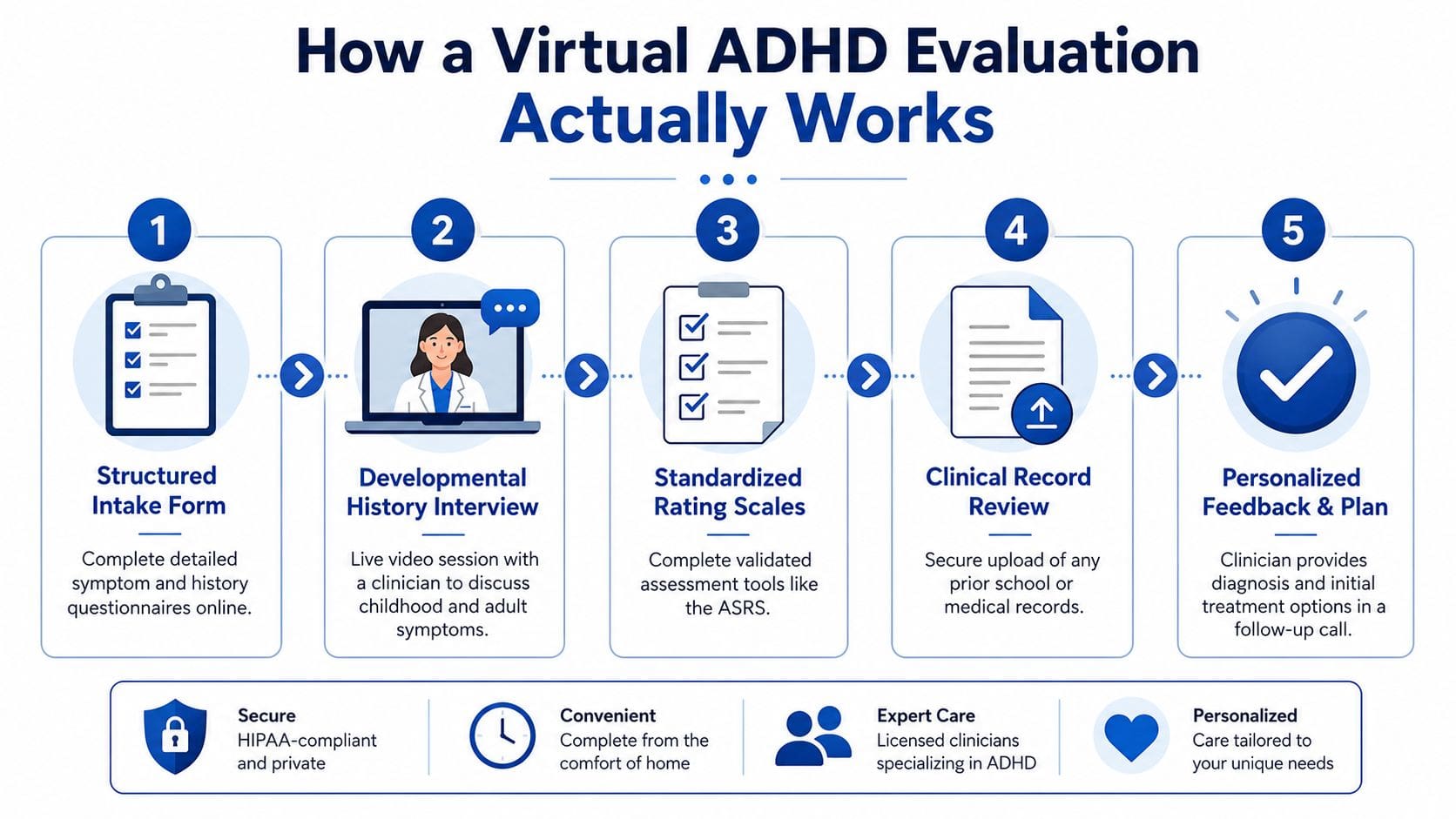
For patients who want the service-page version of that process, an online ADHD evaluation should look this thorough every time.
Telehealth ADHD Treatment Compared With In-Person Care
A first virtual ADHD visit often starts with a practical question, can this patient be evaluated safely without losing anything important by staying online? For many adults, the answer is yes. ADHD telehealth removes commuting, parking, waiting rooms, and missed-work friction, which is why it has become a normal way into care for adults who can be evaluated well by video.
That convenience only matters if the clinician still does the hard part. A good virtual evaluation still screens for childhood symptoms, current impairment, other psychiatric conditions, substance use risk, sleep problems, and medical red flags before medication is discussed. It also asks for records, examples, and collateral history when available. Patients who organize family medical records usually make that review faster and more accurate, which matters when the prescriber has to decide whether telehealth is enough or whether an in-person workup is safer.
The evidence supports telehealth as a real access path, not a shortcut. In a national claims analysis, adults who started stimulant care virtually had higher odds of follow-up than those who started in person, with an OR of 1.61, and adult stimulant initiations increased from 27 before the pandemic to 33 during the pandemic, showing that virtual access helped sustain treatment starts during a period of disruption (telemedicine stimulant initiation and follow-up study). That does not mean every patient should start online. It means virtual care can support continuity when it is used with the same clinical discipline as office-based care.
Where telehealth usually works well
Telehealth works best when the patient can give a clear history, can meet privately, and does not have a medical or psychiatric issue that requires a hands-on exam. It is often a practical fit for adults who need diagnosis, education, medication management, or follow-up adjustments without losing half a day to travel.
It also keeps people engaged. Follow-up is easier when the appointment is a link rather than a commute, and continuity matters in ADHD care because dose changes, side effects, and adherence questions usually show up after the first visit, not during it. For patients who need a plain-language explanation of the format, what telepsychiatry means in practice helps clarify why the video visit is only one part of the process.
Where in-person care still matters
Some situations belong in person. Chest pain, fainting, significant cardiac symptoms before stimulant initiation, severe substance use concerns, new psychotic symptoms, suspected mania, and acute suicidality need a higher level of assessment than a routine video visit can provide. In those situations, a responsible clinician does not push ahead, they direct the patient to the right setting.
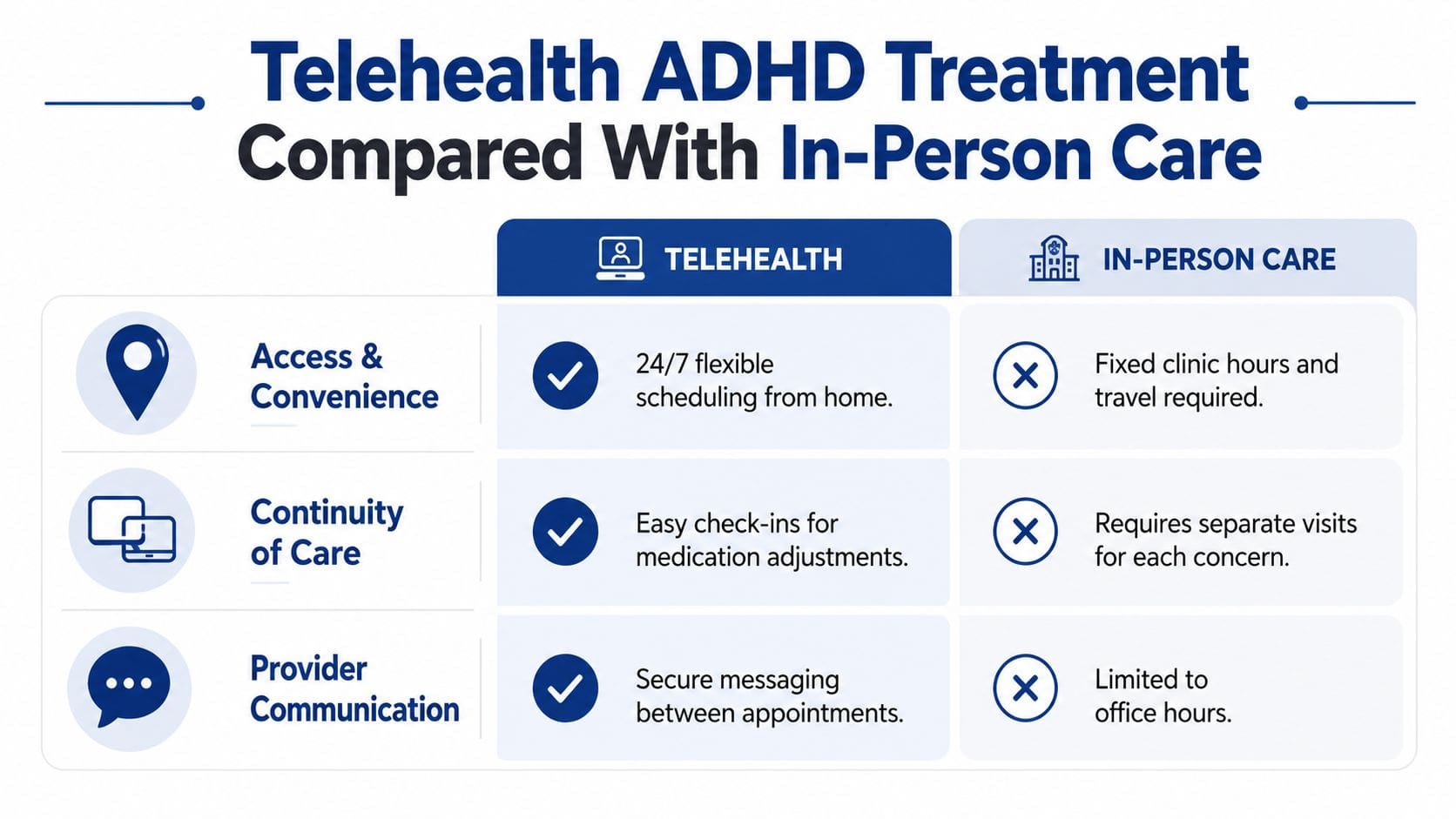
Virtual care should lower friction, not lower standards.
Medication Management for ADHD Through a Virtual ADHD Doctor
After diagnosis, medication management becomes a rhythm. An ADHD psychiatrist online or psychiatric prescriber usually starts by discussing symptoms, side effects, sleep, appetite, blood pressure if available, and the practical goal of treatment, better focus, fewer errors, less time lost to distraction, or less emotional whiplash during the day. That first decision is rarely about the “perfect” medication. It's about the safest, most sensible starting point.
Stimulants and non-stimulants are handled differently. Stimulants often work quickly but bring tighter prescribing rules because they are controlled substances, while non-stimulants may fit patients who cannot tolerate stimulants, have misuse risk, or prefer a different starting strategy. In Pennsylvania, the prescriber has to balance convenience with caution, especially when the patient's history suggests that more monitoring is needed.
What follow-up usually focuses on
The first few follow-ups are about titration and fit. A patient may be asked to track concentration, appetite, sleep, irritability, heart rate or blood pressure if already monitored at home, and whether the medication wears off too early or feels too strong. These details matter because ADHD medication is often adjusted by pattern, not guesswork.
A secure portal makes that process easier. It can be used for refill requests, side-effect updates, and quick check-ins between visits, which keeps treatment moving without turning every concern into a new appointment. For patients who are organizing paperwork, how to organize family medical records can save time before the first medication review.
For people who want a service-level example, online ADHD medication management should include exactly this kind of monitored follow-up, not just a one-time prescription.
What a Real Week of Online ADHD Treatment Looks Like
A grad student in Harrisburg starts the week with a video check-in, not because anything is going wrong, but because the treatment plan depends on steady feedback. By Wednesday, they've used a planner, a journal, and a grounding exercise to keep work from sliding into chaos. By Friday, the clinician has enough information to refine the plan instead of guessing.

The daily structure matters as much as the appointment
Good ADHD treatment Philadelphia patients usually need more than medication alone. Sleep timing, regular movement, predictable meals, and a system for capturing tasks all shape whether treatment holds up outside the video visit. A clinician may coordinate with a primary care doctor or therapist when that helps, but the change often comes from small routines repeated enough times to stick.
That is where patient-side tools can help. The Daily Agenda Planner supports task capture, the Feeling Journal helps track mood and triggers, the Exercise Routine Generator can make movement easier to schedule, and the 5-4-3-2-1 Grounding Tool is useful when distraction or anxiety starts taking over. These tools do not replace care, but they make care usable.
A virtual ADHD treatment plan works best when the patient uses the week between visits well. That's where the habits, the portal, and the clinician's feedback all connect.
Beyond Stimulants What Online ADHD Care Can Offer
A lot of online ADHD content stops at medication, but that misses a large part of what virtual care can do. Evidence on digital ADHD interventions review suggests that self-guided internet interventions can reduce ADHD symptoms and improve ADHD-related quality of life in adults, especially when they are compared with psychoeducation alone. Digital support can matter even when medication is not the whole answer.
A broader review of digital health technologies for adults with ADHD found that the field is expanding, but the evidence base is still uneven, so not every app or online program deserves equal trust. A careful clinician adds value by separating useful tools from hype and matching them to the patient's goals and the limits of telehealth.
The non-drug menu is real, but it has limits
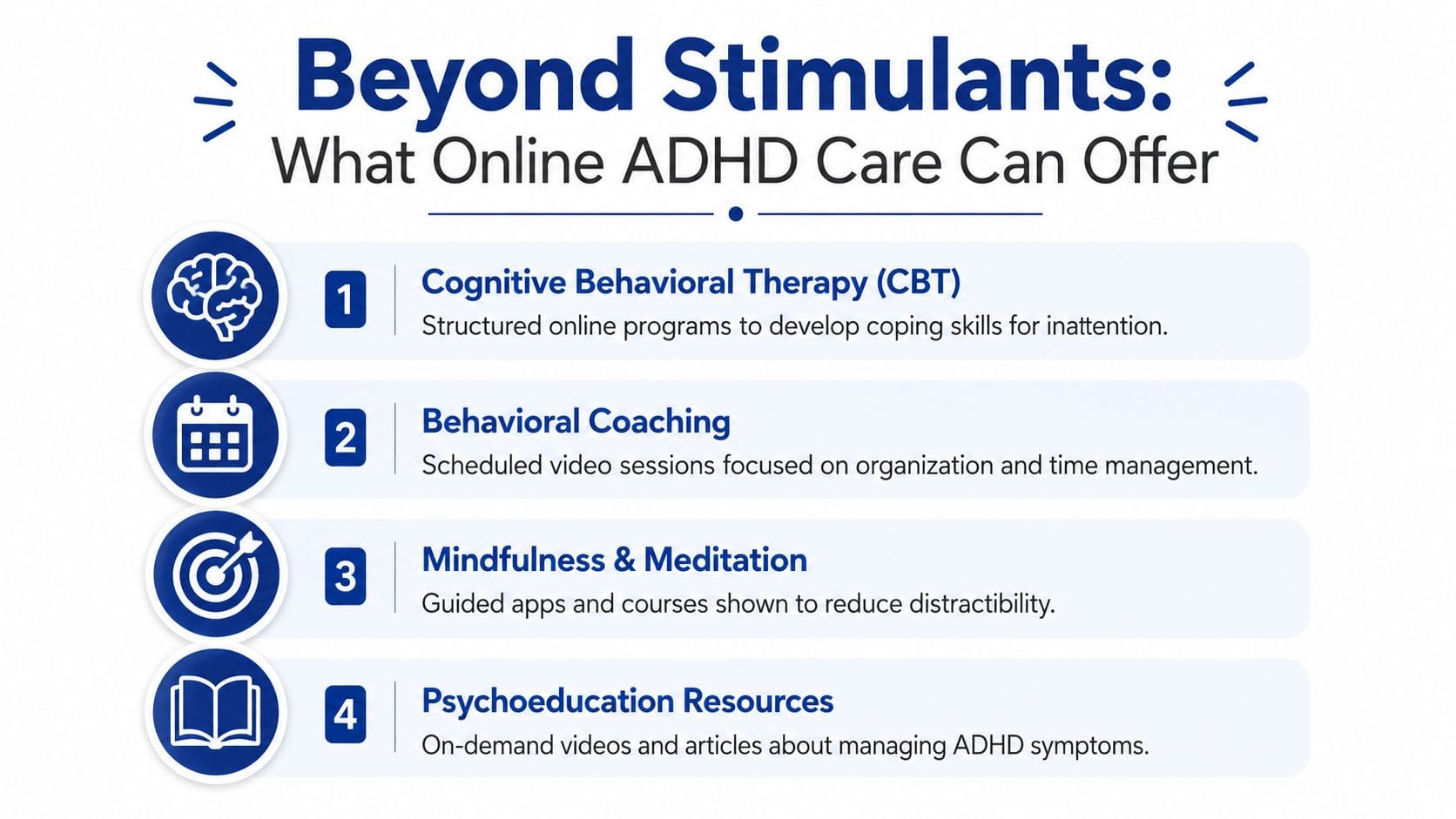
Online care can support cognitive behavioral therapy, behavioral coaching, psychoeducation, and organized routines. It can also help patients who cannot take stimulants, do not want them, or need an adjunctive plan while medication is being adjusted. For many adults, that combination matters more than choosing one “right” intervention.
A few practical options are worth naming:
- Cognitive behavioral therapy. Useful for breaking the cycle of avoidance, shame, and unfinished tasks.
- Behavioral coaching. Helpful for schedules, time management, and follow-through.
- Mindfulness and grounding practice. Best when attention is scattered by anxiety or overload.
- Psychoeducation. Important for understanding how ADHD shows up in real life, not just on paper.
The risk side matters too. In telehealth, a good clinician should slow down or refer out when substance use is complex, mood symptoms suggest bipolar disorder, psychosis is possible, suicidality appears, or a new medical issue needs in-person workup. That is responsible care.
For adults who need a practical adjunct, an executive dysfunction meal plan can reduce decision fatigue around food. For patients who need a medication alternative or adjunct, non-stimulant ADHD treatment belongs in the discussion about online options.
How to Book an ADHD Appointment in Pennsylvania Step by Step
The easiest way to book an ADHD appointment is to start with fit, not availability alone. A patient in Pennsylvania should confirm that the practice serves their city or can treat them statewide, then verify insurance, cash-pay, or membership options before sending records. That keeps the first visit focused on care instead of logistics.
A virtual practice that serves Pennsylvania should be able to see adults in Philadelphia, Pittsburgh, Harrisburg, Erie, Scranton, Allentown, Lancaster, Reading, and elsewhere in the state through secure telehealth. That matters for anyone comparing an online ADHD doctor Pennsylvania search result with a local office, because geography should not be the thing that decides access to evaluation.
What to do before the first visit
The intake process usually includes a brief symptom screen, demographic information, consent forms, and a request to upload prior records if they exist. Patients who have school documentation, old testing, medication lists, or family observations should send them early, because those details can speed up diagnosis and make the treatment plan more accurate.
A simple preparation checklist helps:
- Confirm state coverage. Make sure the practice can legally treat Pennsylvania residents by telehealth.
- Check payment details. Verify insurance or choose the self-pay option that fits the budget.
- Complete forms fully. Partial answers slow the evaluation and can blur the clinical picture.
- Upload records early. Any prior ADHD testing, therapy notes, or school history can be useful.
- Plan for privacy. A quiet room, headphones, and a stable connection improve the visit.
The phrase telehealth ADHD treatment should mean more than convenience. It should mean a structured appointment, a documented evaluation, a follow-up plan, and a prescriber who knows when virtual care is enough and when it isn't. For people searching ADHD treatment Philadelphia or broader statewide access, that standard is the right one.
| Question | Short Answer |
|---|---|
| Can stimulants be prescribed through telehealth in Pennsylvania? | Sometimes, if the prescriber determines it is clinically appropriate and the case is safe for remote management. |
| How quickly can a new patient be seen? | Availability varies by practice, but telehealth often shortens the wait compared with an in-person specialist visit. |
| What does insurance usually cover? | Coverage depends on the plan, network, and whether the visit is evaluation, therapy, or medication management. |
| How are follow-ups handled for controlled medications? | Follow-ups are usually more structured, with symptom review, side-effect tracking, and refill planning through the portal. |
Patients with chest pain, fainting, severe intoxication, active suicidality, or suspected mania should not force the issue through telehealth. Those problems need in-person medical or psychiatric care first.
Integrative Psychiatry of America provides virtual psychiatric evaluations, medication management, and evidence-informed ADHD care for adults across Pennsylvania through secure telehealth. If the right next step is a careful assessment rather than another productivity app, visit Integrative Psychiatry of America to learn about treatment options, verify insurance, and schedule a visit that fits real life.