
You've been pushing through missed deadlines, unfinished chores, and a brain that won't stay on one track, and the hardest part is that other people may only see the surface. On the outside, you look capable. Inside, you may feel like every day takes more effort than it should.
That gap between effort and outcome is often what sends adults looking for adult ADHD psychiatry. The right evaluation can separate self-blame from a real clinical picture, and it can also show whether anxiety, depression, sleep problems, or another condition is part of what's happening.
Table of Contents
- Recognizing the Need for an Adult ADHD Evaluation
- How Psychiatric Providers Diagnose Adult ADHD
- Why Many Adults Experience Delayed Recognition
- Navigating Medication Management and Supply Realities
- Integrative Approaches to Support Executive Function
- Telehealth Pathways and Pennsylvania Prescribing Rules
- What to Expect from an Integrative Telehealth Provider
Recognizing the Need for an Adult ADHD Evaluation
A lot of adults arrive at the same realization in different ways. One person keeps forgetting bills until late fees stack up. Another can manage a demanding job, but only by spending every evening recovering from the strain of keeping up. A third has always been labeled “scattered,” “intense,” or “lazy,” even though the underlying problem is that everyday tasks feel harder than they should.
That pattern matters because adult ADHD is common in adulthood, not just childhood. In 2023, an estimated 15.5 million U.S. adults, 6.0% of the adult population, reported a current ADHD diagnosis, and 55.9% were first diagnosed at age 18 or older, which shows how often recognition happens later in life CDC analysis.
Why the struggle often looks like character flaws
Adult ADHD rarely shows up as the stereotype people learned in school. It usually looks more like chronic overload, unfinished follow-through, time blindness, emotional exhaustion, or a life that takes too much conscious effort to manage. People often compensate for years before the system breaks down at work, in parenting, or in relationships.
Practical rule: if the same patterns keep showing up across jobs, homes, and relationships, it's worth treating them as a clinical question, not a personal failure.
A focused evaluation starts with the adult's actual functioning, not with assumptions. That's why many patients do better when they begin with a targeted overview like the adult ADHD symptoms guide before scheduling care, because it helps them name the patterns that have been hard to describe out loud.
The goal isn't to label every distracted day as ADHD. The goal is to decide whether the pattern is persistent, impairing, and worth a full psychiatric assessment.
How Psychiatric Providers Diagnose Adult ADHD
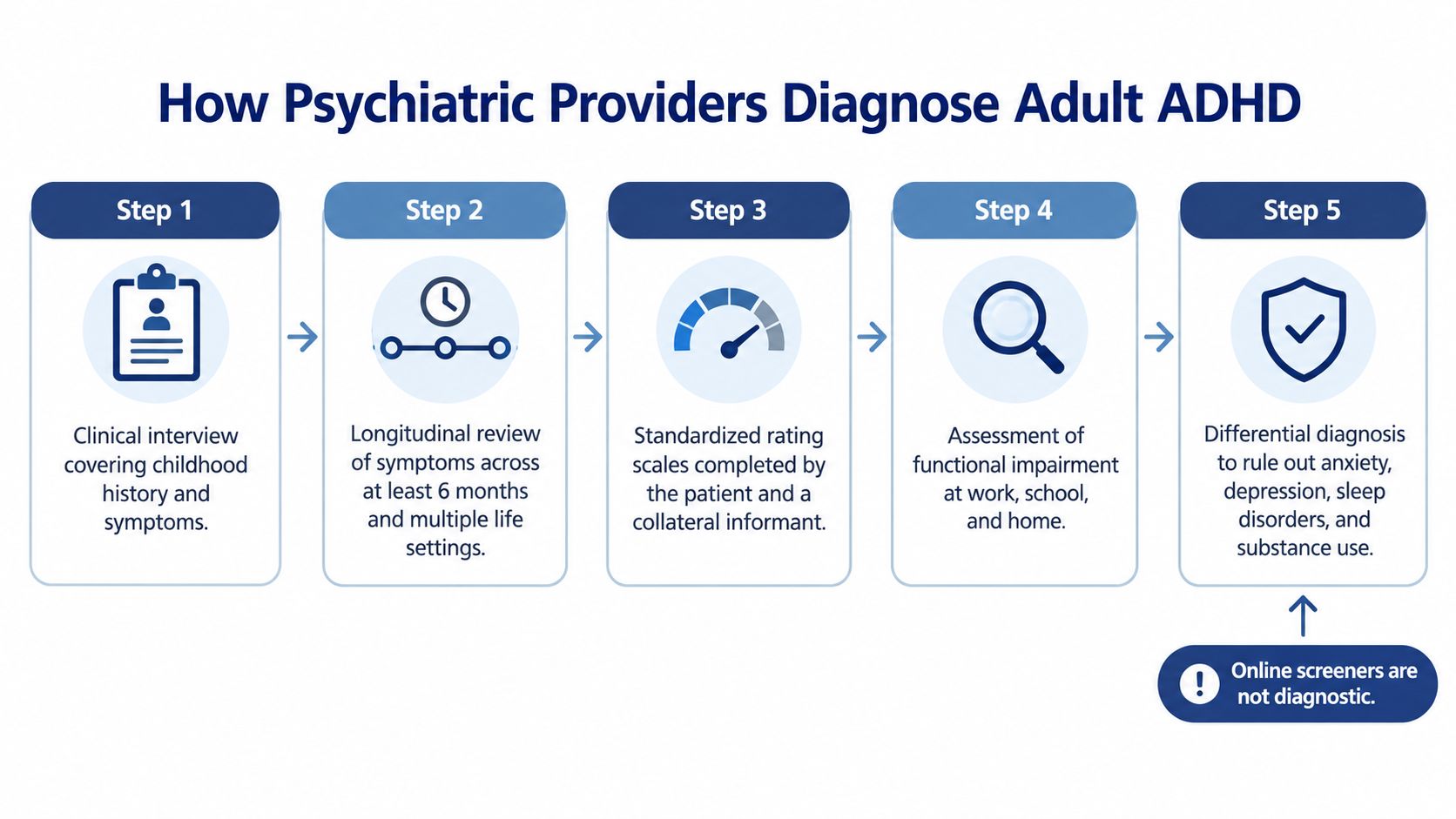
A real diagnosis is not based on a quick quiz or a single symptom list. Adult ADHD diagnosis is a longitudinal, impairment-based clinical process that requires documenting symptom expression across multiple real-world settings and evaluating alternative or co-occurring explanations NICE guidance. That means the clinician is looking at how symptoms have shown up over time, not just how someone feels on one appointment day.
The evaluation usually begins with a structured interview that covers childhood behavior, school history, work patterns, home life, relationships, and past mental health treatment. A board-certified psychiatric mental health nurse practitioner may also ask for old report cards, family observations, or other historical details when available, because adult recall alone can miss important pieces.
What a careful intake checks
The best assessments look at more than current attention problems. They ask where impairment shows up, how often it happens, and whether something else could explain the same symptoms. That includes anxiety, depression, substance use, sleep disorders, thyroid disease, neurologic illness, and medication effects, because poor concentration is not specific to ADHD.
A useful intake also checks whether symptoms existed in childhood and persisted into adulthood. That matters because adult complaints alone can be misleading. Someone may be functioning well in one area while struggling everywhere else.
ADHD assessment is strongest when it connects symptoms to daily impairment, not just to a checklist.
For patients preparing for telehealth, the how to get an ADHD diagnosis as an adult guide can help them organize old records, family examples, and current concerns before the visit. That preparation doesn't create a diagnosis, but it can make the clinical interview more precise.
A careful evaluation should end with a clear formulation, not just a yes-or-no label. If ADHD is present, the next question is how it affects functioning and what treatment makes sense in everyday life.
Why Many Adults Experience Delayed Recognition
Late recognition is often the rule, not the exception. A 2025 review found that women are frequently diagnosed late or misdiagnosed, and that hormonal transitions can intensify ADHD symptoms, which helps explain why many adults don't get identified when they're younger review in PubMed.
That delay is especially hard on adults who looked “fine” from the outside. High grades, strong coping skills, perfectionism, or a quiet personality can hide executive dysfunction for years. Some people are first treated for anxiety, depression, or bipolar symptoms because those are the problems that were easiest to notice, even though ADHD was sitting underneath them the whole time.
Masking changes the story
Masking doesn't mean the symptoms aren't real. It means the person has built enough structure, pressure, or overcompensation to keep the problem out of view until life becomes less forgiving. College, parenthood, job promotions, caregiving, and hormonal shifts can all make the cracks much more visible.
That delayed recognition can bring two very different reactions at once. Many patients feel relief because the pattern finally has a name. They also may feel grief, anger, or embarrassment about the years spent thinking they were just failing at life.
The clinical point is simple. A late diagnosis doesn't make the condition less valid. It usually means the person adapted until the adaptations stopped being enough.
Navigating Medication Management and Supply Realities
Medication can be a good fit for adult ADHD, but it's only one part of treatment. A thoughtful prescriber looks at symptom severity, sleep, cardiovascular history, substance use risk, anxiety, depression, and day-to-day functioning before deciding whether a stimulant or a nonstimulant makes sense.
The choice also changes over time. Some adults need careful titration because the first dose is too low, too activating, or not aligned with their sleep pattern. Others need treatment for another condition first, because untreated depression or sleep deprivation can make attention problems look worse than they are.
What good medication management actually includes
Good prescribing is practical, not rushed. It usually includes baseline history, monitoring for benefit and side effects, and repeat assessment of how the person is functioning at work, at home, and in relationships. The point is not just symptom reduction. The point is whether the treatment is helping the person live better.
Shortages complicate that work. Recent CDC data indicate that 71.5% of adults taking stimulant medication reported difficulty filling prescriptions because of limited availability, which makes continuity planning a safety issue rather than a minor inconvenience CDC-related data.
When access gets unstable, refill planning matters more. Prescribers may need to adjust timing, revisit dose options, or discuss alternatives if a pharmacy can't fill a prescription. That's one reason structured follow-up systems matter so much. A practical guide to medication management systems can also help patients understand how reminders, refill tracking, and monitoring reduce missed doses and last-minute scrambling.
Clinical reality: good ADHD prescribing is rarely a one-and-done prescription. It's a monitored process that changes as symptoms, sleep, and supply conditions change.
For Pennsylvania adults who want that level of continuity, the online ADHD medication management page is the relevant service path to review.
Integrative Approaches to Support Executive Function
Medication can help, but executive dysfunction usually improves faster when treatment also supports the rest of the system. Sleep, nutrition, movement, and structure don't replace psychiatric care. They make it easier for the brain to use it well.
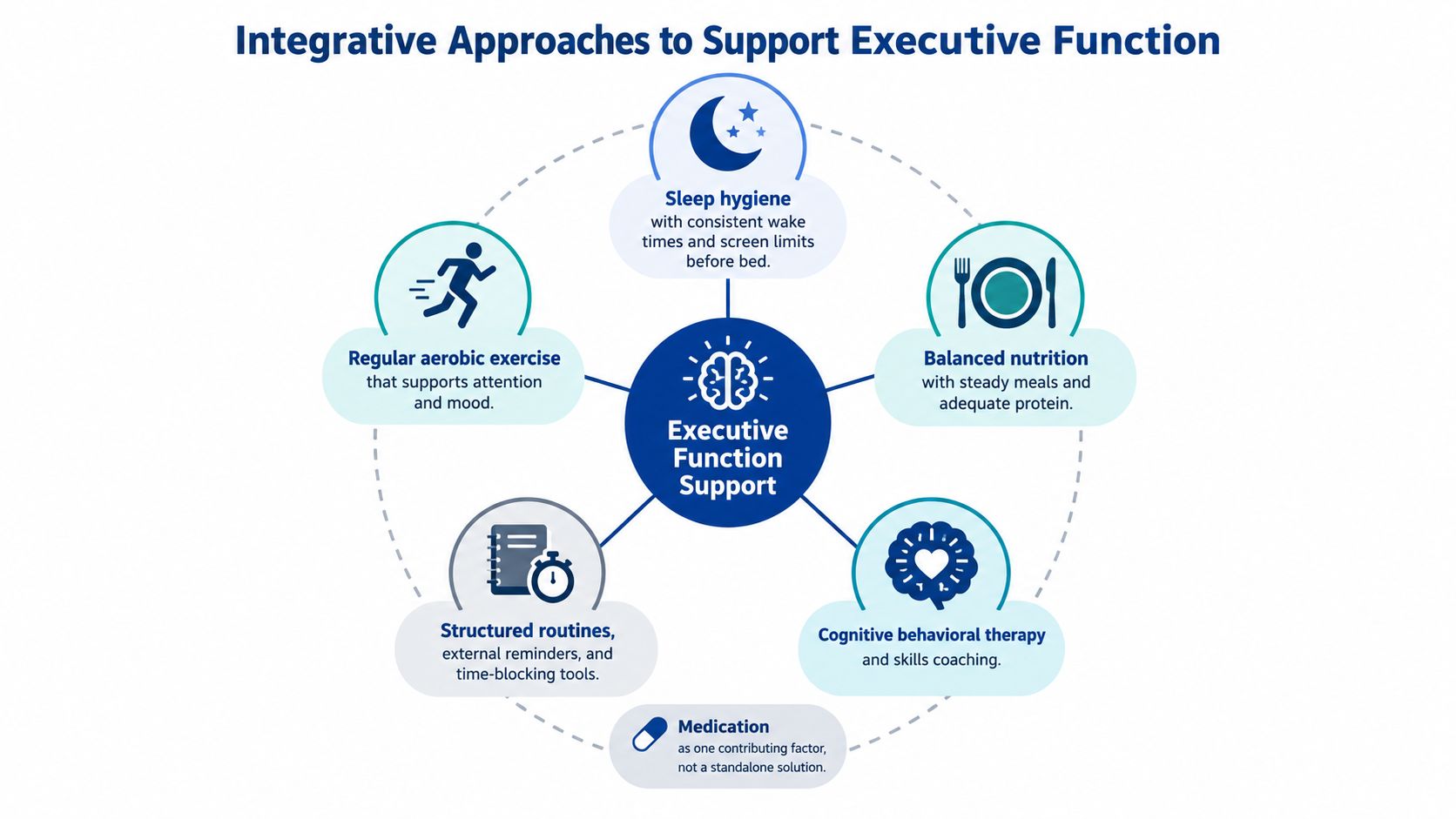
A helpful model starts with basic stability. Regular wake times, adequate protein, movement, and fewer late-night screens won't cure ADHD, but they can reduce the friction that makes symptoms feel louder. Patients often do better when routines are externalized with reminders, calendars, and time-blocking instead of relying on memory alone.
Whole-person care is not an add-on
Integrative psychiatry has real value here. A provider may combine medication with coaching-style structure, mindfulness, nutrition education, and exercise counseling, all of which support attention and follow-through in different ways. Someone comparing supplements or “brain boosters” should be cautious here, too. A careful discussion of the safety of nootropics for ADHD is useful because not every product marketed for focus is appropriate, safe, or well studied.
The clinical question isn't whether someone can build willpower. It's whether the plan makes daily life more manageable. For some adults, that means using therapy or skills coaching alongside medication. For others, it means tightening sleep and routines first so medication has a better chance to work.
The integrative psychiatry for ADHD, anxiety, and depression page is a useful reference for adults whose attention problems overlap with mood or anxiety symptoms.
Telehealth Pathways and Pennsylvania Prescribing Rules
Virtual care makes ADHD evaluation much easier to access, but it doesn't remove prescribing rules. In Pennsylvania, clinicians prescribing controlled ADHD stimulants are required under state law to obtain and review a report from the Pennsylvania Prescription Drug Monitoring Program before prescribing Pennsylvania prescribing guidance.
That requirement matters for safety and documentation. It helps the prescriber review controlled-substance history, check for overlapping prescriptions, and make a more informed decision before starting or continuing medication. Telehealth can streamline the appointment, but it does not bypass medical review.
What patients should expect in online care
A solid telehealth workflow usually includes a detailed intake, review of medical and psychiatric history, and a discussion of current medications and sleep. It also means insurance may not behave the same way for every plan, so benefits, copays, deductibles, and telehealth coverage should be verified ahead of time.
Patients who want online care in Pennsylvania can usually expect a more efficient process than in-person visits, but not a looser one. The same clinical questions still apply. The same safety checks still apply. The same need to document impairment still applies.
For adults considering remote stimulant management, the telepsychiatry medication management page is the right place to understand how virtual follow-up works in practice.
What to Expect from an Integrative Telehealth Provider
A strong telehealth practice should make evaluation feel organized, not rushed. Patients need secure messaging, reliable appointment access, clear refill pathways, and a provider who understands that ADHD often overlaps with anxiety, depression, OCD, and PTSD. They also need a team that knows how to verify insurance without promising coverage that depends on the plan.
CDC data show that 46.0% of adults with current ADHD had ever received telehealth services for the condition, and 67.2% used telehealth to obtain an ADHD medication prescription since 2020, which shows how established virtual ADHD care has become CDC telehealth data. That makes the quality of the telehealth process even more important, because more adults are using it for diagnosis, follow-up, and medication management.
What good virtual care looks like
A patient-friendly telehealth practice usually does a few things well:
- Uses a structured intake: The first visit should gather developmental history, current impairment, and prior treatment in a way that supports real clinical judgment.
- Explains insurance clearly: Benefits for telehealth can vary, so coverage needs verification before the visit, not after.
- Supports follow-up, not just intake: ADHD treatment often needs dose review, side-effect monitoring, and periodic reassessment.
- Makes care workable: Easy portal messaging, refill requests, and appointment scheduling reduce the friction that often derails follow-through.
For patients who struggle with routines, the peptide scheduling tips that stick are a useful example of how reminders and schedule adherence tools can support consistency, even though ADHD treatment itself still needs a clinical plan.
Integrative Psychiatry of America offers that kind of Pennsylvania-based virtual psychiatric care, with adult ADHD evaluation, medication management, and whole-person support through secure telehealth. If you're ready for a careful assessment and a practical treatment plan, visit Integrative Psychiatry of America to request an appointment and verify your insurance.