
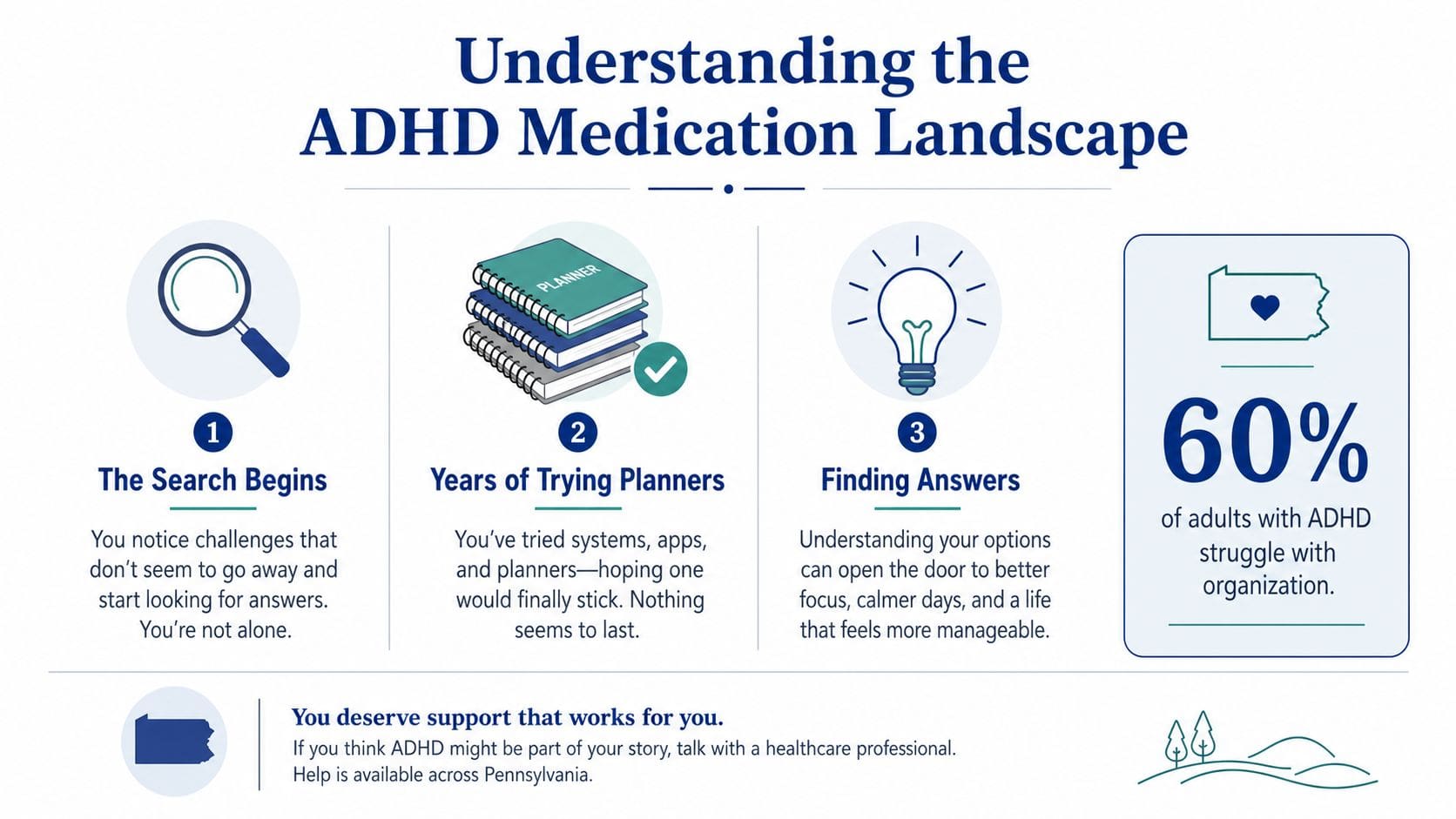
An adult in Pennsylvania may reach the ADHD medication question after years of planners, productivity apps, missed deadlines, and exhausting attempts to compensate through willpower. A stimulant may improve focus quickly, yet worsen sleep or anxiety. A non-stimulant may feel slower, but offer a more practical path when misuse risk, insomnia, tics, or medication shortages affect daily life.
The short answer to ADHD stimulant vs non stimulant is that stimulants usually provide stronger and faster symptom relief, while non-stimulants can be the smarter choice for adults who don't tolerate stimulants, face meaningful misuse concerns, need all-day coverage, or have related conditions that make stimulant side effects harder to manage. The right decision comes from an ADHD evaluation and ongoing medication management, not from a ranking alone.
Table of Contents
- Understanding the ADHD Medication Landscape
- How Stimulants and Non-Stimulants Work Differently
- Effectiveness and Symptom Control Comparison
- When Non-Stimulants Are the Better Choice
- Monitoring, Genetic Testing, and Lab Considerations
- Integrative and Telepsychiatry Approaches to ADHD Care
Understanding the ADHD Medication Landscape
Why stimulants remain the usual starting point
Clinical guidelines continue to place stimulants ahead of non-stimulants for adults when there isn't a medical reason to avoid them. Methylphenidate, dexamfetamine, and lisdexamfetamine are commonly listed as first-line choices, while atomoxetine and guanfacine are generally considered when stimulants are contraindicated, not tolerated, or ineffective. The 2024 ADHD guideline update describes stimulants as first-line because of their average efficacy and tolerability.
Prescribing patterns reflect that hierarchy. In the United States, stimulants accounted for 88.9% of ADHD medication fills in 2023, while non-stimulants represented 11.1%, according to the referenced analysis of stimulant and ADHD medication trends. Total ADHD medication fills increased from 72,849,441 in 2019 to 90,183,437 in 2023, a 23.8% rise, while non-stimulant fills grew faster than stimulant fills, 60.1% compared with 20.4%.
That growth doesn't mean non-stimulants have replaced stimulants. It shows that clinicians and patients are looking for alternatives with different side-effect, scheduling, and misuse profiles. The choice matters particularly for adults managing anxiety, sleep disruption, substance-use risk, or complicated work and family demands.
A practical comparison
| Consideration | Stimulants | Non-stimulants |
|---|---|---|
| Usual guideline position | First-line for many adults | Often used when stimulants aren't suitable |
| Symptom response | Usually stronger and faster | Measurable, but often more gradual |
| Examples | Methylphenidate, lisdexamfetamine, amphetamine products | Atomoxetine, guanfacine, clonidine, viloxazine |
| Misuse profile | Requires careful prescribing and monitoring | Lacks the abuse potential associated with stimulants |
| Daily use | Formulation-dependent | Scheduled daily treatment, not “as needed” |
Adults seeking ADHD medication management should discuss more than concentration. A careful clinician also considers blood pressure, sleep, appetite, anxiety, mood stability, substance-use history, other medications, and the patient's ability to obtain the prescription consistently.
How Stimulants and Non-Stimulants Work Differently
Stimulants and non-stimulants affect attention through different medication pathways. That distinction helps explain why one class can feel noticeable quickly, while the other may require steady daily use before the benefit becomes clear.
Stimulants create a faster change in signaling
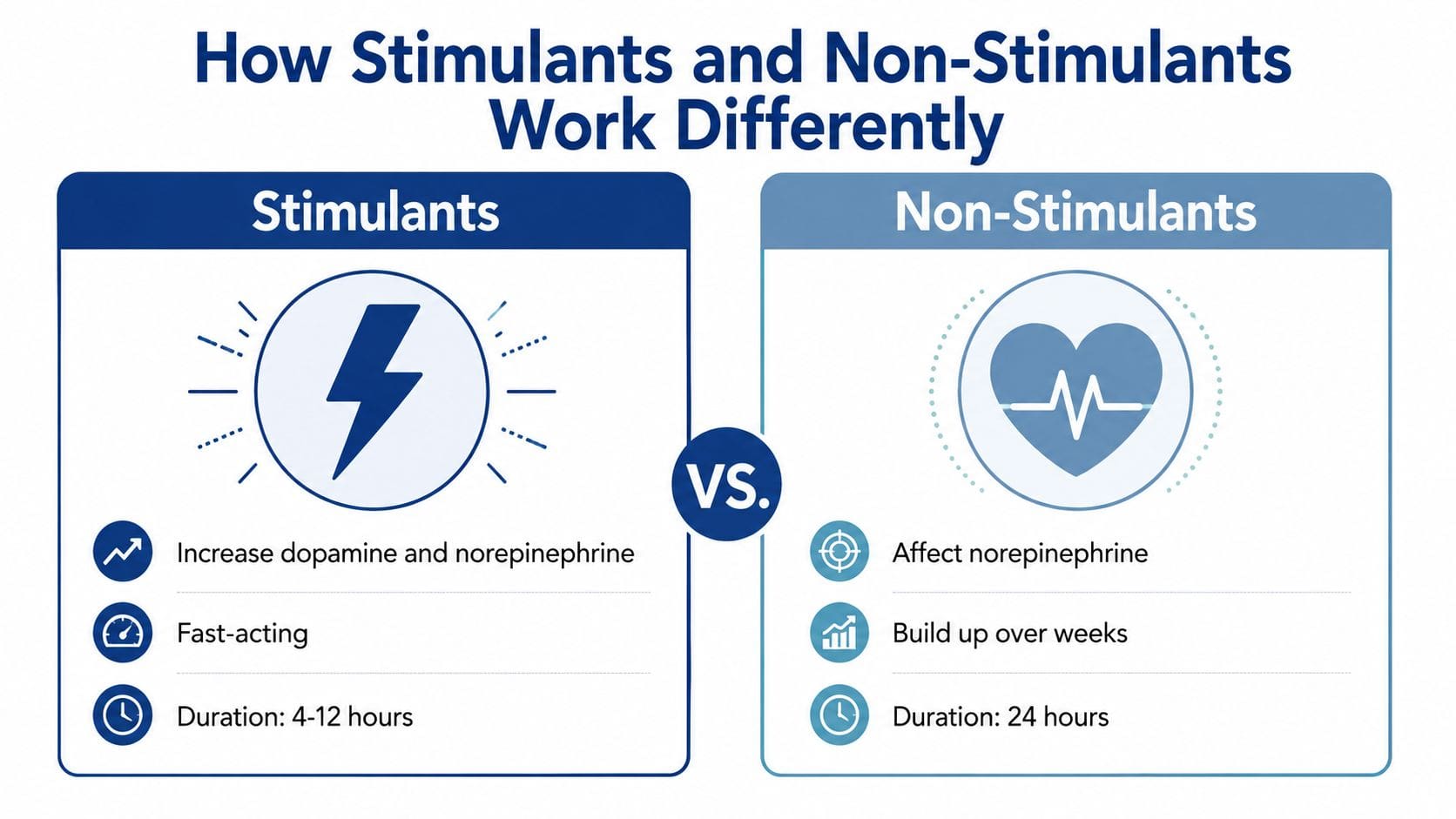
Methylphenidate and amphetamine-based medications increase the availability of dopamine and norepinephrine, two chemical messengers involved in attention, motivation, working memory, and impulse control. They do this through a combination of reuptake inhibition and, for amphetamine products, increased release.
The prefrontal cortex helps organize behavior, hold information in mind, and select what deserves attention. Stimulant treatment can strengthen signaling in this area, which may translate into clearer task initiation, less distractibility, and better follow-through. Some adults notice a difference on the day a prescribed dose is taken, although the exact onset depends on the medication, formulation, dose, metabolism, and individual response.
Immediate-release products generally require more deliberate timing because their coverage is shorter. Long-acting products can reduce the need to plan multiple doses, but they may also last long enough to interfere with appetite or sleep if the timing or dose isn't right.
Non-stimulants regulate attention more steadily
Atomoxetine selectively blocks norepinephrine reuptake. Guanfacine and clonidine are alpha-2 adrenergic agonists that influence noradrenergic signaling in the prefrontal cortex. Viloxazine also works through a non-stimulant mechanism and is approved for ADHD treatment.
These medications don't produce the same rapid stimulant effect. Their benefits build through consistent treatment, so they aren't designed for occasional use before a demanding meeting or a long study session. The clinical summary of adult ADHD treatment specifically describes non-stimulants as scheduled daily medications rather than “as needed” treatments.
Practical rule: A medication that works only when taken consistently must fit the patient's routine. A complicated schedule can become part of the treatment problem.
Non-stimulants may offer steadier coverage and avoid some stimulant-related concerns, but they still have side effects and require monitoring. Atomoxetine can affect appetite, sleep, mood, or blood pressure. Guanfacine and clonidine may cause sedation, dizziness, or low blood pressure. Medication selection should therefore match the person's medical history rather than rely on the label “non-stimulant” as a guarantee of easy tolerability.
A plain-language video can also help adults understand why medication effects differ across classes and formulations.
Adults considering medications such as Adderall should receive individualized guidance about diagnosis, dosing, interactions, and monitoring. A focused discussion of Adderall and ADD treatment considerations can be useful, but online information can't replace a prescribing evaluation.
Effectiveness and Symptom Control Comparison
Average study results favor stimulants for reducing core ADHD symptoms. One adult pooled analysis reported effect sizes of 0.99 for immediate-release stimulants, 0.95 for long-acting stimulants, and 0.57 for non-stimulants, with the authors concluding that non-stimulants were less efficacious than either stimulant group. A separate adult meta-analysis found a smaller gap, with a Cohen's d of 0.67 for stimulants versus 0.59 for non-stimulants, and a statistically significant class difference in placebo-controlled trials. These findings come from the adult ADHD medication meta-analysis.
That evidence supports a straightforward clinical point. If rapid, strong symptom reduction is the main priority, a stimulant will often be considered first. Yet the average effect size doesn't predict which medication will work best for a particular adult, nor does it account for whether the person can tolerate and continue treatment.
Effectiveness at a glance
| Medication Class | Effect Size, Cohen's d | Typical Onset |
|---|---|---|
| Immediate-release stimulants | 0.99 | Relatively rapid |
| Long-acting stimulants | 0.95 | Relatively rapid |
| Non-stimulants | 0.57 | Gradual, requiring consistent use |
Non-stimulants still show benefit above placebo. A recent review reported efficacy for atomoxetine, guanfacine, and viloxazine extended-release in adults, although the clinical impact was generally smaller and evidence certainty varied. The recent randomized-trial synthesis also described modest effects and noted that placebo had better acceptability and tolerability in the analyzed evidence.
The medication that stays in the plan matters
Persistence changes the comparison. Across countries, only 15% to 44% of patients remained covered by ADHD pharmacotherapy after one year, falling to 8% to 30% after two years, according to the adult ADHD formulary brief. These figures don't prove that one class causes discontinuation. They do show why a treatment plan must address side effects, expectations, access, and follow-up.
A person who stops a highly effective stimulant because of insomnia may receive less real-world benefit than someone who takes a somewhat less powerful non-stimulant consistently. Before changing medication, clinicians should ask whether the dose, formulation, timing, diagnosis, sleep pattern, anxiety, or coexisting depression is affecting the result.
Lifestyle strategies don't replace prescribed treatment, but they can support attention and routine. Adults may find practical ideas in these brain focus tips from Lola, especially when paired with skills-based therapy and medication follow-up.
When Non-Stimulants Are the Better Choice
Non-stimulants aren't inferior by definition. They are often the more responsible option when a stimulant's likely drawbacks outweigh its average efficacy advantage for a specific adult.
Anxiety, sleep, and physical tolerability
An adult with ADHD and significant anxiety may describe a stimulant as increasing physical tension, racing thoughts, or sensitivity to normal stress. That reaction doesn't happen to everyone, and untreated ADHD can also worsen anxiety. Still, if careful stimulant adjustments don't resolve the problem, a non-stimulant may offer a better balance.
Sleep deserves equal attention. A long-acting stimulant taken too late can delay sleep, while poor sleep can intensify inattention and emotional reactivity the next day. Appetite suppression can also become clinically important when it affects nutrition, weight, or the ability to maintain a regular eating pattern. A clinician may adjust timing or formulation first, but a non-stimulant becomes reasonable when those changes don't solve the problem.
Substance-use and diversion concerns
Stimulant misuse and diversion remain public-health concerns. A review estimated misuse prevalence at about 5% to 10% among high school students and 5% to 35% among college students, while describing non-stimulants as lacking abuse potential and lacking the fast effects associated with misuse. The review of ADHD medication misuse supports careful screening and patient education.
A personal or family history of substance-use disorder doesn't automatically rule out stimulants. It does change the conversation. The prescriber may consider a non-stimulant, closer follow-up, limited quantities, coordination with addiction treatment, or another risk-reduction plan.
A large adolescent study found that the group with both stimulant and non-stimulant treatment histories had the highest reported past-year prescription stimulant misuse, at 22.3%, along with cocaine use at 10.4% and methamphetamine use at 7.8%. The adolescent study in The Lancet00079-2/fulltext) doesn't mean ADHD medication caused those outcomes. It does reinforce the need to assess substance use directly rather than make assumptions.
Tics and treatment access
Some adults with tic disorders may benefit from medications that don't intensify stimulant-related concerns, although treatment must be individualized. Non-stimulants can also become practical alternatives when stimulant shortages disrupt continuity. Recent reporting described shortages involving mixed amphetamine salts, lisdexamfetamine, and methylphenidate as of May 2025, while UK patient guidance reported limited supplies of several methylphenidate products and continued availability of atomoxetine and guanfacine in that setting. The review of ADHD care during medication shortages explains why access can influence prescribing.
Adults can review ADHD alternative medication options in the UK for broader terminology, but Pennsylvania prescribing decisions must follow the patient's evaluation, medical history, and local availability.
A non-stimulant prescription can reflect thoughtful matching, not a lesser treatment pathway. Information about non-stimulant ADHD treatment can help patients prepare questions for a medication-management visit.
Monitoring, Genetic Testing, and Lab Considerations
Medication choice is only the beginning. Follow-up shows whether the treatment improves real tasks without creating a larger problem elsewhere.
Start with measurable targets
Before a prescription begins, the clinician and patient should identify a few concrete targets. Examples include arriving at work on time, completing medication refills, finishing household tasks, reducing careless errors, or staying engaged during conversations. Symptom checklists can support the assessment, but functional changes often tell the most useful story.
A follow-up should review:
- Attention and executive function: What tasks became easier, and which remain blocked?
- Sleep and appetite: Has bedtime, sleep quality, eating, or weight changed?
- Mood and anxiety: Has the medication reduced overwhelm, increased tension, or affected emotional regulation?
- Physical effects: Has the patient noticed palpitations, dizziness, headaches, or other changes?
- Adherence and access: Can the patient obtain and take the medication as prescribed?
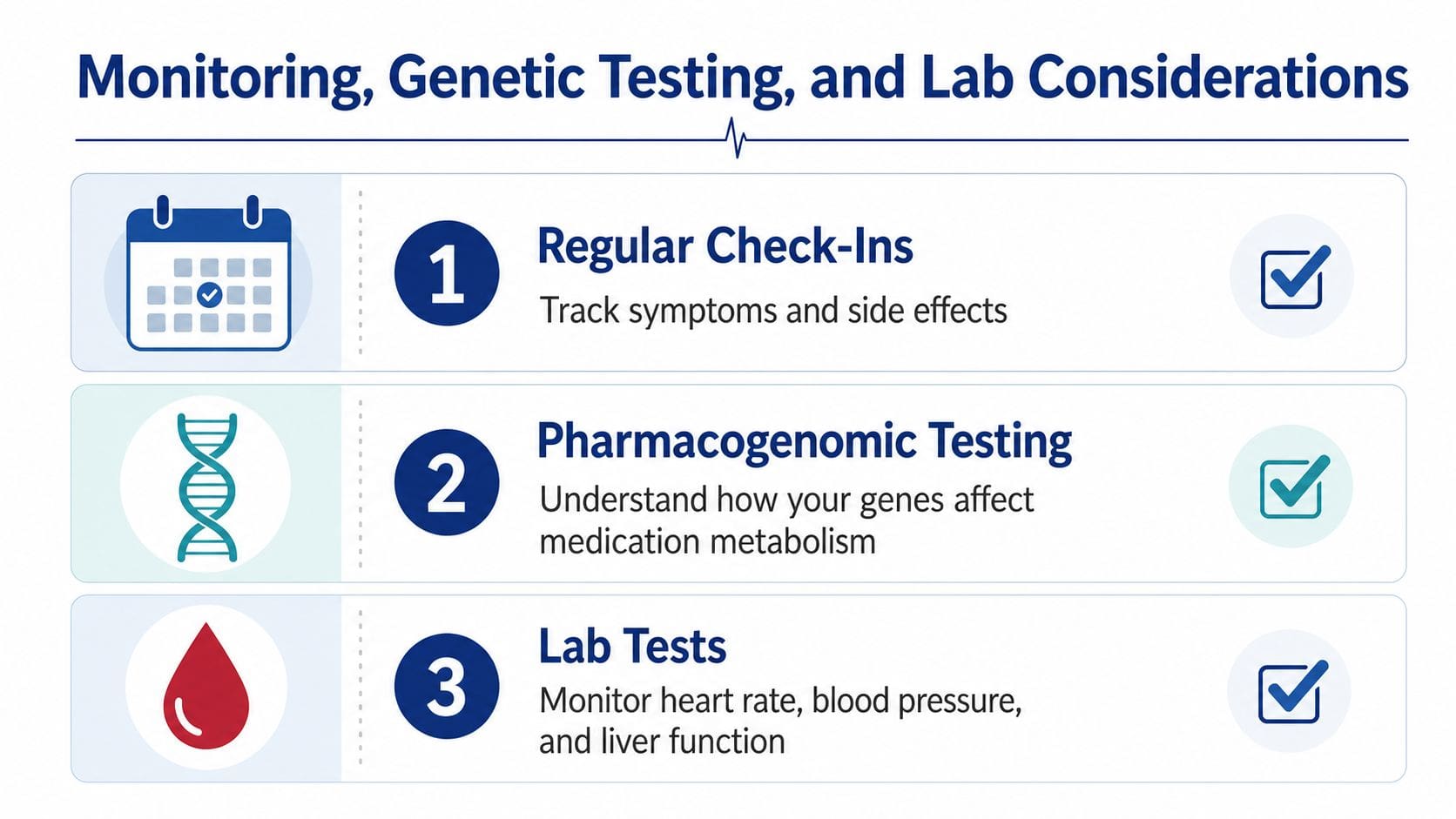
Blood pressure and heart rate tracking matter for both medication classes. Liver function testing may be appropriate in selected situations, particularly when the medication or medical history raises that concern. The exact laboratory plan depends on the medication, symptoms, comorbidities, and other prescriptions.
Where pharmacogenomic testing fits
Pharmacogenomic testing examines genetic variations that can affect how the body processes certain medications. CYP2D6 differences can influence atomoxetine clearance, which may help a prescriber interpret side effects, delayed response, or an unexpectedly strong medication effect.
Testing doesn't select a medication automatically. It also can't replace diagnostic accuracy, careful titration, or a discussion of sleep, anxiety, substance use, and daily routines. The result is one clinical input among several.
Integrative monitoring adds context
Medication data becomes more useful when combined with behavioral and physical health information. Sleep routines, movement, nutrition education, therapy skills, and workload patterns can explain why a medication seems effective on one week and disappointing the next.
Adults interested in genetic testing for psychiatric medications should ask what the test can and can't answer, how results will affect prescribing, and whether the clinician will interpret the findings alongside the full clinical picture.
A lab result can inform a treatment decision. It can't make the decision on its own.
Integrative and Telepsychiatry Approaches to ADHD Care
ADHD treatment works best when medication addresses symptoms and the care plan addresses the environment around those symptoms. Psychotherapy-informed strategies can support planning, emotional regulation, and follow-through. Sleep optimization, exercise counseling, and nutritional education can help protect the routines that medication alone can't create.
Sleep deserves special attention because stimulant timing, late-night work, anxiety, and inconsistent schedules can interact. An ADHD-friendly sleep guide may offer practical ideas to discuss with a clinician, particularly when insomnia complicates medication decisions.

Telepsychiatry can make consistent follow-up more accessible for adults throughout Pennsylvania, including Philadelphia and communities farther from in-person specialty care. A virtual visit can address symptom response, sleep, anxiety, side effects, refill barriers, and the need to switch between stimulant and non-stimulant options.
Integrative Psychiatry of America provides virtual psychiatric evaluations and medication management for ADHD and related concerns through telehealth in Pennsylvania. Adults can learn more about online ADHD treatment and consider whether a structured evaluation fits their needs.
Integrative Psychiatry of America offers virtual ADHD evaluations, medication management, and integrative psychiatric care for adults across Pennsylvania, including treatment planning around stimulant and non-stimulant options. Visit Integrative Psychiatry of America to learn about care, verify insurance, or schedule an appointment.