
The search often starts late at night. An adult has missed another deadline, forgotten a simple errand, and reread the same email three times without answering it. They type “Adderall and ADD” into a search bar because they're trying to figure out whether this is stress, burnout, anxiety, or something that has followed them for years.
For many adults, the problem isn't laziness or a lack of discipline. It's a persistent pattern of inattention, disorganization, task paralysis, mental clutter, and inconsistent follow-through that affects work, school, relationships, and self-esteem. ADD is an older term that many people still use, but clinicians now usually diagnose ADHD, predominantly inattentive presentation when attention problems are the main issue.
Medication can help. So can therapy, sleep, structure, exercise, and careful assessment for lookalike conditions such as anxiety, depression, trauma, or substance use. Adderall is one option within that larger plan.
Table of Contents
- The Adult Struggle with Focus and the Role of Adderall
- How Adderall Works to Manage Inattentive ADHD
- Gauging Adderall's Effectiveness and Limitations
- Understanding the Risks and Side Effects of Adderall
- Integrative Treatments and Adderall Alternatives
- How to Get an ADHD Evaluation with a Telehealth Provider
- Frequently Asked Questions About Adderall Treatment
The Adult Struggle with Focus and the Role of Adderall
A common adult ADHD story looks ordinary from the outside. Someone performs well enough to get by, but only through last-minute panic, excessive caffeine, missed details, and constant self-correction. Bills are paid late. Meetings are forgotten. Laundry sits unfinished because the person got distracted halfway through.
That's one reason so many adults look up Adderall and ADD when they're trying to make sense of years of inconsistency. The symptoms may have started in childhood, but many people aren't evaluated until adulthood, especially if they weren't hyperactive or disruptive.

When attention problems are more than stress
ADHD is common enough that it affects routine clinical practice, not just rare specialist cases. The CDC estimated that 7 million U.S. children ages 3 to 17 had ever been diagnosed with ADHD in 2022, while NIMH estimated that 4.4% of U.S. adults ages 18 to 44 have current ADHD, according to the National Institute of Mental Health ADHD statistics page.
Those numbers matter because adults often dismiss their symptoms for too long. They may assume they just need better habits, more motivation, or stricter self-control. Sometimes they do need stronger routines. But sometimes the deeper issue is an untreated neurodevelopmental condition.
For adults in Pennsylvania who want a closer look at these patterns, this overview of ADHD in adults and integrative psychiatry in Philadelphia describes how inattentive symptoms can show up beyond childhood.
Adults with inattentive ADHD often don't look “hyper.” They look overwhelmed, behind, and frustrated with themselves.
Where Adderall fits
Adderall is a prescription stimulant used in ADHD treatment. It can reduce distractibility, improve task initiation, and help some patients stay mentally engaged long enough to complete ordinary responsibilities. But it isn't a personality transplant, and it doesn't teach planning, sleep habits, emotional regulation, or coping skills.
That's where a psychiatric nurse practitioner's perspective matters. A good treatment plan asks practical questions. Is the target problem sustained attention, procrastination, impulsive spending, chronic lateness, or mental fatigue? Are anxiety, trauma, sleep deprivation, or depression making the picture worse? Is medication appropriate, or would another path fit better?
How Adderall Works to Manage Inattentive ADHD
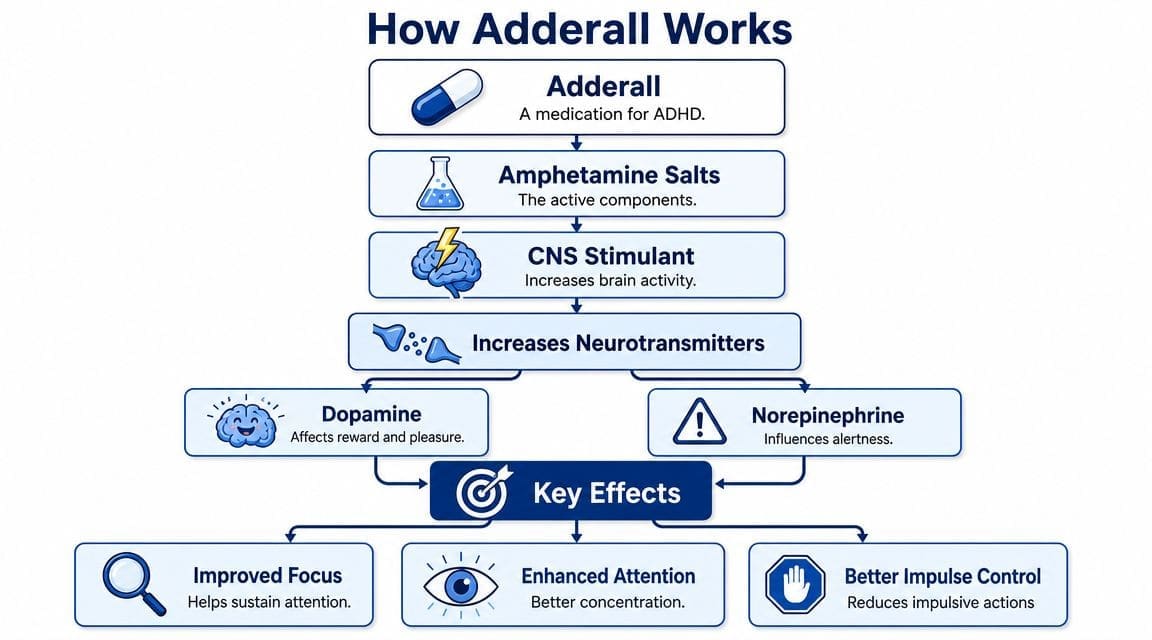
Adderall is a central nervous system stimulant made from amphetamine salts. In plain language, it changes how certain brain signaling systems function, especially the ones involved in alertness, motivation, and executive control.
For patients with inattentive ADHD, the medication doesn't “create” focus out of nowhere. It helps the brain use attention more consistently. Many people describe the effect less as feeling energized and more as finally being able to stay with one task without mentally slipping away every few minutes.
The brain chemistry in simple terms
Adderall's therapeutic effect is tied to increasing synaptic dopamine and norepinephrine. It does this through transporter disruption and interference with VMAT2, which increases catecholamine signaling in the prefrontal cortex and other central nervous system circuits. That mechanism is also why Adderall is a Schedule II stimulant with abuse potential, as summarized by The Recovery Village's explanation of ADHD and Adderall.
A useful analogy is air traffic control. In inattentive ADHD, signals related to priority, motivation, and sustained effort may not be coordinated well. Adderall can help the brain act more like a better traffic controller. Fewer signals get lost. Important tasks hold their lane longer. The person is less likely to veer off course every time a notification, thought, or unrelated task appears.
What patients usually notice first
The earliest benefits tend to be practical, not dramatic. Examples include:
- Longer task follow-through: reading a report, answering messages, or finishing paperwork without constant restart.
- Better mental filtering: less pull toward every sound, thought, or tab on the screen.
- Reduced impulsive switching: fewer moments of jumping from one task to another without finishing anything.
- More usable motivation: not euphoric motivation, but enough activation to begin what needs to be done.
A fuller review of ADHD medication options can help patients understand where Adderall sits among stimulants and non-stimulants.
Patients who want a broader, patient-friendly explanation of stimulant classes can also review this guide from Insight Diagnostics Global, which outlines how stimulant ADHD medications are typically framed in clinical discussions.
Practical rule: If a medication improves focus but worsens sleep, anxiety, appetite, or irritability to the point that daily life gets harder, the plan needs adjustment.
Why a prescription and monitoring matter
Because the same chemistry that improves attention can also raise misuse risk, prescribing Adderall isn't just about matching symptoms to a pill. It requires screening for medical history, substance use concerns, co-occurring psychiatric symptoms, sleep problems, and functional goals.
That's also why “borrowing” someone else's medication is unsafe. A stimulant that helps one person with diagnosed ADHD may cause side effects, anxiety, or impaired judgment in someone else.
Gauging Adderall's Effectiveness and Limitations
Adderall can be very useful for the right patient, but expectations need to be realistic. It tends to help most with the core ADHD domains that matter in everyday life: sustained attention, task persistence, organization, and impulse control. It doesn't solve every performance problem, and it doesn't replace systems, therapy, or rest.
A clinician usually looks for functional change, not just a feeling. Has the patient started turning work in on time? Are they missing fewer appointments? Are they following through on household tasks with less chaos? Are they less overwhelmed by basic planning?
What “working” usually means
When Adderall is a good fit, improvement often shows up in ordinary routines:
| Area | Signs treatment may be helping |
|---|---|
| Work | Fewer careless mistakes, better follow-through, less avoidance |
| Home | More consistent routines, improved bill management, less clutter from unfinished tasks |
| School | Better study endurance, less drifting during reading, improved completion of assignments |
| Relationships | Better listening, fewer missed commitments, less frustration around forgetfulness |
Patients sometimes expect a dramatic internal shift. Some do notice one. Others come to realize, after a week or two, that the day feels less fragmented.
What it does not do well
Adderall is often misunderstood as a universal “smart drug.” The evidence doesn't support that idea. In healthy adults without ADHD, a moderate dose produced small-to-minimal effects on reading comprehension, fluency, and overall academic performance, while also impairing working memory, according to the study published in PMC on mixed amphetamine salts and cognitive performance.
That matters because many adults compare themselves to a myth. They think medication should make them sharper in every domain, more creative, more productive, and better at everything. That's not how stimulant treatment works.
Medication can improve access to attention. It can't turn every task into a strength, and it can't replace judgment, learning, or discipline.
How clinicians judge success
A balanced response includes both benefit and tolerability. If focus improves but the patient becomes too anxious, overly rigid, emotionally flat, or unable to sleep, the treatment isn't working well enough. Dose, timing, formulation, or even the medication class may need to change.
That is the practical answer to questions about Adderall effectiveness. It can be excellent for the right symptom cluster. It's not a global cognitive upgrade.
Understanding the Risks and Side Effects of Adderall
Every stimulant discussion should include safety. Adderall can be appropriate and helpful, but it also carries meaningful trade-offs. Patients need to understand the common side effects, the more serious risks, and the reasons careful follow-up matters.
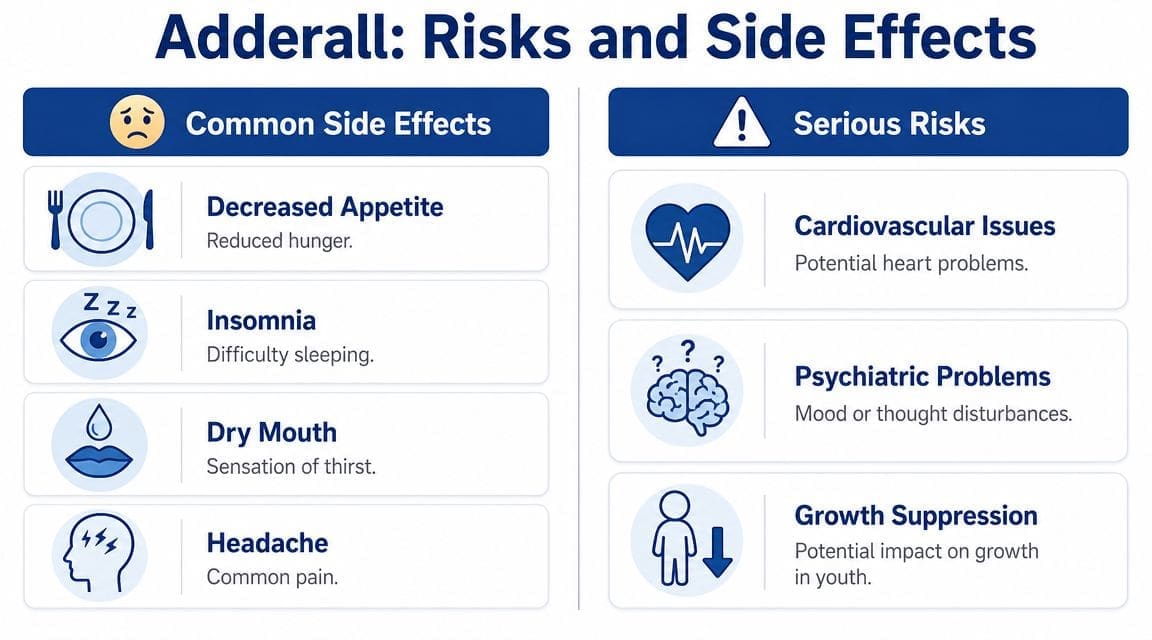
The most manageable problems are usually physical or schedule-related. Appetite may drop. Sleep can get pushed later. Some patients notice dry mouth, headaches, jitteriness, or increased anxiety. These issues don't always require stopping the medication, but they do require attention.
Common side effects versus red flags
A simple way to frame risk is to separate nuisances from warning signs.
- Common but often manageable: decreased appetite, insomnia, dry mouth, headache, feeling overstimulated.
- Needs prompt clinical review: significant mood changes, marked agitation, chest symptoms, troubling blood pressure or heart rate changes, or symptoms that suggest psychosis.
- Needs a fuller risk discussion before prescribing: certain cardiac histories, active substance misuse, or psychiatric instability.
This video gives a useful overview of stimulant concerns and patient questions:
Why misuse risk is taken seriously
Adderall is a controlled substance for a reason. Some people develop a pattern of taking more than prescribed, taking it for non-medical reasons, or chasing productivity rather than treating ADHD symptoms. Others may become psychologically reliant on the idea that they can't function without it.
That doesn't mean properly prescribed use is the same as misuse. It does mean clinicians should track response, refill patterns, side effects, and the patient's broader mental health picture.
Adults who are searching specifically for an Adderall prescription near them should expect a legitimate evaluation, not a quick prescription.
What good supervision looks like
Good prescribing includes more than a diagnosis and a refill. It usually involves:
- Clear target symptoms: What exactly is supposed to improve?
- Side effect monitoring: Appetite, sleep, mood, anxiety, and cardiovascular symptoms should be reviewed.
- Substance use screening: Past or current misuse matters.
- Adjustment when needed: Dose changes, timing changes, or switching medications should happen if the trade-offs are too high.
A patient shouldn't feel shamed for side effects. But side effects also shouldn't be minimized.
Integrative Treatments and Adderall Alternatives
A common adult ADHD pattern looks like this: the medication helps you start tasks, but your day still falls apart because sleep is erratic, meals are skipped, your workspace is chaotic, and every interruption pulls you off course. That does not mean treatment failed. It usually means the plan is incomplete.
Adderall can be useful, but it is one tool. In practice, the best results often come from matching the right medication approach to the person, then building routines and supports that make those gains usable in real life.
Medication alternatives
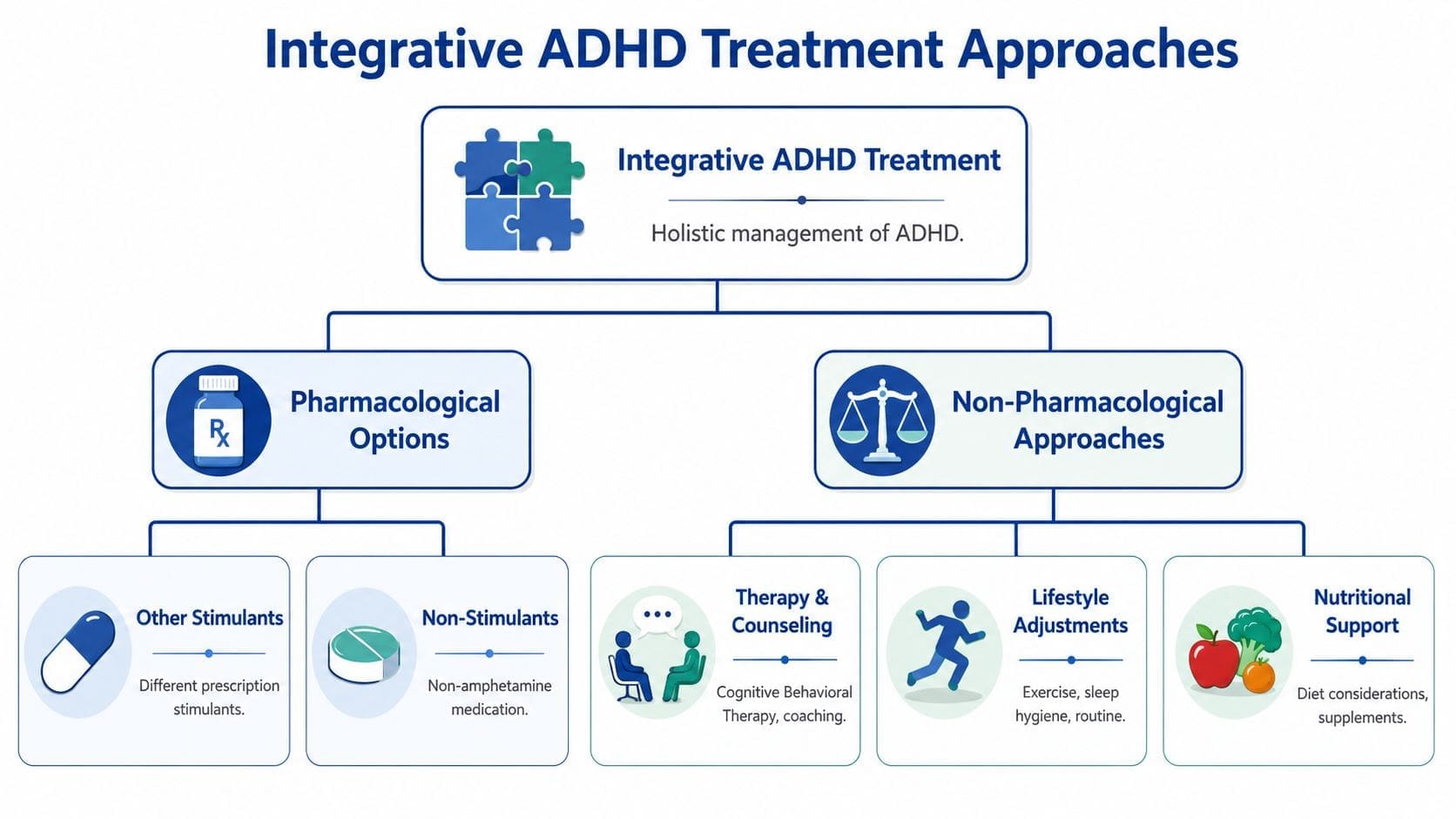
Some adults do poorly on Adderall because the side effects outweigh the benefit. Others have anxiety, sleep problems, blood pressure concerns, a history of substance misuse, or do not want a stimulant. In those cases, clinicians may consider other stimulants or non-stimulant options such as atomoxetine or viloxazine, depending on symptom pattern, past response, and co-occurring conditions.
If you are weighing stimulant treatment against a different medication strategy, this guide to non-stimulant ADHD treatment explains where those options may fit.
Medication choice is rarely just about symptom control. It is also about timing, tolerability, work demands, appetite, sleep, and whether the treatment can be used consistently without creating new problems.
The non-medication pieces that change outcomes
Medication can improve attention. It does not automatically create structure, planning skills, or realistic daily expectations.
The adults I see tend to do better when treatment also includes practical changes such as:
- CBT for ADHD: helps with procrastination, perfectionism, avoidance, and the negative self-talk that builds after years of struggling
- Sleep support: a regular sleep schedule often improves attention, irritability, and medication tolerance
- Exercise planning: movement can help regulate energy, mood, and restlessness
- Nutrition support: regular meals matter, especially if stimulant use lowers appetite during the day
- Mindfulness or attention training: helps some patients catch distraction earlier and return to the task with less frustration
- Environmental changes: reminders, visual systems, reduced clutter, and simpler workflows often matter more than patients expect
Sometimes a small behavioral change makes medication work better. Sometimes it reduces how much medication is needed. Sometimes it shows that the problem was never just attention.
What an integrative plan can look like
A workable plan is usually simple and specific. It might include morning medication, a fixed wake time, protein early in the day, calendar blocking for the two hardest tasks, one therapy session focused on executive function, and a rule for where keys, wallet, and work items go every night.
That kind of plan respects trade-offs. A higher dose is not always the answer if the current dose helps focus but worsens sleep or appetite. In that situation, I am more likely to adjust timing, reconsider the medication, or strengthen the behavioral supports than to keep pushing the dose upward.
Integrative Psychiatry of America is one telehealth practice that offers medication management along with psychotherapy, exercise counseling, nutritional education, mindfulness, and related psychiatric services. The point is broader than any one clinic. Adults with ADHD often improve more steadily when treatment addresses the full pattern of symptoms and daily habits, not just the prescription.
How to Get an ADHD Evaluation with a Telehealth Provider
Many adults delay evaluation because the process feels burdensome. They assume it will require multiple office visits, a long wait, or an uncomfortable conversation about symptoms they've spent years hiding. Telehealth has changed that for many patients, especially those who already struggle with scheduling, commuting, and follow-through.
That shift matters because adult ADHD recognition has increased. A multi-year Truveta analysis found a 27% increase in first-time ADHD diagnosis rates from January 2021 to October 2024, and the largest increases were in adults ages 30 to 44 and 45 to 64, according to Truveta's research insights on first-time ADHD diagnosis rates.
What usually happens in an online evaluation
A proper telehealth ADHD assessment is more than a checklist. It typically includes history-taking, symptom review, discussion of school or work patterns, screening for anxiety or depression, questions about sleep and substance use, and a review of medical factors that may affect treatment decisions.
A psychiatric nurse practitioner will usually want to know:
- When symptoms began
- Where symptoms show up, such as work, school, home, or relationships
- What's already been tried, including therapy, coping strategies, or prior medications
- What could be mimicking ADHD, such as trauma, burnout, poor sleep, or mood disorders
What to prepare before the appointment
Patients get more from an evaluation when they bring concrete examples instead of broad labels. Helpful details include:
- Recent patterns: missed deadlines, unfinished tasks, forgotten appointments
- Childhood clues: report card comments, chronic daydreaming, disorganization
- Medication history: past stimulants, antidepressants, or side effects
- Health history: heart issues, substance use concerns, sleep problems
Adults who want a clearer picture of the process can review how to get an ADHD diagnosis as an adult.
The goal of evaluation isn't to prove someone “deserves” medication. It's to identify what's actually causing the symptoms and what treatment fits safely.
What to expect after diagnosis
Not every diagnosis leads to Adderall. Some patients need therapy first. Some need a sleep workup, substance use treatment, or a non-stimulant approach. Others are appropriate candidates for stimulant treatment with regular follow-up and monitoring.
That's the value of telehealth done correctly. It can lower barriers without lowering standards.
Frequently Asked Questions About Adderall Treatment
How quickly does Adderall start working
That depends on the formulation and the individual patient. Some people notice benefits the same day they start. Others need dose adjustments, schedule changes, or a different medication before the response is clear.
Does Adderall cure ADD or ADHD
No. It treats symptoms. It can improve focus, initiation, and impulse control, but ADHD usually still requires routines, skills, and follow-up.
Can someone drink alcohol while taking Adderall
That's a conversation for the prescribing clinician, not a guess. Mixing alcohol with stimulant medication can complicate judgment, side effects, and safety. Patients should ask for individualized guidance based on their dose, health history, and patterns of use.
What if Adderall helps focus but causes anxiety
That's a common reason to re-evaluate the plan. Sometimes the dose is too high. Sometimes timing is wrong. Sometimes a different stimulant or a non-stimulant is a better fit. The answer usually isn't to just push through.
Does everyone with inattentive ADHD need Adderall
No. Some adults prefer therapy-first care, some respond better to another medication, and some need to address sleep, trauma, depression, or anxiety before stimulant treatment makes sense.
Is telehealth a reasonable way to manage ADHD
For many adults, yes, as long as the process includes a real psychiatric assessment and ongoing monitoring. People comparing virtual and office-based care in other health settings often ask similar convenience questions. This discussion of choosing a weight loss method is about a different area of care, but it illustrates the same practical issue. Access matters when follow-through is already hard.
Adults who are wondering whether Adderall fits their ADHD treatment don't need to figure it out alone. Integrative Psychiatry of America provides secure telehealth psychiatric evaluations and treatment planning in Pennsylvania, including ADHD care that can combine medication management with therapy-informed, whole-person support.