
It's Tuesday night, the house is quiet, and the same worry from dinner is still with you. You open a short form, tap through the questions, and a number lands on the screen. That number can feel like a verdict. It isn't one.
An anxiety assessment online estimates how often anxiety symptoms showed up recently. It doesn't name a disorder, and it doesn't pick a treatment. The useful next move is a clinical conversation, including a secure video visit for adults anywhere in Pennsylvania.
Table of Contents
- What an Online Anxiety Assessment Can and Cannot Tell You
- Validated Anxiety Tests Compared Including GAD-7
- How to Prepare for an Online Anxiety Assessment
- How to Read Your Anxiety Score Without Overreading It
- Accuracy Limits and Who Needs Extra Care
- Privacy and Telehealth Safeguards for Online Screening
- Choose the Next Step After a Positive Result
What an Online Anxiety Assessment Can and Cannot Tell You
Say an adult in Lancaster finishes a seven-question form on a Tuesday night, sees a high score, and treats that score as the whole answer. The form did one job. It flagged symptoms. It didn't decide what those symptoms are.
An anxiety assessment online is a screening step. It estimates how likely clinically relevant anxiety symptoms are. It doesn't diagnose a condition, and it doesn't set a treatment plan. People who screen positive still need further diagnostic evaluation and, when appropriate, evidence-based care, as the U.S. Preventive Services Task Force recommendation published in JAMA states. That recommendation gives screening for adults aged 19 to 64, including pregnant and postpartum people, a Grade B. It also notes there is no established optimal screening frequency, so a weekly retake isn't a proven schedule.
From a score to a decision
Screening asks whether symptoms are frequent enough to review. Evaluation asks how long they have lasted, how much they interfere, and what else could explain them. Diagnosis asks which condition, if any, fits. Treatment asks what care matches that person. A secure online mental health evaluation is where a questionnaire result becomes clinical context rather than a label.
After a positive result, a clinician reviews duration and impairment. The review also checks panic disorder, OCD, PTSD, and depression. Medications, substances, and medical causes get the same pass, along with immediate safety. A negative result doesn't clear episodic, trauma-related, or panic-related anxiety. A screen can miss those patterns because it wasn't built for them.
Practical rule: If the number doesn't lead to a clinical conversation, it hasn't finished its job.
| Stage | Question it answers | Who completes it | What it produces |
|---|---|---|---|
| Screening | Are symptoms frequent enough to review? | The person, often before a visit | A score, not a diagnosis |
| Evaluation | How long, how impairing, and what else is present? | Clinician with the patient | A clinical picture |
| Diagnosis | Which condition, if any, fits? | A qualified clinician | A diagnostic conclusion |
| Treatment | What care fits this person? | Clinician and patient together | An individualized plan |
Repeat checks belong with that review. They aren't a daily verdict.
Validated Anxiety Tests Compared Including GAD-7
The GAD-7 is the most widely used validated online anxiety screen: seven items about the past two weeks produce a score from 0 to 21.
At a cutoff of 10 or higher, usually read as at least moderate anxiety symptoms, pooled sensitivity was 0.79 and specificity was 0.89 across three studies in the U.S. Preventive Services Task Force evidence review. Sensitivity is the share of people with generalized anxiety disorder the screen catches. Specificity is the share without the disorder who screen negative. Those figures support triage when a clinician also reviews history, substances, trauma, and impairment. The short form also fits secure pre-visit intake.
One caution sits inside the name. The GAD-7 was validated against generalized anxiety disorder, so a score above the cutoff confirms the symptom load while the kind of anxiety stays an open question. Panic attacks, obsessions, and trauma flashbacks can all push the number up, and the clinical review that follows the score is what decides what the number means.
How the other instruments differ
The GAD-2 is a two-item first pass covering the same worry theme with less detail. A raised score should lead to the full GAD-7, not a label.
The online Mental Health Screening Tool for Anxiety Disorders is a validated digital option aimed at generalized anxiety disorder; its accuracy figures sit in the limits section below, alongside the pregnancy and postpartum guidance covering the anxiety subscale of the Edinburgh Postnatal Depression Scale.
Validated means item wording, scoring, and cutoffs were tested against clinical criteria. A generic quiz usually has none of that record.
Research reviews also include the Generalized Anxiety Scale and a panic-disorder instrument from the Patient Health Questionnaire family. Generalized-anxiety tools target persistent worry. Panic, social anxiety, OCD, and PTSD need instruments built for those patterns, and a GAD-7 can't stand in for them.
Before you trust a score, run a three-part check:
- Named instrument: The page should name the scale, not just say "anxiety test."
- Published scoring: You should see the item count, the range, and the cutoff.
- Validation reference: A study or guideline should show the cutoff was tested.
| Tool | Screens for | Items | Score range | Common cutoff |
|---|---|---|---|---|
| GAD-7 | Generalized anxiety symptoms over two weeks | 7 | 0-21 | 10 or higher |
| GAD-2 | Generalized anxiety, first-pass screen | 2 | 0-6 | 3 or higher |
A validated score is only as useful as the clinical conversation that follows it.
How to Prepare for an Online Anxiety Assessment
Two evenings, same two weeks. A screen rushed through after a double espresso can read higher than one taken carefully in a quiet room. Preparation changes the accuracy of your answers more than it changes their number, so the work starts before you open the test.
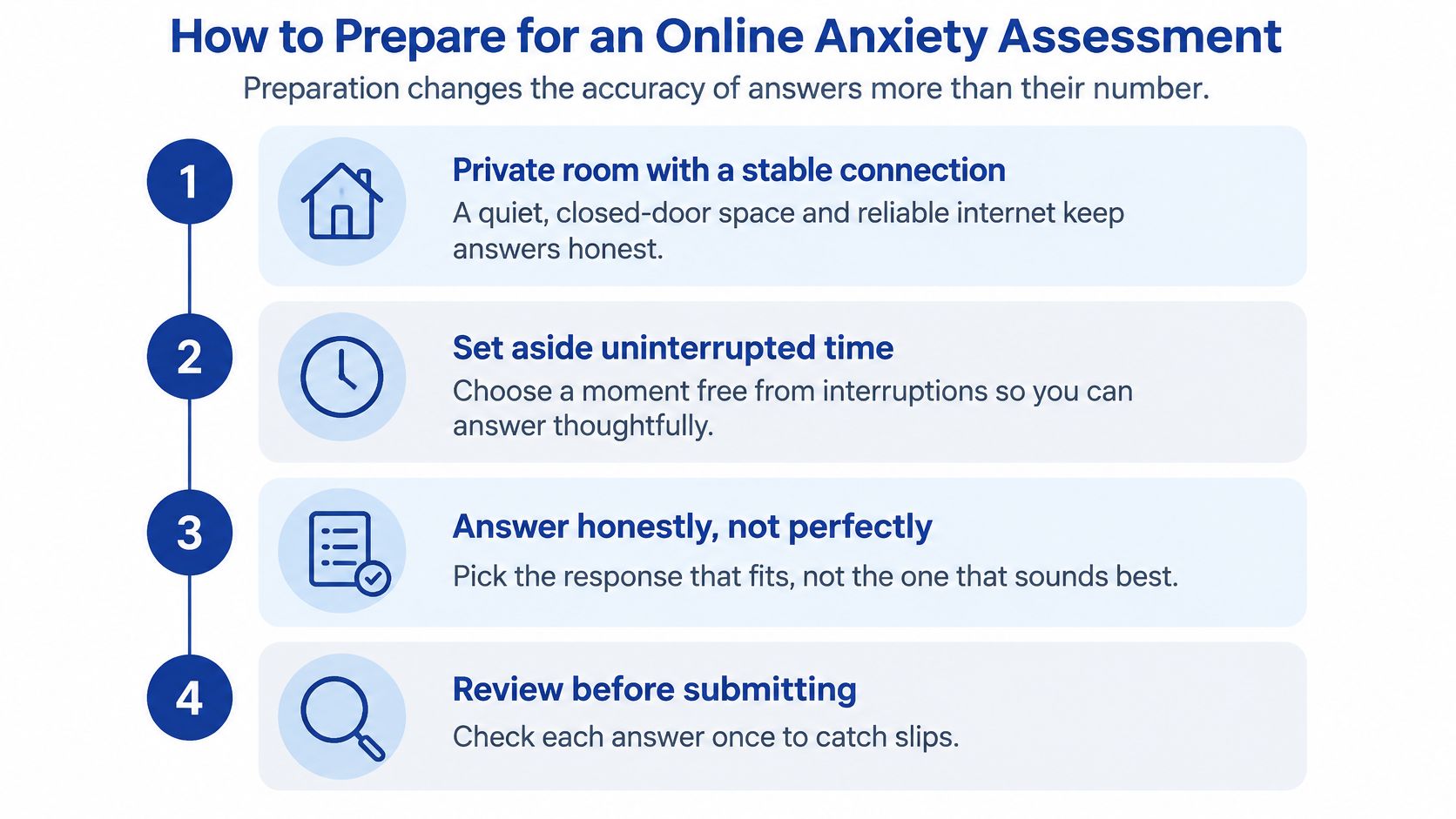
Seven steps before you submit
- Choose a private room and a stable connection. Interruptions and a shared screen change how you read the items.
- Check the timeframe, usually the past two weeks, and write it down. A vacation week or a low-caffeine week can pull the score off your usual pattern.
- Sketch a short timeline: when worry began, what worsens it, and whether it shows up at work, while driving, or in social events. Vague "always" answers hide the pattern a clinician needs.
- List medications, supplements, caffeine, alcohol, and cannabis. Each can produce or amplify anxiety symptoms, and skipping one hides a clue.
- Note medical conditions, especially thyroid problems, heart rhythm issues, asthma, chronic pain, and sleep disorders. These can mimic anxiety, so list them, and a clinician can help tell them apart from anxiety symptoms.
- Describe impairment in plain words: missed deadlines, avoided errands, strained relationships. Symptom counts without impact are easy to misread.
- Answer each item for the full timeframe, not one unusually good or bad day. One awful Tuesday isn't the whole two weeks.
The GAD-7 items are: feeling nervous, anxious, or on edge; not being able to stop or control worrying; worrying too much about different things; trouble relaxing; being so restless it's hard to sit still; becoming easily annoyed or irritable; and feeling afraid as if something awful might happen. Each item runs from 0 (not at all) to 3 (nearly every day), so a higher score means more frequent symptoms, not a more severe disorder by itself.
Put the timeline, the substance list, and the impairment notes on one page. That page is what turns a number into a clinical conversation: a positive screen on its own can't say which kind of anxiety is present, but your notes give the evaluation somewhere to start. Bring it to the visit, or send it through a secure portal before online anxiety treatment, which is available online across Pennsylvania. If any item about self-harm is answered yes, follow the crisis guidance on the screen immediately. Don't wait for the score.
How to Read Your Anxiety Score Without Overreading It
A parent in Harrisburg finishes the GAD-7 and scores 12. That lands in the moderate band. The number is a reason to talk with a clinician, not a diagnosis. The next questions are whether worry is frequent, whether panic, sleep loss, or drinking explains part of the score, and whether work or family life is affected.
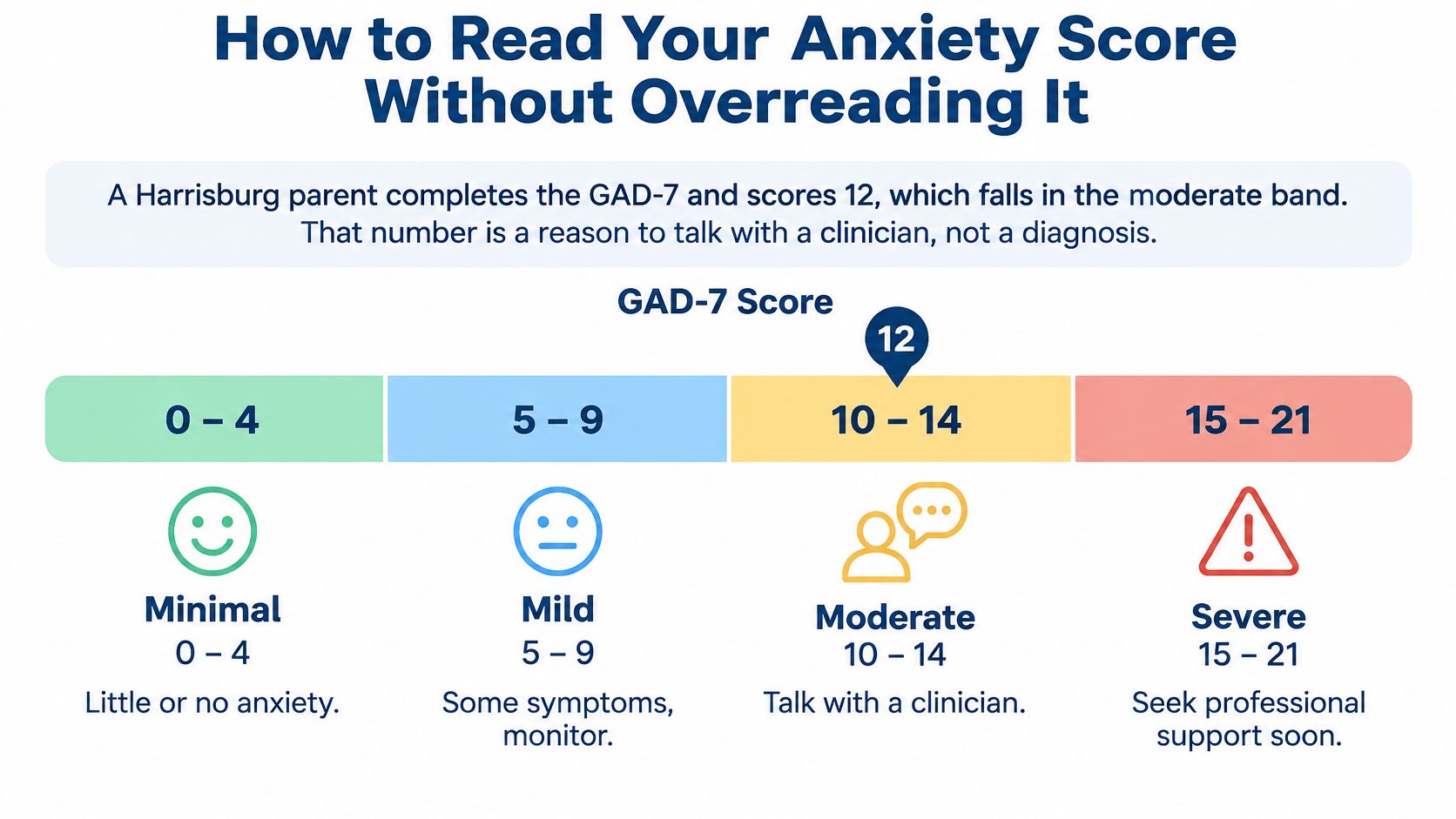
What the bands suggest
| GAD-7 score | Band | Suggested next step |
|---|---|---|
| 0-4 | Minimal | Keep tracking; the score alone doesn't rule out anxiety |
| 5-9 | Mild | Note impairment and repeat the scale over time; discuss if it persists |
| 10-14 | Moderate | Book a clinical evaluation to confirm or rule out a disorder |
| 15-21 | Severe | Book a clinical evaluation promptly; seek urgent care if safety is at risk |
A score of 12 says symptoms sat in the moderate range for two weeks. It cannot say which disorder produced them. Panic attacks, short sleep, or heavier drinking can lift the same items, and persistent uncontrollable worry points a different direction than sudden panic episodes or trauma reminders. Sorting those patterns is the clinician's job, which is why a positive screen leads to questions, not a label.
Why the cutoff changes the trade-off
Cutoff choice shifts missed cases against false positives. A diagnostic meta-analysis of 12 samples and 5,223 participants found pooled sensitivity of 83% and specificity of 84% at a cutoff of 8, with broadly similar performance from 7 to 10, according to a BMJ Open diagnostic meta-analysis. Pooled numbers still move with the population and setting tested, so they describe how the scale performs on average rather than what your score proves.
A lower threshold finds more possible cases and flags more people who don't have the disorder. A higher threshold does the reverse. No single rigid line fits every reader.
A score of 9 or 10 sits on a boundary. Treat it as a prompt for clinical review, not a yes-or-no stamp.
Track scores over several weeks. One stressful week can move the total, and symptom severity can change without proving a specific disorder. Write the score, note the date, and bring the series to the first appointment. A run of three readings tells a clinician far more than one number on one day.
Accuracy Limits and Who Needs Extra Care
Trust starts with a plain reading of the numbers. In a validation study of 527 adults, the online Mental Health Screening Tool for Anxiety Disorders reached 98% sensitivity and 80% specificity for generalized anxiety disorder, and the online format performed at least as well as paper, which had 90% sensitivity and 83% specificity, per the validation study in PMC.
98% sensitivity means nearly everyone in that study who met GAD criteria screened positive. 80% specificity means about four in five people without GAD screened negative, so about one in five without it still screened positive.
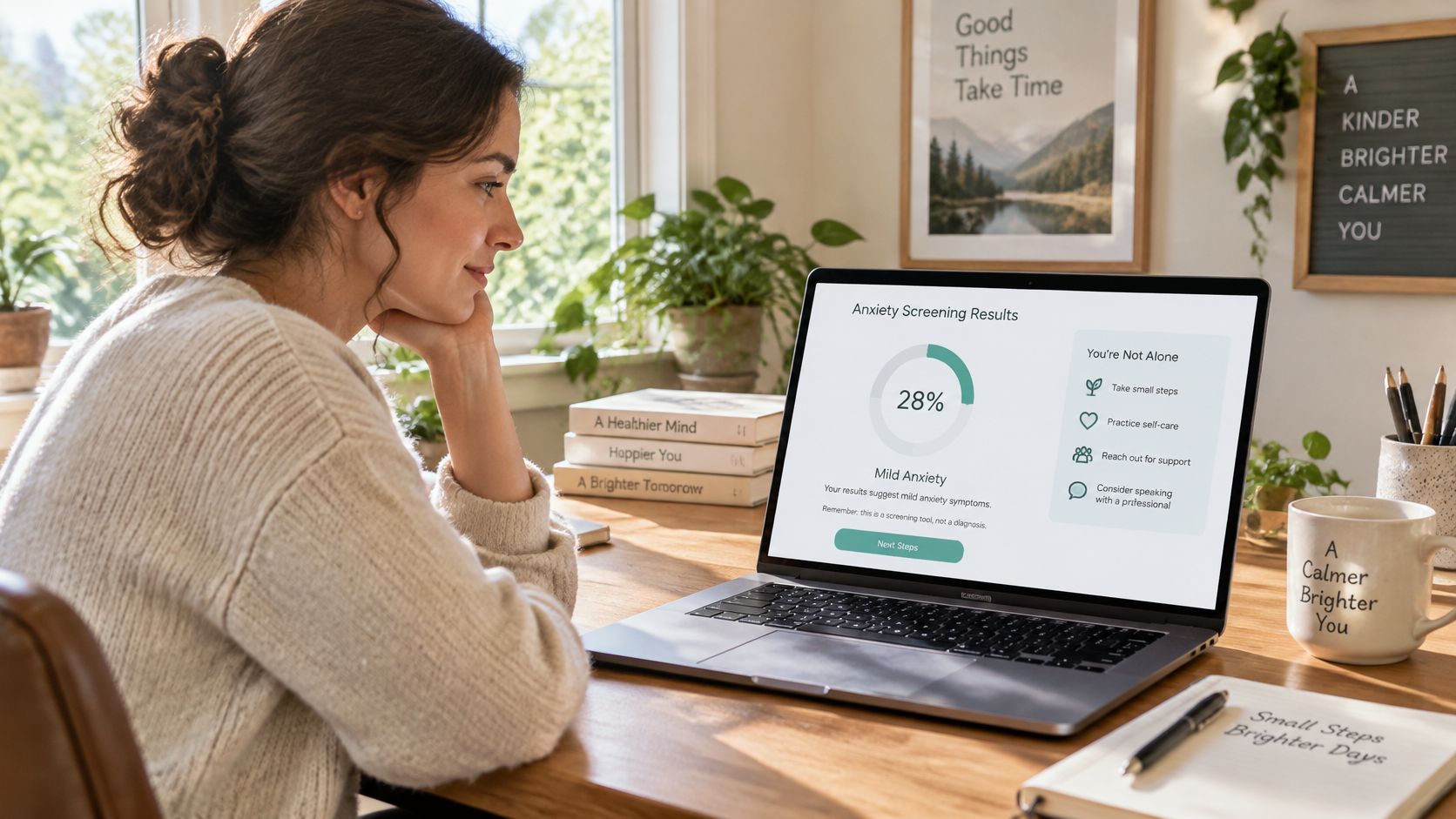
Picture two coworkers who both score high after a brutal month. One has months of uncontrollable worry and missed work. The other had a short stretch of poor sleep and extra coffee. The same positive screen fits both stories. That's a false positive for the second person if no disorder is there. A false negative is the reverse: someone with brief panic spells or trauma symptoms scores low because the items never asked about those patterns.
What these tools do well and where they fail
- Speed and privacy: A validated scale takes minutes and can be completed at home.
- Consistent wording: Everyone sees the same items, which makes a baseline easier to compare later.
- No clinical context: The form can't see medical illness, substances, or safety risk.
- Narrow focus: It can't sort generalized worry from panic, OCD, PTSD, or depression.
- Honest answers required: Rushed or "best-sounding" replies move the score.
- Episodic symptoms: A bad month that falls outside the rated window can be missed.
Who needs a closer look
Adults aged 65 and older need extra care. The Healthy People evidence summary of the Task Force recommendation reports insufficient evidence to judge screening benefits and harms in that age group, and inadequate evidence on instrument accuracy. A high score may reflect illness, pain, sleep problems, cognitive change, bereavement, medicines, or substances.
Pregnant and postpartum readers still need follow-up beyond the subscale. So does anyone with new physical symptoms. When worry and inattention travel together, an ADHD versus anxiety review matters, because an anxiety score doesn't evaluate attention disorders. CDC guidance reflecting American Academy of Pediatrics recommendations says clinicians evaluating children and adolescents ages 4 through 18 should gather parent, school, and youth reports, confirm diagnostic criteria, and screen for coexisting conditions including anxiety, as described in CDC clinical-care guidance.
When the score is high, or medical symptoms sit beside it, pair the online result with a medical evaluation. A positive screen should trigger a structured interview, not a self-assigned diagnosis.
Privacy and Telehealth Safeguards for Online Screening
Is a free online anxiety test private, and is a clinical telehealth visit more protected? The difference is who runs the tool and how the visit is set up.
HHS telehealth guidance states that telehealth appointments, messages, and related health and billing information are protected by HIPAA in the same general way as comparable in-person records. Covered providers must use platforms with secure communications and data storage, plus access controls and audit controls. HHS also advises private locations. Patients shouldn't take telehealth in public or semi-public settings unless they consent or exigent circumstances exist. A closed door, headphones, and a screen no one else can see match that advice.
HIPAA coverage depends on who runs the tool, not on the topic of the questions. HHS Privacy Rule guidance covers health plans, health-care clearinghouses, and providers that conduct certain electronic standard transactions, such as electronic billing. A free quiz on a general wellness site may fall outside HIPAA. Covered entities stay responsible even when vendors handle essential functions. The Privacy Rule generally treats mental-health information like other protected health information and can allow disclosure to other providers for treatment and care coordination.
A short privacy checklist
- Look for a privacy notice and a named provider, not only a website banner.
- Check that a secure patient portal, not ordinary email, carries results and messages.
- Ask how records are stored and who can open them.
- Confirm whether the form is a clinical intake or a general wellness quiz, because protections differ.
Integrative Psychiatry of America describes its HIPAA compliance for telehealth for visits held online. Information can go to a treating clinician for care. Decide what to include, and remember a screening score is one part of a larger record.
Choose the Next Step After a Positive Result
If you have thoughts of self-harm or you're in crisis, contact 988 or emergency services now. Don't wait for an appointment to make that call.
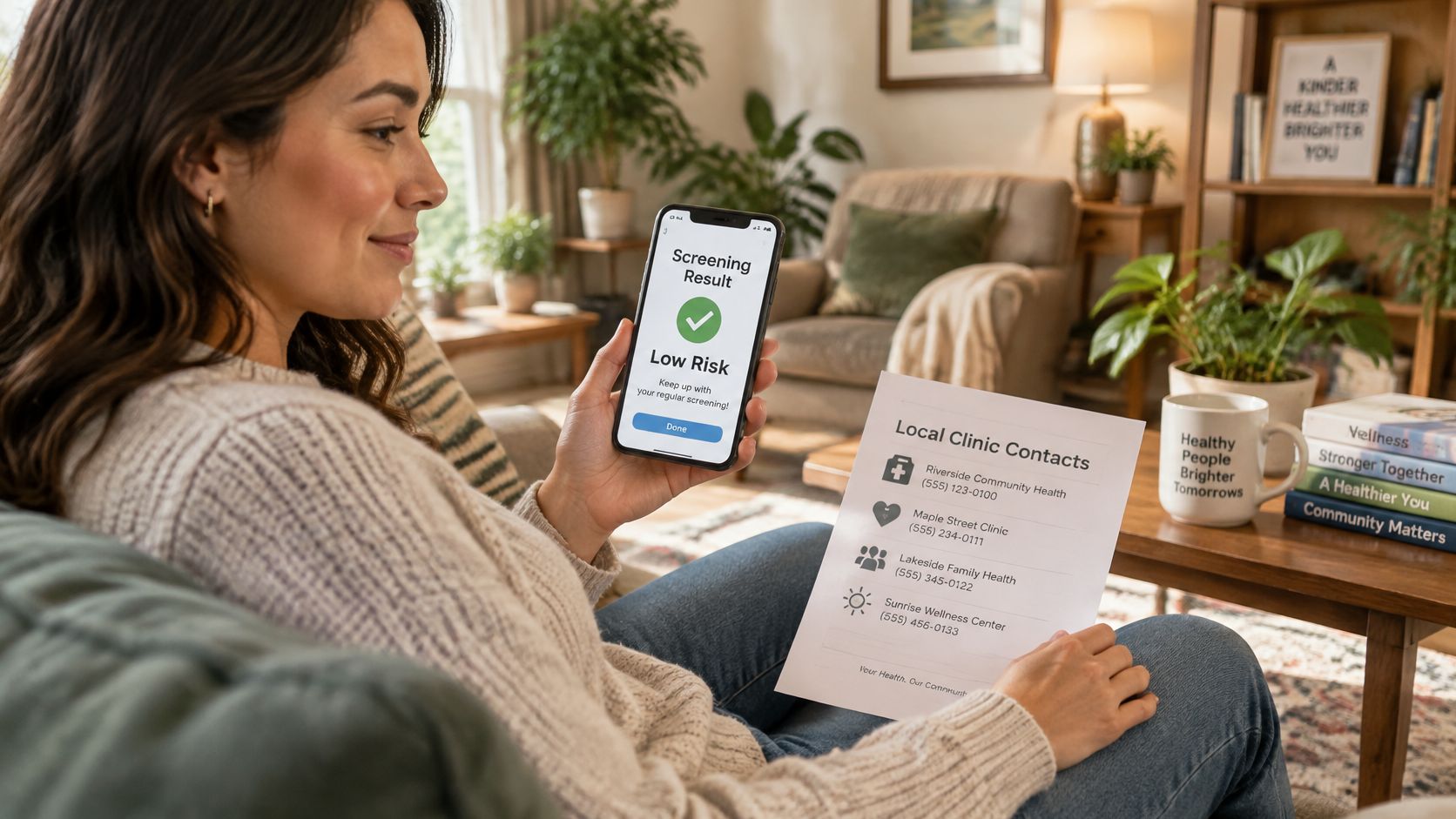
The GAD-7 band sets the first step. Moderate and severe scores are a reason to book an evaluation. Other signals can justify that visit even when the score is lower: a mild score that persists with impairment, panic attacks, sleep loss, alcohol or cannabis use rising with anxiety, or new physical symptoms that need a medical check first. Those signs are discussed further in guidance on when to see a psychiatric provider.
What the visit actually covers
Integrative Psychiatry of America schedules a psychiatric evaluation on its website. All visits run through secure telehealth for patients anywhere in Pennsylvania. A board-certified psychiatric mental health nurse practitioner reviews symptoms, history, and screening results. When clinically appropriate, that clinician builds a treatment plan and manages medication. Anxiety care covers generalized anxiety, social anxiety, panic disorder, and OCD, using medication management and therapeutic techniques. The practice is led by Christopher Clark, MSN, PMHNP-BC. Free tools include an Anxiety Symptom Checker inside a library of 15 tools, alongside an Adult ADHD Screener and a grounding exercise. The checker is informational. It doesn't replace the evaluation.
Before you book, check benefits, copays, deductibles, network status, and authorization rules. Those details vary by plan, and nothing here guarantees coverage. New patients can enter insurance details on the site and see coverage verification before the first appointment.
Two actions fit most readers. Request the evaluation if a moderate or severe score, lasting impairment, panic, rising substance use, or safety concern is present. Or keep a dated GAD-7 series and bring it to the first visit so the clinician sees a pattern, not a single night.
A short video walks through what a structured anxiety conversation sounds like before you decide.
Integrative Psychiatry of America provides virtual psychiatric care across Pennsylvania, including evaluation and treatment for anxiety that starts with a real clinical review rather than a questionnaire label. If your score, your impairment, or your safety concerns say it's time to talk, you can verify benefits and request an appointment through Integrative Psychiatry of America. Bring your dated scores. A psychiatric mental health nurse practitioner can help sort what the number means and what care fits.