
A capable adult misses a deadline, rereads the same email, and lies awake reviewing every possible mistake. During the day, that person feels restless and distracted. At night, the question becomes difficult to avoid: is this ADHD, anxiety, or both?
The answer rarely comes from matching symptoms to an online checklist. ADHD vs anxiety is a clinical question about timing, context, developmental history, internal experience, and functional impairment. A psychiatric assessment can show whether attention problems reflect ADHD, worry-driven cognitive overload, another condition, or more than one diagnosis.
Table of Contents
- Why ADHD and Anxiety Are So Hard to Tell Apart
- Overlapping Symptoms That Create Diagnostic Confusion
- How Clinicians Separate ADHD From Anxiety Patterns
- When Both Conditions Occur Together
- What a Comprehensive Psychiatric Evaluation Covers
- Treatment Sequencing When ADHD and Anxiety Co-Occur
- Why Many Adults Are Misdiagnosed or Diagnosed Late
Why ADHD and Anxiety Are So Hard to Tell Apart
A person may appear bright, organized, and successful while privately struggling to start tasks, regulate attention, manage time, and quiet a racing mind. They may procrastinate until pressure creates enough stimulation to act, then assume the resulting panic proves anxiety caused everything. Another person may spend hours worrying about failure, avoid an assignment because it feels threatening, and mistake that avoidance for ADHD-related task initiation difficulty.
Both conditions can involve distractibility, restlessness, procrastination, racing thoughts, irritability, and sleep problems. The visible behavior doesn't identify the cause. A clinician needs to ask what happens inside the moment, when the pattern began, and whether symptoms continue during relatively calm periods.
Clinical distinction: The same missed deadline can arise from executive dysfunction, fear-based avoidance, or both.
For example, an adult with ADHD may lose focus during a routine task because attention regulation is inconsistent. An adult with anxiety may lose focus because worry occupies working memory. Someone with both may begin with ADHD-related disorganization, receive criticism, develop fear of repeating the failure, and then experience anxiety that further disrupts concentration.
That interaction explains why ADHD or anxiety is often the wrong framing. A lifespan review reported a 25% comorbidity rate between ADHD and anxiety disorders, while adult clinical samples have shown substantial overlap, including a study in which 47.1% of adults with ADHD met criteria for a lifetime anxiety disorder (PubMed review of ADHD and anxiety across the lifespan).
Self-help strategies can still support daily functioning. Someone struggling with task initiation may find practical ideas in Master procrastination with AIDictation, but productivity tools cannot determine whether worry, ADHD, sleep disruption, depression, trauma, or another issue drives the problem. That distinction requires an evaluation.
Overlapping Symptoms That Create Diagnostic Confusion
The most useful question isn't whether a symptom exists. It is what triggers it, how consistently it appears, and what mental process sustains it.
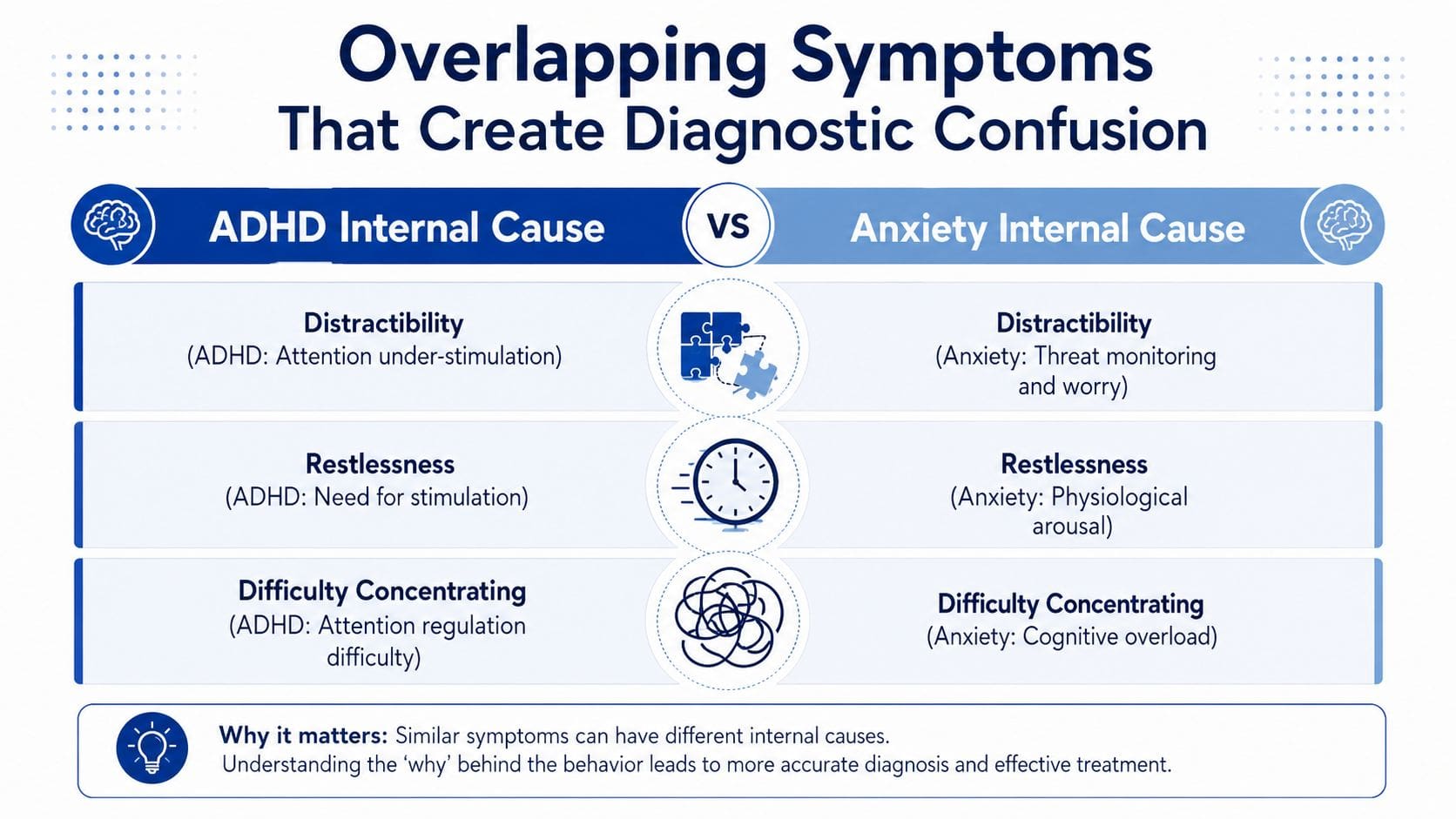
Distractibility and concentration
ADHD-related distractibility often reflects difficulty directing and sustaining attention, especially during repetitive or low-interest activities. Attention may shift toward sounds, notifications, ideas, or anything more stimulating. Anxiety-related inattention usually follows worry, threat monitoring, or repeated mental review of feared outcomes.
A clinician may ask whether concentration improves when worry settles. If focus remains unreliable across calm and stressful settings, ADHD becomes more clinically relevant. If concentration worsens mainly around specific fears, anxiety may be driving the impairment. The adult ADHD symptoms guide offers general education, but it can't replace diagnostic history.
Restlessness and racing thoughts
ADHD restlessness may feel like boredom, impatience, or a need for stimulation. It can appear even when the person doesn't feel afraid. Anxiety-related restlessness more often includes muscle tension, a sense of threat, physical agitation, or difficulty feeling safe.
Racing thoughts also differ in quality. ADHD can involve rapid shifts among ideas, plans, memories, and distractions. Anxiety tends to produce repetitive loops, such as reviewing a conversation or predicting what might go wrong. These patterns can coexist, which makes the person feel mentally busy without clarifying the diagnosis.
Procrastination, avoidance, and sleep
ADHD procrastination commonly involves difficulty starting, sequencing, estimating time, or maintaining effort. Anxiety-related procrastination is more likely to involve fear of criticism, perfectionism, embarrassment, or failure. The outward behavior looks similar, but the intervention may differ.
Sleep problems require the same careful analysis. ADHD can involve difficulty transitioning away from stimulating activities or maintaining a regular schedule. Anxiety can keep the mind focused on worries at bedtime. A psychiatric assessment considers whether sleep disruption worsens attention the next day, rather than treating poor concentration as proof of either condition.
How Clinicians Separate ADHD From Anxiety Patterns
A clinician doesn't diagnose ADHD from adult distractibility alone. ADHD is a neurodevelopmental condition, so the evaluation looks for a longstanding pattern that began in childhood. Adult diagnostic guidance emphasizes symptom history, functional impact, and targeted screening, including the ASRS-v1.1 for ADHD and GAD-7 for generalized anxiety disorder (adult ADHD assessment guidance and screening tools).
Childhood evidence may come from school records, family recollections, report cards, or the adult's consistent memories of organization, forgetfulness, impulsivity, or time-management problems. Anxiety can begin later, after a health event, loss, trauma, relationship difficulty, work change, or prolonged stress. Timing doesn't answer everything, but it provides an essential diagnostic anchor.
| Factor | ADHD pattern | Anxiety pattern |
|---|---|---|
| Onset | Symptoms trace back to childhood and affect development or functioning over time | Symptoms may emerge at any point and follow worry, fear, or stress |
| Settings | Difficulties often appear across work, home, school history, and relationships | Symptoms may intensify in specific situations connected to perceived threat |
| Attention | Attention regulation is inconsistent, particularly with low-interest tasks | Worry or threat monitoring consumes attention |
| Restlessness | Stimulation-seeking, impatience, fidgeting, or a need to stay engaged | Tension, hypervigilance, dread, or physical unease |
| Impulsivity | Disinhibition, interrupting, quick decisions, or reward-seeking behavior | Rapid action may aim to escape or prevent a feared outcome |
| Organization | Persistent problems with planning, time estimation, prioritizing, and follow-through | Organization may remain intact when anxiety is controlled |
| Thought flow | Rapid shifts, many ideas, novelty seeking, or hyperfocus on interest | Repetitive worry, rumination, and feared-outcome rehearsal |
Why context matters
Clinicians also ask whether executive-function problems persist during low-stress periods. Guidance for co-occurring ADHD and anxiety highlights stimulus-seeking behavior, disinhibition, and chronic organization or time-management problems as features that can point toward ADHD rather than primary anxiety (CADDRA clinical guidance).
An ADHD evaluation rather than ADHD testing is therefore more than a score. It integrates symptom patterns, history, impairment, and alternative explanations.
When Both Conditions Occur Together
A patient may arrive with chronic disorganization, escalating worry, and avoidance. The clinical question is whether one condition explains the pattern or whether ADHD and anxiety are both contributing.
Adult research describes anxiety disorders as common ADHD comorbidities. One review reports anxiety in roughly 25% to 50% of patients across summarized studies (adult ADHD and anxiety study review). The same review reports lifetime anxiety disorder in 47.1% of participants, including social phobia at 29.3%, specific phobia at 22.7%, and PTSD at 11.9%.
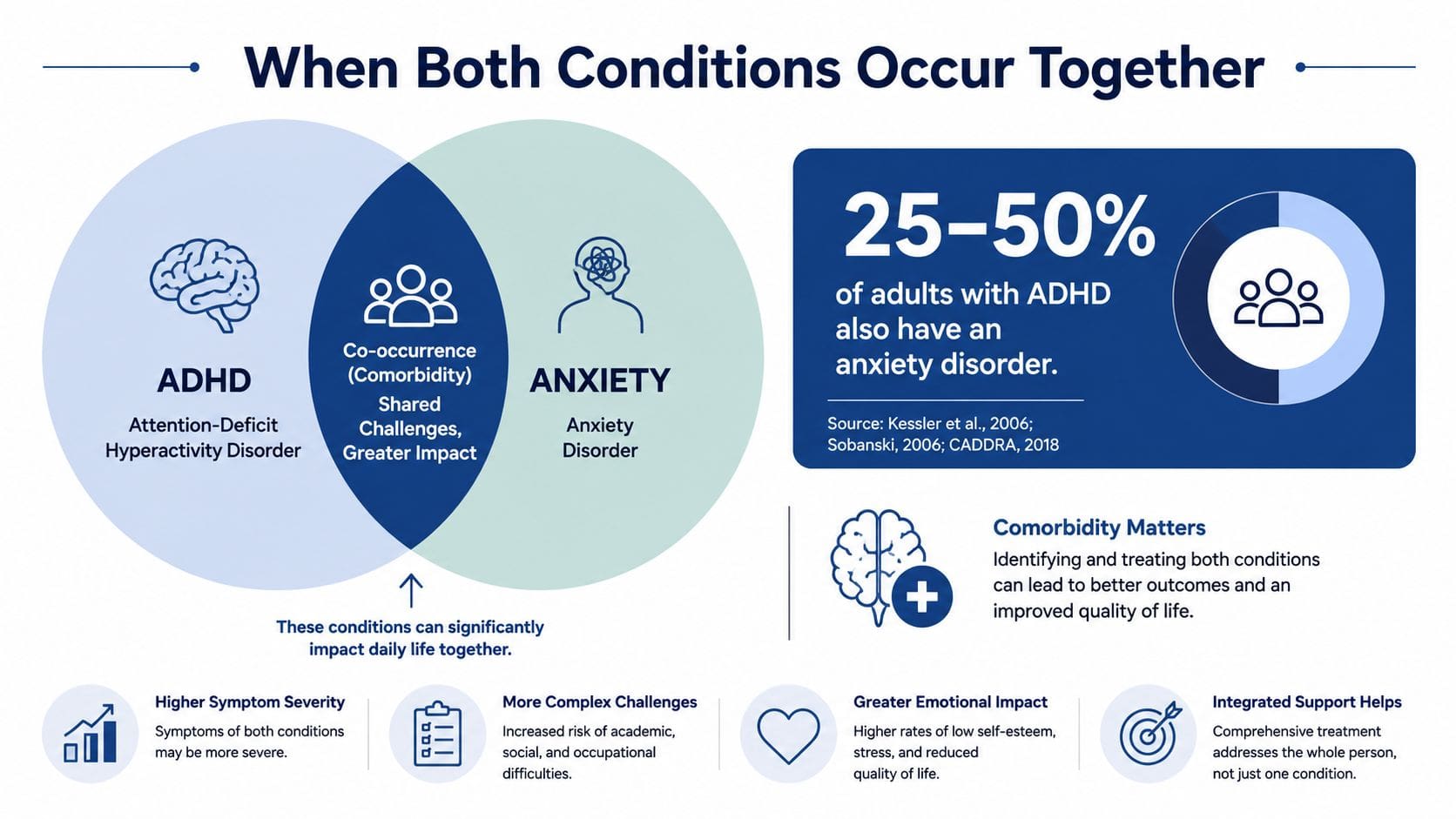
The conditions can reinforce each other. Missed obligations linked to ADHD may produce fear of consequences. Anxiety can then absorb attention, increase avoidance, and make planning harder. Treating anxiety may reduce worry while leaving longstanding disorganization unchanged. Treating ADHD may improve task management while panic, social fear, or rumination continue.
Research in adult anxiety populations also finds substantial ADHD symptom overlap, with particularly strong overlap reported for generalized anxiety disorder (review of ADHD and anxiety symptom overlap). A separate review describes anxiety-disorder risk in people with ADHD approaching 50% (review of ADHD and anxiety comorbidity).
These findings explain why a screener cannot settle the diagnosis. Clinicians examine onset, impairment, triggers, and response to prior treatment. Persistent symptoms after treating one condition call for reassessment rather than automatic escalation of that diagnosis.
An overview of co-occurring ADHD, anxiety, and depression treatment in Philadelphia discusses integrated care.
What a Comprehensive Psychiatric Evaluation Covers
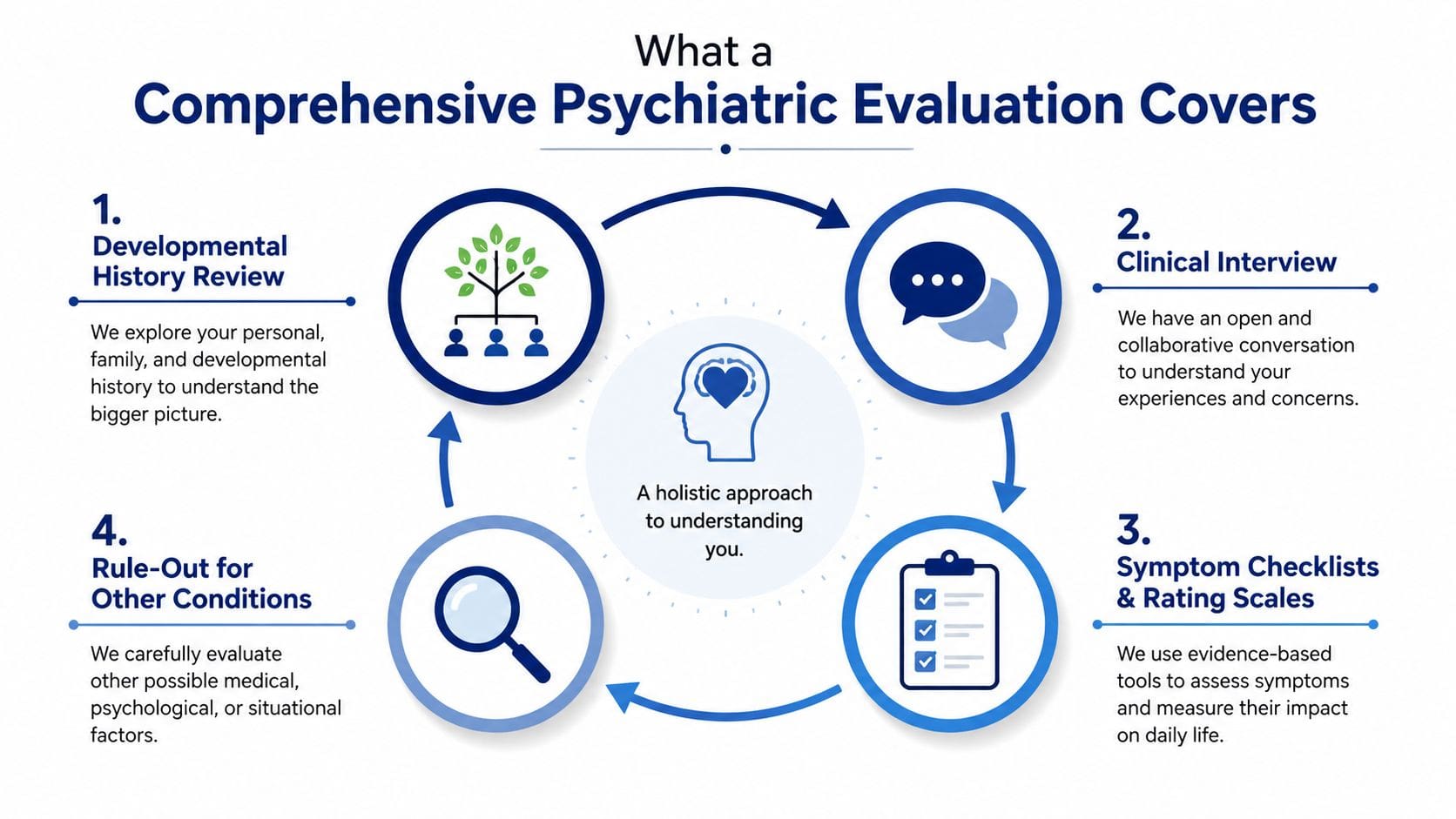
A thorough evaluation turns a vague complaint, such as “the brain feels scattered,” into a clinically useful timeline. The process usually includes several connected parts.
Developmental and clinical history
The clinician asks about childhood behavior, school performance, family observations, work patterns, relationships, sleep, medical history, trauma exposure, substance use, and previous treatment. The goal isn't to force childhood memories into an ADHD diagnosis. It is to identify whether attention and executive-function problems predated adult stress.
The interview also compares settings. A person who functions well when calm but becomes unable to concentrate around contamination fears may need an anxiety evaluation. Someone who struggles with planning at home, work, and school history may need an ADHD-focused assessment.
Rating scales and functional impairment
Tools such as the ASRS and GAD-7 organize symptoms and support clinical interviews. They don't independently establish a diagnosis. Research has found that common ADHD symptom measures can reflect anxiety-related distress rather than ADHD-specific impairment, which helps explain why online self-tests can mislead (research on anxiety-related distortion of ADHD symptom measures).
Clinicians also assess what the symptoms cost the person. Missed work, unstable routines, relationship conflict, exhaustion, avoidance, and reduced self-care may matter more than the symptom label alone.
Other explanations and telepsychiatry
A responsible assessment considers conditions that can mimic or worsen both presentations. These may include sleep disorders, depression, trauma responses, medication effects, substance use, and relevant medical problems such as thyroid disease or sleep apnea. The clinician decides whether additional medical evaluation or testing is appropriate.
Virtual care can support this process when the provider has secure telehealth systems and sufficient time for history-taking. Adults across Pennsylvania may pursue psychological testing for ADHD when a more detailed evaluation is clinically appropriate. Telepsychiatry can reduce travel barriers, but remote care still requires privacy, reliable communication, and individualized clinical judgment.
Treatment Sequencing When ADHD and Anxiety Co-Occur
Treatment usually begins with the condition that is most severe, destabilizing, or functionally impairing. A recent review describes this sequencing principle for comorbid ADHD and anxiety, because stabilizing the dominant problem can clarify which symptoms remain (review of treatment sequencing for ADHD and anxiety).
That doesn't mean one diagnosis is ignored. A person with intense anxiety may begin with anxiety-focused therapy, medication management, sleep stabilization, and practical coping strategies. Once anxiety is more manageable, the clinician can reassess attention and executive functioning. If ADHD creates the largest impairment, ADHD treatment may take priority while anxiety receives parallel monitoring.
Stimulant medication can transiently increase anxiety when initiated or adjusted. CADDRA guidance recommends slow titration and reducing or holding ADHD medication if anxiety becomes too intense before anxiety stabilization and a later re-challenge (CADDRA medication guidance). Medication choices depend on medical history, sleep, cardiovascular considerations, substance-use history, other medications, and patient preference.
Integrated care may combine medication management, cognitive behavioral therapy, exposure-based work for appropriate anxiety disorders, organization strategies, sleep interventions, exercise, and regular symptom tracking. Patients should expect adjustment rather than a one-time decision. A treatment plan should respond to benefit, side effects, functioning, and the changing balance between attention problems and anxiety.
For adults whose worry dominates the clinical picture, generalized anxiety disorder treatment provides a relevant starting point for discussing options with a qualified clinician.
Why Many Adults Are Misdiagnosed or Diagnosed Late
Women and high-functioning adults may receive an anxiety label when ADHD presents through internal restlessness, overwhelm, perfectionism, and exhaustion rather than obvious hyperactivity. Strong academic ability, intense effort, or rigid compensatory routines can conceal executive-function problems until work, caregiving, or relationship demands exceed available coping strategies.
Historical diagnostic models often centered visible hyperactivity and disruptive behavior. That emphasis made inattentive presentations and internalized symptoms easier to miss. A person may look anxious because constant over-preparation is compensating for unreliable memory, time estimation, or task initiation.
Anxiety may be the visible complaint, while ADHD remains the unrecognized contributor. If anxiety treatment reduces fear but chronic disorganization, forgetfulness, time blindness, or task-switching problems continue, the diagnosis deserves another look. That doesn't prove ADHD, but it supports a broader psychiatric assessment.
A 2025 review describes adult ADHD with comorbid anxiety and depression as diagnostically complex, reinforcing the need for careful evaluation rather than symptom checklists alone (2025 review of adult ADHD with anxiety and depression). Adults in Pennsylvania can seek virtual psychiatric evaluations, medication management, and integrative care through Integrative Psychiatry of America, with assessment focused on the complete pattern rather than an either-or label.
Integrative Psychiatry of America provides secure telepsychiatry throughout Pennsylvania for ADHD and anxiety evaluations, medication management, and related mental health care. Adults who remain unsure whether symptoms reflect ADHD, anxiety, or both can visit Integrative Psychiatry of America to learn about scheduling an evaluation.