
The tax folder is open on the screen. The W-2 is somewhere inside it, the deadline matters, and the person staring at it cares about getting this done. Nothing happens. Fifteen minutes pass, the phone wins twice, and self-criticism fills the gap. That gap, between knowing and starting, is ADHD task initiation difficulty. It isn't laziness, and it isn't solved by one generic tip. Starting fails for different reasons on different days, so the first useful move is naming which reason is present.
Table of Contents
- Match Your Stuck Point to the Right Fix
- How to Start Any Task in Five Steps
- Set Up External Structure That Helps You Begin
- Why Emotional Overload Blocks Your Start
- Why Delayed Payoffs Make Starting Harder
- Which Medication and Therapy Options Support Starting
- Track Your Starts for Two Weeks
- Decide Whether an ADHD Evaluation Makes Sense
Match Your Stuck Point to the Right Fix
Say a tax form has sat unopened for nine days. The delay looks identical from outside whether the blocker is vagueness, shame, or exhaustion. From inside, those feel completely different, and each one responds to a different first fix. Guessing wrong wastes effort. A timer doesn't clarify an unclear task, and a smaller step doesn't calm a task that feels threatening.
Six stuck points at a glance
| Stuck point | What it looks like | First fix to try |
|---|---|---|
| Unclear task | You know the goal but not the next action | Name one visible endpoint, such as "open the tax document" instead of "do taxes" |
| Task too large at step one | Opening the task feels vague or heavy | Choose a physical first action that takes under five minutes |
| Distraction beats delayed payoff | The phone or inbox wins every time | Move the cue and materials away from the distraction |
| Overwhelm or shame | Starting feels threatening or perfectionistic | Take a 60-second reset, then produce a deliberately rough first draft |
| No witness or deadline | You start only when someone is watching | Schedule a check-in or use a body double |
| Exhaustion or medication timing | The task feels impossible most days | Review sleep and medication timing with a clinician before blaming willpower |
Use the table against the last task that stalled, not against an ideal version of the day. Pick the row that matches best, run its fix for three days, and move to the next row only if nothing changes. Testing one fix at a time shows what moved the start. Switching strategies hourly shows nothing except that switching is easier than starting.
Where the table stops helping
This lookup is a starting point, not a diagnosis. A stuck point that shows up at work, at home, and at school for several months deserves a professional look, because persistent initiation failure often overlaps with broader executive dysfunction. Readers who recognize that pattern can read about executive dysfunction treatment for adults to see how clinicians approach it. Difficulty that travels across settings and survives honest attempts at these fixes is clinical information, not a character verdict.
Practical rule: Match the fix to the felt blocker. Clarity problems need definition, emotional problems need a reset, and timing problems need a clinician conversation.
How to Start Any Task in Five Steps
A stalled task usually needs to become smaller, more visible, and tied to a specific moment. The five steps below do that conversion in order. Each step removes one decision from the moment of starting, which matters because decisions stacked at the starting line consume the same planning and working memory resources the task itself needs.
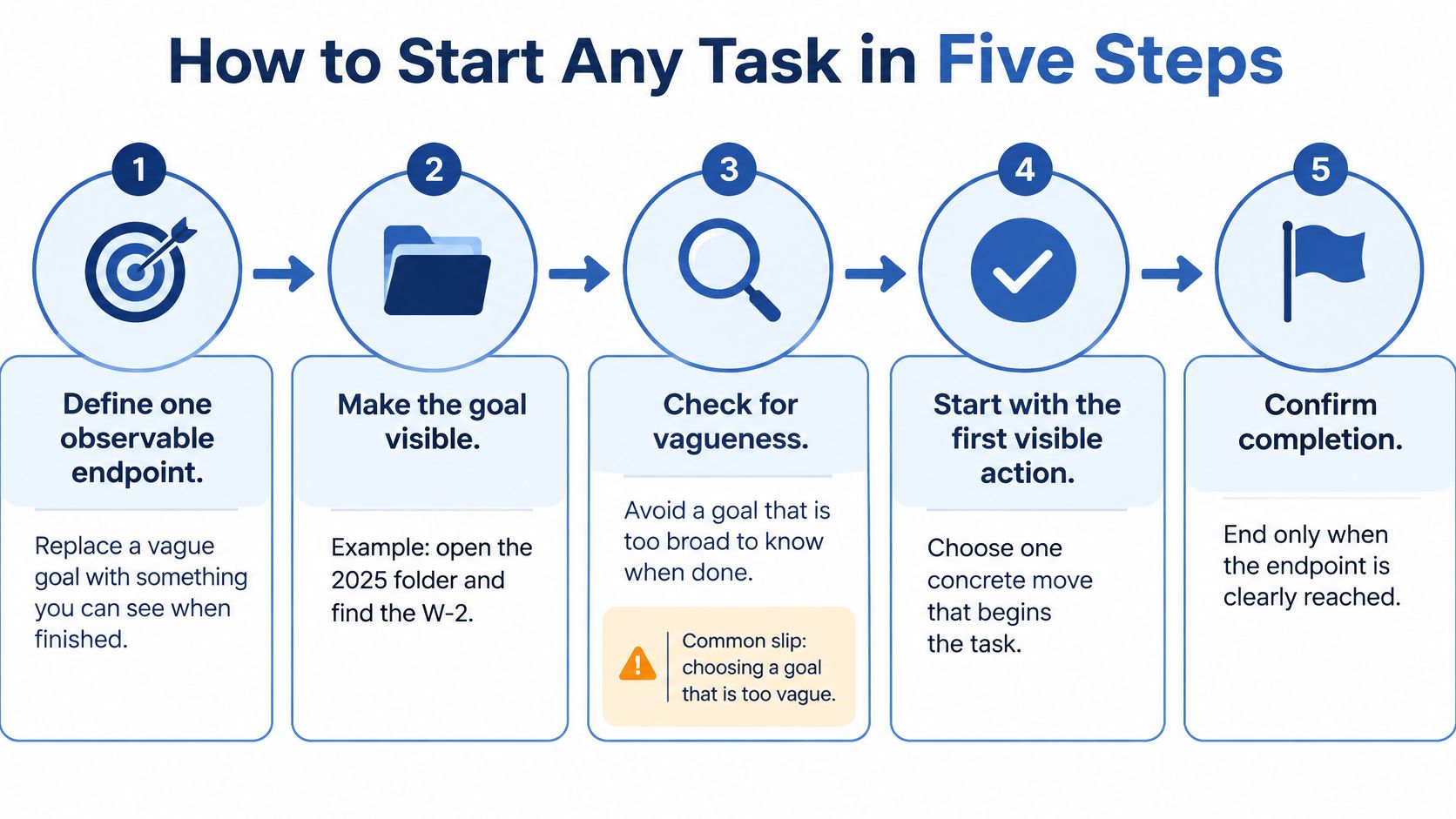
The five steps
- Define one observable endpoint. Replace "do taxes" with something visible when finished, such as open the 2025 folder and find the W-2. The endpoint works because the brain can confirm completion without judgment. The common slip is choosing a goal that still requires a decision before any action happens.
- Break it into a subgoal of roughly 2 to 5 minutes. One action only, such as type the title of the report. Several steps at once add planning load and delay the very start they're meant to enable. Keep the rest of the task out of view until this piece is done.
- Set the cue, location, and first physical action. Write it down: when the kettle clicks off, at the kitchen table, open the template and type the title. "Work on report" fails because it's cognitively ambiguous. A named place and a physical verb leave nothing to interpret.
- Start a timer or external prompt. A 10-minute timer makes the commitment finite, which lowers the cost of beginning. The slip here is setting the timer and then deciding whether to start. The timer is the decision.
- Schedule a stop-and-check before switching. When the timer ends, ask whether the endpoint is visible, note what blocked progress, and name the next subgoal. Stopping on purpose protects the next start. Drifting away teaches the brain that tasks end by escape.
This sequence mirrors the protocol summarized in a systematic review of executive function interventions in ADHD, which describes defining one observable endpoint such as "open the tax document," decomposing it into a subgoal requiring roughly 2 to 5 minutes, specifying cue, location, and first physical action, and inserting a scheduled stop-and-check. That review also notes Goal Management Training used subgoal decomposition and periodic stop-and-check procedures in adults with ADHD, with better outcomes than psychoeducation control conditions. Honesty about limits matters too. The same review found only 17 studies examined adults, even though 88.9% of included studies found significant improvement in overall executive functioning or at least one domain. The evidence supports trying the sequence. It doesn't promise it works for everyone.
What a healthy start looks like
A healthy start is modest by design. The first action is done, the start time is logged, and the task either continues or pauses deliberately. A start counts even when the task is unfinished.
The main pitfall is measuring intention instead of behavior. A beautifully detailed plan, a new app, or a fresh notebook can all feel like progress while the task itself remains untouched. Readers who want a deeper treatment of sustained effort after the start can explore strategies to overcome procrastination on demanding tasks, which pairs well with the short, finite starts described here. Notice the difference in jobs. Deep work techniques sustain attention once it's engaged. The five steps above exist to get attention engaged in the first place, and conflating the two leads people to schedule long focus blocks they never enter.
One more adjustment helps on repeat tasks. The same cue, place, and first action used daily becomes a start script, so the sequence stops requiring fresh negotiation each morning. Email becomes "open inbox, reply to one easy message first." Writing becomes "open draft, write three bad sentences." The script feels almost too simple, and that simplicity is the point. Negotiation is where starts go to die, so the script removes negotiation from the hardest sixty seconds of the task.
Set Up External Structure That Helps You Begin
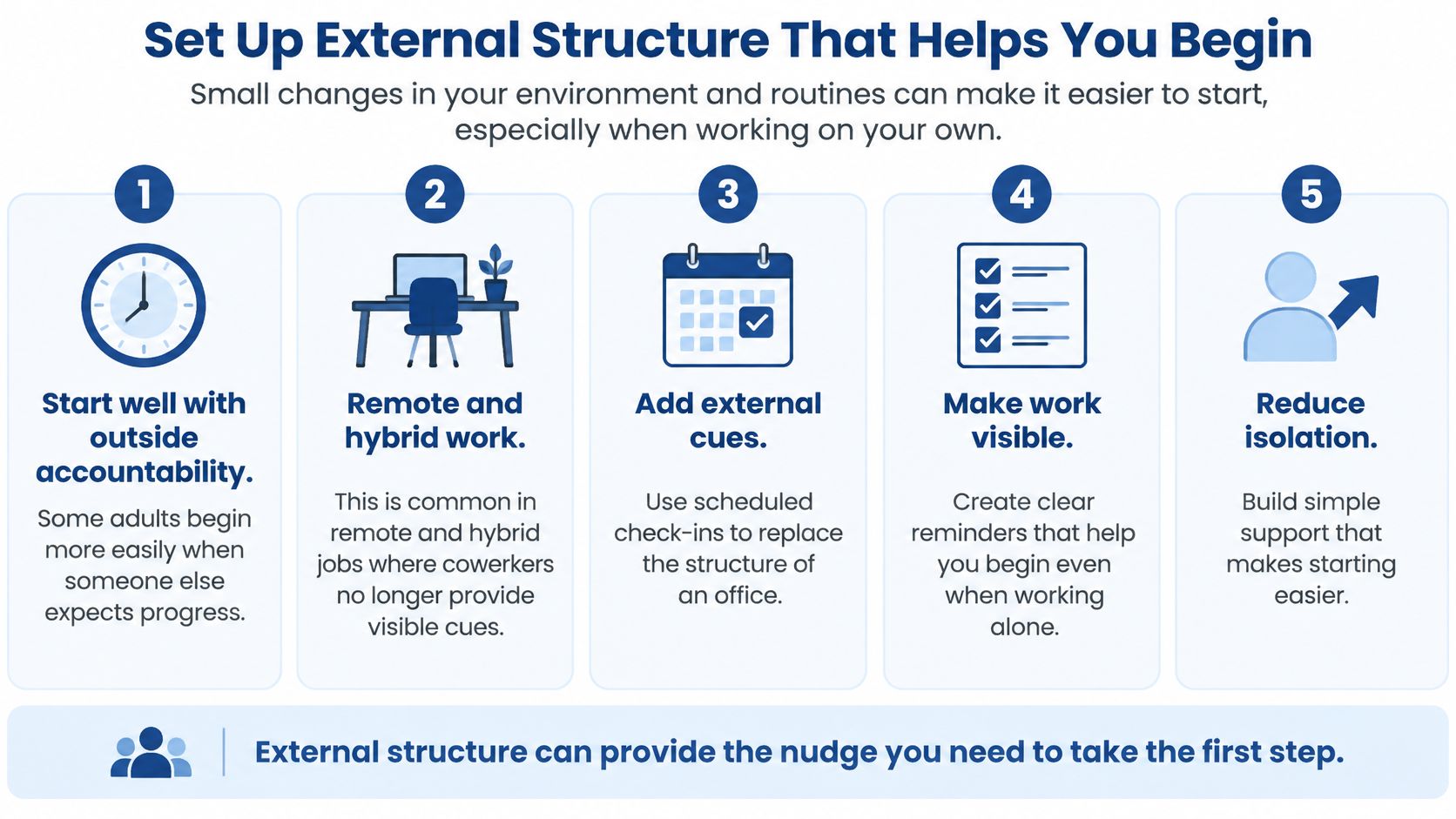
Many adults start promptly when a coworker is waiting, a meeting anchors the hour, or a manager will ask about progress by noon. Alone at a kitchen table, the same person stalls for two hours. Remote and hybrid work removed the visible cues that offices supplied automatically, and nobody replaced them. Rebuilding those cues deliberately goes faster when you match the structure to how you fail to start.
An organizational gap and a witnessing gap need different tools. Someone who starts fine but drifts twenty minutes in needs a sustaining structure, like a body double or a check-in halfway through. Someone who never reaches the first action needs a cue and a witness at the very beginning, not mid-task. Buying the wrong one is the most common reason people conclude that structure doesn't work for them.
Comparing six external supports
| Structure | Works best when | Watch for |
|---|---|---|
| Body doubling | You start only when someone is present | Can become dependence; test working alone for a week |
| Live coaching or accountability check | Deadlines are missed for several weeks | Cost and scheduling; pick a fixed weekly time |
| Calendar time blocks | Tasks feel open-ended | Blocks get overridden by interruptions; keep them short |
| Timers and visual cues | Starting is the main problem | Constant alerts create notification overload |
| Desk and device changes | Distractions sit within easy reach | Works in one setting; needs a daily reset |
| Employer accommodations | Remote or hybrid roles remove coworker cues | Requires documentation; terms vary by employer |
A 2025 randomized controlled trial protocol on workplace ADHD intervention targets difficulties with time management, attention regulation, task prioritization, and meeting deadlines, with follow-up planned through 12 months. That framing is useful because it treats starting as a work-design problem, not only a personal habit problem.
On-device systems that detect inactivity and offer context-sensitive prompts are still early and under-studied. Treat them as experiments you evaluate for yourself, not as treatment. The test for any of them is narrow: does the prompt arrive in the sixty seconds before you would otherwise stall, without adding notification noise or a privacy cost you haven't agreed to? The same test applies to planners built for other routines, which is why comparing Strive Workout Log's routine planner picks comes down to cue timing rather than feature count.
A physical setup checklist
- Clear the desk to one task: Everything else leaves the surface.
- Pre-open the file: The first action should be visible, not buried in folders.
- Move the phone out of reach: Another room beats face-down on the desk.
- Set a visible timer: A clock on the desk outperforms a phone timer beside notifications.
- Choose one accountability option for the week: Not five. One, tested sincerely.
Employer accommodations such as written deadlines and priority lists help, but they vary by employer and usually require documentation. Ask what's available rather than assuming. Adults building this kind of structure at work may also benefit from guidance on how to manage ADHD at work, especially around prioritization and interruptions. I would add one structure per week and keep it for a full week before judging it, because the first three days of any new cue mostly measure novelty.
Why Emotional Overload Blocks Your Start
"Why do I understand what to do but still feel unable to start?" It's the question underneath most task initiation complaints, and the honest answer is that knowing and starting run on different systems. Starting is not laziness, and it isn't a lack of caring. People often care intensely about the exact tasks they can't begin.

Two different barriers, two different fixes
An organizational barrier means the task is unclear, so definition fixes it. An emotional barrier means the task feels threatening, shameful, or exhausting, so definition alone changes nothing. The emotional version needs down-regulation, self-compassion, and a smaller, lower-stakes entry point. Applying organizational fixes to an emotional barrier is why capable people conclude that nothing works for them.
A 2025 pilot study published in JMIR Formative Research tested a 12-module, clinician-supported online program in 36 working adults with ADHD, combining cognitive-behavioral strategies for executive functioning, stress management, and emotion regulation. Participants showed large improvements in ADHD symptoms (Cohen's d=0.98), perceived stress (d=0.83), exhaustion (d=1.12), anxiety (d=1.70), depression (d=1.25), and quality of life (d=0.84). Those numbers are encouraging, and they need their limits stated plainly. It was a small pilot without a control group, so it isn't proof of effect. It does suggest that treating stress and emotion alongside organization is a reasonable direction.
The short video below walks through the experience of feeling stuck at the starting line and what helps in that moment.
A reset that takes one minute
Name the feeling in one sentence, out loud or on paper. "This email feels like a verdict" is more workable than a vague heaviness. Then use a brief grounding exercise, such as the 5-4-3-2-1 technique described in this guide on how to self-soothe, and begin with a deliberately rough version of the task. A bad first paragraph can be revised. A blank page guarded by perfectionism can't.
A rough start counts. The standard for minute one is contact with the task, not quality.
Persistent initiation problems that carry heavy shame, dread, or exhaustion warrant assessment for ADHD, anxiety, depression, sleep problems, medication effects, or overlapping conditions. Another generic productivity app is not the answer to a clinical pattern.
Why Delayed Payoffs Make Starting Harder
Delay discounting is the tendency to value a smaller reward now more than a larger reward later. Everyone does it sometimes. The question is how steeply the future gets discounted, because steep discounting makes any task with a distant payoff feel almost weightless at the moment of starting.
What the choice experiments show
In one experimental setup described in a study of delay discounting and ADHD traits, participants repeatedly chose between JPY 50,000 immediately and JPY 100,000 after a delay, starting at three weeks and adjusted after each choice across intervals from one day to two years. Higher ADHD-trait scores were associated with steeper delay discounting, reduced sustained attention, more working-memory errors, and poorer decision-making under risk. Modeling in that study linked the steeper discounting to ADHD traits through sustained attention, working memory, and decision-making pathways.
Translate that into a Tuesday afternoon. Checking a phone pays off in two seconds. Avoiding an unpleasant email pays off immediately, in relief. Completing insurance paperwork pays off in three weeks, invisibly. The immediate option isn't winning because the person is weak. It's winning because, in that brain, at that moment, it's worth more.
A second finding adds context. In a study of adults with ADHD and comparison participants, delay-aversion questionnaire scores produced t(82)=10.186, delay-discounting scores produced t(82)=9.201, and the BRIEF-A inhibition scale produced t(81)=12.486, all with p<0.0005. Two measures in that study, delay frustration and mean initial thinking time, did not differ significantly, which is a useful reminder that the picture isn't uniform. These are group-level findings. They don't diagnose anyone, and not every initiation problem is ADHD.
Three moves that shrink the delay
- Attach a small immediate reward to the first five minutes: Coffee that starts when the file opens, music reserved for admin work, a checkmark on a visible streak card.
- Move the payoff closer: A visible deadline today beats an important deadline next month. Artificial deadlines work better when someone else can see them.
- Tie the task to a near-term consequence: Prepare the document because a meeting starts in 30 minutes and a colleague will open it. Proximity creates the urgency the distant payoff couldn't.
Each move accepts the discounting instead of arguing with it. Exhorting someone to value the future more has a poor track record. Restructuring the task so something worthwhile happens now has a much better one.
Which Medication and Therapy Options Support Starting
No single medication or therapy fixes task initiation. That's the direct answer, and any source promising otherwise should be read skeptically. What treatment can do is lower the barriers, ADHD symptoms, anxiety, poor sleep, low activation, so that skills have a fair chance to work.
Medication in plain terms
Several FDA-approved stimulant and non-stimulant medications treat ADHD in adults. The right choice depends on symptom pattern, side effects, sleep, heart and blood pressure history, and co-occurring conditions. Medication can ease symptoms for many people, but it doesn't teach a new skill, response varies between individuals, and side effects need monitoring.
At Integrative Psychiatry of America, providers conduct ADHD evaluations and, when clinically appropriate, prescribe and manage ADHD medications in line with current Pennsylvania and federal telehealth prescribing regulations. Medication decisions are made collaboratively, and stopping or changing a medication should always involve the prescriber. A fuller overview of ADHD treatment options for adults lays out how these choices get weighed.
Therapy that targets starting specifically
Cognitive-behavioral strategies adapted for ADHD address the thoughts and avoidance patterns wrapped around starting. Goal Management Training works directly on the mechanics, decomposing goals into subgoals and inserting periodic stop-and-check points, the same architecture used in the five-step sequence. Skills-based work pairs naturally with medication rather than competing with it. Medication may quiet the noise. Skills decide what happens in the quiet.
Practical preparation improves these conversations. Bring the two-week start log to the appointment. Note when doses are taken against the usual start window, because a medication that peaks after the hardest task of the day is mistimed, not ineffective. Ask whether a skills plan should accompany any prescription. Coverage for medication visits and therapy differs by plan, so checking benefits before booking avoids surprises. The reasonable next step is a conversation, not a commitment. Request an appointment, bring the log, and talk through which combination fits the actual pattern.
Track Your Starts for Two Weeks
One good day proves nothing, and one bad day disproves nothing. Judgment requires repetitions. Tracking at least 5 to 10 comparable opportunities turns a vague impression into a pattern a person can act on.
The log format
For each task, record these columns:
- Date and task: Keep tasks similar in type and size.
- Planned start: The time agreed in advance, not reconstructed later.
- Actual first action: The physical thing done, and when.
- Minutes to start: The gap between planned and actual.
- Prompts: How many reminders it took.
- Uninterrupted minutes: Time worked before the first break.
- Micro-goal done: Yes or no. Nothing fuzzier.
The primary outcome stays simple: started within the agreed window, or not. That's the benchmark described in a PubMed summary of a clinician-supported online CBT-based trial, which tracked planned start time, actual first action, initiation latency in minutes, number of prompts, uninterrupted work duration, and completion of the predefined micro-goal. In that 36-person, 12-module trial, participants opened 78% of modules on average and 36% (13/36) achieved clinically significant quality-of-life improvement at follow-up. Those are adherence and quality-of-life figures, not task initiation success rates, and confusing module opening with skill use is exactly the error a behavior log prevents.
Change one variable at a time, task size, cue, environment, or accountability, so improvement has an identifiable cause. Readers new to self-monitoring may find progress insights from Thesis Book Project helpful on why repeated small measurements beat occasional big reviews. Escalate in a safe order: visual cue, environment setup, timed start, brief accountability check. If the log also shows shifting mood, anxiety, sleep, substance use, or medication effects, that pattern calls for clinical reassessment rather than stronger reminders. Tracking is self-observation. It isn't a diagnostic test, and a tidy log doesn't rule anything in or out.
Decide Whether an ADHD Evaluation Makes Sense
An evaluation earns its place when difficulty starting has lasted for months, appears across work, home, or school, was present in childhood, or keeps producing missed deadlines, job strain, or relationship conflict after the routines above have had a fair trial. Duration, spread, and consequence matter more than one bad week. The decision turns on whether the pattern is persistent and wide enough that a clinical look will change what you do next.
Screening is not diagnosis
| Step | What it involves | What it can tell you |
|---|---|---|
| Adult ADHD Screener | Free self-report screen | Whether symptoms deserve a closer look; it cannot establish a diagnosis |
| Professional evaluation | Clinical interview, history and symptom review across settings | Whether symptoms fit ADHD or a similar condition such as anxiety, depression or sleep problems |
| Diagnosis | Clinician conclusion after evaluation | Whether ADHD is present and which treatment fits |
The free Adult ADHD Screener is a structured way to ask whether symptoms deserve closer attention. It cannot establish a diagnosis, and a low score does not erase a real pattern. A professional evaluation examines history, symptoms across settings, and conditions that mimic ADHD, including anxiety, depression, and sleep problems. Readers who want the full pathway can review how to get an ADHD diagnosis as an adult before deciding.
At Integrative Psychiatry of America, ADHD care includes diagnostic evaluations and ongoing medication management for children, adolescents, college students, and adults throughout Pennsylvania, delivered through secure telehealth by board-certified psychiatric nurse practitioners. The intake process has three steps. Send a message about what brings you in, the care team follows up within one business day, and then the first virtual session gets booked at a time that works for you.
Insurance is where good intentions stall. Benefits, copays, deductibles, network status, and authorization requirements vary by plan, so verify insurance before booking rather than assuming coverage. Then take the screener, complete the two-week log, and request an appointment if the pattern persists. That combination gives any clinician something concrete to work with from the first conversation.
Pennsylvania adults whose difficulty starting tasks has persisted for months can receive a thorough ADHD evaluation and, when clinically appropriate, medication management through secure statewide telehealth. Visit Integrative Psychiatry of America to verify insurance, try the free Adult ADHD Screener, and request an appointment, bringing the two-week start log along so the first session starts with real data.