
The workday has ended, but the important task still hasn't left the drafts folder. Messages got answered, meetings happened, and smaller requests filled the afternoon. For a tired Pennsylvania employee, figuring out how to manage ADHD at work starts with identifying where work breaks down, not adding another complicated productivity system.
A workable plan measures the obstacle, tests a small adjustment, and adds clinical support when impairment continues. It also leaves room for privacy. Asking for clearer instructions doesn't have to begin with announcing a diagnosis.
Table of Contents
- What ADHD Costs on a Workday
- Start a Two-Week Work Protocol
- Match Each Work Barrier to a Small Fix
- Request Support Before You Disclose ADHD
- Reset a Workday That Is Already Off Track
- Add Pennsylvania ADHD Care When Routines Stall
What ADHD Costs on a Workday
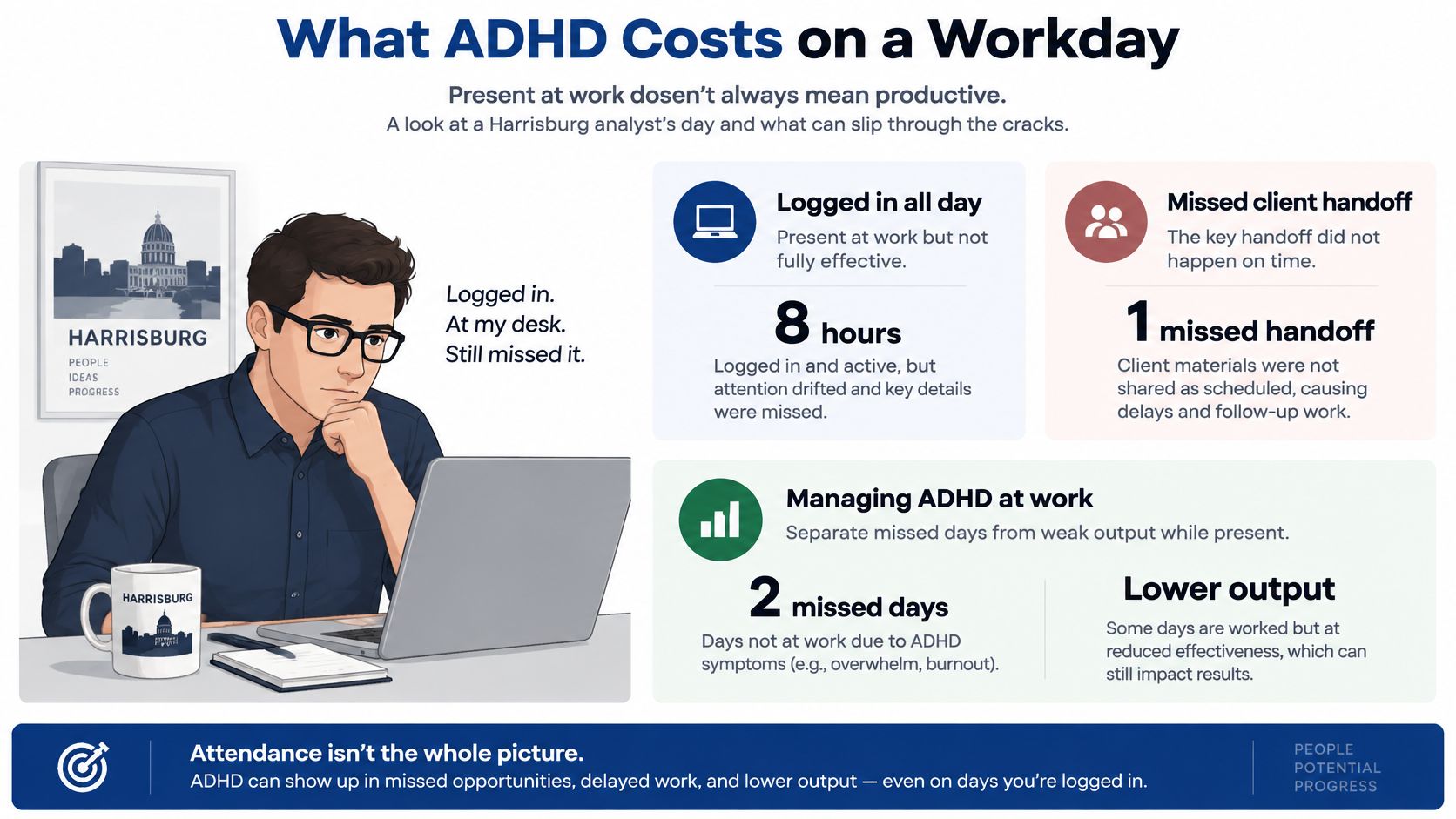
Consider a Harrisburg analyst who stays logged in all day but misses the client handoff. Managing ADHD at work starts by separating missed attendance from reduced output while present, then moving reminders and priorities into visible controls.
Absenteeism means missing work. Presenteeism means being at work but functioning below capacity. Neither measure describes an employee's effort, intelligence, or value.
The distinction matters because attendance alone can hide the actual difficulty. An employee may spend the day responding to messages while the assignment requiring sustained attention remains untouched.
Work loss linked to adult ADHD
These published estimates describe different populations and measures. They aren't forecasts for an individual employee or a personal performance score.
| Source snapshot | Absence or out of role | Reduced performance while present | How to read it |
|---|---|---|---|
| 2025 U.S. societal analysis | 13.6 workdays annually | 21.6 presenteeism workdays annually | $28.8 billion in annual excess U.S. productivity costs, comprising $19.9 billion among men and $8.9 billion among women |
| International lost-role study | About 8.4 excess days absent or otherwise out of role annually | 21.7 days associated with reduced quantity and 13.6 days associated with reduced quality annually | 22.1 additional lost-role days annually. Categories overlap and must not be added together. |
| Study of 135 employed adults using the Work Productivity and Activity Impairment questionnaire | 15.71% of work time missed because of health problems | 40.59% impairment while working | 45.65% overall work impairment, based on participants' self-reports |
Identify the actual failure point
A missed handoff could involve forgetting the request, underestimating the preparation, or never knowing which assignment took priority. Each problem calls for a different response. A reminder won't resolve conflicting instructions.
Executive functions are the skills used to organize, begin, monitor, and complete work. External controls, such as written priorities and visible deadlines, reduce the amount an employee must hold in mind.
Not every concentration problem is ADHD. Anxiety, depression, poor sleep, and medication effects can cause similar workday difficulties, so clinical assessment matters. Reviewing adult ADHD symptoms can help an employee organize examples without treating a symptom list as a diagnosis.
A short work log provides more useful information than a general impression of having another unproductive week.
Start a Two-Week Work Protocol
Keep the same job and change the container. A useful starting protocol combines a brief baseline log with external reminders, manageable tasks, and a review routine. It treats attention as a function to measure, the way a technician tracks where a machine jams before replacing a part. Nothing in it requires telling an employer about a diagnosis; disclosure stays optional unless a formal accommodation request requires documentation.
The baseline should capture ordinary work before major changes whenever practical. Employees shouldn't postpone urgent support or allow a preventable deadline failure merely to preserve a clean experiment. The log is a gauge, not a verdict. It shows where the workday breaks so the changes that follow have a target instead of a guess.
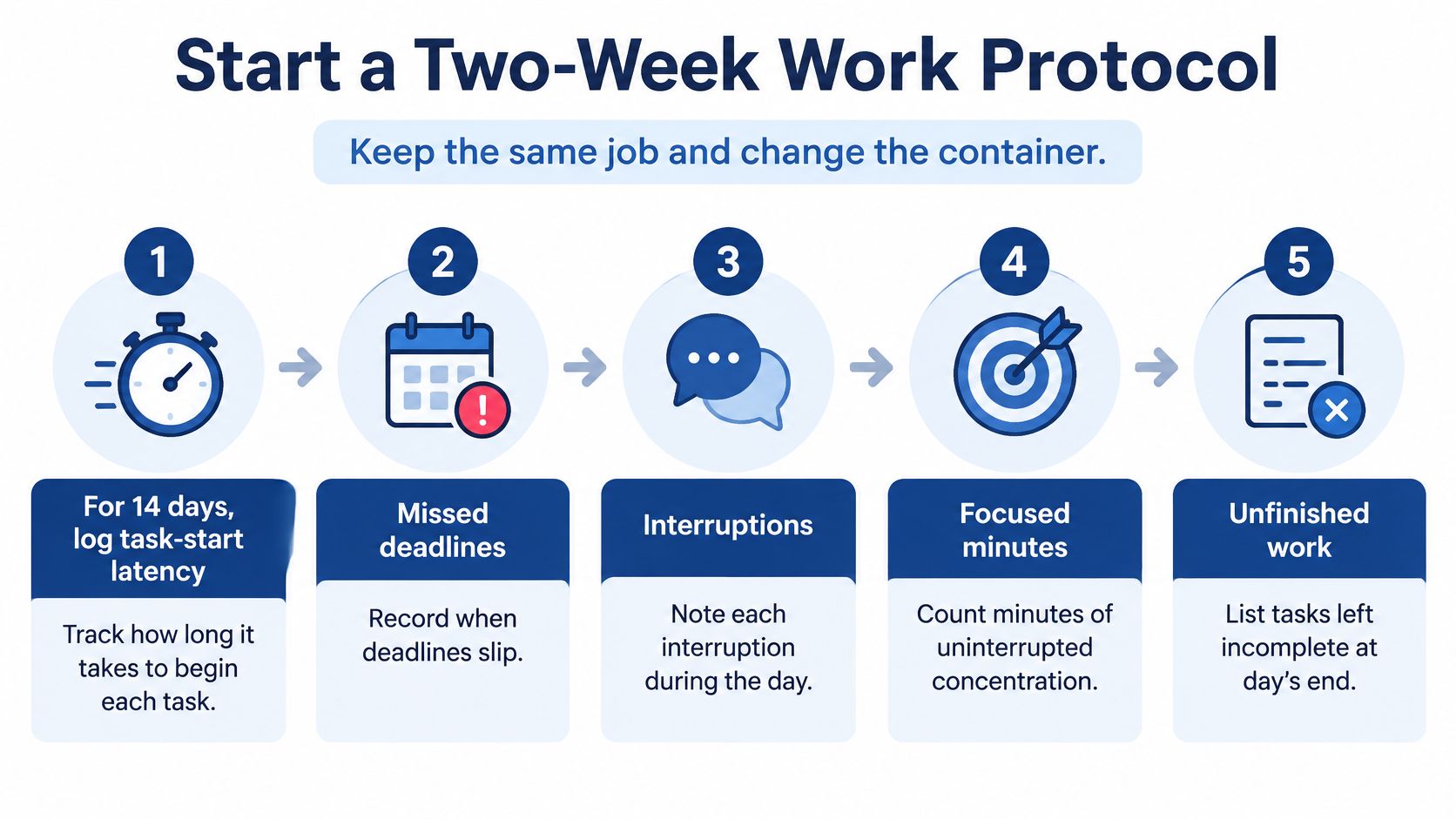
This visual summarizes what belongs in the baseline log.
Build the routine in order
Record the baseline for 14 days. On a calendar or single page, log task-start latency, meaning the delay between the intended start and actual start. Add missed deadlines, interruptions, focused minutes, and unfinished end-of-day items. Brief entries are enough; detailed journaling can become another unfinished assignment.
Divide projects into deliverables taking 15 to 30 minutes. Replace a broad assignment such as preparing a presentation with a concrete piece, such as drafting the opening slide. The smaller deliverable gives the employee a visible finish line rather than an undefined demand.
Leave a visible next action before switching tasks. A note such as opening the budget spreadsheet and checking the travel column makes returning easier. Writing only the project name leaves the employee to reconstruct the plan.
Protect two or three focus periods. Place work blocks on the calendar, not just meetings. Where the role permits, decline or negotiate conflicting meetings rather than assuming focused work will fit between interruptions.
Use a visual timer and stop at the boundary. The timer makes elapsed time visible. When it ends, the employee checks progress and deliberately decides whether to continue, rather than drifting into another activity.
Enter real deadlines with alerts at 7 days, 2 days, and 30 minutes. Earlier alerts prompt preparation; the final alert prompts delivery. A reminder should name the action required, such as sending the approved file, rather than merely announcing the deadline.
Control the surroundings. Use headphones or a quiet room when safe and permitted, silence nonessential notifications, and plan a break. A defined break has a return point; an open-ended scroll doesn't.
Hold a 15-minute weekly review. A supervisor, coach, or trusted colleague can help compare intended work with completed work. Retain controls that improve a logged measure, and simplify those that add effort without helping.
Keep expectations realistic
A randomized Work-MAP telehealth trial involving 46 adults found significant, moderate-to-strong improvements in work participation, executive functioning, and quality of life that remained at three-month follow-up. Direct evidence on which workplace adjustments work remains thin across the broader research, so treat the protocol as a structured personal test rather than a guaranteed result. The log is what turns a hopeful change into a measured one.
The common traps are vague goals, too many simultaneous tasks, relying on memory, and adding tools without reviewing them. A calendar, a short agenda, and a visible goal list may be sufficient. The focus block planner offers a place to organize the work without requiring another software subscription.
Practical rule: A useful system reduces the decisions required to begin. If maintaining it becomes another project, simplify it.
Match Each Work Barrier to a Small Fix
A workplace adjustment works like a key cut for one lock: it changes a specific task demand and nothing else. The employee selects a recurring barrier from the log, tests the smallest relevant change for two to four weeks, and keeps or revises it based on what the log shows.
A quieter seat reduces competing sound. It does nothing for unclear instructions, a stalled start, or a workload no schedule could absorb. Matching the fix to the barrier keeps a reasonable tool from becoming an expensive distraction.
Smallest workplace fix by barrier
| Work barrier | Smallest test | Keep it if, after 2 to 4 weeks |
|---|---|---|
| Distractibility | Quieter seat, headphones, or white noise, plus written instructions | Context switches decrease and the deliverable gets finished |
| Time blindness | Interim deadlines and calendar alerts; flexible start only if essential duties allow it | Handoffs happen at the agreed time |
| Working memory | Agenda before meetings, written action list afterward, structured notes or permitted recording | Repeated or forgotten requests decrease |
| Hard to start | A clearly defined first step and a brief check-in | The logged start delay gets shorter |
| Meeting overload | Advance alerts and written priorities after the meeting | Follow-through improves without skipping essential meetings |
| Home or hybrid distraction | Noise control plus a written priority list | Output improves without persistent isolation or unclear tasks |
An employee who repeatedly delays monthly reporting might open the template and list the missing figures. That is a testable first action. Rebuilding the entire reporting system before beginning would add work without touching the logged barrier.
For additional task-initiation ideas, Voice Control Pro's guide can help employees find brain-friendly ways to get started. Resources like this supplement a measured trial; they don't establish a diagnosis or replace treatment.
Judge the result, not the appeal
In a 2025 survey of 106 employed adults with ADHD, 79.3% reported negative effects on work performance, and 58.5% used adjustments; among adjustment users, 87.1% reported reduced stress or anxiety. These are self-reports, not controlled treatment success rates. Respondents in that survey also pointed to remote or hybrid arrangements, flexible hours, and noise control as valued supports.
Research on workplace-specific ADHD supports is still limited, so each adjustment earns a fair trial judged by its observable results. Stigma and a poor fit between the person and the environment can still block a change that looks good on paper.
Remote work deserves the same honest test. Removing office noise may help, while home interruptions or vague priorities may persist. The question stays narrow: does the actual work get easier to start and finish?
When the log shows the same breakdown across several tasks despite tested changes, executive dysfunction treatment for adults may address the underlying function problem better than a larger collection of productivity tools.
A broad request for more flexibility, without a baseline or review date, gives employee and manager little to evaluate. A narrow request names the barrier, the proposed change, and the result that would justify keeping it, and it can stay focused on the task itself rather than a diagnosis.
Request Support Before You Disclose ADHD
An employee can ask for written instructions, quieter seating, predictable scheduling, fewer interruptions, or a meeting alternative without naming ADHD. An employer may grant these as ordinary work arrangements, although informal requests don't automatically trigger formal disability protections.
Disclosure can happen in stages. An employee might first describe the work difficulty, then request a tested adjustment, and discuss disability-related documentation only if formal accommodation becomes necessary.
A work-focused request could explain that verbal assignments sometimes get lost and that written priorities after meetings would support timely delivery. It doesn't need to include medication details, family history, or a full account of mental health care.
Choose the route deliberately
- Start with the manager when appropriate. A manager may be able to provide written priorities or protect a focus block without changing policy.
- Use human resources for formal changes. Policy exceptions, equipment, and disability accommodations may require the employer's designated process. Occupational health or a union representative may also help clarify that process.
- Keep a dated record. Save the request, the proposed adjustment, the response, and relevant work examples in a manner consistent with workplace confidentiality rules.
- Consider the manager's history. If the manager has responded punitively to health disclosures, approaching human resources first may be more appropriate.
Privacy decisions deserve care. Interviews with working adults in a study of ADHD disclosure described both potential access to support and concerns about stigma and career consequences.
In a 2024 Understood.org and Harris Poll survey, 60% of surveyed U.S. adults reported feeling stigma around asking for workplace support. Hesitation isn't evidence that an employee doesn't need help.
Understand the formal accommodation standard
The EEOC's guide to employment rights under the ADA explains that employers with 15 or more employees must provide reasonable accommodations to qualified employees with disabilities unless doing so creates undue hardship. The adjustment must help the employee perform essential job functions or access employment benefits equally; a diagnosis alone doesn't settle eligibility.
Possible accommodations include modified schedules, job restructuring, policy changes, equipment or software, and adjusted training or testing. Employers generally don't have to remove essential duties.
A formal request may require appropriate documentation describing the disability-related functional limitations and need for accommodation. That doesn't mean an employee must voluntarily provide an entire clinical history. Questions about what information is needed and who receives it belong early in the process.
Disclosure is a practical privacy decision, not a test of courage or commitment.
If an employer denies a request, the employee can ask for the reason in writing and explore narrower alternatives. Guidance on setting boundaries can also support clear discussions about availability and interruptions without unnecessary personal disclosure.
Reset a Workday That Is Already Off Track
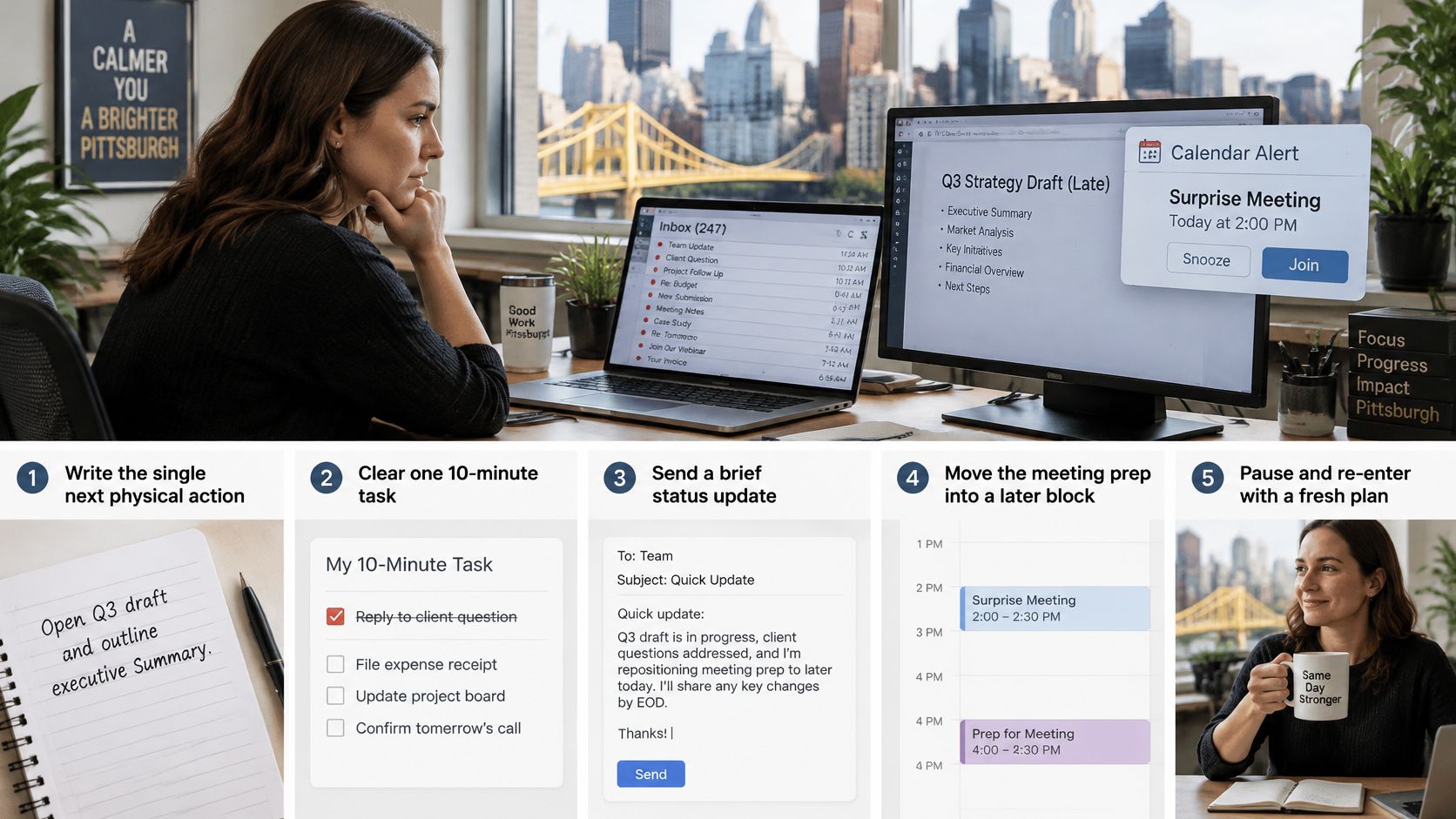
Consider a Pittsburgh afternoon when an overflowing inbox, a late draft, and a surprise meeting arrive together. The immediate task isn't to repair the entire week. It's to select a useful deliverable and communicate clearly about timing.
Being present at a desk doesn't establish that essential work is moving forward. A reset should produce something observable, such as a completed revision or an updated handoff time, rather than another stretch of unstructured effort.
The image illustrates a contained response to a crowded workday.
Keep the rescue smaller than the problem
Installing a new productivity app, rebuilding the task system, or working late without a defined stop can consume the remaining energy. Those activities may feel purposeful while leaving the overdue assignment untouched.
For optional preparation outside the urgent work period, Pretty Progress describes practical ways to focus with ADHD. During an active deadline problem, choosing a single approach is more useful than comparing an entire collection.
Hours at the desk aren't the score. A sent revision and a finished, 15-minute piece of work provide clearer evidence of progress.
One difficult day doesn't establish a new diagnosis. A continuing pattern of missed deadlines, rising anxiety, or deteriorating sleep warrants an evaluation rather than an endless sequence of rescue tactics.
Use a contained reset
Write the next physical action. Instead of completing the client report, the action might be opening the draft and correcting the totals in the summary table. The wording should identify something an employee can do, without requiring another planning session.
Set a 15-minute timer and work only on that action. Close unrelated tabs and leave the inbox alone unless the role requires continuous monitoring. The short boundary makes the assignment finite; it isn't a promise that the full project will be finished.
Send a revised time to the relevant stakeholder before the original deadline passes. The update should identify what is complete, what remains, and a realistic delivery time. If the deadline has already passed, the update still matters and shouldn't wait for a perfect explanation.
Park new requests on a list instead of opening them. Capture the sender, request, and deadline, then return to the selected action. Safety-critical or urgent responsibilities still take priority.
Take a short movement or food break, then return to the same action if unfinished. The break should address a basic need, not become an unplanned search for stimulation. Before stepping away, leave the document open at the precise return point.
Add Pennsylvania ADHD Care When Routines Stall
When the work log still shows prolonged start delays, missed deadlines, or substantial impairment after small adjustments, clinical care is more useful than another template. Significant distress or threatened job stability can justify seeking care sooner.
Workplace tools and treatment address different parts of the problem. A psychiatric evaluation can examine why concentration is difficult, while workplace changes address how the job presents its demands.
Separate screening from diagnosis and treatment
- A symptom checker organizes concerns. The Adult ADHD Symptom Checker can help an employee prepare examples, but a screening result doesn't diagnose ADHD.
- An evaluation gathers the history. A clinician examines symptoms, developmental history, impairment across settings, sleep, other conditions, and possible medication effects.
- A diagnosis is the clinician's conclusion. It follows the assessment rather than a single score or a difficult workweek.
- Treatment is the individualized plan. Depending on the assessment, it may include medication management, therapy, sleep-related changes, and compensatory work routines.
A systematic review of 143 studies on adult ADHD at work found that most intervention research focused on medication, while workplace-specific evidence remained limited. It also identified group-based therapy, involvement of trusted supporters, and a strong clinician–patient relationship as potentially useful psychosocial components.
Medication isn't a guarantee of restored productivity, and a telehealth visit doesn't change an unrealistic workload. Treatment should account for both symptoms and the setting in which the employee is trying to function.
Make the visit useful
Employees can bring a concise log, examples of recurring errors, a current medication list, and notes about sleep or anxiety. Useful examples describe what happened and its consequence, rather than stating that focus was poor.
For instance, an employee might report repeatedly overlooking verbal requests despite understanding them during meetings. That gives a clinician a clearer starting point than describing an entire workday as a failure.
Among Pennsylvania care options, IPA provides virtual psychiatric care statewide through board-certified psychiatric mental health nurse practitioners. Adults in Philadelphia, Pittsburgh, or Harrisburg can attend a secure visit from home through online ADHD evaluation and treatment.
Choose the next step
Prepare examples with the Adult ADHD Symptom Checker, then use the findings as discussion material rather than proof of a diagnosis. Verify Insurance before assuming an evaluation, follow-up visit, or medication-management appointment is covered.
Patients commonly ask about Cigna, Aetna, UnitedHealthcare, and BCBS/IBX. Coverage, copays, deductibles, network status, and prior authorization requirements vary by plan and aren't guaranteed.
Request an Appointment when impairment remains ongoing or the strain is becoming difficult to manage. For an employee whose situation remains manageable while testing an adjustment, another two weeks of logging may clarify whether it helps; persistent difficulty afterward is a reason to add care, not blame.
Integrative Psychiatry of America offers virtual psychiatric care across Pennsylvania, including adult ADHD evaluation and individualized medication management when appropriate. Employees facing persistent work difficulties can visit Integrative Psychiatry of America to request an appointment and ask about insurance verification, bringing their work log as a starting point for care.