
A man in his late forties in the Lehigh Valley has felt persistently tired, less motivated and weaker than usual. He asks whether his insurance will pay for testosterone replacement therapy, or TRT, and learns that the answer depends on more than a prescription or one low lab result.
Testosterone replacement therapy may be covered by insurance when a plan's medical-necessity rules are met. That usually means documented symptoms, consistently low testosterone and an identifiable underlying cause. The clinical diagnosis, the benefit that processes the medication and the plan's written policy each affect the outcome.

Table of Contents
- When Insurance Pays for Testosterone Therapy
- Lab Results and Symptoms Insurers Require
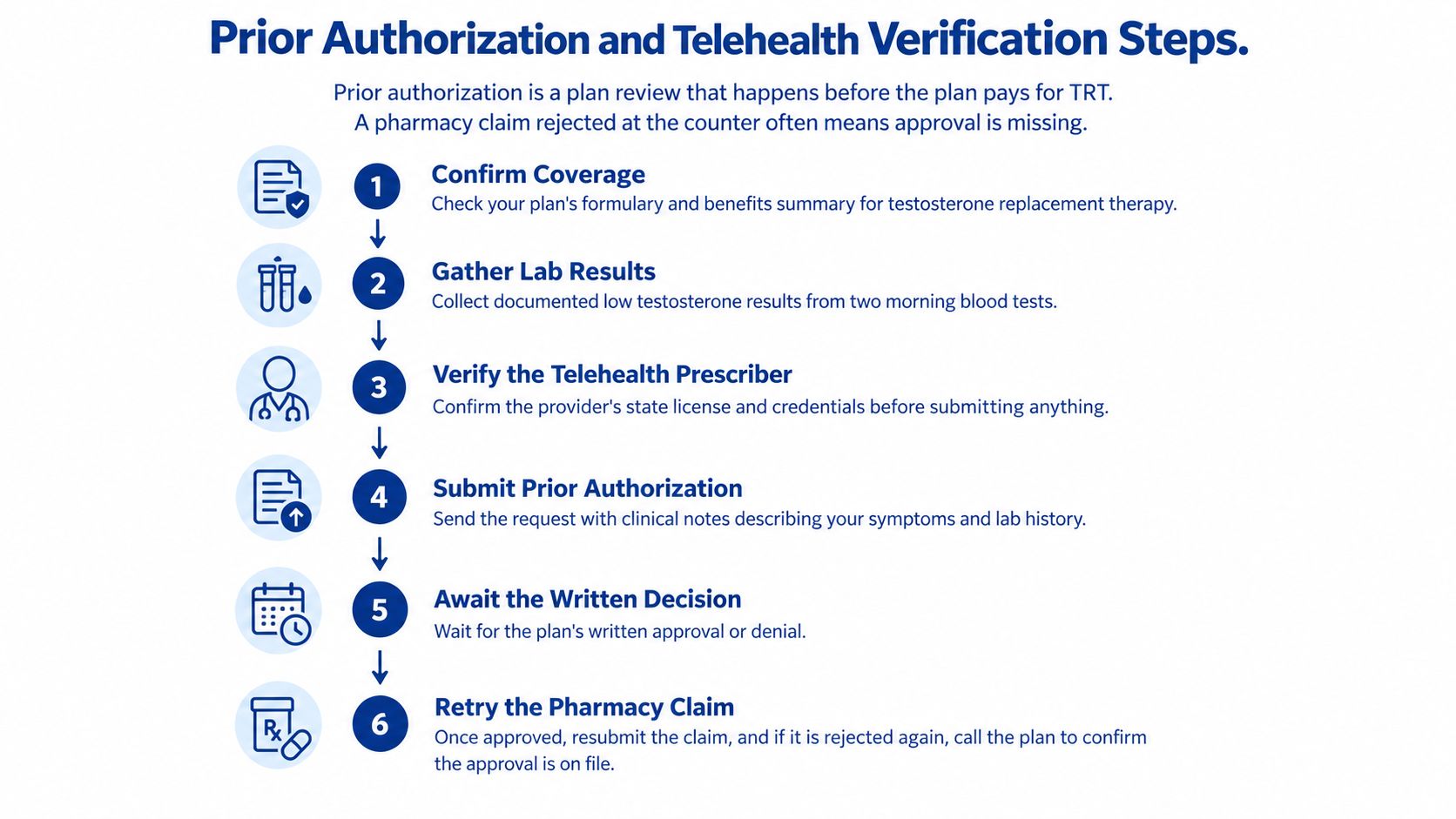
- Prior Authorization and Telehealth Verification Steps
- Why TRT Claims Get Denied and How to Respond
- What You May Pay Out of Pocket
- Frequently Asked Questions About TRT Insurance Coverage
When Insurance Pays for Testosterone Therapy
Hypogonadism means the body doesn't produce enough testosterone, and a clinician diagnoses it based on symptoms or signs together with consistently low levels. Under Medicare's local coverage policy, medically reasonable and necessary treatment includes symptomatic hypogonadism caused by a disorder of the testicles, pituitary gland or brain, as well as treatment for delayed male puberty. A request based only on fatigue, weight concerns or a desire to optimize testosterone may not meet Medicare's covered indications without evidence of an underlying qualifying disorder.
The three coverage decisions can come apart. A clinician may consider treatment appropriate, but the plan may exclude or restrict the chosen product. Or the medication may be covered while the visit, lab work or administration is processed separately.
| Scenario | Typical coverage outlook | What decides it |
|---|---|---|
| Low testosterone with a testicular, pituitary or brain disorder and related symptoms | Often reviewed as a covered indication under Medicare criteria | Documented diagnosis, dated lab reports and symptom records |
| Delayed male puberty | Covered indication under Medicare criteria | Clinical evaluation confirming the diagnosis |
| Fatigue, weight concerns or age-related decline without a qualifying disorder | Often not covered under Medicare criteria | Whether an underlying qualifying condition is documented |
| Commercial plan, self-administered gel, oral or nasal product | Usually pharmacy benefit, frequently with prior authorization | Formulary tier and the plan's preferred product list |
| Clinic-administered injection or implanted pellet | Often medical benefit | Site-of-care rules and who administers the dose |
| Cash-pay or membership arrangement | Not billed to insurance | Program price, included services and total cost |
The table describes common coverage patterns, not guarantees. Medicare has local policies, and commercial plans set their own criteria, so the same clinical situation can receive different decisions.
For Pennsylvania patients considering TRT as part of broader care, Integrative Psychiatry of America's testosterone replacement therapy information describes the service. Patients comparing insurance with direct-pay options can also review the practice's Insurance and Fees information.
Lab Results and Symptoms Insurers Require
A testosterone prescription can meet the clinical standard and still face a coverage denial. Insurers commonly look for two separate early-morning testosterone tests, along with symptoms or signs consistent with hypogonadism, meaning testosterone deficiency supported by both clinical findings and consistently low levels. The Endocrine Society's clinical practice guideline recommends fasting, early-morning total-testosterone measurements using an accurate assay because levels vary with time of day, food intake and day-to-day changes.
A common payer benchmark is two results below 300 ng/dL (10.4 nmol/L), or below the laboratory's reference range. Plans and lab ranges differ, so compare results with the written criteria for the relevant benefit. A result near a cutoff, on its own, does not establish a diagnosis.
| Requirement | What it looks like in practice | Why insurers ask |
|---|---|---|
| Two early-morning total testosterone tests | Two separate fasting samples drawn between 7:00 and 11:00 a.m. on different dates | Testosterone varies by time of day and from day to day |
| Low-result threshold | Below 300 ng/dL (10.4 nmol/L) or below the laboratory's reference range | Common benchmark in payer medical policies |
| Accurate testing method | Assay method shown on the lab report | Confirms the measurement is reliable |
| Symptoms documented over time | Dated notes on fatigue, reduced libido, low muscle mass or other signs | Establishes a compatible clinical picture |
| LH and FSH testing | Ordered when total testosterone is low | Helps distinguish a testicular cause from a pituitary or brain cause |
| Prolactin and further evaluation | Considered when testosterone, LH and FSH are all low | Further evaluation for pituitary disease or other chronic illness may be appropriate |
| Medication and health review | Current medication list and documented conditions | Some medicines and illnesses affect testosterone levels |
LH and FSH help locate a possible cause. Low testosterone with low LH and FSH can point toward a pituitary or brain cause; low testosterone with high LH and FSH can point toward a testicular cause. When all three are low, prolactin testing or assessment for chronic illness may be appropriate before treatment.
Dated symptom notes give the clinician a clearer record than a general statement that someone “feels off.” For practical information on lab preparation, see this guide to testosterone therapy blood test guidance. Weight concerns can overlap with symptoms associated with low testosterone; information on low testosterone and weight gain offers further context.
Keep dated lab reports and symptom notes together so the clinician can submit them as one packet. Clear records can support a coverage request and reduce avoidable delays, but approval is not guaranteed. The clinician determines whether TRT is medically appropriate, while the insurer applies its own policy to the requested treatment.
Prior Authorization and Telehealth Verification Steps
A TRT prescription can clear the clinical review and still be denied at the pharmacy. Coverage involves three separate decisions: whether a clinician diagnoses hypogonadism, which benefit covers the specific product, and whether the plan's policy criteria are met. Hypogonadism means the body does not produce enough testosterone. Prior authorization is the plan's review of a treatment request before it agrees to pay. A rejected pharmacy claim may mean that approval is missing, not that TRT is excluded altogether.
Some payer policies require low early-morning results on separate dates. For example, a Blue Cross Blue Shield of Texas policy requires results below the laboratory's lower limit of normal on at least two occasions, with samples collected between 7:00 and 11:00 a.m. Other plans set their own timing and threshold rules.
Eight checks before submitting a request
Identify the benefit for the product. Ask whether the exact formulation and route, such as self-administered gel or a clinic-administered injection, are billed through the pharmacy benefit or medical benefit. A medical benefit generally handles care or products billed through a provider, while a pharmacy benefit handles prescription claims. The same prescription may qualify under one benefit and fail under the other.
Get the written policy. Request the plan's testosterone coverage criteria, including lab timing, result thresholds, and any product-specific rules. A verbal summary may not cover the exact formulation.
Check the laboratory network and test requirements. Confirm the lab is in network, then arrange the separate early-morning tests according to the plan's instructions. This helps avoid a claim issue and an unexpected lab charge.
Ask the clinician to prepare the clinical record. The request can include the diagnosis, symptoms, medical history, current medications, and relevant test results. The record should explain why the requested treatment is being considered.
Submit a complete authorization request. Ask whether the prescribing office will include diagnosis codes, dated lab reports, the dosing plan, and follow-up monitoring schedule. Missing paperwork can delay review or lead to a denial.
Confirm the decision and renewal rules. Ask how long review is expected to take and whether repeat testing is required to renew approval. Keep the representative's name, call date, and reference number.
Check provider status and likely costs. Confirm that the prescriber, lab, and administration site are in network. Ask how deductible, copay, coinsurance, and separate administration fees apply.
Follow the appeal deadline. If the request is denied, obtain the written reason and criteria used, then follow the deadline in the denial letter. Keep copies of the request and any additional records submitted.
Integrative Psychiatry of America provides secure, HIPAA-compliant telehealth visits. A clinician determines whether TRT is appropriate; checking benefits does not replace that assessment or guarantee coverage. Patients can use the practice's insurance verification process to check benefits, or use the site's Verify Insurance or Request Appointment options.
The following video offers additional context on coverage:
Why TRT Claims Get Denied and How to Respond
A Bucks County patient gets a pharmacy rejection after the clinician submits one low testosterone result without a dated symptom history. That doesn't automatically mean treatment can never be covered. It means the patient needs the written denial reason to determine whether the issue is missing evidence, the product, the billing route or the place of service.
The same prescription can face different rules under different benefits. A Cigna testosterone coverage policy illustrates how some oral, nasal, topical and self-administered injectable products may be handled through pharmacy benefits, while certain office-administered products may be reviewed under medical benefits. Policies can also prefer one formulation or require prior authorization for some products but not others.
| Denial reason | What it usually means | Practical fix |
|---|---|---|
| Insufficient lab documentation | Only one testosterone result, or results not drawn in the early morning | Repeat two early-morning tests on separate dates and submit both reports |
| No qualifying diagnosis | Request based on symptoms alone | Document the clinical evaluation and any testicular, pituitary or brain disorder |
| Formulation not preferred | Plan prefers a different product | Ask whether a preferred product is clinically appropriate for this patient |
| Missing prior authorization | Pharmacy claim rejected at the counter | Submit the prior authorization before the first fill |
| Out-of-network lab or site of care | Lab or clinic isn't in the plan network | Confirm an in-network lab before the blood draw |
| Missing follow-up monitoring | Plan requires repeat levels to continue coverage | Schedule and document follow-up tests on the plan's timeline |
| Quantity or dose above plan limit | Requested dose or quantity exceeds plan limits | Document the dosing rationale and the goal of using the lowest effective dose |
A request based only on age-related decline, weight loss or a wish to optimize testosterone may not meet a plan's medical-necessity criteria. Cosmetic or anti-aging programs also may fall outside covered benefits. These decisions are plan-specific, and a clinician may recommend a different approach if TRT isn't appropriate.
A formulation change is a coverage option, not a clinical shortcut. A plan-preferred generic injection may resolve a formulary barrier that affects a branded gel, but the clinician still needs to determine whether that product suits the patient and the plan must allow it.
To appeal, get the written reason, note the deadline, and ask which policy criteria the reviewer applied. Submit the missing lab reports or clinical notes and keep a complete copy of the appeal. When an explanation of benefits arrives, patients can use this guide to spot billing errors on an EOB, the statement that describes how a claim was processed. Appeals don't always succeed, and coverage rules differ.
What You May Pay Out of Pocket
The prescription is only one part of TRT's cost. A patient may also pay for a telehealth visit, lab work, prescription management, follow-up tests, or an administration fee. Medication prices vary by product, dose, pharmacy, and whether the plan covers the prescription.
| Cost item | Usually billed as | What changes the amount |
|---|---|---|
| Telehealth visit and prescription management | Professional service | Copay or coinsurance; network status |
| Initial testosterone, LH, FSH and prolactin labs | Laboratory service | In-network lab; deductible status |
| Medication under pharmacy benefit | Pharmacy claim | Tier; generic or brand; deductible |
| Office-administered injection | Medical claim plus administration fee | Site of care; medical benefit coinsurance |
| Follow-up monitoring labs | Laboratory service | Monitoring frequency; plan limits |
| Cash or membership program | Direct payment | Program terms and included services |
A deductible is the amount a patient may owe for covered services before the plan begins sharing costs under its benefit rules. Until the deductible is met, the patient may pay the plan's negotiated rate. After that, copays or coinsurance may apply. Network status also affects the amount.
The same TRT prescription can have different costs depending on which benefit pays. Medication picked up at a pharmacy is generally processed through the pharmacy benefit, while an injection administered at a clinic may be billed under the medical benefit, with a separate administration charge. Check both benefits, along with the plan's coverage policy, rather than assuming approval under one means coverage under the other.
Compare the estimated insured total for visits, labs, medication, and any administration fee with a cash or membership quote that specifies what is included. Check what in-network means for online psychiatry in Pennsylvania when confirming whether a provider or lab is in the plan's network. Integrative Psychiatry of America offers cash and membership options alongside insurance-based care, and its Insurance and Fees page can help patients compare them.
Your plan's summary of benefits and written coverage policy are the best references for estimating your own costs. Amounts depend on the plan's rules and the services required.
Frequently Asked Questions About TRT Insurance Coverage
Does insurance cover TRT for age-related low testosterone alone?
Usually not under Medicare criteria. Medicare's covered indications include symptomatic hypogonadism linked to a disorder of the testicles, pituitary gland or brain, and delayed male puberty. Age-related decline without a qualifying disorder may not meet those criteria.
Can TRT start through telehealth with insurance paying?
Often, the visit or prescription may be covered, but the plan must allow the product and route. Lab work may need to be done in person at an in-network location. Confirm the prescriber, medication benefit and lab coverage before booking.
How long does an approval last?
Approval periods vary by plan. Some plans require repeat lab work to renew authorization, so ask about renewal conditions when requesting approval.
Can one low result be enough?
Usually not. Many plans require two properly timed morning results from separate dates, but the written policy sets the rule for the specific plan.
What if a patient pays cash?
Cash or membership care is billed directly rather than to insurance. Compare the total price and included services with the insured estimate using the practice's Insurance and Fees information, and review whether insurance covers online psychiatric care.
Is coverage guaranteed?
No. Benefits, copays, network status and authorization rules differ by plan, so the plan's summary of benefits and written policy should guide the decision. Pennsylvania patients who have checked their benefits can request an appointment, while those without coverage can compare cash options before deciding.
Integrative Psychiatry of America provides secure virtual care across Pennsylvania, with clinical evaluation and treatment planning that may include TRT when a clinician determines it's appropriate. Patients can verify insurance or compare cash and membership options before requesting an appointment through Integrative Psychiatry of America.