
A person in Pennsylvania may spend weeks noticing worsening anxiety, low mood, trauma symptoms, or attention problems before making one practical calculation: Can the next appointment fit the household budget? A deductible may still apply, a copay may be unclear, or the available provider may not accept the patient's plan. Some people delay care, attend briefly, or avoid specialty treatment altogether because the price feels unpredictable.
Sliding scale mental health care offers one way to lower that first financial barrier. It isn't free care in every setting, and it doesn't guarantee a timely appointment, a particular specialty, or telehealth availability. It's one affordability model among several, including insurance-supported care, cash payment, membership pricing, community clinics, and training clinics.
The right choice depends on the patient's income, household size, insurance status, urgency, location, and type of care needed. An adult seeking therapy may find a different path from someone seeking ADHD evaluation, medication management, OCD treatment, PTSD care, or integrated psychiatric services. This guide explains how sliding fees are calculated, what documentation clinics may request, where availability can narrow, and how Pennsylvania patients can compare practical options before booking.
For people who prefer virtual psychiatric care, insurance verification can clarify whether a telepsychiatry appointment is covered, what out-of-pocket costs may apply, and whether authorization is required. A lower-cost option matters, but predictable access and continuity matter too.
Table of Contents
- Introduction to Sliding Scale Mental Health Care
- What Sliding Scale Mental Health Means and How Fees Are Set
- Eligibility Rules Documentation and Availability Limits
- Benefits and Limitations of Sliding Scale Care
- How to Find and Access Sliding Scale Providers in Pennsylvania
- Alternative Ways to Make Mental Health Care Affordable
- Next Steps Toward Affordable and Consistent Care
Introduction to Sliding Scale Mental Health Care
A Pennsylvania adult notices that concentration has deteriorated at work and sleep has become unreliable. The person searches for an ADHD evaluation, then pauses after seeing a private-pay fee. Another person in Philadelphia has insurance but can't tell whether the deductible applies to psychiatric medication management. A parent near Pittsburgh finds a therapy listing marked “sliding scale,” yet the provider doesn't explain whether the reduced fee applies to an initial evaluation or only ongoing therapy.
These situations share a practical problem. The need for care may be clear before the cost is.
Sliding-scale pricing adjusts a provider's fee according to financial circumstances. The clinic may consider income, household size, insurance status, and available reduced-fee appointments. Some providers use a written schedule, while others review each request individually. The result can be a lower upfront charge, but the patient still needs to confirm the exact service, fee, duration, billing policy, and availability.
Important distinction: A sliding fee can reduce cost. It can't promise immediate access, a specific clinician, or coverage for every specialty service.
Affordability support has been part of the U.S. mental health delivery system for many years. A 2010 survey found that about 4 in 5 mental health treatment facilities offered payment assistance, either through sliding fees, no-charge services, or both, according to the National Survey of Mental Health Treatment Facilities summary. That history shows that sliding-scale care isn't merely an informal favor from an individual therapist. In many public-serving and outpatient settings, it became an administrative way to reduce the cash barrier to first contact.
The model still has limits. A clinic may offer reduced-cost psychotherapy but not medication management. A community program may have a waitlist. A provider may reserve only a small number of discounted appointments. Patients can make better decisions by asking specific questions early, comparing sliding scale with insurance-supported telepsychiatry, and preparing income information before intake.
What Sliding Scale Mental Health Means and How Fees Are Set
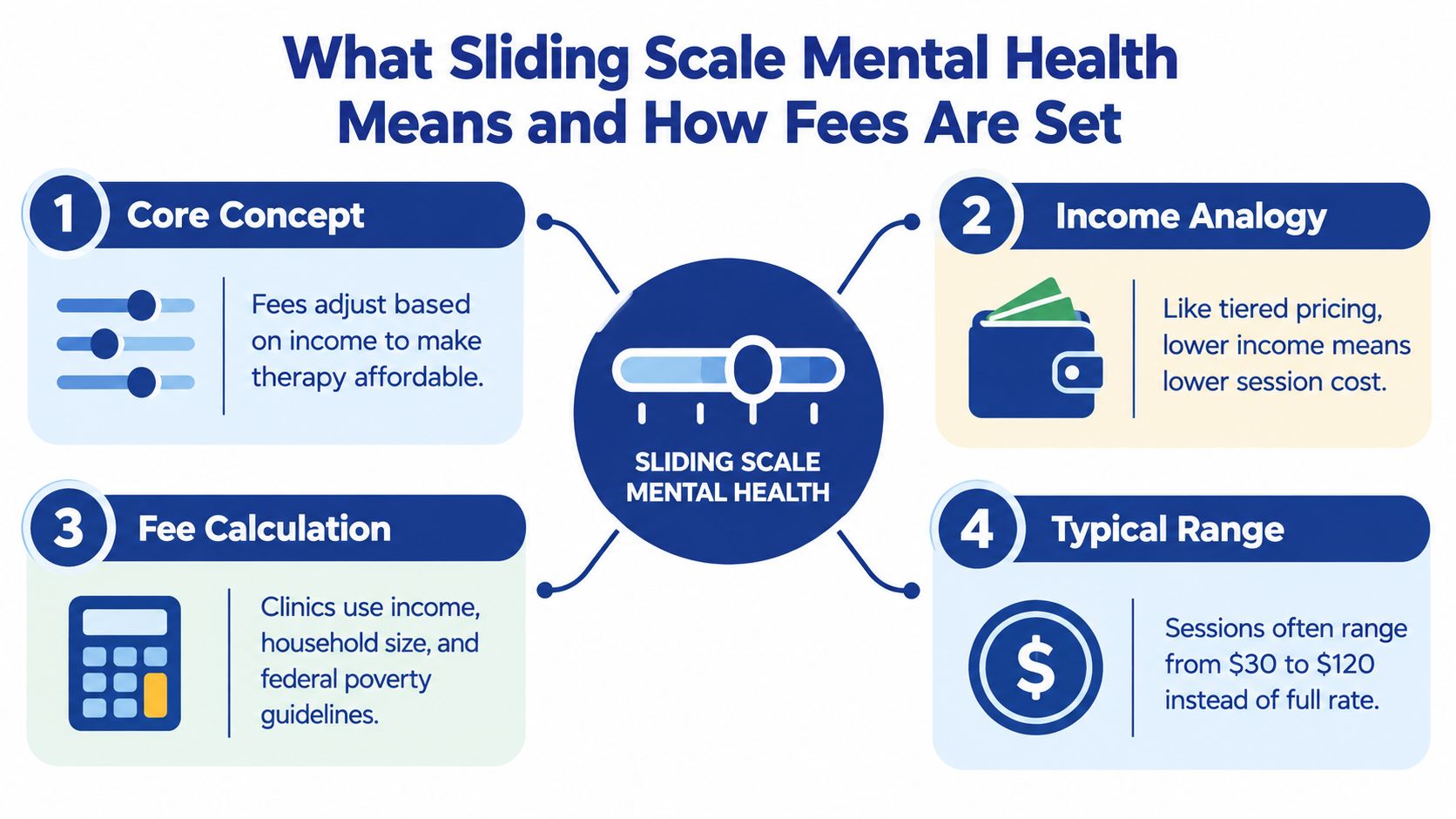
Sliding scale mental health pricing means that a patient's fee changes according to financial circumstances instead of staying at one flat rate. Clinics commonly organize fees into income bands, often using household income and Federal Poverty Guideline information as reference points.
The easiest analogy is tiered pricing. A household with very limited income may pay the lowest sustainable amount. A household with more financial capacity may receive a smaller discount or pay the standard rate. The clinic sets the bands in advance so that the process is more consistent than negotiating a different price for every patient.
That image URL does not match the required asset for this section. The required infographic is included below.
How income bands become actual fees
A Pennsylvania provider-directory example shows how a written schedule can work for a single-person household. The schedule lists:
- $15,060 or below: a nominal $10 fee
- $15,061 to $22,590: a $20 fee
- $22,591 to $27,861: a $30 fee
- $27,862 to $30,120: a $40 fee
- Above $30,121: no discount in that schedule
These thresholds and fees come from the Pennsylvania provider-directory example for Western Psychiatric Institute and Clinic. They're an example of mechanics, not a universal Pennsylvania rate. Another clinic may use different bands, household definitions, service fees, or documentation rules.
A patient comparing regional pricing can also review Coral Gables therapy rates as an example of how a private practice may present fees clearly. The location and policy may differ, but transparent rate information helps patients understand what questions to ask their own provider.
What a fee schedule should clarify
A useful schedule identifies the income measure, household-size rules, lowest fee, standard fee, and services included. It should also explain whether the fee applies to an intake, follow-up visit, therapy session, medication visit, testing, or missed appointment.
Patients can review IPA's Insurance & Fees information when comparing insurance-supported, cash, and membership pathways. Periodic review is common because income, household circumstances, insurance, and clinic capacity can change. Patients should ask how often the clinic reassesses eligibility and whether a fee can change during ongoing treatment.
Eligibility Rules Documentation and Availability Limits
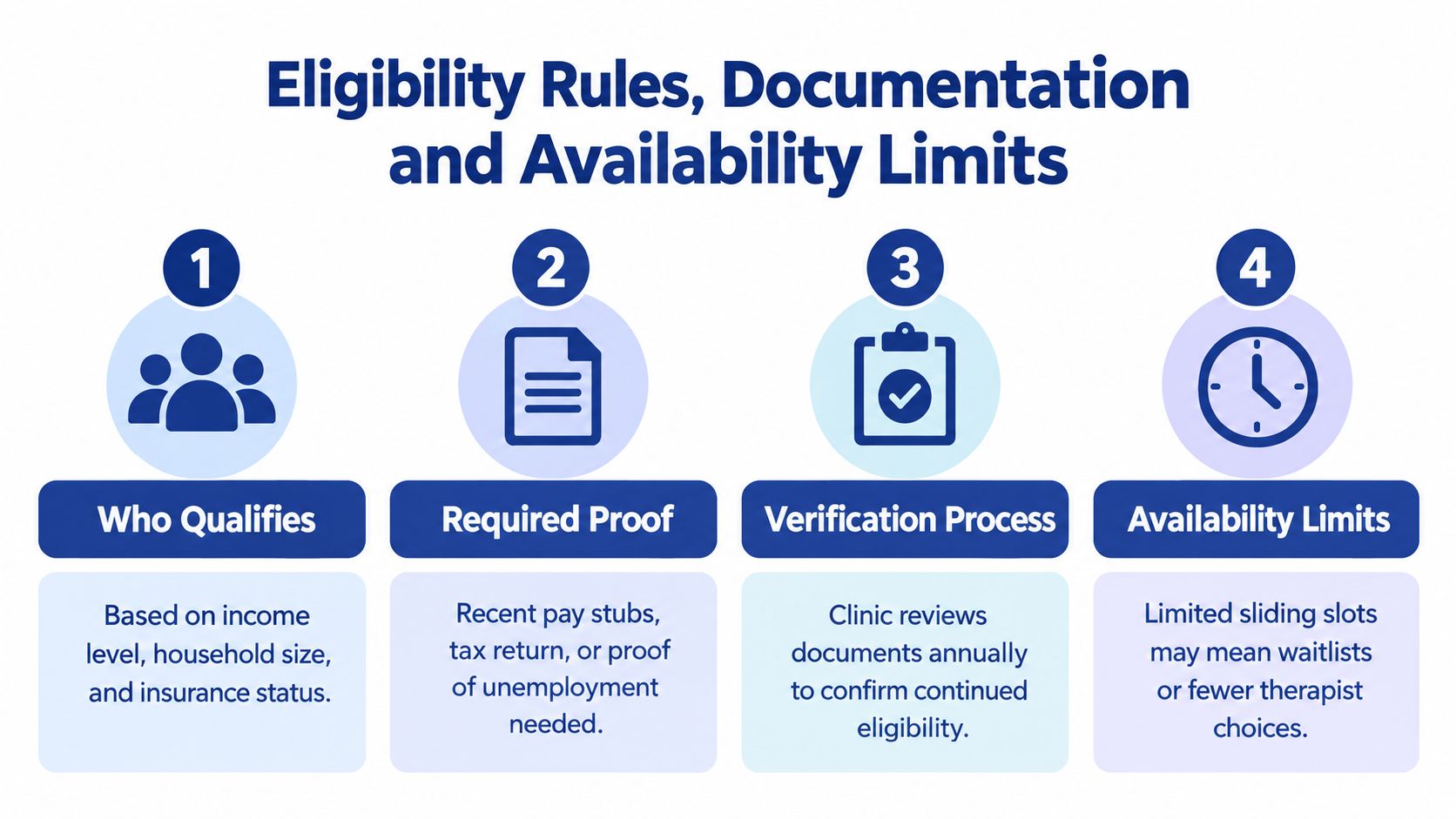
Eligibility usually depends on more than income alone. A clinic may consider household size, current income, insurance status, financial hardship, and the number of reduced-fee openings available for a specific service.
Providers often request recent pay stubs, tax documents, benefit statements, unemployment records, or other proof of financial circumstances. A patient without standard employment may need to explain self-employment income, inconsistent work, disability benefits, or a recent change in household finances. The clinic should explain which documents it accepts before the intake whenever possible.
Documents that can reduce intake friction
A patient can prepare a small file before contacting a provider:
- Income information: Recent pay stubs, tax records, benefit letters, or self-employment documentation
- Household details: The number of people supported by the household income
- Insurance information: Plan name, member identification, and network details
- Service request: Whether the patient needs therapy, psychiatric evaluation, ADHD assessment, medication management, or another specialty
- Questions about review: How long approval lasts and when the clinic reassesses eligibility
Income verification protects consistency, but it can feel intrusive. Patients can ask how documents are stored, who reviews them, and whether the clinic accepts an explanation when income has recently changed.
Why availability can be narrower than expected
Many people ask whether reduced-cost care covers medication management, telehealth, OCD, PTSD, or integrated care. Public guidance often confirms that sliding fees exist but tells patients to ask providers about the details, without explaining which services qualify or how many openings exist. The SAMHSA guidance on free or low-cost treatment supports that practical next step.
Reduced-fee care often connects to community clinics, federally supported sites, or limited openings within a private practice. A clinic may have a sliding policy but no current slot for a particular specialty. Patients seeking virtual care should confirm that the clinician can serve the patient's Pennsylvania location and that the reduced fee applies to telehealth.
For insurance questions, patients can use IPA's insurance verification process before assuming that sliding scale is the only route.
Benefits and Limitations of Sliding Scale Care
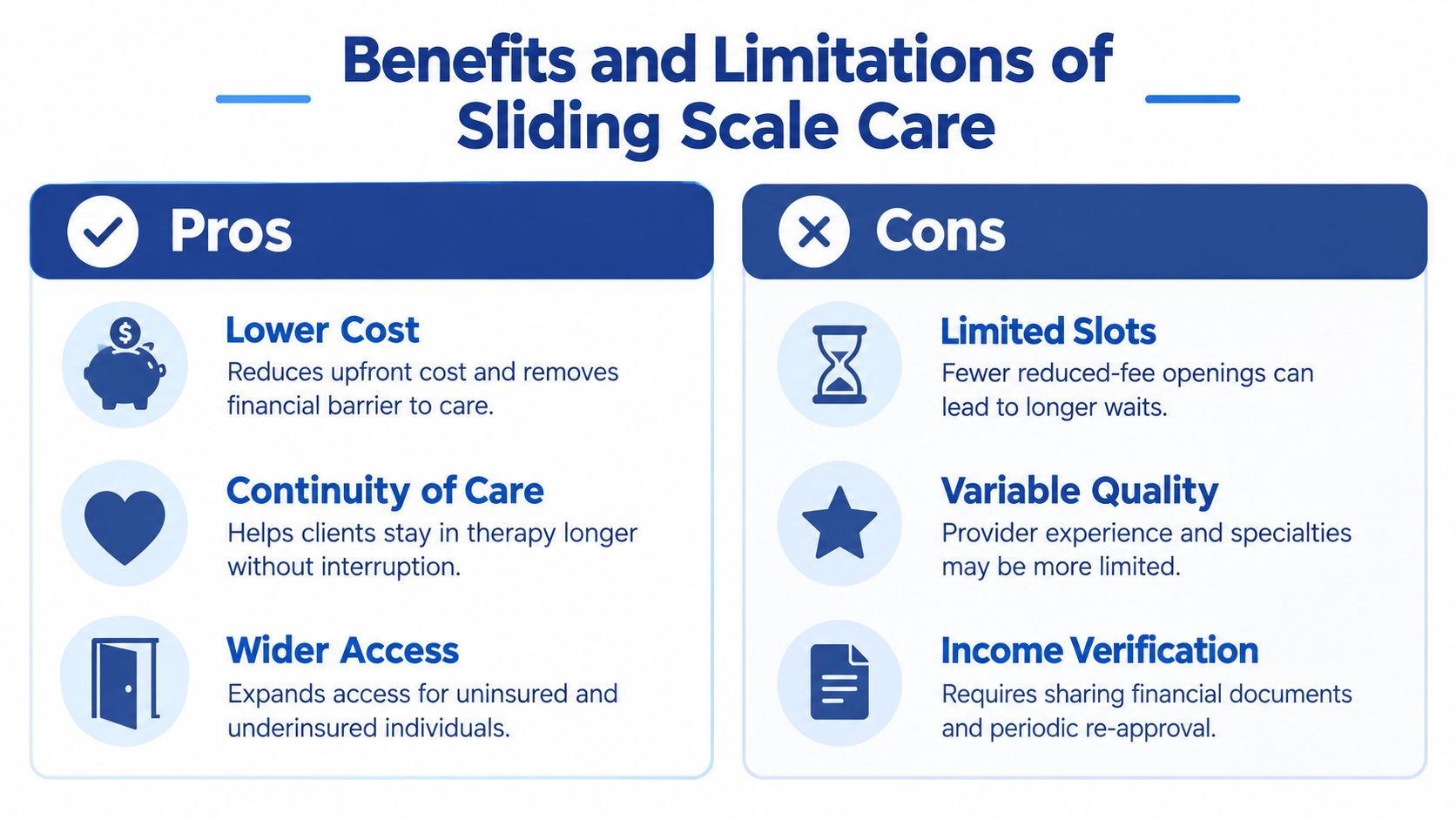
Sliding-scale care can be a strong fit when the immediate cash barrier is the main reason a patient hasn't scheduled. It can make an initial appointment more manageable and help a patient pursue outpatient support before symptoms become harder to manage. The model also gives community-serving facilities a repeatable way to offer affordability assistance without treating every request as an informal exception.
A 2010 SAMHSA report found that 18.8% of facilities offered sliding-fee services only, 18.4% offered no-charge services only, and 42.7% offered both types of assistance. Together, those figures indicate that roughly 4 in 5 facilities provided some form of payment assistance for people who couldn't pay full price, as reported in the SAMHSA short report on payment assistance.
The practical tradeoff
| Potential benefit | Possible limitation |
|---|---|
| Lower upfront cost | Reduced-fee openings may be limited |
| A clearer path into outpatient care | A waitlist may delay the first visit |
| Support for uninsured or underinsured patients | Eligibility may require financial documents |
| A written fee can improve predictability | The fee may not cover every service |
| Ongoing care may become more sustainable | Specialty availability can vary by location |
Sliding scale may work well for a patient seeking regular therapy through a community clinic. It may be less suitable when a patient needs a specific clinician, rapid medication evaluation, formal ADHD assessment, or coordinated treatment that the low-cost setting doesn't provide.
Affordability also doesn't equal accessibility. A patient may qualify financially but face limited appointment times, transportation challenges, language barriers, or a shortage of clinicians with the needed specialty. Telehealth can reduce travel demands, but it still requires confirmation of clinical availability, technology access, and payment rules.
The best option is the one that makes care financially manageable and clinically appropriate enough to continue.
How to Find and Access Sliding Scale Providers in Pennsylvania
Pennsylvania patients can make the search more efficient by treating it as a short screening process rather than contacting every provider without a plan. The first task is to identify the needed service. Therapy, psychiatric evaluation, ADHD assessment, medication management, and integrated care may follow different eligibility and billing rules.
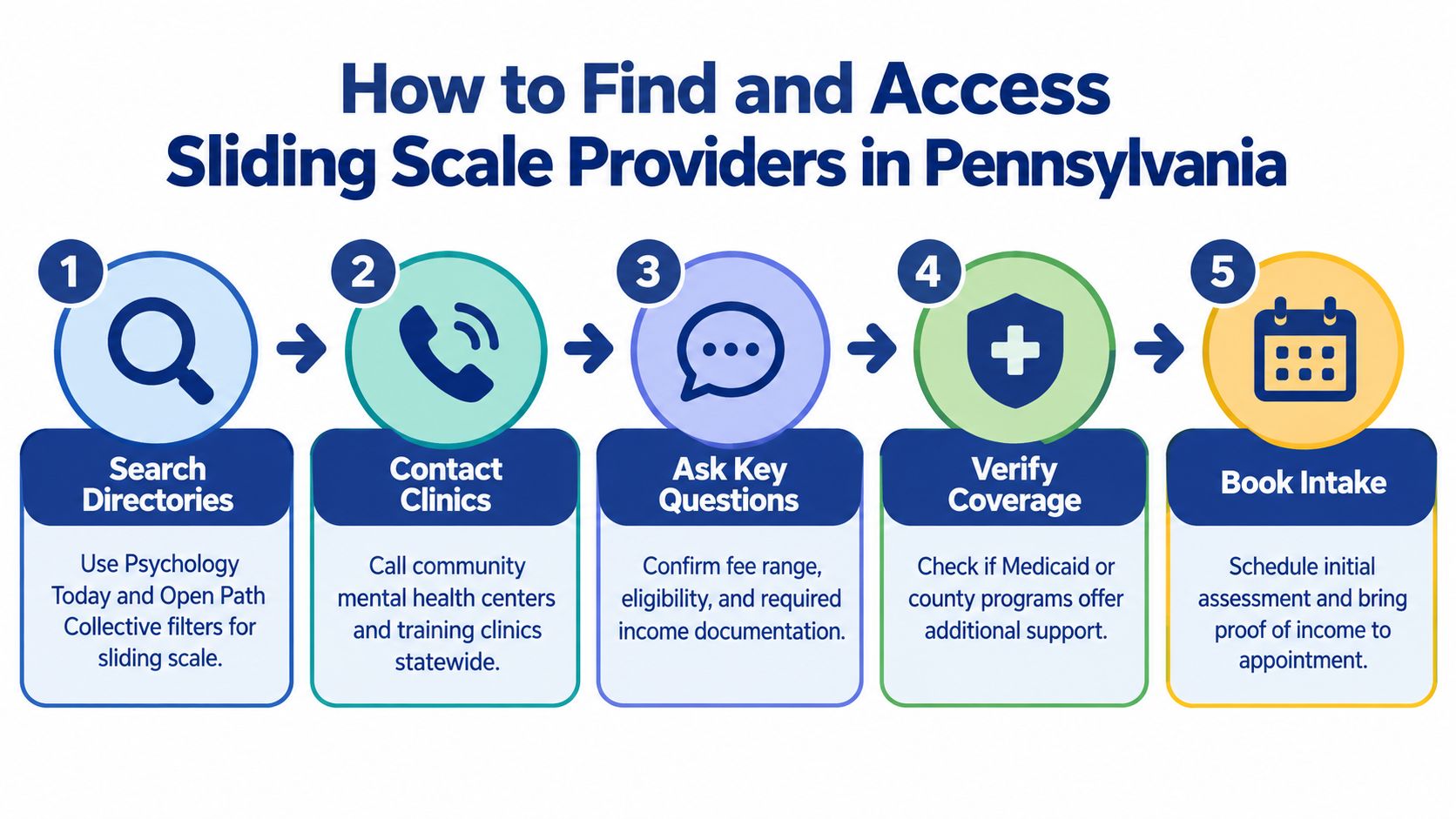
A practical Pennsylvania search sequence
Search targeted directories. Use filters for sliding scale, insurance, telehealth, specialty, and location. A patient in the Philadelphia area may need different results from someone in the Lehigh Valley, Lancaster, Erie, or Scranton and Wilkes-Barre region.
Contact community and training settings. Community mental health centers, federally supported sites, and university training clinics may have affordability programs. Their reduced-fee policies can differ, so the listing alone isn't enough.
Ask for the exact service and fee. The patient can ask, “Does the reduced fee apply to the initial evaluation?” and “Does it cover medication follow-up, ADHD assessment, or only psychotherapy?” A second useful question is, “Are reduced-fee appointments currently open?”
Confirm documentation. Ask whether the clinic needs household income, tax records, pay stubs, insurance information, or another form of verification. Patients can also ask whether the clinic reviews eligibility periodically.
Check the appointment pathway. Confirm the expected wait, whether the visit is virtual or in person, what technology is required, and what happens after the first appointment.
Lower income can affect service use even when mental health need is similar. In a Canadian population study, adults with mood or anxiety disorders and income between $40,000 and $79,999 were less likely to have spoken with a mental health professional, with an OR of 0.45, and less likely to have received counseling or therapy, with an OR of 0.53, compared with higher-income peers, according to the peer-reviewed analysis of socioeconomic position and mental health service use. The finding supports a low-friction intake process, but it doesn't establish that every sliding-scale clinic will have immediate capacity.
For professional context about mental health roles and training, patients may find the Pennsylvania psychologist education resource useful while comparing provider types.
Patients seeking virtual psychiatric treatment can review Philadelphia psychiatric care options and confirm whether the service, clinician type, insurance plan, and appointment format match their needs.
A short educational video can help patients recognize the questions that matter before contacting a clinic:
Alternative Ways to Make Mental Health Care Affordable
Sliding scale is only one route. A patient with insurance may spend less through an in-network telepsychiatry provider than through a reduced-fee cash arrangement, especially when the needed service involves ongoing medication management or a structured ADHD evaluation. Another patient may have no usable coverage and need a community clinic, cash rate, or membership discount.
| Option | Best for | Typical cost structure | Key trade-off |
|---|---|---|---|
| Sliding scale | Patients with limited income who can document eligibility | Fee adjusts by income or household circumstances | Openings and eligible services may be limited |
| Insurance-supported care | Patients with usable in-network benefits | Copay, deductible, coinsurance, or authorization may apply | Benefits and network rules vary by plan |
| Cash pay | Patients who want a direct, simple payment arrangement | Patient pays the published rate or negotiated policy | The full fee may be difficult to sustain |
| Membership plan | Patients seeking predictable access and practice-specific discounts | Recurring membership payment plus stated benefits | Membership terms may not replace insurance coverage |
| Community mental health center | Patients needing public-serving services or broader support | Eligibility-based fees, insurance, or public funding | Wait times and clinician choice may be constrained |
| University training clinic | Patients comfortable receiving care through supervised training programs | Often uses a reduced educational-clinic fee structure | Appointment schedules and services can be limited |
Parity rules also matter for telehealth psychiatry. Pennsylvania Insurance Department guidance, summarized by IPA, states that insurers must provide the same level of coverage for mental health and substance-use treatment as for medical and surgical services under parity rules, as described in the discussion of online ADHD treatment with insurance. Parity doesn't mean every plan pays every claim the same way. Patients still need to confirm benefits, copays, deductibles, network status, telehealth rules, and authorization requirements.
An ADHD evaluation can require more clinical time than a brief screening. The American Academy of Family Physicians says adult ADHD assessment usually requires at least two visits, with attention to symptom persistence, functional impairment, symptoms across settings, and conditions that can mimic ADHD, including anxiety, mood disorders, medical disorders, and substance use, according to AAFP's adult ADHD clinical guidance. A patient seeking that level of assessment may benefit from comparing insurance-supported care with a low-cost clinic that offers only limited screening.
Patients can also use free mental health tools to organize symptoms and questions before contacting a provider. These tools don't diagnose a condition, but they can help a patient describe concerns clearly.
Next Steps Toward Affordable and Consistent Care
A sustainable care plan starts with a precise cost question. Patients can identify the needed service, gather income and insurance information, ask for the total expected charge, and confirm whether follow-up visits use the same payment arrangement. A clinic's fee may apply differently to therapy, psychiatric evaluation, medication management, testing, or missed appointments.
Clinical fit deserves equal attention. A legitimate adult ADHD evaluation should review history, impairment, symptoms across settings, possible mimicking conditions, and relevant collateral information. The 2024 AAFP review recommends considering childhood records, school transcripts, work evaluations, and observer reports when appropriate, and notes that medication may work better when combined with psychotherapy, as explained in AAFP's review of ADHD in adults. A screening questionnaire can support a conversation, but it doesn't establish a diagnosis by itself.
Patients who want a structured starting point can review IPA's online mental health evaluation pathway and ask whether the visit format, clinician credentials, specialty, payment route, and follow-up plan fit their needs. Medication decisions require individualized clinical judgment, including review of symptoms, medical history, current medications, risks, benefits, and monitoring needs.
A reduced fee may open the door, but consistent care keeps the door open. The strongest choice is one the patient can afford, access, and continue while receiving an evaluation or treatment plan that matches the clinical concern.
Integrative Psychiatry of America offers secure virtual psychiatric care across Pennsylvania, including evaluation, medication management, and treatment support for concerns such as ADHD, anxiety, depression, OCD, and PTSD. Pennsylvania patients can visit Integrative Psychiatry of America to review care options, verify insurance, compare available payment pathways, or request an appointment.