
Finding mental health care in Philadelphia can feel heavier than it should. Many adults start with the same problems: long waitlists, confusing insurance questions, office visits that require time off work, and uncertainty about whether a provider will offer more than a quick prescription check. That friction matters in a city where mental health need is substantial. About 20% of Philadelphia residents, or around 300,000 people, experience some form of mental illness annually, according to Philadelphia mental health statistics compiled by New Mind.
Telehealth has changed that search in meaningful ways. Instead of limiting the choice to nearby offices, patients can compare care models across the city and across Pennsylvania, then choose the one that best fits ADHD, anxiety, depression, PTSD, addiction treatment, or more specialized concerns. For many adults, that means looking beyond location and paying closer attention to access, provider type, follow-up style, and whether the practice treats the whole person.
This guide narrows the field quickly. It focuses on philadelphia psychiatrists, psychiatric practices, and telehealth-capable clinics that stand out for different reasons, from academic systems to boutique specialists to integrative online care. Patients interested in documentation and workflow tools may also find it useful to see how modern clinics use technology such as voice recognition in healthcare to support more efficient care.
Table of Contents
- 1. Integrative Psychiatry of America
- 2. Penn Medicine Psychiatry
- 3. Jefferson Health Adult Inpatient and Outpatient Psychiatry
- 4. Rittenhouse Psychiatric Associates
- 5. Philadelphia Integrative Psychiatry
- 6. Dr. Dara Psychiatry
- 7. Voyage Healing Psychiatry and Ketamine Clinic
- Philadelphia Psychiatry: 7-Provider Comparison
- Your Next Step Toward Better Mental Health
1. Integrative Psychiatry of America
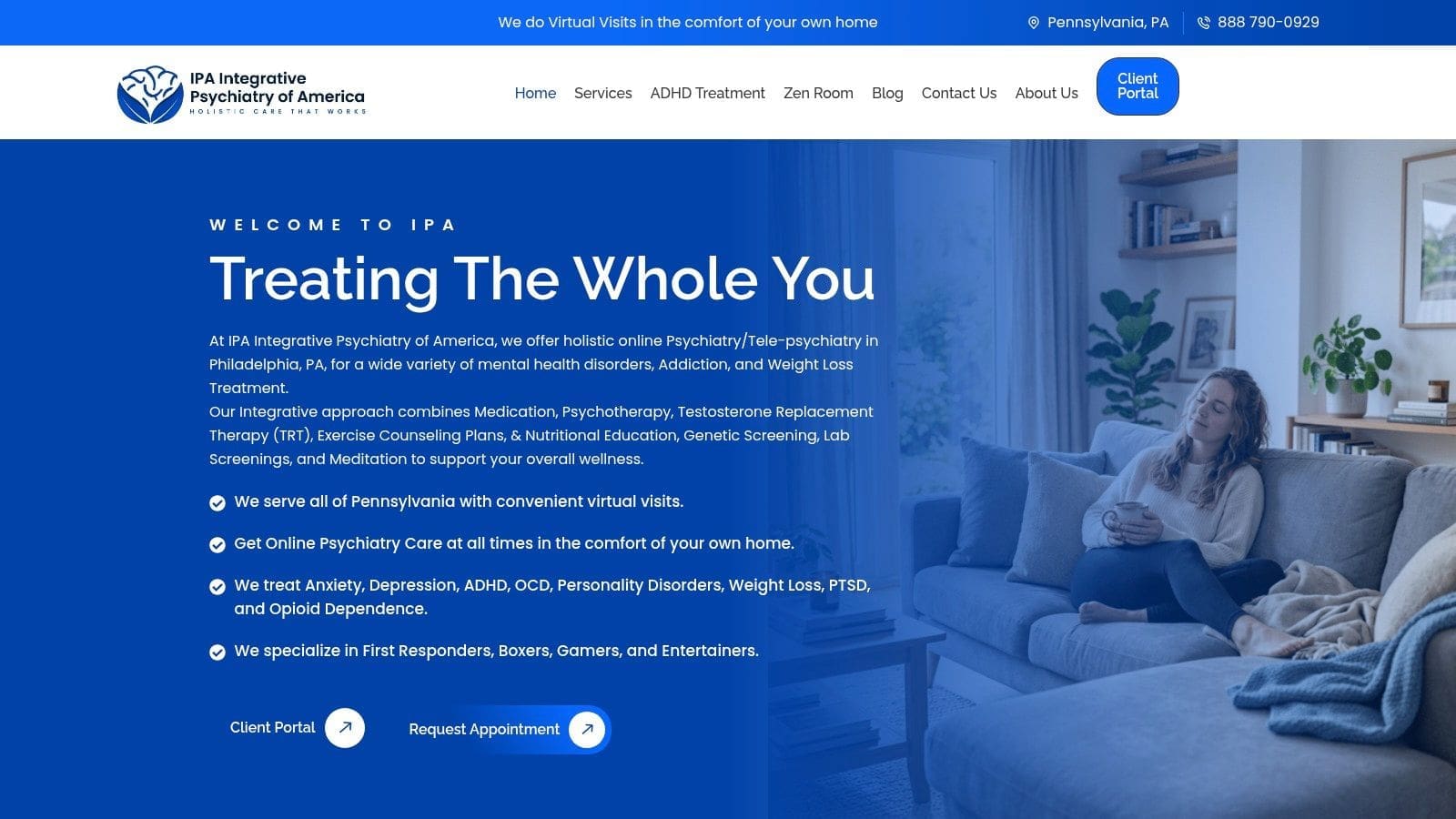
A common Philadelphia scenario looks like this: someone needs psychiatric care, wants virtual visits that fit work and family life, and does not want treatment reduced to a quick prescription check. Integrative Psychiatry of America fits that need well. The practice is led by board-certified psychiatric nurse practitioner Christopher Clark, MSN, PMHNP-BC, and serves adults across Pennsylvania through secure telehealth visits with a clear focus on accessible outpatient care.
What makes this entry different from a standard list of philadelphia psychiatrists is the provider model. IPA is PMHNP-led, which matters for patients comparing training backgrounds, visit style, and treatment scope. Adults who are weighing the difference between a psychiatric nurse practitioner and a psychiatrist often find that the better choice depends less on title alone and more on complexity, care goals, and whether they want a broader lifestyle-oriented plan alongside medication management.
Why this clinic stands out
IPA uses an integrative outpatient model. That means treatment may include medication management and psychotherapy, along with exercise counseling, nutrition education, mindfulness strategies, and, when clinically appropriate, lab testing or genetic screening. For patients with anxiety, depression, trauma, ADHD symptoms, sleep problems, or stress that shows up in both mind and body, that structure can be more useful than a narrow med-check approach.
The practice is also fully virtual. Patients can use a secure portal for messaging, refill requests, and appointment management, which lowers the usual friction that comes with follow-up care.
Patients who want to see how the practice organizes care for local residents can review the dedicated Philadelphia online psychiatry page.
Another practical strength is range. The clinic treats standard outpatient concerns such as mood and anxiety disorders, but it also addresses opioid dependence, weight management, trauma-informed care, and testosterone replacement therapy when clinically indicated. That wider scope can help when symptoms overlap instead of fitting into one clean diagnostic box.
Practical rule: Patients who want medication follow-up, therapy-informed care, and attention to sleep, habits, and physical health drivers in one treatment plan often do better with an integrative telehealth clinic than with a medication-only office.
IPA also states clearly that it serves LGBTQ+ patients and offers care suited to first responders, boxers, gamers, and entertainers. That kind of niche attention is not cosmetic. It can improve treatment fit when work hours are irregular, privacy matters, or stigma makes in-person care harder to maintain.
Best fit and trade-offs
Integrative Psychiatry of America is a strong option for adults who want online psychiatry in Philadelphia with more than prescription management alone. It fits patients who value convenience, need flexible scheduling, or want one clinician to address psychiatric symptoms alongside behavior, recovery, and lifestyle factors.
There are trade-offs.
- Best for telehealth users: This is a virtual-only practice, so it will not fit patients who prefer office visits or need routine in-person assessment.
- Best for integrative care: Patients looking for medication plus psychotherapy plus lifestyle guidance may find more value here than in a conventional med-management model.
- Pricing requires confirmation: The practice offers insurance verification, cash pay, and membership options, but patients should confirm out-of-pocket costs directly before starting care.
For many adults, the question is not whether telehealth is better than in-person care in the abstract. It is whether the clinic's model matches the kind of support they will use consistently. On that point, IPA stands out as a modern Philadelphia option for patients who want accessible psychiatric care with a broader treatment lens.
2. Penn Medicine Psychiatry
Penn Medicine Psychiatry is the classic academic medical center choice. For patients who want one system that can handle outpatient visits, inpatient care, crisis support, and specialty referrals, Penn is hard to ignore. That's especially true for adults with complex diagnoses, medical comorbidity, or situations where outpatient treatment might need escalation.
The trade-off is the one many patients already expect from large systems. Access can be slower, and scheduling can feel centralized rather than personal.
Where Penn works well
Penn makes sense when a patient wants institutional depth more than speed. Its Adult ADHD program and Hall-Mercer community behavioral health resources are meaningful strengths. This is often the right fit for someone who needs system-level coordination, not just a single prescriber.
Patients deciding between large systems and smaller practices often benefit from understanding when to see a psychiatric specialist, especially if symptoms have started affecting work, sleep, concentration, or safety.
Large health systems work best when the diagnosis is complicated, the medical picture is messy, or the patient may need hospital-based backup.
Penn is less ideal for adults who want fast telehealth intake, high-touch communication, or a more integrative style that includes lifestyle medicine. It's a strong medical system. It isn't built like a boutique private practice.
3. Jefferson Health Adult Inpatient and Outpatient Psychiatry
Jefferson Health's adult psychiatry services serve a similar role on the Philadelphia map, but some patients prefer Jefferson because it feels more regionally distributed and easier to connect with through existing primary care or specialist relationships. Adults already in the Jefferson system often have a simpler referral path than they would starting fresh elsewhere.
This is another hospital-based option where the main strengths are infrastructure and continuity across levels of care. In practical terms, that means easier coordination when psychiatric symptoms overlap with chronic medical illness, neurologic concerns, or emergency visits.
Best use case
Jefferson is a good fit for adults who want in-network care inside a teaching hospital environment and value access to consult teams, specialty referrals, and inpatient resources if needed. It's also a reasonable choice for patients who don't want a fully virtual clinic and prefer the reassurance of a hospital-backed system.
Some patients compare Jefferson with philadelphia psychiatrists in private practice and don't realize they may also be deciding between provider types. This breakdown of psychiatric NP vs psychiatrist differences can help clarify what matters most in ongoing care.
A fair caution belongs here. Teaching hospitals may involve trainees, and some patients appreciate that environment more than others. For non-urgent outpatient care, large systems also tend to feel less nimble than smaller telehealth clinics or private offices.
4. Rittenhouse Psychiatric Associates

Rittenhouse Psychiatric Associates offers something many adults want but don't always find in larger settings: a thorough, deliberate evaluation without the sprawl of a hospital system. The practice includes psychiatrists, psychiatric nurse practitioners, and psychologists, and it has built a strong reputation around longer diagnostic appointments, psychotherapy access, and careful medication management.
That longer intake matters. Adults with ADHD, bipolar spectrum symptoms, trauma histories, or overlapping anxiety and depression often need more than a brief symptom review. A 60 to 90 minute evaluation gives the clinician more room to sort out whether the issue is attention, sleep disruption, substance use, burnout, grief, or a combination.
What patients usually like here
Rittenhouse tends to appeal to patients who want a high-touch private practice and are comfortable with out-of-network billing. It often feels more personal than an academic center, and the fee structure is easier to understand upfront than at many private clinics.
- Thorough diagnostics: Longer evaluations can reduce the risk of oversimplifying ADHD, mood disorders, or trauma-related symptoms.
- Multiple care modalities: Patients can often access medication management and psychotherapy through the same practice.
- Telehealth plus office access: This hybrid model suits adults who want flexibility without giving up an in-person option.
The best private practices don't feel rushed. That doesn't automatically make them better, but it often improves diagnostic clarity.
The biggest downside is cost. Out-of-network psychiatric care can become expensive quickly, especially for patients who need regular follow-up. For adults who want broad insurance acceptance, this won't be the easiest option.
5. Philadelphia Integrative Psychiatry
Philadelphia Integrative Psychiatry stands out because it brings interventional psychiatry into the conversation earlier than most practices do. Patients can access medication management and psychotherapy, but also TMS, Spravato, ketamine therapy, ADHD coaching, autism and behavior services, and nutrition support. That makes it a notable option for adults who have already tried standard treatment and want a broader toolkit.
Its physical base is in Devon rather than Center City, but telehealth extends access across Pennsylvania. For some patients, that combination works well. They can use virtual follow-ups while still having access to in-person interventional services if appropriate.
What makes it different
This practice is better viewed as a multidisciplinary center than a standard office for philadelphia psychiatrists. Patients who are exploring a more whole-person model can also compare it with integrative psychiatry options in Philadelphia to understand how interventional care differs from telehealth-first integrative treatment.
Philadelphia's public behavioral health infrastructure is also a reminder that capacity and continuity matter. Community Behavioral Health managed care for more than 735,000 residents in 2022, and DBHIDS reported over 180,000 annual unique recipients in its system, according to DBHIDS planning and research information. In that kind of environment, multidisciplinary clinics that can absorb more complex outpatient cases fill an important role.
Patients should still be realistic about the trade-offs.
- Strong fit for treatment-resistant cases: TMS, Spravato, and ketamine expand options for patients who haven't responded to conventional care.
- Less convenient for some in-person visits: Devon may be a long trip for patients based in Center City or South Philadelphia.
- Insurance questions remain important: Interventional care often involves prior authorization or variable out-of-pocket costs.
6. Dr. Dara Psychiatry
Dr. Dara Psychiatry is a boutique practice with a narrower but very useful niche. Adults seeking careful assessment for ADHD, especially late-diagnosed ADHD or presentations that have been overlooked in women, may find this practice particularly appealing. The practice also addresses mood and anxiety disorders and combines medication management with psychotherapy.
A focused practice can be a real advantage when the patient's question is specific. Some adults don't need a giant system or a multidisciplinary center. They need a clinician who spends enough time to determine whether longstanding concentration problems represent ADHD, anxiety, trauma, sleep disruption, or all of the above.
Who should consider this practice
Longer evaluations are one of the strongest reasons to consider this clinic. When a practice protects intake time, it usually creates better room for diagnostic nuance and a more individualized treatment plan.
This kind of boutique model is often a good fit for:
- Adults seeking ADHD clarification: Especially patients who've masked symptoms for years or were dismissed in earlier care.
- Women's mental health concerns: A smaller specialist practice can offer more continuity around hormonal changes, reproductive transitions, and mood symptoms.
- Patients who value continuity: Smaller panels often mean the same clinician follows the case closely over time.
The downside is predictable. Small specialist practices usually have limited appointment capacity, and many operate out of network. That doesn't make them a poor choice. It means patients should enter with clear expectations about access and cost.
7. Voyage Healing Psychiatry and Ketamine Clinic

Voyage Healing fills a different clinical need than most of the practices on this list. It's especially relevant for adults dealing with treatment-resistant depression, severe anxiety, or PTSD who are already beyond the first round of standard medication choices. The clinic offers medication management, psychotherapy, ketamine-assisted psychotherapy, and multiple ketamine delivery options, along with Spravato.
That breadth matters because not all interventional clinics are built the same. Some focus on one modality. Voyage Healing gives patients more than one pathway under psychiatrist oversight, which can make decision-making easier when the clinical picture is complex.
When this model makes sense
Interventional psychiatry works best when the patient has already had an appropriate diagnostic workup and standard care hasn't been enough. It is not usually the first step for uncomplicated mild anxiety or mild depression. It's more relevant when symptoms are persistent, impairing, and resistant to routine treatment.
Patients who want to understand one of these options in more depth can review ketamine treatment for anxiety and depression in Philadelphia telepsychiatry.
Interventional care can be life-changing for the right patient, but it asks more from the patient too. There's more screening, more monitoring, and often more financial planning.
A note of caution is important here. Ketamine and Spravato programs can involve significant clinic time and variable insurance coverage. Patients should verify what is included, what requires in-person attendance, and what remains self-pay before starting.
Philadelphia Psychiatry: 7-Provider Comparison
| Provider | Care model & complexity 🔄 | Resource requirements ⚡ | Expected outcomes 📊 | Ideal use cases 💡 | Key advantages ⭐ |
|---|---|---|---|---|---|
| Integrative Psychiatry of America | Virtual, integrative model combining meds, therapy, lifestyle interventions, moderate coordination required | Telehealth platform, genetic/lab screening, lifestyle coaching; lower facility needs | Personalized symptom reduction and functional gains (⭐⭐⭐⭐) | Adults in PA wanting whole‑person, virtual care and MAT integration | Integrates meds + psych + lifestyle + genetic insights |
| Penn Medicine Psychiatry (UPenn) | Large academic system with outpatient, inpatient, crisis, high organizational complexity | Multisite clinics, inpatient beds, specialist teams; broad institutional resources | Comprehensive continuity, escalation-ready care (⭐⭐⭐⭐⭐) | Patients needing specialist referrals, inpatient or crisis services | System-level integration, broad insurance acceptance |
| Jefferson Health – Adult Psychiatry | Hospital‑based academic care with outpatient/inpatient options, high complexity | Teaching teams, inpatient units, multidisciplinary consults | Strong clinical oversight and escalation (⭐⭐⭐⭐⭐) | Patients preferring hospital-based, in‑network care and access to teaching resources | Easy escalation to ED/inpatient and multidisciplinary teams |
| Rittenhouse Psychiatric Associates | High‑touch private practice with extended evaluations, moderate complexity | Longer intake sessions, mixed in‑person/telehealth; self‑pay common | Thorough diagnostic clarity and targeted plans (⭐⭐⭐⭐) | Patients seeking detailed evaluations and faster private‑practice access | Extended assessments, transparent fees, clinical expertise |
| Philadelphia Integrative Psychiatry | Multidisciplinary with interventional suite (TMS, Spravato, ketamine), technically complex | Interventional equipment, REMS protocols, prior auths; clinic visits required | Strong outcomes for interventional candidates (⭐⭐⭐⭐⭐) | Patients seeking TMS/Spravato/ketamine and integrated team care | Full interventional offerings plus nutrition and therapy |
| Dr. Dara Psychiatry (Dara Kassamali, MD) | Boutique specialist practice with long intakes, low system complexity, high clinician involvement | Extended initial assessments, small panel; often out‑of‑network billing | High diagnostic accuracy and continuity (⭐⭐⭐⭐) | Adults with ADHD/women's mental health needing personalized workups | Niche expertise, long intake for diagnostic clarity |
| Voyage Healing – Psychiatry & Ketamine Clinic | Psychiatrist‑led interventional clinic focused on ketamine/Spravato, high procedural complexity | IV/IM/oral ketamine suites, monitoring, psychiatric oversight; frequent visits | Strong responses for treatment‑resistant conditions (⭐⭐⭐⭐⭐) | Treatment‑resistant depression, PTSD, severe anxiety needing ketamine/Spravato | Multiple ketamine modalities and integrated psychotherapy |
Your Next Step Toward Better Mental Health
Philadelphia offers more mental health options than many people realize, but more choice doesn't always make the decision easier. Some patients need a large academic center because they want hospital resources, crisis backup, or specialty referrals under one roof. Others want a smaller private practice with longer visits and more continuity. Still others want telehealth that reduces commute time, simplifies follow-up, and makes treatment easier to sustain.
That distinction matters in a city where access pressure is real. For at-risk youth in Philadelphia, more than 66,000 children were identified as potentially at risk for mental and behavioral disorders, with only 60 qualified child and adolescent psychiatrists available, according to WHYY's reporting on the city's child psychiatry shortage. Adult care has a different structure, but the same broader lesson applies. Demand is high, and finding a provider who is available, appropriate, and aligned with the patient's goals takes intention.
For many adults, the strongest next step isn't finding the most famous name. It's finding the best-fitting care model. A patient dealing with anxiety, depression, ADHD, OCD, PTSD, or opioid dependence may do better with a telehealth-first practice that offers both evidence-based medication management and practical support around sleep, movement, nutrition, mindfulness, and follow-up access. A patient with severe instability or a need for hospitalization may need an academic system instead. The better question isn't “Who is best?” It's “Who is best for this situation?”
Adults looking for confidential, flexible care across Pennsylvania may also appreciate the broader career shift toward virtual psychiatric services reflected in resources about finding remote psychiatry jobs, because that same shift has made patient access more practical than it used to be.
For patients who want a modern, whole-person model, Integrative Psychiatry of America is worth close consideration. The practice offers online psychiatry across Pennsylvania with a focus on Philadelphia, combining medication management and psychotherapy with lifestyle-based support in a secure telehealth setting.
Integrative Psychiatry of America offers adults in Pennsylvania a practical path to online mental health care that's confidential, accessible, and personalized. Patients can explore Integrative Psychiatry of America to verify insurance, review services, and schedule a virtual appointment that fits real life.