
An adult lies awake at midnight, finishing one thought while several others compete for attention. An unfinished email leads to tomorrow's meeting, then a forgotten errand, then a conversation that suddenly needs another review. Searching for racing thoughts and ADHD may offer a possible explanation, but it can also raise an unsettling question: is this ADHD, anxiety, a sleep problem, or something else?
The pattern matters more than the label. When the thoughts began, how sleep has changed, and whether mood or medication changes occurred can help a psychiatric provider identify the right next step.
Table of Contents
- What Racing Thoughts Mean in Adult ADHD
- Racing Thoughts Compared With Anxiety, Bipolar Disorder and Medication Effects
- Why the Mind Speeds Up in ADHD
- How Clinicians Evaluate Racing Thoughts and When to Seek Help
- Treatment Options That Address Racing Thoughts
- Daily Habits That Calm Racing Thoughts
- Insurance, Benefits and Out-of-Pocket Costs for ADHD Care
- Book an ADHD Evaluation in Pennsylvania
What Racing Thoughts Mean in Adult ADHD
Racing thoughts are rapid, crowded, or hard-to-stop mental activity. They can warrant an ADHD evaluation, but they don't prove ADHD on their own. Someone may feel mentally overactive while lying completely still.
The bedtime experience can make that distinction easier to understand.

Consider an adult who remembers an unpaid bill while preparing for sleep. Before deciding when to pay it, another idea arrives about work, followed by a household task. The difficulty isn't necessarily the content of any thought. It's the crowded pace and trouble selecting which thought deserves attention.
Mental hyperactivity isn't the same as mind wandering
Mind wandering means attention drifts away from the current activity. Racing thoughts describe the speed, crowding, or difficulty controlling mental activity. Someone can experience either or both.
A 2023 study available through the U.S. National Library of Medicine assessed 84 adults with ADHD, distinguished racing thoughts from mind wandering, and associated racing thoughts with ADHD symptoms and functional impairment. The sample included different ADHD presentations, rather than only people with prominent physical hyperactivity.
Racing thoughts aren't a standalone diagnostic symptom in the DSM or ICD diagnostic systems. Clinicians nevertheless need to ask about internal restlessness, because an adult's ability to sit still doesn't reveal how difficult it feels to settle mentally.
A still body doesn't necessarily mean a quiet mind.
Observations worth bringing to an appointment
Useful notes describe the experience rather than assigning it a diagnosis:
- Developmental pattern: Whether similar difficulties appeared during childhood or school.
- Settings: Whether crowded thinking affects work, home responsibilities, or conversations.
- Consequences: Whether sleep, task completion, relationships, or decision-making suffer.
An occasional busy evening differs from a persistent pattern that interferes with daily life. Neither experience requires self-blame, but recurring impairment deserves clinical attention.
Racing Thoughts Compared With Anxiety, Bipolar Disorder and Medication Effects
| Condition | Typical racing-thought pattern | Clues that point elsewhere | Next step |
|---|---|---|---|
| ADHD | Thoughts jump between topics and feel hard to choose between | A lifelong pattern supports ADHD; a sudden onset suggests another explanation | Full evaluation with childhood history and impairment review |
| Anxiety disorder | Worry loops around perceived threats, often with physical tension | Racing heart, avoidance, or situation-linked worry suggests anxiety may contribute | Anxiety assessment and possible therapy referral |
| Bipolar disorder | Thoughts accelerate during a distinct mood change | Less need for sleep, unusually elevated or irritable mood, or grandiose ideas | Prompt mood assessment before stimulant decisions |
| Medication or substance effects | Restlessness or insomnia follows starting, increasing, or stopping a substance | Timing matches a prescription change, caffeine intake, or other substance exposure | Medication and substance review with the prescriber |
| Sleep deprivation | Mental overactivity accompanies disrupted or insufficient sleep | Improvement after recovered sleep supports a sleep contribution | Sleep assessment and sleep-focused habits |
These are assessment clues, not diagnostic rules. Several conditions can coexist, and someone may recognize more than one row.
Similar experiences can require different care
In a 2021 study indexed by PubMed, ADHD groups recorded higher racing-thought scores than hypomanic and euthymic bipolar groups. Euthymic means a period without a current major mood episode. The finding challenges the assumption that racing thoughts belong exclusively to bipolar disorder, but the symptom still couldn't reliably distinguish the conditions.
For anxiety, the emotional theme often matters. Repeated predictions of danger, embarrassment, or failure suggest a different starting point than rapid shifts between unrelated ideas. The discussion of anxiety versus ADHD in adults offers further context for that overlap.
Bipolar assessment focuses on a change from usual functioning, not merely a busy mind. Accelerating thoughts with markedly reduced sleep, unusual confidence, impulsive behavior, or pronounced irritability need prompt attention.
Medication-related symptoms require careful timing notes. Prescribed drugs, caffeine, supplements, and other substances belong on the same review list. Abruptly stopping a prescription without guidance can introduce additional problems.
Sleep also deserves its own assessment. Being exhausted but unable to fall asleep differs from sleeping very little without feeling tired.
Pattern check: Did the experience begin early in life, or did it follow a medication change, sleep disruption, or mood shift?
For readers exploring supplements, Wallaby Wellness discusses natural hemp support for anxiety. That commercial resource isn't diagnostic evidence or a treatment recommendation; hemp products warrant prescriber review for interactions and possible adverse effects.
Why the Mind Speeds Up in ADHD
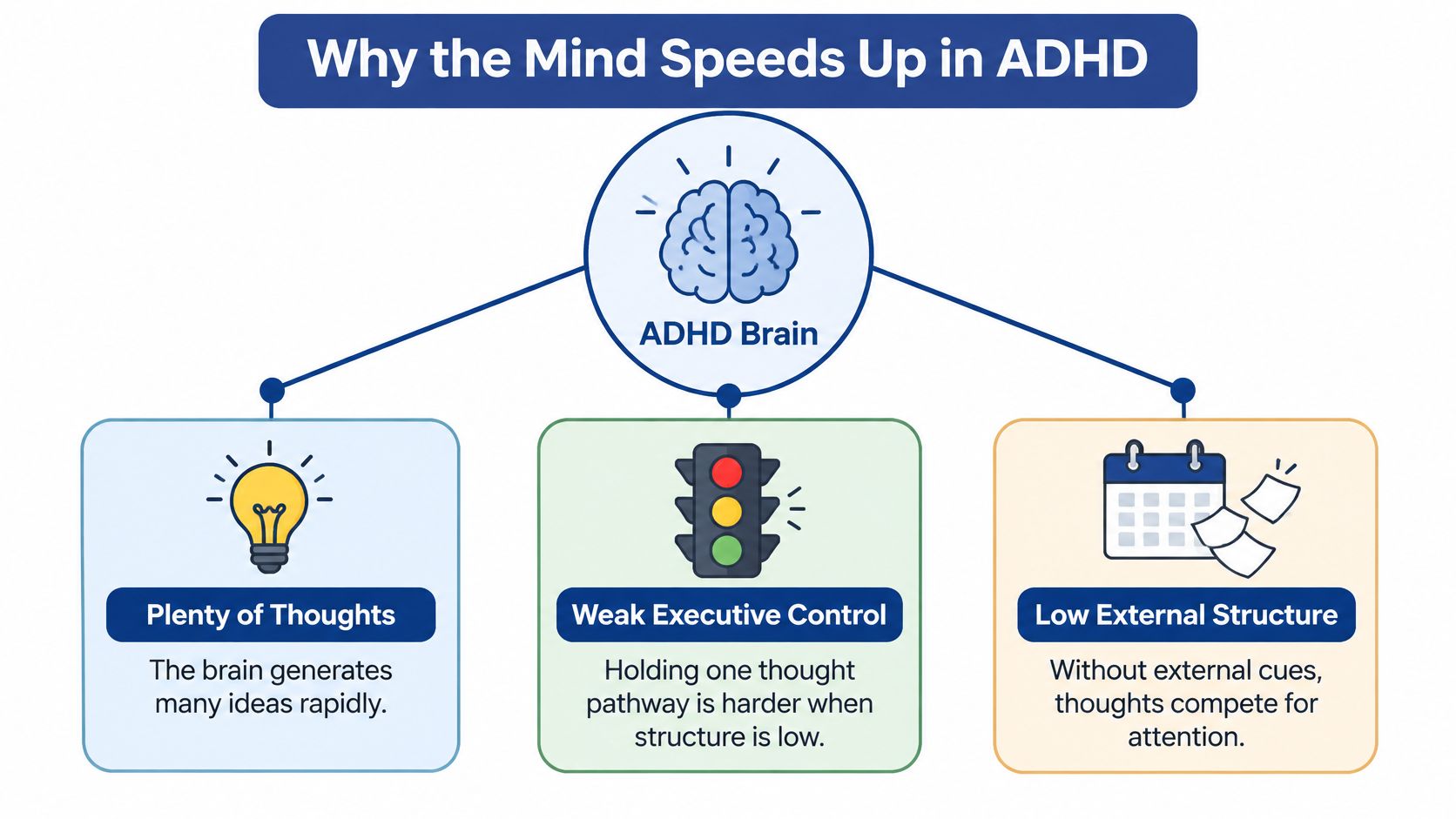
One explanation is that thoughts arise readily, while holding a selected thought pathway becomes harder when external structure is low. This is an explanation of a possible process, not a brain test that establishes ADHD.
Executive control describes the ability to direct attention, hold a goal in mind, and return after distraction. A person may know exactly what needs doing yet struggle to keep that goal mentally prominent.
The concept map illustrates how thought generation, attention control, and structure can interact.
More switching doesn't necessarily mean more thoughts
In verbal-fluency research published in the Journal of Affective Disorders, adults with ADHD produced approximately the same total number of words as healthy participants but switched between semantic categories more frequently. Semantic categories are groups of related meanings, such as animals or household objects.
That result supports difficulty maintaining a thought set rather than faster speech or greater output. It doesn't mean every adult with ADHD thinks in the same way.
A useful analogy is a train that passes stations without stopping long enough to complete a task. Another is a browser with many open tabs: the problem isn't just the number of tabs, but difficulty keeping the intended one active.
Why quiet evenings can feel mentally loud
Work schedules, conversations, and visible deadlines provide external direction. When those cues disappear, unfinished tasks and worries may become harder to set aside. Rising tiredness doesn't automatically create the ability to disengage.
Stress, caffeine, and unstructured time are useful factors to track rather than assumed explanations. Similar switching also appears in hypomania, so a sharp departure from a person's usual pattern shouldn't automatically receive an ADHD label.
A brief log can capture:
- Timing: When thoughts become crowded.
- Preceding events: Work demands, conflict, caffeine, or medication timing.
- Afterward: Sleep obtained, next-day energy, and task completion.
Written prompts, a single visible task, and a separate place to capture new ideas can provide practical structure while an evaluation clarifies the cause.
How Clinicians Evaluate Racing Thoughts and When to Seek Help
It is late, and your mind keeps leaping from an unfinished task to an old worry to tomorrow's schedule. You may not know whether this night needs emergency care, or a planned evaluation that can tell ADHD restlessness apart from anxiety, a mood episode, or a medication effect. Screening can show whether an evaluation may be useful. A clinical evaluation can lead to a diagnosis. Immediate safety concerns come before either step.
Call or text 988, or seek emergency care now, for thoughts of harming yourself or someone else. Do the same for major sleep loss paired with a heightened, grandiose, or intensely irritable mood, and for a sudden change such as new hallucinations, confusion, or an inability to care for basic needs. Immediate danger needs emergency help rather than a routine appointment.
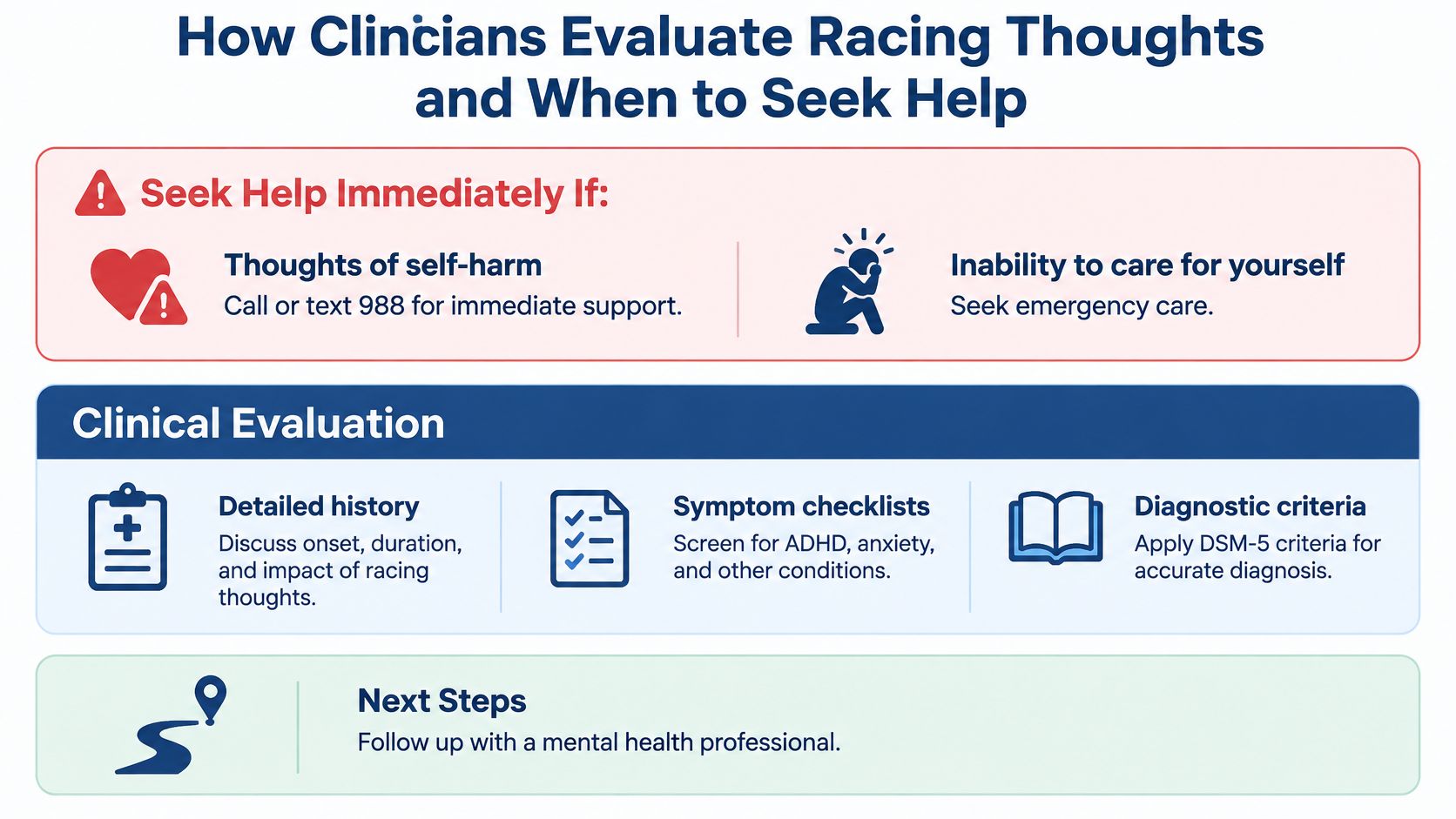
Screening, evaluation, and diagnosis serve different purposes
An Adult ADHD Screener can organize concerns before a visit. A positive result does not establish ADHD, and a negative result does not explain every cause of distress. Screening works like a smoke alarm: it says to look closer, not what started the problem.
An evaluation examines childhood history, symptoms across settings, and meaningful impairment. It also considers anxiety, mood episodes, trauma-related arousal, sleep problems, medication effects, and substance use. The timing of the speedup points to the next step. Thoughts that rise with worry and settle when that worry is addressed fit an anxiety review. A sharp break from usual sleep and mood, especially with grandiosity or intense irritability, needs a mood-episode assessment before it is treated as ordinary ADHD restlessness. A change that follows a new dose, caffeine, or another substance belongs in a medication and substance review. Medical symptoms may prompt assessment for conditions such as thyroid dysfunction.
The CDC adult ADHD surveillance report found that 15.5 million U.S. adults, or 6.0%, reported a current ADHD diagnosis in 2023. Diagnosis generally requires persistent symptoms beginning in childhood, occurring across settings, and not better explained by another condition.
A diagnosis follows that assessment, not a single questionnaire score. The guide to getting an ADHD diagnosis as an adult explains the appointment pathway.
Preparation makes the visit more useful
Bring materials a clinician can compare against your usual pattern:
- A symptom timeline: Early difficulties and recent changes.
- Sleep and mood notes: Bedtime, wakefulness, energy, and emotional shifts.
- A complete medication list: Prescriptions, supplements, caffeine, and other substances.
- Outside observations: Relevant comments from partners, teachers, or colleagues, when available.
Board-certified psychiatric nurse practitioners perform evaluations and prescribe when clinically appropriate. Integrative Psychiatry of America providers conduct ADHD evaluations and manage medication in line with current Pennsylvania and federal telehealth prescribing regulations.
Christopher Clark, MSN, PMHNP-BC, leads the practice.
Treatment Options That Address Racing Thoughts
| Option | What it targets | Evidence and limits | Clinician's role |
|---|---|---|---|
| Stimulant ADHD medication, including methylphenidate- or amphetamine-based options | Core inattention and restlessness that may contribute to crowded thinking | Adult ADHD options have FDA approval; insomnia, appetite loss, and increased heart rate can occur | Confirm diagnosis, select medication, adjust dose, and monitor |
| Non-stimulant medication, including atomoxetine and guanfacine extended-release | Core ADHD symptoms through different medication mechanisms | Atomoxetine is FDA-approved for adults; guanfacine extended-release is approved for children and adolescents, not adult ADHD | Review age indication, medical history, cardiovascular considerations, and tolerability |
| Cognitive behavioral therapy adapted for ADHD | Planning, procrastination, thought patterns, and self-talk | Functional improvement requires practice; therapy doesn't remove every symptom | Provide structured treatment or coordinate referral |
| Mindfulness-based practice | Attention regulation and reactions to intrusive thoughts | Evidence suggests modest benefit; it's an adjunct rather than a replacement for indicated care | Guide practice or recommend suitable training |
| Care for co-occurring anxiety or bipolar disorder | Symptoms that resemble or add to racing thoughts | Treatment differs by diagnosis; bipolar symptoms require particular caution with stimulants | Establish the diagnosis before treatment changes |
Treatment should address the condition producing the symptoms, not just the sensation of mental speed. Racing thoughts alone don't determine which medication or therapy fits.
Medication management requires follow-through
ADHD medication targets core symptoms. Some people experience less mental restlessness when attention and self-regulation improve, but relief isn't guaranteed.
Medication selection considers prior response, sleep, appetite, cardiovascular history, other conditions, and substance use. Follow-up visits help distinguish a helpful effect from activation, worsening anxiety, or sleep disruption.
Non-stimulants aren't automatically free of adverse effects. Fatigue or sleepiness can occur, and improvement may take time. Age-specific approval matters: an adult considering guanfacine extended-release needs a discussion of off-label use rather than an assumption that every ADHD medication has the same indication.
A useful medication review considers functioning, sleep, mood, and adverse effects together, rather than asking only whether concentration improved.
Skills and integrative care have distinct roles
ADHD-adapted cognitive behavioral therapy makes daily difficulties concrete. A therapist might help an adult break an avoided task into manageable actions or challenge self-critical thinking after a missed deadline.
Mindfulness practice focuses on noticing a thought without automatically pursuing it. The aim isn't an empty mind. It's a more deliberate response when attention shifts.
Integrative Psychiatry of America tailors care by integrating advanced lab monitoring, genetic evaluations, exercise and nutritional counseling, mindfulness techniques, and psychotherapy. These components serve different purposes; not every test or intervention is necessary for every person.
For supplement questions, the GutRx article can help readers compare probiotic strains for ADHD, but a commercial comparison doesn't establish that probiotics treat racing thoughts. Supplements shouldn't displace appropriate evaluation or established care.
A record of medications, therapies, benefits, and unwanted effects supports shared decisions. The overview of adult ADHD treatment options provides additional context for those conversations.
Daily Habits That Calm Racing Thoughts
Daily habits can support attention, sleep, and a calmer response between visits, but they don't replace clinical treatment. A manageable routine is more useful than an elaborate schedule that becomes another source of pressure.
The visual offers examples of everyday supports.
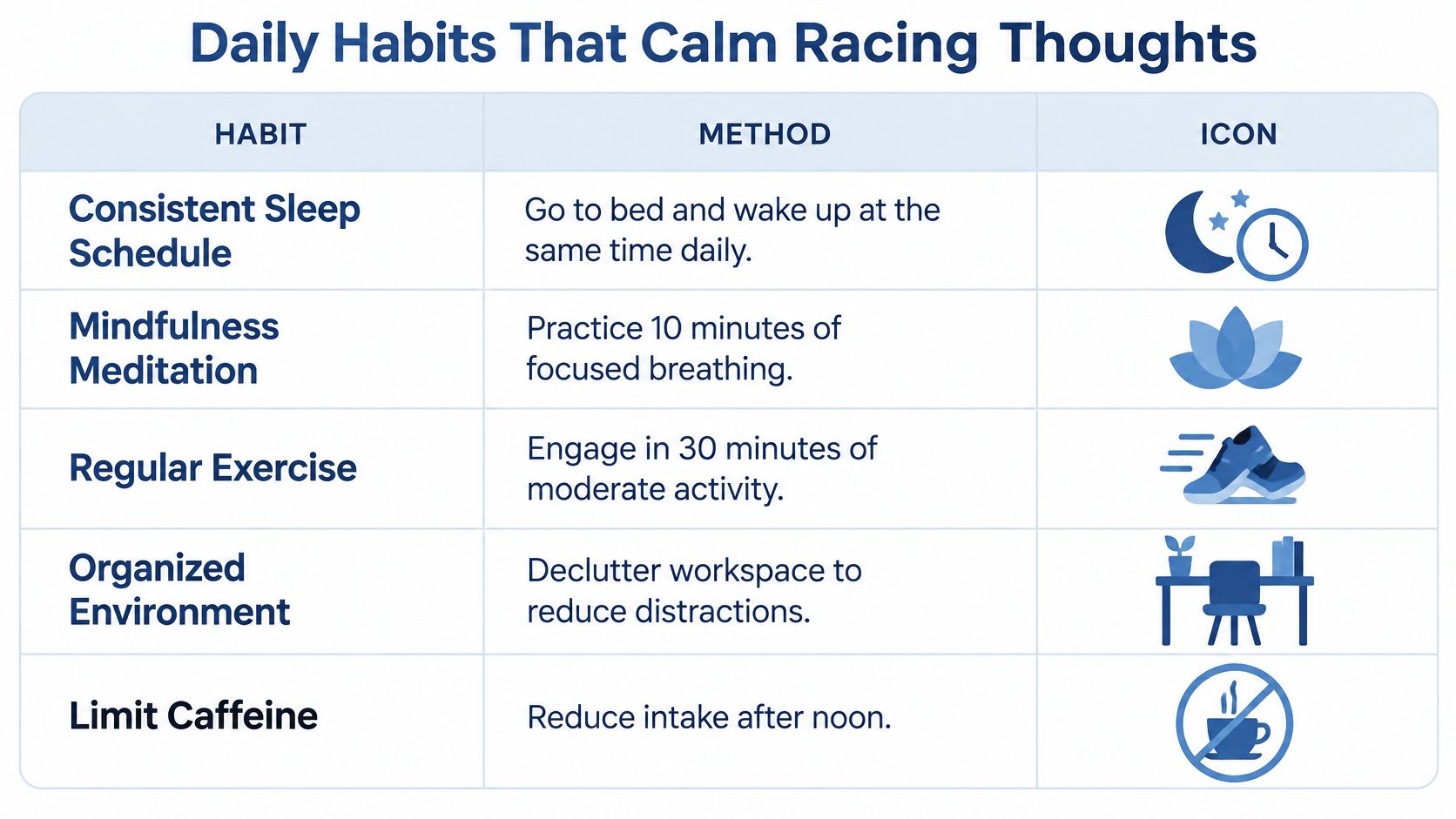
| Habit | How to do it | Why it helps |
|---|---|---|
| Brain dump before bed | Put open tasks and ideas on paper | Reduces the need to mentally rehearse unfinished items |
| Single-task focus blocks | Use a timer for a manageable work period, followed by a break | Adds boundaries around attention |
| Parking-lot list | Record unrelated ideas separately for later review | Allows returning to the current task |
| Slow breathing | Breathe gently, with a comfortable, slightly longer exhale | Can help settle physical tension |
| 5-4-3-2-1 grounding | Notice things seen, touched, heard, smelled, and tasted | Redirects attention toward the immediate environment |
| Fixed sleep and wake times | Keep a consistent routine, including weekends | Provides predictable sleep cues |
| Regular exercise | Choose repeatable activities such as walking, cycling, or swimming | Supports general health and offers a structured activity |
| Caffeine and meal timing | Move caffeine earlier and maintain regular meals | Helps identify avoidable jitteriness or hunger-related distraction |
Practical starting points
- Begin with a brief brain dump. Write unfinished tasks without trying to solve them all. Mark the next actionable item, then leave the list outside the bed.
- Use a timed focus block for a clearly defined task, such as drafting an email rather than completing all correspondence. A separate parking-lot list keeps unrelated ideas available without acting on them.
- Make evenings predictable. Keep a steady wake time, reduce stimulating screen use before bed, and reserve bed for sleep rather than work. Persistent insomnia warrants assessment rather than increasingly strict self-imposed rules.
For example, an adult might trial five minutes of writing and a 25-minute work block, then adjust either interval to fit attention and fatigue. These are practical starting settings, not required therapeutic doses.
For work-related rumination, Acheloa Wellness offers steps to stop overthinking work. A specific end-of-day shutdown routine may be easier to follow than a general intention to relax.
The accompanying video offers another format for considering these strategies.
The discussion of exercise and ADHD benefits can support activity planning. A short trial recorded in the sleep and mood log helps reveal what feels useful; persistent impairment calls for clinical follow-up, not blame.
Insurance, Benefits and Out-of-Pocket Costs for ADHD Care
Coverage for ADHD evaluation, medication management, and telehealth follows the specific insurance plan. Benefit verification helps estimate responsibility, but it doesn't guarantee payment of a future claim.
Copays, deductibles, coinsurance, network status, and prior authorization requirements can differ even among plans from the same insurer. Readers considering Cigna, Aetna, UnitedHealthcare, or Blue Cross Blue Shield plans, including IBX in Pennsylvania, shouldn't assume that an insurer's name confirms coverage.
Questions for the benefits representative
- Telehealth eligibility: Does the plan cover psychiatric or mental health video visits with a psychiatric nurse practitioner?
- Evaluation coverage: Does it cover the proposed ADHD evaluation, and does prior authorization apply?
- Follow-up visits: Do medication management appointments have the same benefit rules as the initial evaluation?
- Patient responsibility: What copay, remaining deductible, or coinsurance applies to each visit type?
- Pharmacy coverage: Which ADHD medications fall under the pharmacy benefit, and what authorization or quantity limits apply?
The answers should distinguish a clinical evaluation from any separately billed testing. A medication benefit is also separate from coverage for the appointment at which a prescription is discussed.
Cost check: An estimate is most useful when it identifies the provider, visit type, network status, and applicable plan benefit.
The guide to insurance coverage for ADHD testing helps clarify questions before scheduling. Integrative Psychiatry of America offers insurance verification, allowing prospective patients to begin that process rather than assume out-of-pocket costs.
The practice's Insurance and Fees information can also support planning. Any remaining uncertainty about the visit estimate or pharmacy benefit deserves clarification before an appointment or prescription decision.
Book an ADHD Evaluation in Pennsylvania
Adults in Pennsylvania with persistent racing thoughts don't need certainty about the cause before seeking an evaluation. A useful appointment begins with describing the experience and its impact, not arriving with a settled diagnosis.
Integrative Psychiatry of America provides care through secure telepsychiatry with board-certified psychiatric mental health nurse practitioners. Its statewide clinical scope includes children, adolescents, college students, and adults. Families can confirm age eligibility when scheduling; the practice evaluates children ages 6 and older.
A clear appointment pathway
- Complete an optional screen. An Adult ADHD Symptom Checker can help organize concerns, without determining the diagnosis.
- Verify insurance benefits and likely out-of-pocket responsibility for the proposed appointment.
- Request an appointment through the online portal. Include the main concern, such as longstanding distractibility, nighttime mental overactivity, or a recent change.
- Attend the evaluation prepared to discuss developmental history, current functioning, sleep, mood, and medication exposure.
- Review appropriate options together. The plan may involve ADHD care, assessment of another condition, or coordinated treatment for overlapping concerns.
A symptom timeline, complete medication list, sleep and mood log, and insurance card make preparation more concrete. Available school records or observations from someone familiar with longstanding difficulties may add useful context, but missing records shouldn't prevent an initial inquiry.
For daily organization, a free time-blocking planner can help translate intentions into visible tasks. It remains a practical support rather than a diagnostic instrument or substitute for treatment.
A virtual appointment offers a way to discuss sensitive concerns from an appropriate private setting. The goal is a careful explanation and a clinically suitable plan, without promises about a diagnosis, medication, coverage, or outcome.
Integrative Psychiatry of America offers virtual ADHD evaluations and ongoing medication management throughout Pennsylvania, with assessment of sleep, mood, anxiety, and other possible contributors to racing thoughts. Adults seeking clarity can visit Integrative Psychiatry of America to request an appointment and begin a clinical evaluation.