
Two adults describe the same afternoon. One lost three hours to a loop of worry about a performance review. The other lost three hours and couldn't say where they went. Both say they can't focus. One leaves an appointment with an anxiety diagnosis, the other with ADHD, and a third leaves with both.
The symptom list doesn't separate them. Adults with anxiety and adults with ADHD report the same concentration trouble, restlessness, irritability, sleep problems, procrastination and overwhelm. The anxiety vs ADHD in adults distinction rests on the timeline, the settings where symptoms appear, and the mechanism underneath. It also depends on keeping four steps apart: screening, evaluation, diagnosis and treatment.
Table of Contents
- Anxiety and ADHD Side by Side in Adults
- Symptom Overlap and the Timeline Test
- Masking, Comorbidity and High-Achieving Adults
- Which Situation Points to Which Path
- Treatment Options Compared for Each Condition
- Choose Your Next Step in Pennsylvania
Anxiety and ADHD Side by Side in Adults
When attention problems show up, what matters is not only how they feel today, but when they began and where they occur. Anxiety centers on excessive fear, worry, or avoidance. ADHD involves persistent inattention and/or hyperactivity-impulsivity that affects daily functioning. The two can coexist, so one pattern does not rule out the other.
| Feature | Anxiety | ADHD | Key question |
|---|---|---|---|
| Core pattern | Excessive fear, worry, or avoidance beyond ordinary stress | Persistent inattention and/or hyperactivity-impulsivity across settings | Is worry driving the difficulty, or does attention remain difficult when life is calm? |
| Typical onset | Can begin at any age, sometimes after stress, illness, or trauma | Symptoms begin before age 12, even if recognized later | Were focus or organization problems present in childhood? |
| Pattern over time | May rise and fall with threat, uncertainty, or life events | Persists over time and affects functioning | Does the pattern continue during quieter periods? |
| Where it shows up | May be tied to particular situations, such as meetings or social settings | Appears in multiple areas of life, such as home, work, school, or social settings | Where do the difficulties occur? |
The questions in the last column turn broad descriptions into a personal history. For example, difficulty concentrating only during high-pressure meetings may point to a different pattern than trouble organizing tasks at home and work, even when stress is low. An adult ADHD symptom overview can help you understand the symptoms clinicians consider, but a symptom list alone cannot establish a diagnosis.
What the Numbers Can and Cannot Tell You
Population figures describe how common a condition is, not what explains one person's difficulties. The National Institute of Mental Health's anxiety statistics estimate that 19.1% of U.S. adults had an anxiety disorder in the previous 12 months, while 31.1% had one at some point in their lives. For generalized anxiety disorder, the estimates are 2.7% in the previous year and 5.7% over a lifetime.
Those figures cannot distinguish anxiety from ADHD in an individual. The more useful clues are the history of symptoms and the situations in which they arise. Write down when the difficulties began, where they occur, and a few concrete examples. That record can help a clinician decide what to assess; screening, evaluation, diagnosis, and treatment are separate steps.
Symptom Overlap and the Timeline Test
Anxiety and ADHD look alike from the outside. The timeline and the settings where symptoms appear separate them more reliably than the symptoms themselves.
Both conditions can produce:
- Concentration trouble that shows up mid-meeting, mid-page or mid-conversation
- Restlessness, whether it feels keyed-up or under-stimulated
- Irritability aimed at people who didn't cause anything
- Sleep disruption, from a mind that won't stop or a body that won't settle
- Procrastination and forgetfulness that cost real money and goodwill
What the Overlap Evidence Actually Shows
A systematic review archived by the National Institutes of Health found co-occurring anxiety-disorder estimates among people with ADHD ranging from 4.3% to 47.1% in general-population samples and 3.9% to 84.0% in psychiatric samples. A separate review in that body of work compared adults with ADHD to controls and reported anxiety prevalence estimates from 2.2% to 44.3%, with a pooled odds ratio of 5.0. The odds of anxiety were roughly five times higher among the adults with ADHD in the included studies.
Those ranges are wide for unglamorous reasons: studies differ in design, diagnostic threshold, clinical setting, and whether they counted current or lifetime anxiety. The takeaway isn't that every adult with ADHD has an anxiety disorder. It's that guessing from symptoms alone produces errors in both directions.
When both are present, they feed each other. A missed deadline or an unpaid bill creates worry, and worry consumes the attention left over. Years of that cycle build a low, constant vigilance that looks like a personality trait and behaves like an anxiety disorder.
The Five-Symptom Rule and the Six-Month Window
The National Institute of Mental Health guidance on ADHD sets the bar for adults 17 and older at at least five symptoms of inattention and/or hyperactivity-impulsivity. Those symptoms must persist for at least six months, appear in two or more settings such as home, work, school or social situations, and cause clinically meaningful impairment. The same guidance warns that sleep disorders, anxiety, depression, physical illnesses and other conditions can produce ADHD-like symptoms, so a symptom checklist alone can't settle the question.
That two-setting requirement does quiet diagnostic work. Everyone loses focus in a dull meeting. Fewer people lose the thread at home, at work and in conversation with a friend during the same week.
The Timeline Test in Three Adults
ADHD requires evidence that symptoms were present before age 12, even when nobody named the condition back then, according to NIMH's overview of ADHD. Anxiety can begin at any age and often follows stress, illness, trauma or a long stretch of uncertainty. Three patterns show why the question matters so much.
The adult with a childhood paper trail. A 34-year-old who fought over homework in third grade, lost the same permission slip twice a week, and still forgets bill due dates shows one consistent thread. A calm weekend doesn't fix it.
The parent after a job loss. Concentration collapsed in the month after a layoff and improved by degrees as money and routine stabilized. That arc points toward anxiety first, with attention reassessed once the pressure eases.
The nurse with both. School reports describe disorganization going back to elementary years, and worry became unmanageable during a hospital crisis. Two timelines run side by side, and a thorough evaluation has to cover both.
What to Gather Before an Evaluation
Evidence beats memory here. Pull old report cards, any prior psychological testing, and notes from previous treatment. Ask a parent or sibling what they remember about your organization and attention as a child. Keep a two-week log of sleep, mood, focus and missed commitments.
Sleep deserves its own line. Short or fragmented sleep degrades attention, and worry delays sleep, so the two problems sustain each other. The Sleep Consultant's explanation of anxiety and insomnia is a practical primer on that loop to read before an appointment. A proper workup, such as the psychological testing for ADHD process, pairs the interview with rating scales and records review instead of a single questionnaire.
Masking, Comorbidity and High-Achieving Adults
A person can meet deadlines, lead meetings, and keep a home organized while using enormous effort to do it. Strong performance does not rule out ADHD or anxiety. The key is to ask what the effort is compensating for and whether the pattern has been present over time.
Research indicates that adults with ADHD commonly report masking or camouflaging, particularly at work or school and within families, as discussed in a review of ADHD masking research. Yet masking is not specific to ADHD. Social anxiety, generalized anxiety, trauma-related hypervigilance, and perfectionism can also lead someone to overprepare or hide distress. The same outward behavior can have different causes.
Clues, Not Proof
Look at the effort behind daily routines, not just the visible result:
- Over-preparation: a 20-minute task takes two hours.
- Deadline crises: work stalls until the last possible hour.
- Repeated checking: emails, locks, calendars, or messages are checked again and again.
- Rigid routines: one disrupted step throws off the rest of the day.
- People-pleasing: saying yes to avoid seeming unreliable.
- Recovery exhaustion: a week of sustained effort leaves little energy for the weekend.
These patterns can help explain what is difficult, but they cannot establish a diagnosis. Track when they occur and what seems to trigger them. Symptoms tied mainly to feared outcomes may point toward anxiety; difficulties that persist across settings, including calmer periods, may warrant closer attention to ADHD. Both conditions can also be present.
Who Gets Missed
A polished exterior can make internal strain harder to notice. Caregiving responsibilities, demanding roles, or routines that provide strong structure may conceal how much effort it takes to stay on top of daily tasks.
Consider a project manager who works past midnight to stay ahead, rehearses meetings aloud, and spends Saturday recovering. ADHD, anxiety, or both could contribute. How anxiety, depression, and ADHD can overlap explains why symptom lists alone may not clarify the cause. An evaluation considers the history and context behind the pattern.
For one week, record the time spent compensating and the effects on sleep, mood, or relationships. That account can make the effort behind outward performance easier to discuss at an appointment.
Which Situation Points to Which Path
| Situation | First step | What to bring | Urgency |
|---|---|---|---|
| Worry spikes around work and focus returns when stress eases | Anxiety evaluation, then reassess attention | Mood and worry log, sleep notes | Routine scheduling |
| Lifelong disorganization and forgotten tasks, with school struggles recalled | ADHD evaluation with developmental history | Old report cards, prior evaluations, family observations | Routine scheduling |
| Symptoms present since childhood plus current worry | Comprehensive evaluation covering both conditions | Full timeline and a symptom log | Routine scheduling |
| Previously diagnosed with ADHD and feeling worse on current treatment | Medication review and reassessment | Current dose, side effects, sleep and mood notes | Prompt review, not waiting for the next routine visit |
| Thoughts of self-harm, panic that blocks eating or working, or escalating substance use | Same-day help: urgent care, 988 in the United States, or emergency services | Current medications and substances used | Urgent |
Find your situation, note the first step, then set aside an hour to gather what the third column asks for. Read the bottom row first, even if it doesn't describe you.
Urgent Situations Come First
Thoughts of self-harm, panic that blocks eating or working, or substance use that's escalating need same-day help. In the United States, that means urgent care, the 988 Suicide and Crisis Lifeline, or emergency services. Bring current medications and anything you've taken, because the answer changes what's safe to prescribe.
Sudden confusion, fever, a head injury or new neurological symptoms need a medical evaluation before any psychiatric workup. Those presentations can mimic anxiety or ADHD, and the medical cause comes first every time.
Working Through the Routine Rows
A worry spike that eases when the stressor lifts points toward an anxiety evaluation, with attention reassessed afterward. A lifelong pattern of lost keys, late bills and forgotten tasks, plus school reports to match, points toward an ADHD evaluation built on developmental history. When both timelines run in parallel, ask for an evaluation that covers both conditions instead of the loudest symptom.
If you already carry an ADHD diagnosis and feel worse on current treatment, request a medication review rather than waiting for the next routine visit. Sleep changes, appetite shifts and new anxiety all belong in that conversation.
Free self-assessments are conversation starters. Integrative Psychiatry of America publishes a Free Tools Library of 15 tools, including an Adult ADHD Screener, Anxiety Symptom Checker, 5-4-3-2-1 Grounding Tool, Focus Block Planner and My Self-Care Tracker. None of them diagnoses anything. They tell you which questions to raise and where to start the timeline.
Report escalating substance use at the first visit. It changes both the diagnosis and the treatment plan, and no clinician can account for what they never hear.
Treatment Options Compared for Each Condition

Anxiety treatment and ADHD treatment overlap less than most adults expect. The table lines up the main approaches; the notes column explains what changes when both conditions are present.
| Treatment approach | Anxiety | ADHD | Notes when both are present |
|---|---|---|---|
| Medication class | SSRIs or SNRIs are commonly first-line; benzodiazepines are generally short-term | Stimulants and non-stimulants are both used | The prescriber weighs interactions, sleep, substance use and which condition is most impairing |
| Psychotherapy | Cognitive behavioral therapy and exposure-based work | Skills training and behavioral coaching for organization and planning | Therapy may target worry and executive function in the same plan |
| Daily structure | Regular sleep, caffeine review and grounding practice | Scheduled tasks, reminders and external timers | Structure supports both, and a time-blocking or reminder tool can help |
| Monitoring | Mood and worry tracked over several weeks | Focus and impairment rated across home, work and school | Track both symptom sets so changes in one are not mistaken for the other |
Benzodiazepines are generally short-term because of dependence risk, which is why a prescriber may offer one while an SSRI or SNRI takes effect and then taper it. Stimulant and non-stimulant medications both carry side effects worth tracking: appetite change, sleep disruption, and raised heart rate or blood pressure. Cognitive behavioral therapy and exposure-based work carry the strongest evidence on the anxiety side, while skills training and behavioral coaching do the heavy lifting for organization and planning on the ADHD side.
Why the Order of Treatment Matters
A stimulant can worsen anxiety in some people. When both conditions are present, the prescriber weighs interactions, sleep, substance use and which condition is most impairing before deciding what to treat first. Sometimes anxiety has to come down before attention can be assessed accurately. Sometimes unrecognized ADHD is generating the worry, and attention leads the plan.
What Integrative Care Adds
Integrative psychiatry incorporates nutritional counseling, exercise education, mindfulness, supplements, and advanced genetic and blood testing alongside psychotherapy and medication management. Those additions support care. They don't replace medication management or psychotherapy when either is needed, and they don't shorten the diagnostic work.
Daily structure belongs in every plan: a consistent sleep window, a caffeine review, scheduled reminders for recurring tasks, and a time-blocking tool for the work that gets avoided. Detail on ADHD treatment options for adults is worth reading before an appointment.
What to Ask Before Starting
- Which condition is being treated first, and why that order was chosen
- How progress will be measured, and over what stretch of weeks
- Which side effects to report immediately rather than at the next visit
- What the plan is if the first medication doesn't work or stops working
Medication choices follow a full evaluation and belong to the prescriber who knows your history, sleep and substance use.
Choose Your Next Step in Pennsylvania
To get evaluated in Pennsylvania, build a timeline, verify insurance, then book a telehealth evaluation with a board-certified psychiatric mental health nurse practitioner. Those three moves clear most of the delay adults run into on their own.
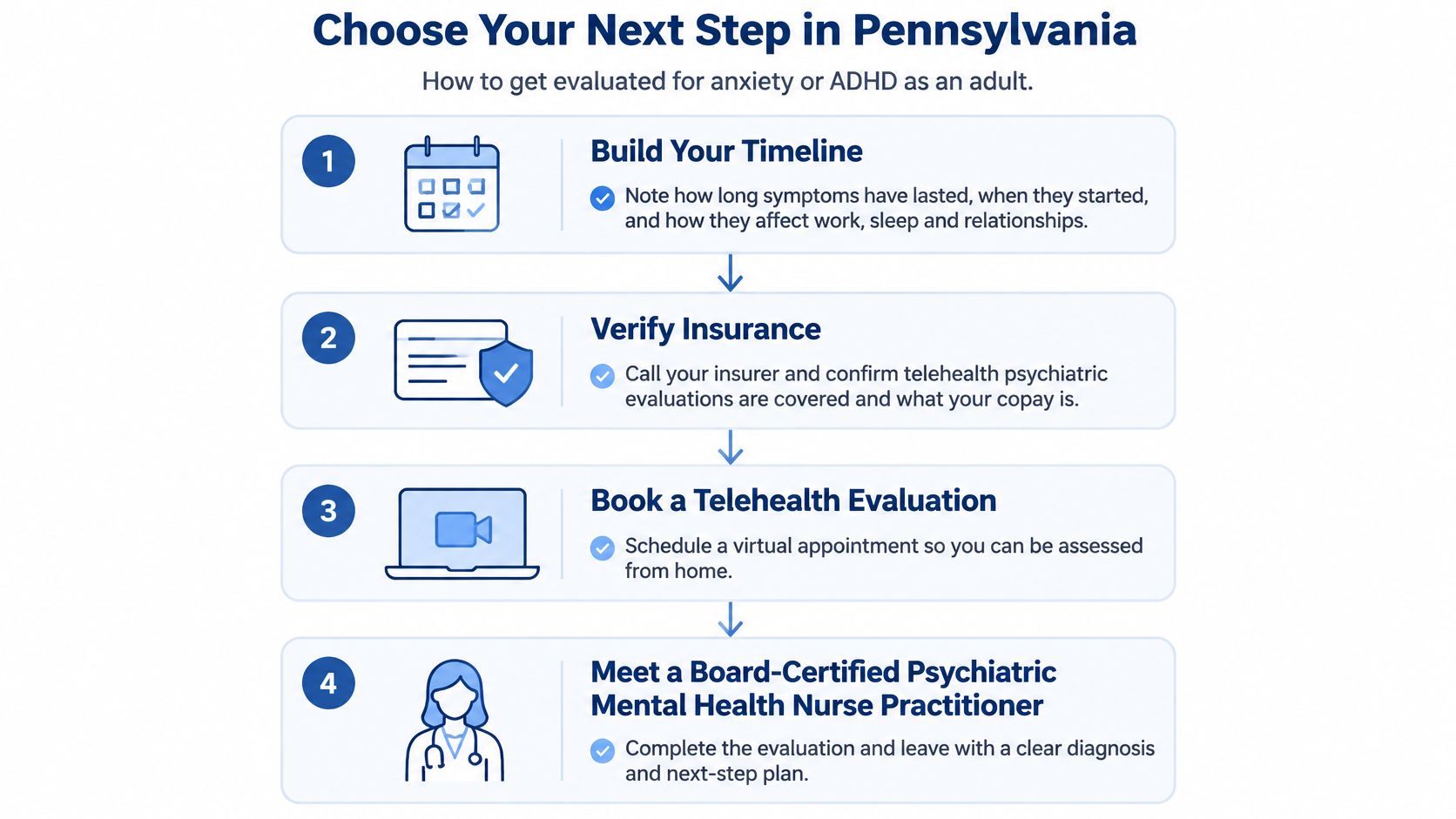
- Build your timeline. A two-week log of focus, worry, sleep and missed commitments shows patterns that memory flattens.
- Bring the routing answers. Situation, first step and paperwork all feed the clinician's questions. None of it diagnoses anything.
- Verify insurance before booking. Benefits, copays, deductibles, network status and prior authorization vary by plan, including Cigna, Aetna, UnitedHealthcare and BCBS/IBX plans. Confirm with your insurer rather than assuming.
- Book a secure video visit. Appointments happen online from home, an office or anywhere else in Pennsylvania.
- Ask what was ruled out. Which conditions were considered, what treatment is proposed, and how progress gets measured.
Screening Is Not Diagnosis
A screener is a checklist. An evaluation is the full workup: history, rating scales, records review, and screening for sleep, mood and medical causes. A diagnosis is the clinician's conclusion after that work, and treatment is the plan that follows. Blending those four steps is the most common reason adults feel rushed or dismissed after an appointment.
Integrative Psychiatry of America provides ADHD evaluation, diagnosis and medication management for children ages 6 and older, adolescents and adults through secure telepsychiatry, delivered by board-certified psychiatric nurse practitioners. A follow-up appointment costs $275 without insurance, and pricing varies by visit type. More on how adult ADHD diagnosis works online is available before booking.
Request an appointment once your timeline is ready. If cost is the open question, verify insurance first.
Integrative Psychiatry of America offers virtual psychiatric evaluation and ongoing medication management to adults across Pennsylvania, including the anxiety and ADHD assessments described here. If the timeline in your head has been running for years, one appointment can put it in order and clarify what comes next. Visit Integrative Psychiatry of America to request an appointment or verify your insurance.