

Many newly licensed PMHNPs leave training ready to diagnose, assess risk, manage medications, and support complex patients. Then private practice starts, and friction appears. The clinical side feels familiar, but the business side often doesn't. Entity formation, credentialing, insurance platforms, EHR setup, e-prescribing, billing, scheduling, policies, intake, and patient acquisition all arrive at once.
A common pattern looks like this. A provider gets licensed, opens accounts on Headway or Alma, and assumes the hard part is done. Then the gaps show up quickly. The calendar isn't structured well, follow-up capacity wasn't protected, intake forms are incomplete, documentation templates don't match visit types, and billing questions start piling up. Joining a platform is helpful, but it isn't the same as building an operating practice.
That's where PMHNP private practice mentorship becomes practical rather than theoretical. PMHNP Practice Builders is built around the reality that most PMHNPs don't need another generic checklist. They need help deciding what to do first, what to configure correctly, what to review, and what to change when early results are uneven. Even small operational improvements can matter, especially for solo owners trying to protect clinical quality while building a sustainable business.
For practices thinking about responsiveness and first impressions, even adjacent tools can be worth reviewing. Some owners also explore resources on AI for local service businesses to think more clearly about missed calls, lead response, and front-end communication workflows.
Table of Contents
- Why PMHNPs Often Need Business Mentorship
- How Headway Can Fit Into a PMHNP Practice
- Turning Platform Participation Into an Organized Practice
- Zocdoc and Other Patient Acquisition Channels
- EHR and ePrescribing Setup
- Conclusion and Next Steps
Why PMHNPs Often Need Business Mentorship
Most PMHNPs were trained to treat patients, not to assemble a compliant, functional business from scratch. That gap matters because private practice problems usually don't start with clinical judgment. They start with operational uncertainty. Should the entity be an LLC, PLLC, or another professional structure? Is a Type 2 NPI needed? How should CAQH be configured? Which EHR fits the intended model? How should appointment lengths, forms, and follow-up policies be built?
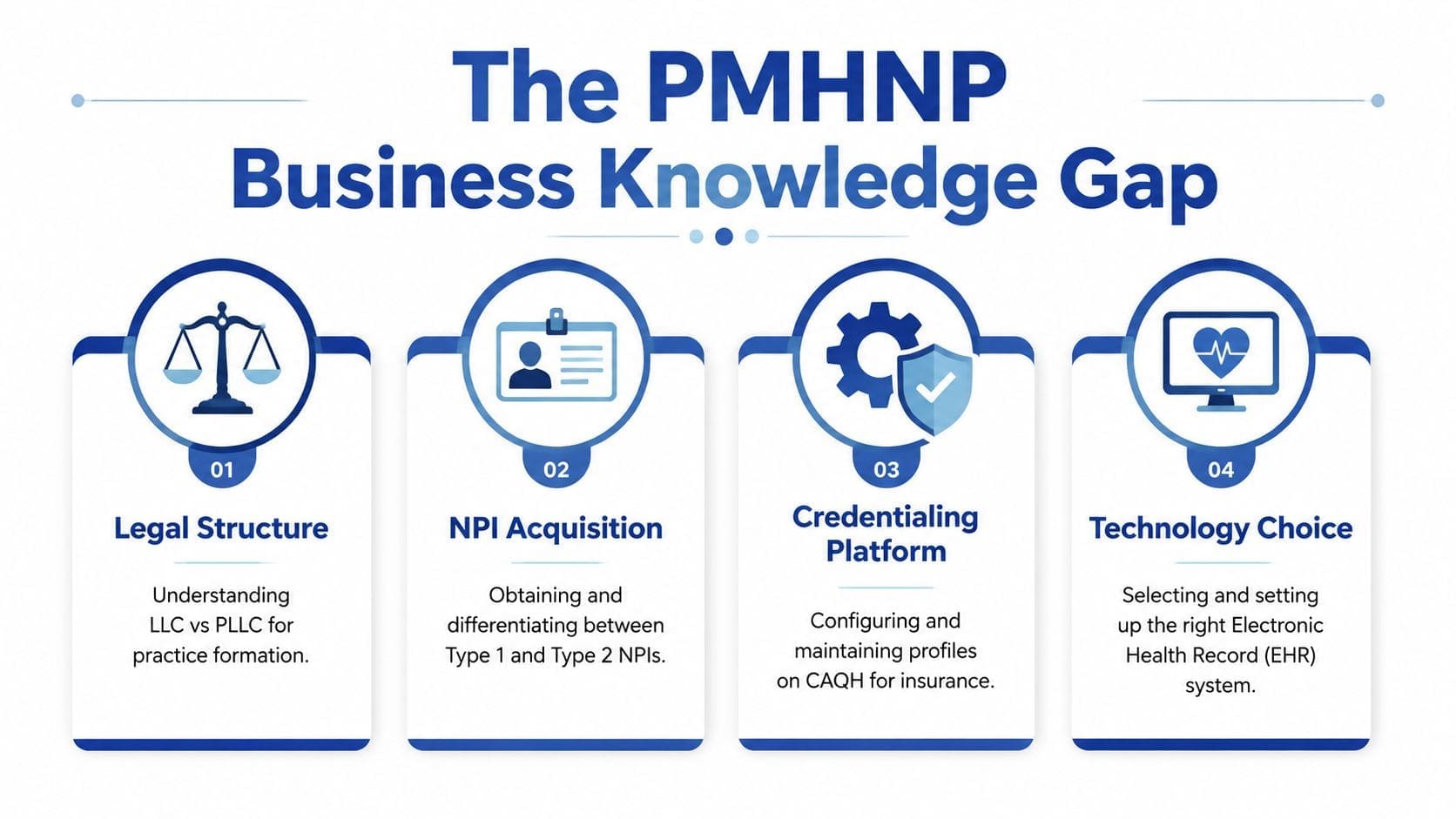
The need for business mentorship is growing, not shrinking. The PMHNP workforce is the fastest-growing specialty within the nurse practitioner field, with the U.S. Bureau of Labor Statistics projecting 46% employment growth from 2023 to 2033, adding over 135,000 new jobs and 118,600 new PMHNP positions according to this PMHNP job outlook summary. More clinicians entering the field means more clinicians asking the same startup questions at the same time.
The questions that usually stall progress
A new owner often needs answers in several categories at once:
- Entity and compliance choices that should be confirmed with an attorney, accountant, or other qualified professional based on state rules.
- Payer and platform setup including CAQH, credentialing readiness, and insurance participation strategy.
- Clinical operations such as evaluation length, follow-up cadence, refill rules, no-show handling, and intake workflow.
- Business visibility including which directories matter and how to judge whether a channel is useful.
Practical rule: Legal, tax, accounting, and state-specific regulatory decisions should always be verified with the appropriate licensed professionals before implementation.
Why outside guidance can shorten the learning curve
A mentor doesn't replace professional advisors. A mentor helps the PMHNP ask better questions, avoid preventable sequencing errors, and recognize which missing step is blocking progress. That's especially important in areas with significant need, including the mental health provider shortage in Pennsylvania, where demand may be strong but systems still need to be built correctly.
Some owners also benefit from tools that help them gain financial clarity in healthcare so they can review collections, expenses, and workflow bottlenecks more consistently.
How Headway Can Fit Into a PMHNP Practice
Headway may help eligible providers with insurance credentialing, billing, claims, eligibility workflows, payments, provider profiles, and patient matching. That can remove friction. It can also create a false sense of completion if the provider assumes platform participation alone will build a stable practice.

A Headway account is part of a system, not the whole system. The provider still needs organized scheduling, documentation readiness, intake procedures, response habits, and a realistic plan for follow-up care. That's where PMHNP practice consulting becomes useful. PMHNP Practice Builders does not merely tell members which platforms exist. It helps PMHNPs understand how the pieces of a private practice fit together, implement appropriate systems, evaluate what is working, and determine what to adjust next.
What mentorship changes inside a Headway workflow
The same platform can produce very different results depending on how the practice is configured. Mentorship may help a provider think through:
- Profile completeness so the listing communicates actual specialty focus rather than vague availability.
- Patient-population positioning so visit reasons, diagnoses treated, and scope are described clearly.
- Calendar structure so new-patient openings don't consume the slots needed for follow-up retention.
- Inquiry management so prospective patients aren't left waiting while the practice loses momentum.
- Reimbursement tracking so payer differences are recognized instead of ignored.
A profile can be accurate and still underperform if appointment availability, intake readiness, and follow-up planning don't match each other.
Platform participation still needs clinical and operational context
For telehealth-focused practices, the surrounding patient experience matters too. Many Pennsylvania patients already expect a clear virtual process. A typical telepsychiatry sequence includes scheduling and forms, a secure video evaluation, plan development, and ongoing follow-up, as described by this overview of telepsychiatry care. A provider who enters Headway without those workflows in place may look available but still feel disorganized to patients.
Integrative Psychiatry of America has hands-on operational experience and is experienced in implementing and optimizing Headway workflows within a psychiatric practice. That matters because the work isn't just getting on a platform. It's making the platform fit the practice model.
Turning Platform Participation Into an Organized Practice
Credentialing can open the door, but it doesn't run the clinic. Many PMHNPs discover that the primary business problem isn't getting listed. It's what happens after the listing goes live. If availability is inconsistent, follow-up slots are overbooked, documentation lags, or payments aren't reconciled carefully, revenue potential leaks out through preventable operational problems.
Private practice PMHNPs generate $200,000 to over $400,000 in gross annual revenue, with telehealth-only models achieving net margins of 75% to 85% and experienced owners earning $250,000 to $380,000+ in net income, according to this private practice PMHNP income analysis. Those figures show what may be possible in the right model. They do not mean every practice will perform that way. Results depend on the provider, market, payer participation, schedule design, implementation, and execution.
The difference between being listed and being organized
An organized practice pays attention to operational details such as:
| Area | What to watch |
|---|---|
| Availability | Are initial evaluations offered often enough, but not at the expense of follow-ups? |
| Intake | Are forms, consent documents, and medication history collected before the visit? |
| Cancellations | Is the practice tracking no-shows and last-minute gaps rather than just hoping the week fills? |
| Documentation | Are notes compliant and matched to the services actually delivered? |
| Reconciliation | Are payments reviewed against completed appointments and expected reimbursement? |
| Capacity | Is the clinician building a panel that can be followed safely over time? |
Reactive practices usually stay stressed
The reactive version of private practice looks busy from the outside. The inbox is full, the schedule changes daily, and the provider spends too much time patching holes. That approach may create activity, but it often produces poor schedule utilization and uneven cash flow.
Operational reality: Completed appointments matter more than scheduled appointments.
A systems-based approach is better. Mentorship can help a PMHNP build rules around appointment types, refill timing, documentation expectations, and follow-up intervals. It can also help the owner review what's already in place and identify what's missing. For practices centered on online medication management, that kind of consistency is what turns access into sustainable care.
Zocdoc and Other Patient Acquisition Channels
Zocdoc is a patient-directed healthcare marketplace. It may help a provider present availability and receive online appointment bookings, but it shouldn't be treated as an automatic solution. The same is true for Alma, Psychology Today, Doximity, insurance directories, referral relationships, a compliant website, and Google Business Profile when a practice is eligible. Every channel should be measured, not assumed.
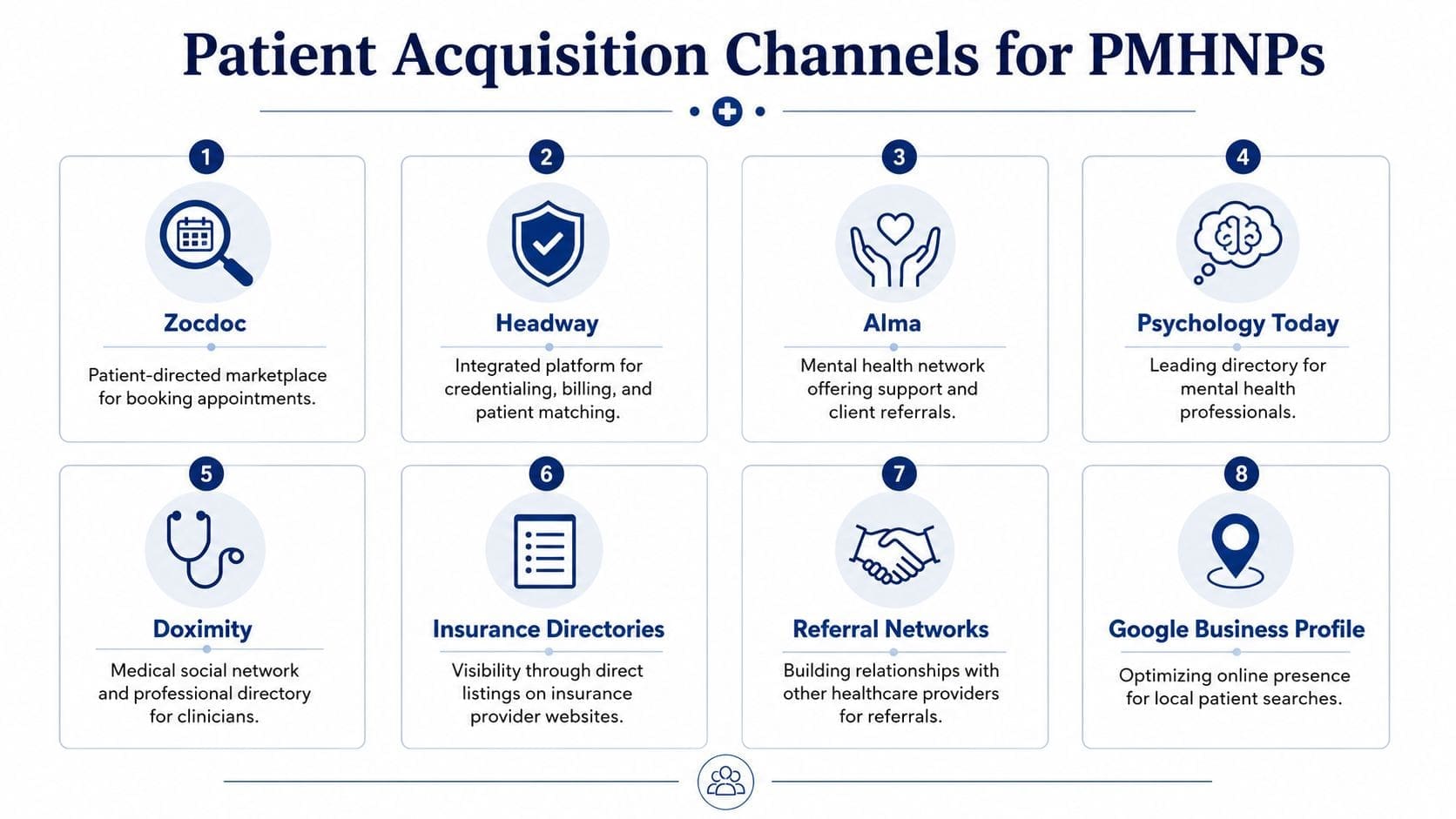
A common mistake in PMHNP patient acquisition is opening profiles everywhere without deciding how to evaluate them. That creates scattered visibility but weak decision-making. A better approach is to look at each channel as a measurable input with a defined purpose.
How to compare acquisition channels
A practical comparison often includes these criteria:
- Profile presentation including headshot, biography, clinical focus, and visit reasons.
- Insurance accuracy so booked patients are more likely to be appropriate for the practice.
- Scheduling fit so the channel doesn't send demand the calendar can't absorb.
- Booking quality including cancellation patterns, no-shows, and completed intake rates.
- Retention value so the provider knows whether new patients stay engaged after the first visit.
Practices that secure licensure in multiple states and optimize free listings on Google Business Profile and Psychology Today can gain 2 to 5 new patients monthly through those channels, and targeted outreach to primary care providers can improve referral conversion rates, according to this PMHNP growth guide.
What works better than random directory signups
The better strategy is usually selective, not maximal. Some practices do well with insurance-driven marketplaces. Others do better with direct referral relationships, especially when they offer clear communication and timely access. Some owners also review broader startup marketing strategies to think more systematically about positioning, messaging, and channel selection.
A strong content and visibility foundation matters too. Reviewing examples on the Integrative Psychiatry blog can help a PMHNP understand how educational content supports credibility, search visibility, and referral confidence without relying on one directory alone.
EHR and ePrescribing Setup
EHR selection isn't just a software purchase. It's the operating framework for the practice. A poor setup creates friction everywhere else, from intake to billing to refills. A good setup supports consistent care, cleaner documentation, and fewer avoidable administrative problems.
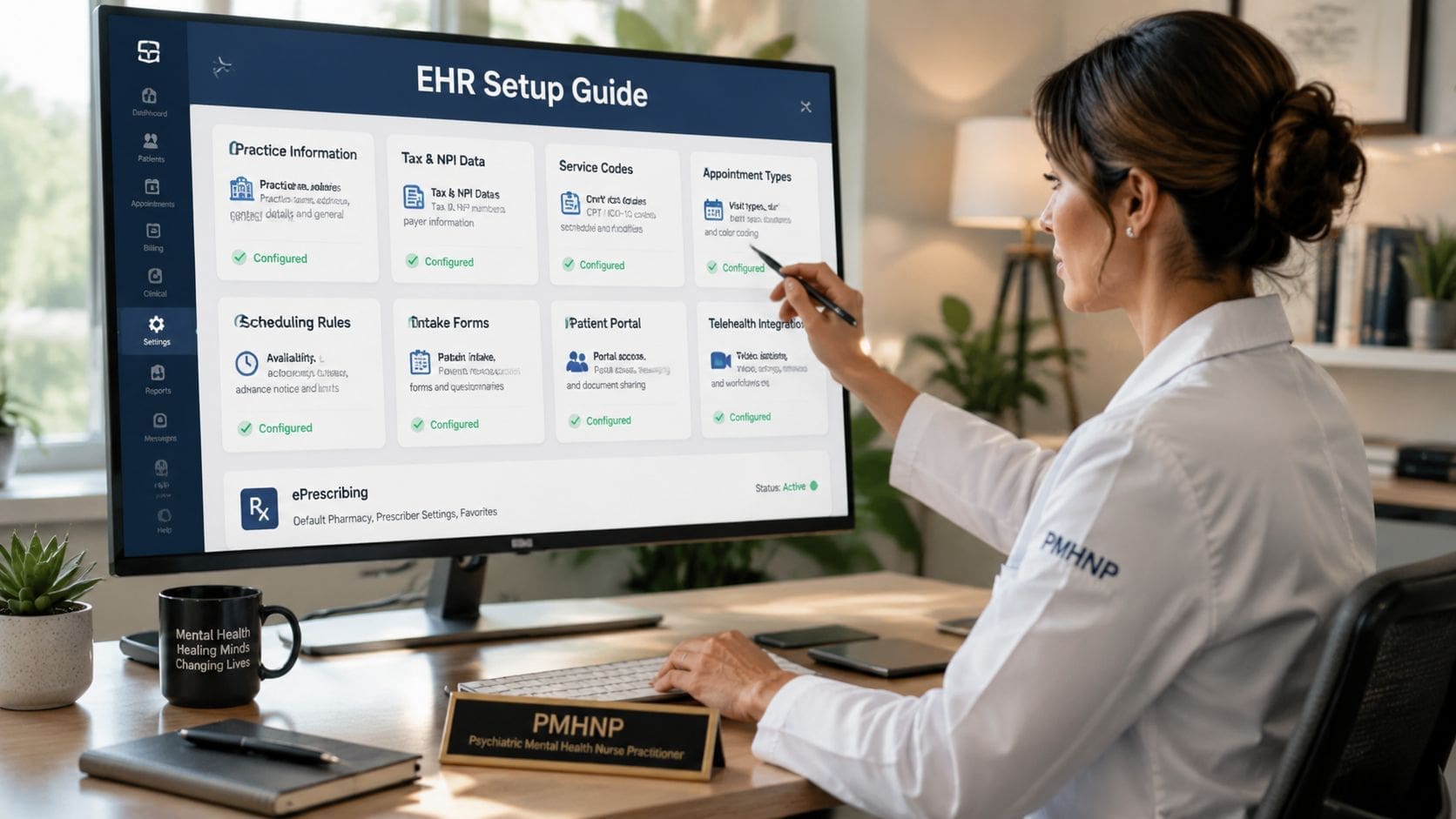
In PMHNP EHR setup, the problem usually isn't forgetting to buy a platform. The problem is incomplete configuration. Tax data, NPI data, locations, appointment types, service codes, forms, patient portal settings, telehealth links, and payment collection all need to work together. If one part is off, the practice feels disjointed to both staff and patients.
Core setup areas that need deliberate attention
A PMHNP building a private practice should review:
- Practice identity including legal business information, tax details, and NPIs
- Scheduling rules such as evaluation length, follow-up types, buffer time, and cancellation policies
- Clinical forms including consent, intake questionnaires, medication history, and standard policies
- Telehealth workflow so links, reminders, rooming steps, and patient instructions are consistent
- Prescribing functions including e-prescribing and EPCS activation where applicable
- Billing readiness with service codes, payer entries, and payment collection logic
The easiest EHR to buy isn't always the easiest EHR to operate well.
Practices offering both psychotherapy 90834 and medication management 99213 generate up to 30 to 40% more revenue per patient than med-management-only models, while also supporting retention and per-visit income, according to this video discussion of PMHNP service diversification. That makes setup decisions more important, because the EHR has to support the actual services being delivered.
ePrescribing problems are often workflow problems
ePrescribing and EPCS issues can delay care fast. The software might technically work while the practice still struggles with pharmacy routing, refill requests, identity verification, or internal policy confusion. That's why PMHNP billing guidance and EHR guidance often belong in the same conversation. Documentation, coding, telehealth, and prescribing all touch each other.
For practices delivering virtual care, HIPAA compliance in telehealth should also be part of the setup review, not an afterthought.
A short walkthrough can help clarify what a cleaner setup looks like:
Conclusion and Next Steps
PMHNP Practice Builders increases revenue potential in the way sound business systems usually do. Not through guarantees, shortcuts, or vague motivation, but through better sequencing, cleaner implementation, and more informed decisions. A PMHNP who understands entity formation questions, platform participation, EHR configuration, scheduling structure, intake workflow, billing habits, and patient-acquisition measurement is in a better position to build a stable practice.
That matters for newly graduated PMHNPs, recently licensed clinicians, employed PMHNPs considering private practice, and solo owners with inconsistent schedules. Many don't need more scattered information. They need PMHNP private practice mentorship that helps them review what's been done, identify what's missing, implement the next step correctly, and evaluate results without unnecessary trial and error.
The trade-offs are real. Some channels produce visibility but poor-fit bookings. Some schedules look full but undermine follow-up care. Some EHRs seem simple until prescribing, billing, and documentation collide. Mentorship helps make those trade-offs visible earlier, when they're easier to fix.
For PMHNPs building in Pennsylvania, including Philadelphia, Pittsburgh, Harrisburg, Erie, Scranton, Allentown, Lancaster, Reading, and statewide telehealth models, organized systems can support better schedule utilization, clearer workflows, and stronger long-term sustainability. Results still depend on the individual provider, market conditions, payer mix, availability, and implementation.
PMHNPs who want structured guidance can learn more through Integrative Psychiatry of America. The practice offers statewide virtual psychiatric evaluations, medication management, and evidence-informed mental health treatment in Pennsylvania, along with PMHNP Practice Builders for clinicians seeking practical mentorship on launching, organizing, and growing a private practice.