
A lot of Pennsylvania adults start this search in a familiar place, after one antidepressant made them feel flat, another caused side effects, and a third never seemed to help at all. By the time someone types genetic testing for psychiatric medications near me, the question usually isn't about DNA alone, it's whether there's a smarter way to choose medication without endless trial and error.
That search makes sense. Pharmacogenomic testing can be a useful decision-support tool, but it isn't a shortcut around a full psychiatric evaluation, and it isn't a brain scan. It works best when a clinician uses it alongside symptom history, prior medication response, sleep, substance use, lab work, and follow-up medication management, which is why many patients in Philadelphia, Pittsburgh, Harrisburg, Allentown, Erie, Scranton, Reading, Lancaster, Bethlehem, and York end up looking for a provider who can both order the test and act on the result. A useful lens for that shift is understanding digital transformation for healthcare, because telehealth has changed how patients connect with specialty care across the state.
For Pennsylvanians who are dealing with long waits or a shortage of local prescribers, a statewide virtual practice can be a practical answer. Mental health provider shortage in Pennsylvania is part of why many adults now look for telepsychiatry instead of a nearby office, especially when the need is careful medication selection rather than a one-time lab purchase.
Table of Contents
- Why Pennsylvania Adults Are Searching for Genetic Testing for Psychiatric Medications
- What Pharmacogenomic Testing Examines
- How the Testing Process Works From Order to Results
- GeneSight, Other Panels, and the Psychiatric PGx Market
- Finding Pharmacogenomic Testing Near You in Pennsylvania
- Cost, Insurance, and Coverage Realities
- When PGx Helps and When the Evidence Is Thin
Why Pennsylvania Adults Are Searching for Genetic Testing for Psychiatric Medications
A patient in Philadelphia or Pittsburgh often lands here after the same pattern repeats. A first SSRI helps a little, the next one brings nausea or sleep problems, and the third feels no better than a coin toss. The appeal of psychiatric medication genetic testing is obvious in that moment, because a DNA-based answer sounds more precise than another round of guesswork.
That impulse is reasonable, but the test works as a targeted tool, not a broad diagnostic shortcut. The evidence base is strongest for a small group of medication-metabolism genes, especially CYP2D6 and CYP2C19, and a 2021 consensus review found that current published evidence and prescribing guidelines support using PGx testing around those genes for several commonly used antidepressants and antipsychotics, with some gene-based guidance for mood stabilizers such as carbamazepine, oxcarbazepine, and phenytoin (NIH review and consensus summary). That is very different from saying every psychiatric drug can be chosen by genetics alone.
Practical rule: if a lab report looks like a shortcut around clinical judgment, it's being oversold. The better use is as one input inside medication management.
Why the geography matters
Patients searching from Allentown, Erie, Scranton, Reading, Lancaster, Harrisburg, Bethlehem, and York usually aren't asking for a lab kit in isolation. They want a clinician who can review prior failures, interpret a report, and decide whether testing even fits the case. That's where virtual psychiatry becomes useful, because it lets a Pennsylvania-based prescriber work statewide instead of limiting care to one zip code.
A fully virtual practice like Integrative Psychiatry of America fits that model by combining medication management with a broader psychiatric evaluation. The point is not to sell a test, it's to decide whether the test belongs in the treatment plan at all.
What patients actually want answered
Individuals often seek answers to three key questions. Can this guide choices for depression medications, anxiety medications, or ADHD medications? Might it help minimize side effects? Is it a worthwhile step after multiple medication trials?
That's the right frame. Genetic testing before antidepressants can be reasonable in select situations, but the clearest use case is often genetic testing after antidepressants failed or after repeated adverse effects. Patients searching pharmacogenetic testing near me are usually not asking for theory, they're asking whether someone can help choose a medication that's more likely to fit their body the first time.
What Pharmacogenomic Testing Examines
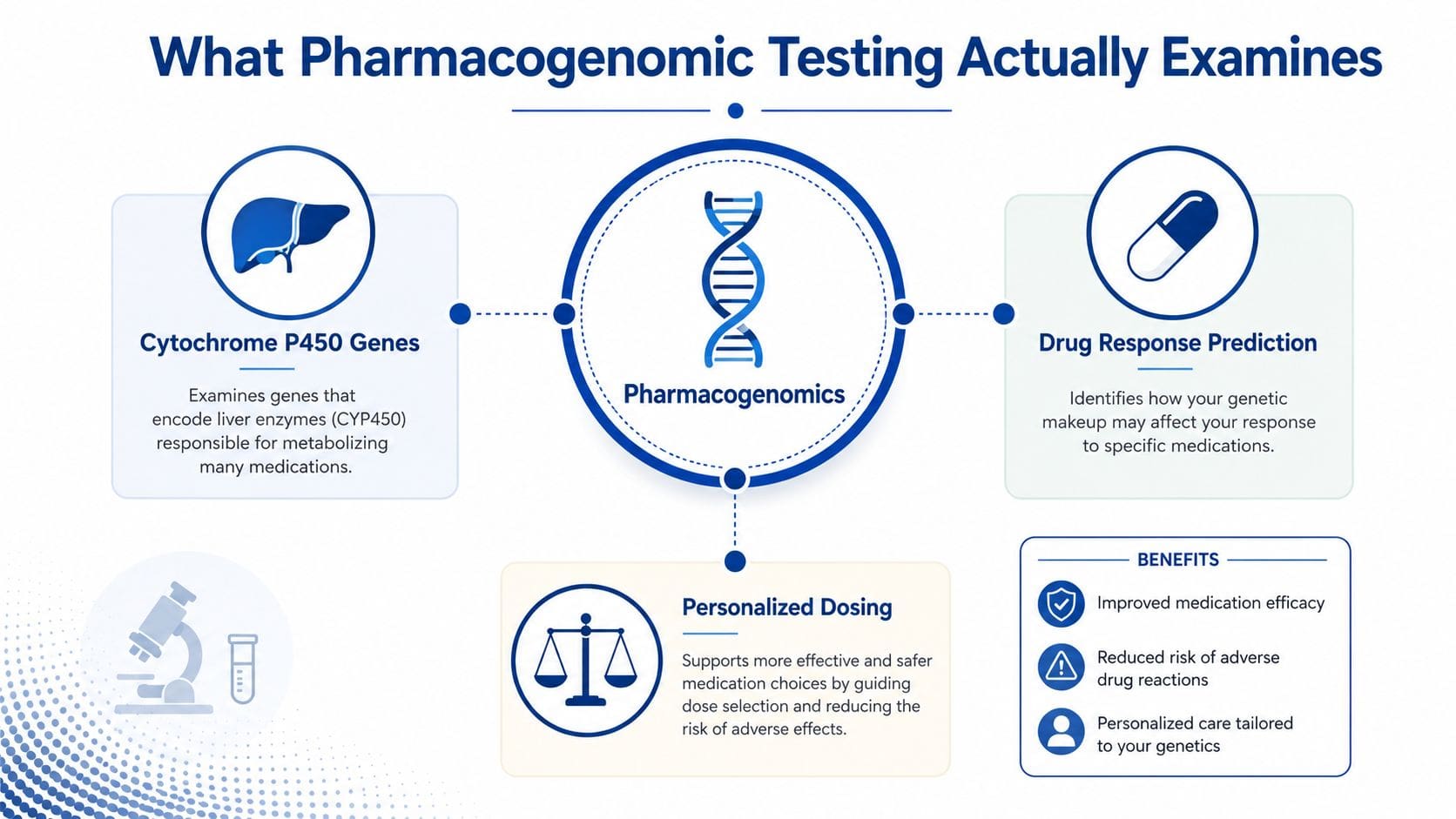
Pharmacogenomics means studying how genes affect drug response. Pharmacogenetics is the narrower version, focused on individual gene-drug relationships. In mental health, the most clinically useful testing usually centers on enzymes in the cytochrome P450 family, especially CYP2D6 and CYP2C19, with additional roles for CYP3A4, CYP1A2, CYP2B6, CYP2C9, and CYP2A6 in some panels.
Those genes help determine how quickly someone metabolizes a medication. A poor metabolizer may process a drug slowly and run into higher exposure or side effects. An ultrarapid metabolizer may break it down too quickly, which can leave the medication ineffective at standard doses. Intermediate metabolizers and normal metabolizers fall in between, and those labels help clinicians think about dose and drug choice rather than making a diagnosis.
What the report is saying
A psychiatric PGx report does not read like a disease test. It usually classifies medications by metabolism or by a traffic-light style system, then gives the prescriber a way to compare likely fit. The important point is that the test covers a defined subset of actionable genes, not the entire genome, and the strongest label-level guidance is concentrated on a narrow group of antidepressants, antipsychotics, and some mood stabilizers (NIH review).
A result like “CYP2D6 poor metabolizer” is not a verdict. It is a dosing clue.
| Common Metabolizer Categories Patients Will See on a PGx Report | Plain-English Meaning | Typical Clinical Direction |
|---|---|---|
| Poor metabolizer | Processes some drugs slowly | Start lower, monitor closely, or consider another medication |
| Intermediate metabolizer | Processes drugs somewhat slowly | Use caution with dose and side effects |
| Normal metabolizer | Typical processing for the gene tested | Standard dosing is often reasonable, if the drug fits clinically |
| Ultrarapid metabolizer | Processes some drugs quickly | Standard doses may be too low, or another drug may fit better |
The report still needs clinical context. A person can be a normal metabolizer and still have poor response because of diagnosis, drug interactions, adherence problems, sleep loss, or another condition. Genetic testing helps with medication metabolism, not with every reason a medication may fail.
For readers who want to understand the serotonin side of this discussion, what is 5-HT is a helpful companion concept, because serotonin pathways often show up in medication selection even when the gene report itself is focused on metabolism.
How the Testing Process Works From Order to Results
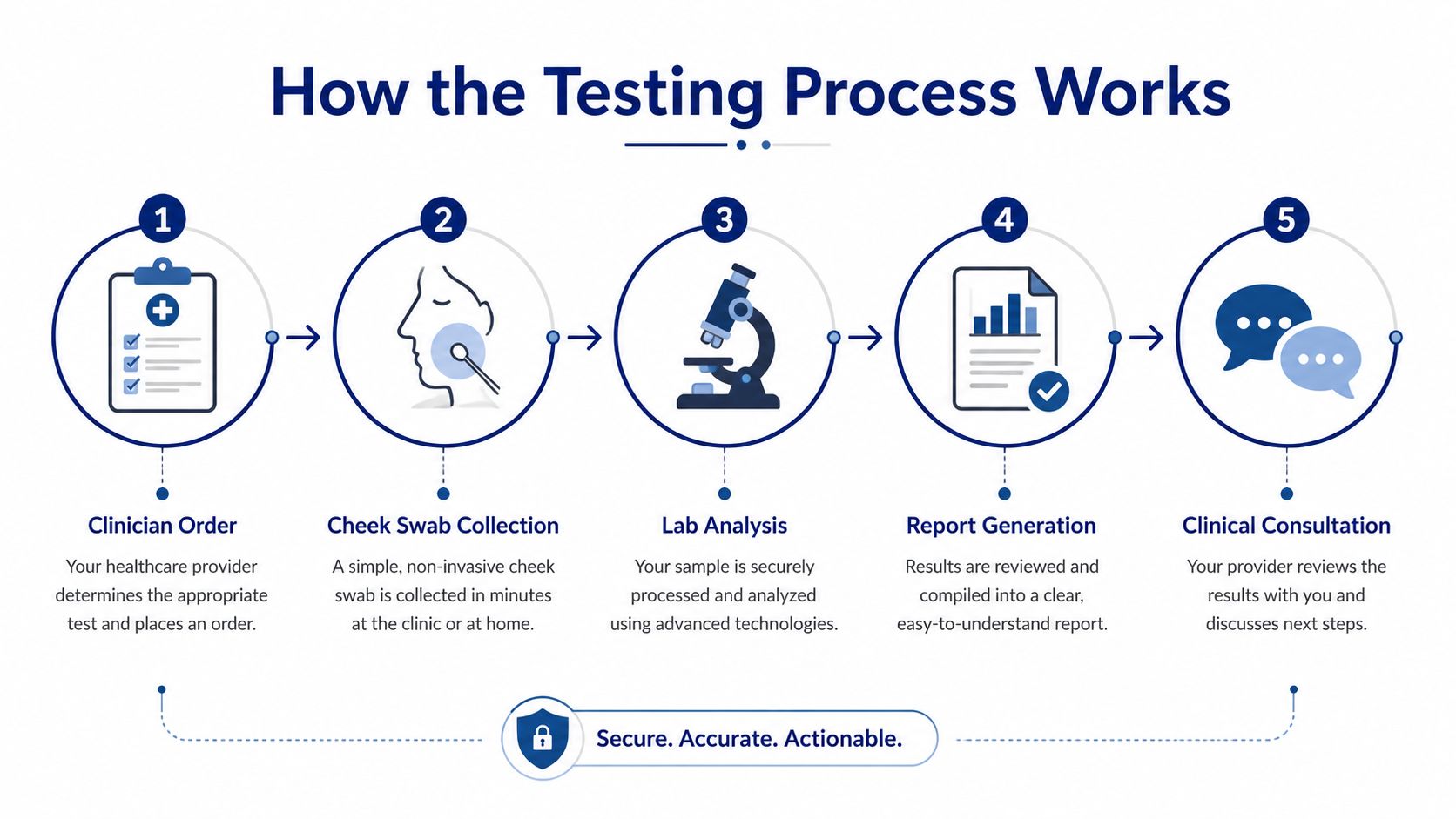
The workflow is straightforward. A registered prescribing clinician orders the test, the patient provides a single buccal swab, saliva sample, or blood draw, and the lab extracts DNA, purifies it, and runs genotyping before returning a report to the clinician for medication review (clinical workflow overview).
That last step matters. The report is not meant to act as a standalone diagnosis tool or a direct-to-patient prescription engine. It lands inside a medication management visit, where the prescriber weighs the genetic data against symptoms, treatment history, side effects, and other medications.
What the patient experiences
Collection can happen in-office or at home, depending on the practice and lab. Some systems use a cheek swab because it's fast and noninvasive. Others accept saliva or blood, which can matter if sample quality is a concern.
One psychiatric panel described in the brief evaluated 12 genes and 65 variants and accepted a dynamic input DNA range of 2.5 to 20 ng/µl, which shows that assay design and sample quality can affect reliability (psychiatry testing implementation summary). In practice, that means a clean sample and a well-run lab both matter.
What the clinician gets back
The clinician usually receives the report, not the patient alone, because the result needs interpretation. Some reports are color-coded, often using green, yellow, and red style tiers to show where a medication may fit well, require caution, or deserve avoidance.
Typical turnaround is usually described by the provider or lab, not the patient. GeneSight Psychotropic says it typically returns results to the provider in about 3 days after the sample is received and can be collected with a cheek swab in office or at home (GeneSight).
Depression genetic test information becomes useful here because the report only matters if it changes the next prescribing decision. Without that step, it's just a file.
GeneSight, Other Panels, and the Psychiatric PGx Market
A patient may come in asking for GeneSight testing Pennsylvania because they want a clear answer about which antidepressant or antipsychotic is likely to fit better. GeneSight Psychotropic is one of the best-known names in this market. The company says a registered prescribing clinician must order it, collection can happen with a cheek swab in office or at home, and results return to the provider after the sample is received. For many people searching GeneSight near me, that clinician-only model is the detail that separates a medical test from an over-the-counter product (GeneSight).
The larger point is that GeneSight is one panel in a crowded field. A peer-reviewed review of Canadian psychiatry PGx tests found 13 pharmacogenetic tests relevant to psychiatry that were available in Canada as of May 30, 2019, which shows that psychiatric PGx is a market with competing approaches rather than one universal standard (review of Canadian psychiatry PGx tests).
Why that matters for patients
Different panels do not always measure the same genes, and that changes how useful the report is in practice. Some panels put most of their weight on CYP2D6 and CYP2C19, which are the two genes I pay closest attention to for a lot of psychiatric prescribing. Others expand into broader gene sets or use different interpretation frameworks, so two psychiatric medication DNA test reports can look similar while pointing the clinician in different directions.
A broader panel is not automatically a better panel. If a report includes markers that do not have clear prescribing guidance, the extra data can add confusion instead of clarity. For a Pennsylvania prescriber, the question is whether the genes included match the medications under consideration and whether the result will change a dose choice, a starting choice, or a decision to avoid a medication that has already caused problems.
Panel design also affects how much weight I give the result. A focused report that clearly interprets genes with stronger evidence can be more useful than a wide report that stretches into weaker associations. That is why the best test is the one a clinician can interpret in the context of prior side effects, previous failures, diagnosis, and the rest of the medication plan.
How a clinician should choose
The right panel depends on the clinical question. A person whose main issue is poor response to SSRIs may need a different emphasis than someone with antipsychotic tolerability concerns or problems with mood stabilizers. That is why a pharmacogenomics psychiatrist Pennsylvania search should end with a prescriber who knows what the report can change and what it cannot.
A practical choice also depends on how the practice uses the result. Some clinicians treat PGx as a single sorting tool before prescribing. Others use it as one piece of a broader medication review, alongside symptoms, side effects, history, and medical comorbidity. The second approach usually fits better in real-world psychiatry, because a genotype does not tell you whether the patient is under stress, sleep deprived, using interacting medicines, or dealing with a diagnosis that has shifted over time.
For patients, the bottom line is straightforward. Genetic testing for psychiatric medications is a category, not one product, and the best option depends on gene coverage, the medication question in front of you, and whether the clinician plans to use the report in treatment rather than file it away. In a Pennsylvania telepsychiatry setting, that often means choosing a practice that can order the panel, review it with the patient, and tie it to ongoing medication management, including an integrative practice such as Integrative Psychiatry of America near me. For clinics thinking about patient acquisition, even local lead gen strategies for conversions matter less than whether the practice can explain and act on the report once it comes back.
Finding Pharmacogenomic Testing Near You in Pennsylvania
Patients across Pennsylvania often need the same thing, a prescriber who can order the test, interpret it, and fold it into ongoing care. That's especially true when the closest in-person option is hours away or booked for months. A telehealth-first practice can solve that access problem without turning the test into an isolated transaction.
A good local search is less about distance and more about fit. Look for a Pennsylvania psychiatric provider who can do a full evaluation, review your medication history, and tell you whether the test would change prescribing. A practice that only sells a lab order without follow-up is missing the point.
Questions to ask before booking
- Can the clinician order the test and interpret it? If the answer is no, the appointment may not be enough for medication management.
- Does the practice serve patients statewide? That matters for adults in Philadelphia, Pittsburgh, Allentown, Erie, Scranton, Reading, Lancaster, Harrisburg, Bethlehem, and York.
- Will results be reviewed in a follow-up visit? PGx only helps if someone uses it.
- Does the workflow support telehealth collection or lab coordination? That reduces friction for patients who need convenience and privacy.
A fully virtual practice like Integrative Psychiatry of America near me fits this use case because the visit can begin with psychiatric evaluation, then move into medication management and genetic or lab screening when appropriate.
Practical rule: if a practice can't explain how the result changes prescribing, it probably isn't using PGx well.
For clinicians or referral sources interested in conversion strategy around this kind of service, local lead gen strategies for conversions is a useful outside resource on why clarity at the first touchpoint matters. In psychiatry, that same principle applies to patients deciding whether a provider can help.
Cost, Insurance, and Coverage Realities
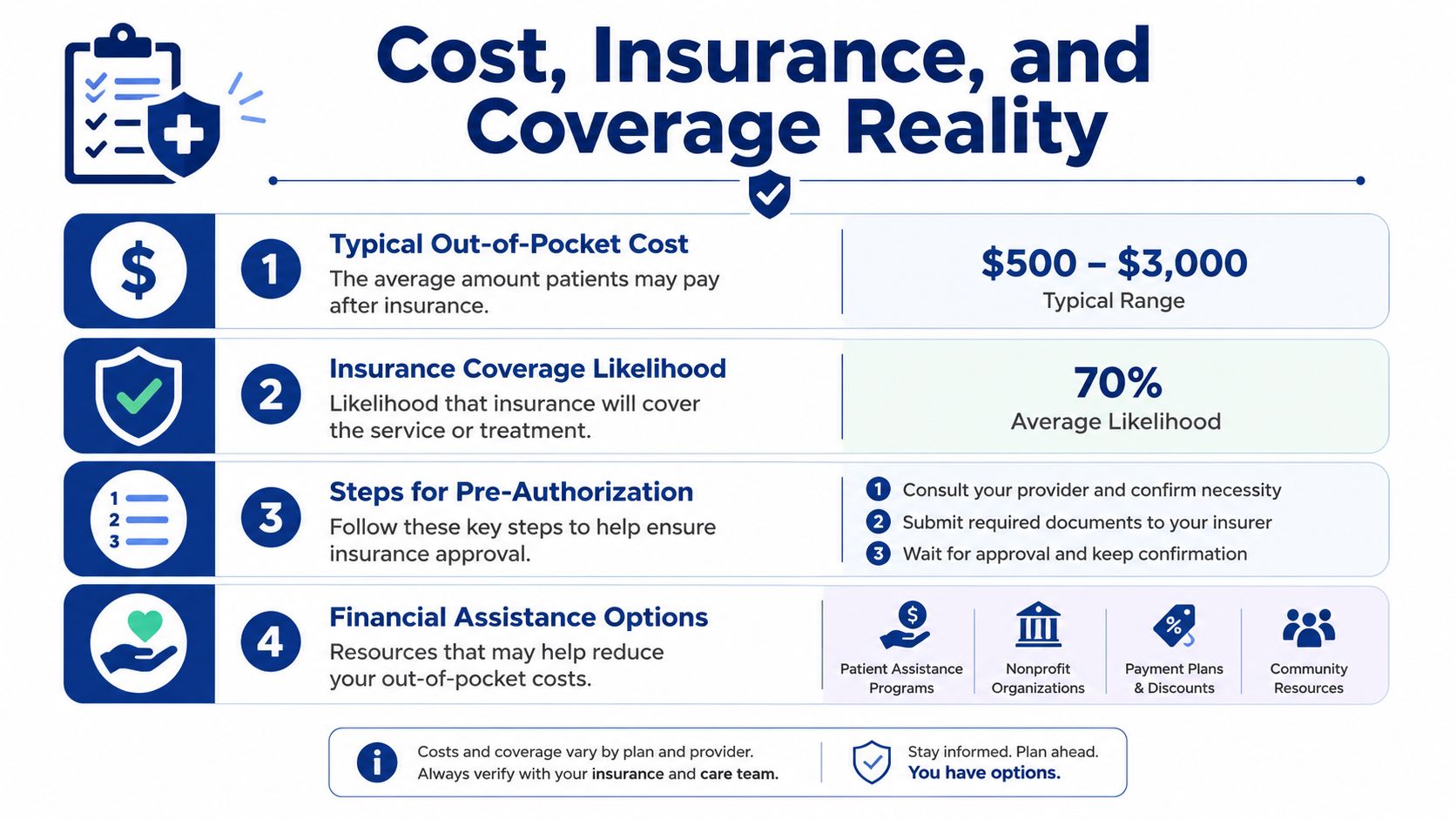
Cost is where many searches stall. Insurance coverage for psychiatric medication genetic testing covered by insurance varies by plan, medical necessity, and lab contracts, and many settings still leave patients with some out-of-pocket responsibility. A psychiatry review in Nature warns that out-of-pocket testing can become a barrier for an already underserved and stigmatized population, and it notes that limited understanding of genetics among patients and clinicians also slows adoption (Nature review).
The office call before booking matters. A patient should not assume a lab test is covered just because the clinician orders it. The practice and the insurer both need to be clear about what counts as medical necessity and what the patient may owe.
What to ask before the appointment
- Which test is being ordered? The panel matters because different labs bill differently.
- What does my insurer cover? Ask the plan directly about pharmacogenomic testing coverage.
- Is pre-authorization needed? If so, who submits it?
- What is the cash-pay cost? Ask the practice before the sample is collected.
- Is financial assistance available? Some labs or practices offer options that reduce the burden.
The practical issue is not only price, it is access. If a test is usable only by patients who can pay upfront, it can widen the gap between people who get personalized care and people who do not. That is why affordability needs to be part of the clinical conversation, not an afterthought.
For readers who want to understand how a practice handles transparency around fees, insurance and fees is the right place to start before making a decision.
When PGx Helps and When the Evidence Is Thin
The strongest case for PGx is not universal screening. It is more specific: patients who have already gone through several medication trials, had repeated side effects, or are stuck with limited options may gain the most from a pharmacogenomic review. A 2022 meta-analysis of five randomized controlled trials found that patients with major depressive disorder who received pharmacogenetic-guided prescribing were 71% more likely to achieve symptom remission than those treated as usual (meta-analysis and related evidence summary). That is a meaningful signal, especially in people who have already spent time cycling through medications without a clear answer.
The same evidence summary points to broader utilization effects. In schizophrenia, pharmacogenetic testing was associated with 28% lower overall medical costs, another claims-based study reported average savings of $562 over four months, equal to 9.5% outpatient cost savings, and real-world data from the University of Texas system found psychiatric hospitalizations fell by nearly 39% while emergency department visits for psychiatric concerns dropped by over 34% after PGx testing (same evidence summary). Those findings do not mean every patient will save money or avoid hospitalization, but they do show that PGx can affect care patterns, not just produce a lab report.
Where it fits best
In my practice, PGx tends to matter most after multiple medication failures or repeated side effects. That matches expert guidance in psychiatry, which does not frame testing as routine screening for everyone starting treatment. The reason is simple. The test only covers a limited set of actionable genes, and for some poor metabolizers, starting doses may need to be reduced by 25% to 50% in certain antidepressants (psychiatry testing guidance).
That kind of information is most helpful when the clinical story already points to a metabolism issue.
Where the evidence is still mixed
The picture is less settled for some antipsychotic uses. A 2024 systematic review found mixed results, with some studies showing no difference from usual care and others favoring pharmacogenetics, especially when multigene panels were used. The authors still called for larger, more consistent trials before routine adoption (systematic review summary).
NAMI also notes that pharmacogenomics is not yet part of clinical practice guidelines in mental health, which is one reason I treat it as one tool inside a broader psychiatric evaluation rather than a stand-alone answer (NAMI).
For patients in Pennsylvania, the useful question is usually whether a real medication review can make sense of the pattern. A clinician who understands when DNA testing for antidepressants or DNA testing for anxiety medications is likely to help can place the result into the larger plan, including prior response history, diagnosis, drug interactions, sleep, and side effect burden. Integrative Psychiatry of America offers virtual psychiatric evaluations and medication management across Pennsylvania, and it uses genetic and lab screening as part of broader care that can also include psychotherapy-informed treatment, sleep, nutrition, and movement counseling when clinically appropriate.
Before scheduling, a patient should verify coverage, prepare a full medication history, and decide whether the current problem is a first-step treatment question or a repeat-failure question. Free tools like the Daily Agenda Planner can help organize symptoms before the visit.