
You may be staring at an overdue project, a trail of half-finished tasks, and a calendar full of reminders that did not fix the problem. A lot of adults in Philadelphia and across Pennsylvania reach the same point. They are not asking abstract questions about attention. They are asking a practical one: how much does ADHD testing cost, and what am I paying for?
That question matters because the price range is wide, the terminology is confusing, and not every “test” leads to a diagnosis you can use for treatment, school, work accommodations, or long-term care planning. Some people find a quick online screener and assume that is enough. Others delay care because they fear a surprise bill.
As psychiatric nurse practitioners, we see that hesitation often. The goal is not to push people into the most expensive option. The goal is to match the evaluation to the reason you need it, the complexity of your symptoms, and your budget. If you have ever wondered whether your focus problems are ADHD, anxiety, burnout, depression, or some combination of them, that uncertainty is exactly why cost can vary so much.
If you are still deciding whether specialist mental health care makes sense, this guide on when to see a mental health professional for psychiatric concerns can help you frame the decision.
The First Step Uncovering the Cost of Clarity
Many adults first look into ADHD testing after years of compensating. They stay up late to finish work they meant to start earlier. They miss deadlines despite caring a great deal. They interrupt in conversations, lose paperwork, forget appointments, and tell themselves they just need better discipline.
Then they start searching.
What they find is frustrating. One website says a few hundred dollars. Another says several thousand. A telehealth ad promises fast answers. A psychology practice describes a detailed battery with formal reporting. It can feel impossible to compare those options.
What many individuals are seeking
They are not just buying a label. They are trying to buy clarity.
That clarity may answer questions like:
- Is this ADHD at all
- Is anxiety driving the concentration problem
- Do I need formal documentation
- Will this evaluation support treatment planning
- Will insurance help with any part of the process
That is why there is no single universal price.
Clinical reality: The least expensive option is not always the most affordable one if it leaves major questions unanswered and forces you to start over later.
Why the sticker shock feels so different from other medical costs
With many medical services, people expect a standard test and a standard price. ADHD evaluation does not work that way. The cost depends on how deep the assessment goes, who performs it, what documentation you need, and whether there are overlapping mental health concerns.
For one adult, a focused diagnostic evaluation may be enough to start treatment safely. For another, especially someone needing workplace or academic accommodations or someone with a complicated symptom picture, a broader evaluation may be more appropriate.
That distinction matters. It is also where a lot of online content becomes unhelpful. It treats all ADHD testing like one product, when in practice it includes very different levels of assessment.
Deconstructing Your ADHD Evaluation Bill
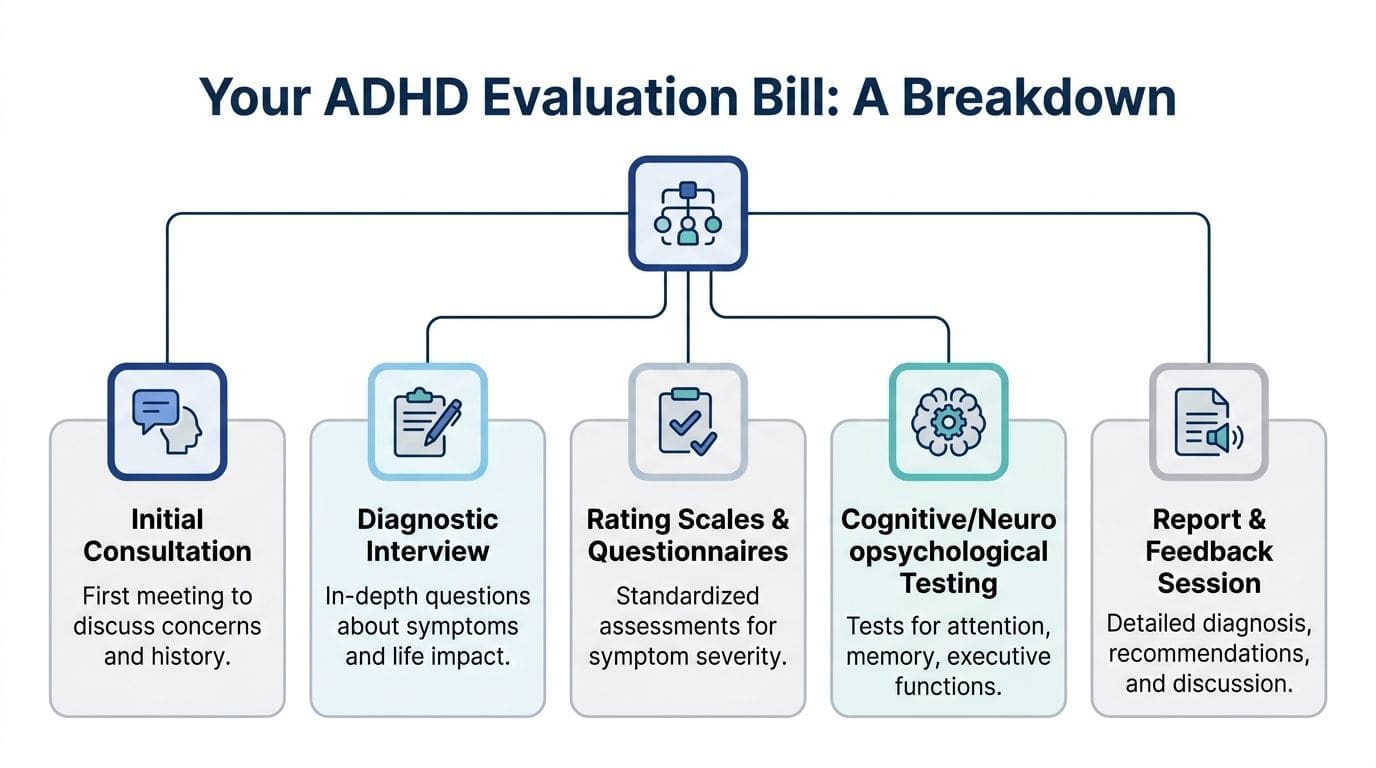
An ADHD evaluation bill usually reflects several separate clinical services, not one flat mystery charge. That distinction matters because two adults can both ask for “testing” and receive very different levels of assessment, documentation, and follow-up.
The basic pricing tiers
Earlier in this article, we noted that ADHD testing can range from a relatively low-cost screening to a multi-session formal evaluation with a much higher fee. The practical reason is simple. You may be paying for a brief diagnostic opinion, or you may be paying for hours of interviews, testing, scoring, interpretation, and written documentation.
At IPA, I encourage adults to ask one question before focusing on price alone: what problem is this evaluation meant to solve? Someone who needs treatment planning may need a focused psychiatric assessment. Someone who needs disability paperwork, academic accommodations, or a detailed cognitive profile may need a broader testing process.
What a fuller evaluation can include
A well-done ADHD evaluation often includes several parts, and each one adds clinician time.
Initial consultation
The first visit reviews your concerns, history, goals, and whether ADHD is the main question or one piece of a larger picture.Diagnostic interview
This is the core of the assessment. It covers childhood symptoms, school or work patterns, daily functioning, sleep, mood symptoms, anxiety, substance use, and medical factors that can affect attention.Rating scales and questionnaires
These forms help organize symptom patterns across settings. They support the diagnosis, but they are only one part of it.Cognitive or neuropsychological testing
This is often the most expensive piece. It can involve attention measures, memory tasks, executive function testing, and formal scoring by a psychologist or neuropsychologist.Report and feedback session
Some adults need only verbal recommendations and a treatment plan. Others need a written report that can be shared with employers, schools, or other clinicians.
If you want a clear view of service options and fees before booking, review IPA's current ADHD evaluation pricing and visit options.
Why the most extensive option costs so much
A formal neuropsychological evaluation costs more because it includes much more work behind the scenes. The face-to-face testing is only part of the service. There is also test selection, scoring, interpretation, record review, differential diagnosis, and report writing.
That level of detail can be appropriate when the picture is unclear. It can also help when ADHD may overlap with learning disorders, cognitive concerns, trauma, anxiety, or depression. In those cases, the higher upfront cost may prevent a more expensive mistake later, such as starting the wrong treatment or needing to repeat the evaluation elsewhere.
Where adults often misjudge the bill
The cheapest option on paper can become more expensive in practice.
I see this most often when someone books a quick screening, gets an uncertain answer, and then has to schedule a second evaluation because mood symptoms, sleep problems, or anxiety were never examined carefully. Adults with depression or chronic anxiety are especially vulnerable to this. Poor concentration may be part of ADHD, but it may also reflect panic, insomnia, burnout, trauma, or a combination of conditions.
That is why the bill should be judged by usefulness, not just the first number you see. A careful evaluation should leave you with diagnostic clarity, a treatment direction, and a realistic next step. If a clinic cannot explain exactly what is included, what documentation you will receive, and how they assess overlapping conditions, the price is not transparent.
Why ADHD Testing Prices Vary So Much
Two adults in Pennsylvania can both ask for ADHD testing and receive very different quotes. One is seeking treatment guidance for work struggles and chronic disorganization. The other needs formal documentation for workplace or academic accommodations. Those are different clinical jobs, and the price usually reflects that difference.
Three variables shape the bill more than anything else: the type of evaluation, the provider's training, and the practice model delivering the care.
| Factor | Lower-cost end | Higher-cost end |
|---|---|---|
| Evaluation type | Focused diagnostic assessment for treatment planning | Formal cognitive or neuropsychological testing with detailed documentation |
| Provider training | Psychiatric clinician assessing ADHD in a medical context | Psychologist or neuropsychologist administering a larger test battery |
| Practice model | Efficient telehealth process | Multi-visit in-person testing with higher overhead |
Provider credentials affect what you are paying for
A psychiatric nurse practitioner, psychologist, and neuropsychologist may all assess ADHD, but they are not billing for the same depth of testing or the same end product.
A focused psychiatric evaluation is designed to answer practical treatment questions. Is ADHD the most likely diagnosis? Are there safety concerns, such as anxiety, depression, sleep disruption, or substance use, that could change the treatment plan? A neuropsychological evaluation usually adds formal cognitive measures, longer testing time, and a written report that may be better suited for accommodations or disability documentation.
That distinction matters because adults often compare prices without comparing purpose. If you want a clearer view of those options, our page on psychological testing for ADHD explains the differences in plain language.
Location still influences pricing
Fees are often higher in large metro areas because staffing, office space, and specialist demand cost more. That pattern shows up across Pennsylvania. A practice serving Philadelphia and its suburbs may charge more than one based in a smaller community, even when the evaluation type is similar.
Price alone does not tell you much, though. A higher fee may reflect longer appointment time, more record review, coordination with other clinicians, or a more detailed written report.
Delivery model changes both access and cost
Traditional in-person testing can be the right fit when someone needs a full battery of standardized measures. It also tends to involve more scheduling steps, more overhead, and more time away from work.
Telehealth psychiatric evaluation can reduce some of that friction. For adults managing jobs, parenting, transportation barriers, or burnout, that convenience has financial value. At IPA, I see this matter most when ADHD symptoms overlap with anxiety or depression. An integrated telehealth model can address both the attention concerns and the mood picture within the same care setting, which may reduce the risk of paying for a quick ADHD screen and then a second evaluation later because the first one missed the broader clinical picture.
This short video gives a helpful overview of ADHD assessment considerations.
Practical takeaway: Ask what the fee is meant to deliver. Diagnosis for treatment, formal documentation, and evaluation of overlapping conditions are not the same service, and they should not be priced as if they are.
The Hidden Financial Impact of Comorbid Conditions
A simple cost chart can be misleading because it assumes ADHD appears by itself. In adults, that is often not the case.
Concentration problems can sit alongside panic symptoms, depressive slowing, trauma-related hypervigilance, obsessive thinking, sleep disturbance, or substance use. Those conditions can mimic ADHD. They can also coexist with ADHD.
Why a cheap first step can become the expensive path
Most ADHD cost guides miss a key issue. Comorbid conditions such as anxiety, depression, and PTSD can escalate evaluation costs. Standard ADHD-only screenings may miss them, and adults with more than one condition may need expanded neuropsychological batteries. That creates a hidden cost layer because an initial cheap screening may not answer the diagnostic question, leading to ineffective treatment and a second, more expensive evaluation later (Sachs Center ADHD testing cost discussion).
That is the part many people do not see coming.
A patient may think they saved money by choosing the fastest low-cost option. Then treatment does not fit. Side effects appear. Symptoms persist. A second clinician has to re-evaluate the whole picture.
What a more integrated evaluation does better
A strong adult ADHD evaluation should look beyond inattention. It should ask:
- Mood pattern: Is poor concentration linked to depression?
- Anxiety pattern: Does worry interrupt focus more than distractibility does?
- Trauma history: Is the person scanning for threat rather than struggling with sustained attention?
- Sleep and substance use: Are these driving executive function problems?
- Function across settings: Did symptoms begin in childhood, or only after stress increased in adulthood?
For Pennsylvania adults, this matters because practical treatment decisions depend on the whole clinical picture, not just an ADHD checklist.
If you suspect overlap between focus problems and mood symptoms, this overview of co-occurring ADHD, anxiety, and depression in Philadelphia is a useful starting point.
Clinical tip: If your symptoms include panic, chronic worry, trauma, low mood, or obsessive patterns, ask upfront whether the evaluation considers those conditions or whether they would require a separate assessment.
Navigating Insurance for Your ADHD Evaluation
Insurance can lower your out-of-pocket costs, but only if you ask precise questions. “Do you cover ADHD testing?” is usually not enough.
Coverage often depends on the type of provider, the type of evaluation, whether the clinician is in network, and whether prior authorization applies.
Terms that matter before you book
Here are the terms patients should understand:
- In-network means the provider has a contract with your insurance plan.
- Out-of-network means the provider does not. You may still have benefits, but reimbursement rules differ.
- Prior authorization means the insurer wants approval before certain services are covered.
- CPT codes are billing codes used to identify the service performed.
- Diagnosis codes explain why the service was medically necessary.
If you want a plain-language primer on what prior authorization entails, that resource is helpful before you call your plan.
Questions to ask your insurance company
Keep the call focused and write down the representative’s name, date, and reference number.
- Do I have coverage for an adult ADHD diagnostic evaluation?
- Is coverage different for psychiatric evaluation versus neuropsychological testing?
- Do I need prior authorization or a referral from primary care?
- Do I have in-network benefits only, or out-of-network benefits too?
- What will my deductible, copay, or coinsurance be?
- Is formal testing for documentation or accommodations covered differently than treatment-focused diagnosis?
For patients who want a virtual care option in Pennsylvania, IPA explains its model on the online psychiatry page for Pennsylvania ADHD care.
Why this is still worth pursuing
The economic burden of untreated ADHD in U.S. adults reached $122.8 billion annually, or $14,092 per affected individual, driven largely by lost income and productivity (Journal of Managed Care & Specialty Pharmacy).
That number matters because people often focus only on the one-time evaluation bill. In practice, untreated symptoms can affect work reliability, organization, academic progress, financial management, and relationships for years.
Best insurance habit: Call before the appointment, not after the bill arrives. Ask for details specific to adult ADHD evaluation, not just “mental health coverage.”
Smart Strategies to Reduce Your ADHD Testing Costs
A common mistake is paying for the wrong kind of evaluation first, then paying again to answer the question that matters. I see this often with adults who start with a low-cost online screener, then learn they still need a psychiatric assessment, and later need added visits because anxiety, depression, trauma, or sleep problems were never sorted out at the start.
The lowest sticker price does not always produce the lowest total cost.
Start by defining the job the evaluation needs to do. If your goal is diagnosis and treatment planning, a treatment-focused psychiatric evaluation is often the more practical choice. If you need formal accommodation paperwork, a detailed cognitive profile, or documentation for a school or workplace process, a larger testing package may make sense.
Comorbid conditions change the math. An evaluation that ignores panic symptoms, depressive episodes, substance use, or OCD can delay the right diagnosis and lead to repeat appointments, extra testing, or treatment that misses the underlying driver of your symptoms. In practice, a slightly more thoughtful first assessment can cost less than fragmented care spread across several providers.
Practical ways to lower the total bill
- Match the service to the purpose: Ask whether you need a treatment-focused ADHD assessment or formal neuropsychological testing. Many adults do not need the most expensive option.
- Use in-network care first: Compare the cash rate, your deductible, and your out-of-network reimbursement before booking.
- Ask about training clinics or community programs: Lower-cost evaluations may be available, but the trade-off is often a longer wait and less scheduling flexibility.
- Request staged payments: Many practices will split the cost into smaller payments if you ask before the first appointment.
- Clarify whether a written report is required: A full report adds time and cost. If your goal is treatment, you may not need extensive documentation.
- Use HSA or FSA funds: This does not lower the billed amount, but it can reduce the strain on your monthly budget.
- Ask how comorbid symptoms are handled: If anxiety or depression is part of the picture, confirm whether the quoted fee includes assessment of overlapping conditions or whether those visits are billed separately.
Helpful outside resources
If you want education and day-to-day support beyond the evaluation itself, these organizations are useful:
- CHADD: Education and practical ADHD support at https://chadd.org
- ADDitude: Articles, webinars, and patient-friendly guidance at https://www.additudemag.com
If billing language or diagnosis paperwork feels confusing, this guide to behavioral health ICD-10 codes can help you read claims and explanations of benefits more clearly.
What often backfires
Fragmented care gets expensive fast. One provider does a brief screening. Another handles medication. A third is asked for documentation. Then a fourth clinician is brought in because depression or anxiety complicates the picture. Each step can add a new intake fee, a new waitlist, and a new opinion.
A better strategy is to choose an evaluation model that can address ADHD and common overlapping conditions in the same care path. For many Pennsylvania adults, that is the difference between one clear plan and several expensive detours.
Your Path Forward with IPA in Pennsylvania
You finally decide to get answers about focus, missed deadlines, and the mental fatigue that has followed you for years. Then the confusion begins. One clinic offers a brief online screener. Another quotes a much higher fee for formal testing. A third can prescribe treatment but may not address the anxiety or depression that often sits beside ADHD and drives the total cost up over time.
For adults in Pennsylvania, the right next step depends on what you need from the evaluation. If you need a treatment-focused diagnosis and a practical care plan, a psychiatric assessment may be the better fit than a lengthy neuropsychological workup. If your symptoms overlap with anxiety, depression, trauma, OCD, or sleep problems, the quality of the evaluation matters because an incomplete assessment can lead to extra visits, repeat intakes, and delayed treatment.
That is one reason I encourage patients to look beyond the price of the first appointment.
At IPA, we approach ADHD care as part of the full clinical picture. Our telehealth model allows Pennsylvania adults to meet with a licensed psychiatric nurse practitioner from home, discuss attention symptoms in context, and sort through common overlapping conditions in the same care path. That can reduce the financial and emotional cost of fragmented care, especially for patients who have already spent time and money bouncing between providers.
You can review IPA’s ADHD services and decide whether the model fits your goals. For many adults, the primary value is not getting tested. It is getting a clear explanation, a realistic treatment plan, and care that accounts for the conditions that often complicate ADHD and make the process more expensive than expected.
Frequently Asked Questions About ADHD Testing Costs
Are cheap online ADHD tests legitimate for a diagnosis
They can be useful as screening tools, but they are not the same as a clinical diagnosis. A symptom checklist cannot fully sort out ADHD from anxiety, depression, trauma, sleep problems, or other conditions that affect concentration.
Do I need a referral from my primary care doctor
Sometimes yes, sometimes no. It depends on your insurance plan and the type of evaluation. If you plan to use insurance, ask whether a referral or prior authorization is required before you book.
What is the difference between a psychologist and a psychiatric nurse practitioner for ADHD diagnosis
A psychologist or neuropsychologist may provide formal testing and detailed reports, especially when cognitive or accommodation documentation is needed. A psychiatric nurse practitioner typically performs a clinical diagnostic evaluation focused on identifying ADHD and building a treatment plan when appropriate. The right choice depends on why you are seeking evaluation.
Will insurance always cover ADHD testing
No. Some plans cover parts of the process, some require prior authorization, and some distinguish between treatment-focused evaluation and formal neuropsychological testing. Always verify benefits directly with your insurer.
Is the most expensive evaluation always the best one
No. The best evaluation is the one that fits your symptoms, documentation needs, and treatment goals. Paying for extensive testing you do not need can waste money. Choosing a very limited screening when your case is complex can also cost more later.
What if I think I have ADHD and anxiety or depression
Bring that up at the first appointment. Overlapping conditions can change the evaluation plan and the treatment recommendation. It is better to address that complexity from the start than to treat each symptom in isolation.
If you are ready for a clearer next step, IPA Integrative Psychiatry of America offers compassionate online psychiatric care across Pennsylvania. You can explore ADHD support, review transparent pricing, and request an appointment through a secure telehealth platform designed to make care simpler and more accessible.