
A lot of people in Pennsylvania start looking for psychiatric care the same way. Sleep is off. Focus is slipping. Small tasks feel bigger than they should. Work is harder, relationships feel strained, and the search bar fills up with questions about anxiety, depression, ADHD, trauma, or whether it's finally time to talk to a psychiatrist.
That moment can feel isolating, but it isn't unusual. Modern psychiatry exists to make sense of those patterns and help people move from surviving the week to functioning with more stability, clarity, and relief. For many adults, the hardest part isn't deciding they want help. It's figuring out what kind of care fits real life, especially when they need confidential treatment, medication guidance, therapy support, and a plan that looks beyond symptoms alone.
Table of Contents
- Understanding Modern Psychiatry and Your Options for Care
- The IPA Difference What Is Integrative Psychiatry
- Compassionate Care for Common Mental Health Conditions
- Treatment Options: From Medication to Mindfulness
- What to Expect from Your Online Psychiatry Visit
- Start Your Journey to Wellness in Pennsylvania Today
Understanding Modern Psychiatry and Your Options for Care
Psychiatry is the part of healthcare focused on emotional health, thinking patterns, behavior, sleep, attention, trauma, and the medical treatment of mental health conditions. In practice, that means careful assessment, diagnosis when appropriate, medication management, psychotherapy support, and ongoing follow-up that adjusts as life changes.
Many people search for a psychiatrist when they need this kind of care. That search makes sense. It's also important to know that highly trained psychiatric nurse practitioners provide advanced psychiatric evaluation and treatment, including medication management and telepsychiatry care. For patients, the practical question isn't the job title they typed into a search engine. It's whether the clinician is qualified, listens well, and builds a treatment plan that fits the person rather than forcing the person to fit the plan.
The need is large. More than one in five U.S. adults, approximately 59.3 million people, live with a mental illness. Anxiety disorders affect 19.1% of adults, and major depression affects 8.8% according to Mental Health America's mental health statistics.
Practical rule: If symptoms are disrupting sleep, work, parenting, school, concentration, or relationships, it's reasonable to seek psychiatric care now rather than waiting for a crisis.
What modern psychiatric care usually includes
A good psychiatric visit doesn't revolve around one rushed prescription. It usually includes:
- A detailed history: symptoms, stressors, medical issues, past treatment, sleep, substance use, and goals.
- A diagnostic discussion: what may be happening, what needs more observation, and what doesn't fit.
- A treatment plan: medication, therapy, behavioral changes, lifestyle supports, or a combination.
- Regular follow-up: checking benefits, side effects, adherence, and whether the original diagnosis still fits.
Why telepsychiatry matters
For adults in Pennsylvania, telepsychiatry removes one of the biggest barriers to consistent care. It's easier to attend follow-ups from home than to miss half a day of work, arrange transportation, or sit in another waiting room while symptoms are already draining energy.
People who are unsure when to reach out can review signs and decision points in this guide on when to see a psychiatrist. The same questions often apply when choosing a psychiatric nurse practitioner for online mental health care.
The IPA Difference What Is Integrative Psychiatry
Integrative psychiatry means mental healthcare that treats symptoms seriously without pretending symptoms tell the whole story. It combines standard psychiatric tools such as diagnosis, medication management, and psychotherapy with broader supports that may affect mood, attention, recovery, stress tolerance, and daily functioning.
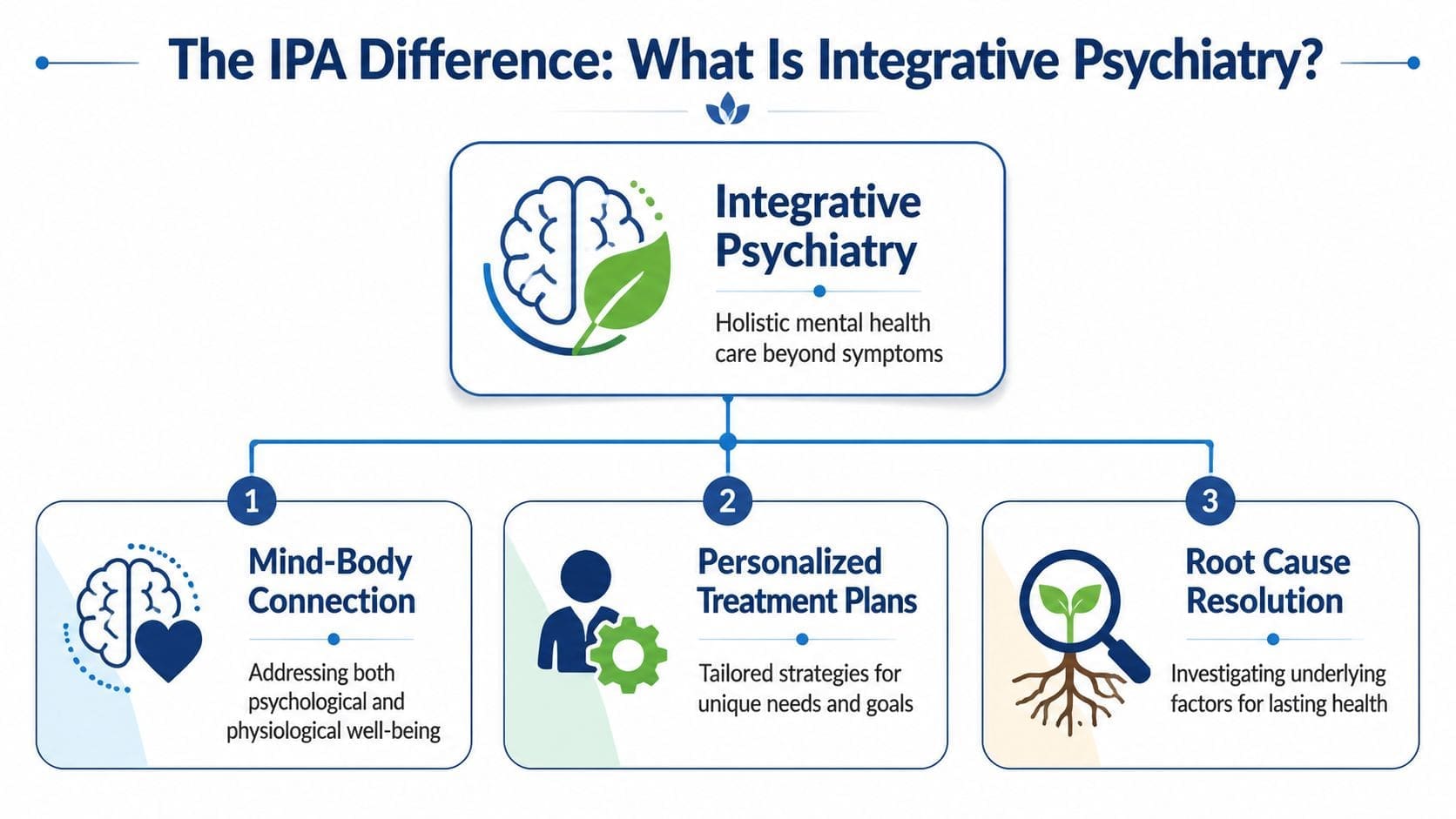
That approach matters most when care has to work for real people with different identities, histories, and barriers. Effective mental health solutions for underserved groups require more than just access. They require culturally sensitive interventions. Data shows that integrating community-based models, peer support, and tele-psychiatry can reduce dropout and improve trust, especially for women, youth, ethnic minorities, and LGBTQ+ communities, as described in this review of underserved mental health care.
What whole-person care looks like in practice
A whole-person model asks better questions. Not only “What diagnosis fits?” but also “What keeps this problem going?” Sleep disruption, chronic stress, poor nutrition, social isolation, trauma exposure, hormone issues, substance use, medical conditions, and inconsistent routines can all affect psychiatric symptoms.
That doesn't mean every problem has a lifestyle solution. Some patients need medication. Some need psychotherapy. Some need both. Some improve only after care becomes more personalized and more realistic.
A helpful companion perspective on embracing a holistic approach shows why mental health treatment often works better when emotional, physical, and behavioral factors are addressed together.
The three pillars patients usually notice
| Pillar | What it means for care |
|---|---|
| Clinical precision | Careful assessment, diagnosis, medication selection, and follow-up rather than trial-and-error without structure |
| Personalization | Treatment shaped around symptoms, medical history, identity, preferences, and daily responsibilities |
| Broader support | Attention to therapy, mindfulness, exercise, nutrition, labs, and other contributors that may affect psychiatric stability |
Good integrative psychiatry doesn't reject conventional treatment. It uses conventional treatment more thoughtfully.
Patients who want a deeper look at this model can read the integrative psychiatry approach. The key idea is simple. Better psychiatric care often comes from combining evidence-based treatment with a more complete view of the person receiving it.
Compassionate Care for Common Mental Health Conditions
People rarely walk into psychiatry saying, “A textbook diagnosis is the problem.” They usually describe life getting harder. Mornings feel heavy. Focus disappears. Panic shows up in the grocery store. Old trauma keeps intruding. Alcohol, opioids, or other substances become a way to get through the day rather than a choice.

How common conditions often feel day to day
Anxiety isn't just “worrying too much.” It can feel like a body that won't power down, a mind that runs disaster rehearsals, and a nervous system that mistakes ordinary stress for danger. For some people, social situations are the hardest part. Skills-based resources such as this CBT for social anxiety guide can help patients understand how thoughts, avoidance, and physical symptoms interact.
Depression often looks less dramatic from the outside than it feels from the inside. People may still go to work and answer messages while feeling flat, slowed down, hopeless, ashamed, or unable to enjoy anything.
ADHD in adults is frequently misunderstood. It isn't laziness. It often shows up as poor task initiation, disorganization, time blindness, forgetfulness, impulsive decisions, and the exhausting cycle of knowing what needs to be done but struggling to start or finish it.
Conditions that deserve careful, nonjudgmental treatment
Some symptoms are more hidden.
- OCD: intrusive thoughts and repetitive behaviors meant to reduce distress, even when the person knows the cycle doesn't make sense.
- PTSD: flashbacks, hypervigilance, emotional shutdown, irritability, nightmares, and a body that stays braced for impact.
- Substance use disorder: repeated use despite harm, cravings, secrecy, withdrawal, relapse, and a deep fear of being judged rather than helped.
A diagnosis should help a patient understand what's happening. It shouldn't reduce a person to a label.
Many Pennsylvanians seek care only after symptoms have already interfered with work, parenting, or relationships for a long time. Treatment can still help. For readers exploring support for worry, panic, and related symptoms, this overview of anxiety treatment in Pennsylvania with CBT, medication, and telepsychiatry offers a practical next step.
Treatment Options: From Medication to Mindfulness
Good psychiatric care matches the tool to the problem in front of you. A patient with panic attacks may need symptom relief quickly. A patient with longstanding ADHD may need medication, behavioral strategies, and systems that make daily life more workable. A patient with depression tied to poor sleep, grief, burnout, or medical issues often needs more than a prescription refill.

Medication management with nuance
Medication management should be thoughtful, collaborative, and specific to the symptom pattern. The work includes deciding whether medication fits the case, choosing an option that makes clinical sense, reviewing side effects plainly, and adjusting the plan over time based on response, tolerability, sleep, appetite, focus, and day-to-day function.
Telepsychiatry can support that process well for many Pennsylvanians, especially people in rural areas, busy parents, college students, and patients who have delayed care because getting to an office was one more barrier.
Psychiatry also includes newer tools. Prescription digital therapeutics such as DaylightRx for generalized anxiety disorder and Rejoyn for major depressive disorder show how software-based cognitive behavioral therapy can complement clinician-managed treatment, as discussed in this overview of prescription digital therapeutics. They do not replace clinical judgment. They can add structure between visits, support skill practice, and give patients another way to engage in care from home.
Therapy, behavior change, and medical context
Psychotherapy remains a core part of treatment. Depending on the person, that may include CBT, supportive therapy, trauma-informed treatment, or skills-based work. Families trying to better understand attachment, reflection, and emotional patterns may also find this article on mentalisation-based therapy for family emotional wellbeing useful as background reading.
Other supports may include:
- Nutrition support: eating patterns can affect mood, energy, concentration, and blood sugar stability. This practical guide on how nutrition affects mental health explains why food choices can matter in psychiatric care.
- Exercise counseling: movement can improve stress regulation, sleep, and follow-through.
- Mindfulness and meditation: these tools can reduce reactivity and help patients notice spiraling thoughts earlier.
- Lab and genetic screening: sometimes useful when symptoms are complicated, fatigue overlaps with medical issues, or medication response has been inconsistent.
- TRT when clinically indicated: appropriate only after medical evaluation and clear indication, not as a catch-all answer for low mood or low motivation.
The best plan is rarely one-size-fits-all. In practice, effective psychiatric treatment often combines medication when needed, therapy that fits the diagnosis, and realistic lifestyle changes a patient can sustain.
What to Expect from Your Online Psychiatry Visit
The first online psychiatry appointment is usually more straightforward than people expect. It isn't a cold checklist and it shouldn't feel like an interrogation. It's a structured clinical conversation focused on symptoms, history, safety, functioning, goals, and what kind of treatment makes sense.

How the process usually works
Most telepsychiatry visits follow a sequence like this:
Scheduling and forms
The patient requests an appointment, completes intake paperwork, and shares current medications, symptoms, and history.Secure video evaluation
The clinician reviews concerns in depth. Topics may include anxiety, depression, ADHD symptoms, sleep, trauma, substance use, prior treatment, and medical factors.Plan development
If medication is appropriate, risks and benefits are discussed clearly. Therapy recommendations, lifestyle supports, labs, and follow-up intervals are also addressed.Ongoing follow-up
Later visits focus on symptom changes, side effects, adherence, function, and whether the treatment plan still fits.
Why many patients trust telepsychiatry
Safety is one of the most common concerns, especially when medications are part of care. The evidence is reassuring. Clinical evidence shows that telemedicine delivers equivalent safety and outcomes to in-person care for psychiatric prescribing, with 84% of surveyed mental health providers reporting high comfort levels with safely prescribing controlled substances virtually without a prior in-person visit, according to this telemedicine prescribing review in JMIR Formative Research.
Online psychiatry works best when the visit is treated like real medical care. Private setting, honest answers, updated medication list, and consistent follow-up.
For patients who want a quick visual sense of what virtual care can feel like, this short video offers helpful context.
Start Your Journey to Wellness in Pennsylvania Today
Access is still one of the biggest problems in mental healthcare. Roughly 60% of U.S. counties have no psychiatrist, and telehealth has become a practical way to provide continuity of care, medication follow-up, and lifestyle support when local access is limited, as outlined by the AAMC's review of barriers to mental health care.
For adults across Pennsylvania, that matters in a very concrete way. Waiting months for a local opening, driving long distances, or piecing together care from multiple offices often leads to delayed treatment and dropped follow-up. Telepsychiatry gives patients another route. They can address anxiety, depression, ADHD, trauma-related symptoms, medication questions, and integrative mental health goals from home with more consistency.
What patients should look for before booking
Not every online psychiatry service is the same. Patients should check for:
- Clear scope of care: assessment, medication management, psychotherapy options, and follow-up structure
- Secure systems: HIPAA-compliant telehealth and a patient portal for practical communication
- Transparent payment options: insurance verification, self-pay clarity, and refill policies
- A treatment philosophy that fits: some patients want medication-only care, while others want a broader plan
A practical place to start is this page for integrative psychiatry near me, which helps Pennsylvania residents understand what statewide online care can look like.
Mental health treatment doesn't need to wait until symptoms become unbearable. If focus has collapsed, anxiety keeps running the day, depression is making ordinary life feel unreachable, or trauma symptoms are wearing down the nervous system, reaching out is a reasonable next step.
Pennsylvania residents who want confidential online psychiatry, medication management, psychotherapy support, and a whole-person treatment approach can explore care options through Integrative Psychiatry of America. The website allows patients to review services, verify insurance, and request an appointment without adding another layer of friction to an already difficult moment.