
Someone may spend the morning checking a locked door, the afternoon avoiding a public restroom, and the evening replaying a conversation for hidden mistakes. Each ritual can bring a brief sense of relief. Then the doubt returns, often stronger, and the cycle starts again.
Exposure Response Prevention therapy, usually called ERP, targets that cycle directly. It combines planned contact with feared thoughts, situations, or sensations and coached resistance to the compulsions that usually follow. ERP can feel uncomfortable, but it gives people a structured way to stop letting avoidance and rituals dictate daily life.
Table of Contents
- When Avoidance and Rituals Take Over
- What Exposure Response Prevention Therapy Actually Is
- The Evidence Behind ERP for OCD and Anxiety
- How a Typical Course of ERP Unfolds
- Real Examples of Exposure Hierarchies
- Combining ERP with Medication and Telehealth
- Preparing for Your First ERP Appointment
- Common Questions About ERP Safety and Access
When Avoidance and Rituals Take Over
A person with obsessive-compulsive disorder may know that repeated checking seems excessive and still feel unable to stop. The lock gets checked once, then again after walking away. A feared contaminant leads to prolonged washing. An intrusive harm thought prompts mental reviewing, reassurance seeking, or avoidance of people and objects.
The ritual appears to solve the problem. Anxiety drops for a moment, so the brain learns that checking, washing, reviewing, or avoiding must have prevented danger. The next intrusive thought then feels more urgent, and the person repeats the same response.
The cycle in daily life
The pattern can affect work, relationships, travel, sleep, and ordinary decisions. Common examples include:
- Checking: Returning to a stove, door, appliance, or message repeatedly.
- Avoidance: Staying away from places, objects, people, or activities linked with feared outcomes.
- Mental rituals: Reviewing memories, repeating phrases, counting, praying, or testing feelings internally.
- Reassurance seeking: Asking another person to confirm that nothing bad happened or that a thought doesn't reflect character.
Clinical perspective: The problem isn't the presence of an intrusive thought. The maintaining loop is the urgent ritual or avoidance response that follows it.
ERP was developed for this mechanism. Treatment doesn't require proving that every fear is impossible. Instead, a trained clinician helps the patient approach carefully chosen triggers while changing the response that has kept the fear powerful.
For someone in Pennsylvania seeking care without repeated travel to an office, virtual OCD treatment may provide access to qualified support through secure telehealth. A clinician can assess the pattern, identify compulsions that aren't obvious to family members, and determine whether ERP fits the person's needs.
What Exposure Response Prevention Therapy Actually Is
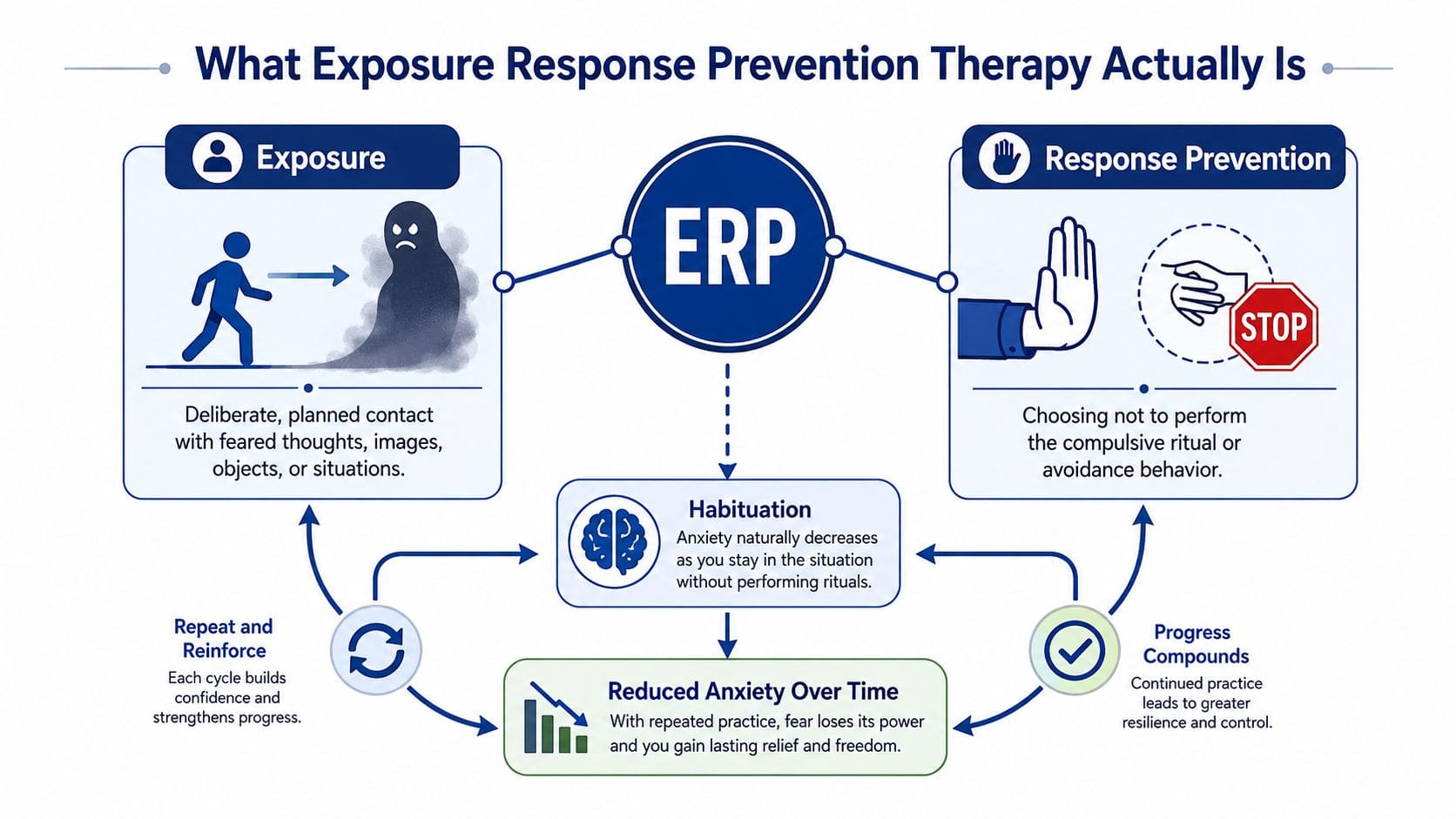
Exposure Response Prevention therapy has two inseparable parts. Exposure means deliberately approaching a feared thought, image, object, sensation, or situation. Response prevention means choosing not to perform the compulsion, avoidance behavior, reassurance ritual, or safety behavior that normally follows.
Exposure is planned, not accidental. A therapist and patient identify a specific trigger, decide how to approach it, and define the ritual that must be resisted. For example, a patient with contamination fears might touch a selected object and then refrain from washing. A patient with checking fears might leave home after a carefully agreed checking routine and resist returning.
Why response prevention matters
Exposure without response prevention can become another ritual. A person might approach a feared object but immediately neutralize the discomfort through washing, mental reviewing, online searching, or asking for reassurance. That response teaches the brain that the ritual remains necessary.
Response prevention isn't physical restraint. The patient remains in control, while the clinician provides coaching, preparation, and accountability. The work involves noticing the urge, allowing uncertainty, and declining to act on the ritual.
A useful analogy is entering cold water gradually. The initial sensation can be intense, but repeated practice makes the experience more manageable. ERP doesn't promise that anxiety will never appear. It helps the patient learn that discomfort can be present without controlling behavior.
Patients can learn more about this approach through integrative OCD treatment with CBT and ERP. The central lesson remains simple: exposure changes what a person approaches, and response prevention changes what a person does next.
The Evidence Behind ERP for OCD and Anxiety
ERP's modern evidence base began with a 1966 report by Meyer, which described improvement in obsessive-compulsive symptoms after patients faced feared stimuli without performing compulsions. Later reviews identified that work as a foundation for ERP and documented clinical trials supporting its use for OCD. This historical review of ERP places the method within the development of evidence-based OCD care.
The strongest evidence comes from controlled research, although the experience for a patient remains practical and demanding. A 2022 systematic review and meta-analysis included 39 randomized controlled trials and 1,793 participants. ERP outperformed medication alone, and follow-up findings supported added benefit when medication was combined with ERP. The reported mean difference was -7.14, with a 95% confidence interval of -9.17 to -5.10 and P < 0.00001, according to the 2022 ERP meta-analysis.
What the findings mean
A separate peer-reviewed ERP evidence review reported that approximately 60% to 85% of patients who complete ERP achieve significant improvement, while about 25% drop out and roughly 60% recover. These figures also clarify the trade-off: ERP can help substantially, but completing treatment requires repeated exposure practice and willingness to tolerate distress between appointments.
Another review describes ERP as a first-line treatment for OCD. Several well-powered randomized controlled trials found it at least as efficacious as serotonin reuptake inhibitors in adults. A 2022 meta-analysis found significant overall effects on OCD symptoms, with g = 0.37 overall, g = 0.97 against placebo, and g = 0.59 against drug control conditions.
The results do not predict an identical response for every patient, and medication may still have a role. They establish ERP as a rigorously tested psychotherapy rather than an experimental approach. For patients whose anxiety extends beyond obsessive-compulsive patterns, care may also be coordinated with generalized anxiety disorder treatment through accessible telepsychiatry services in Pennsylvania.
How a Typical Course of ERP Unfolds
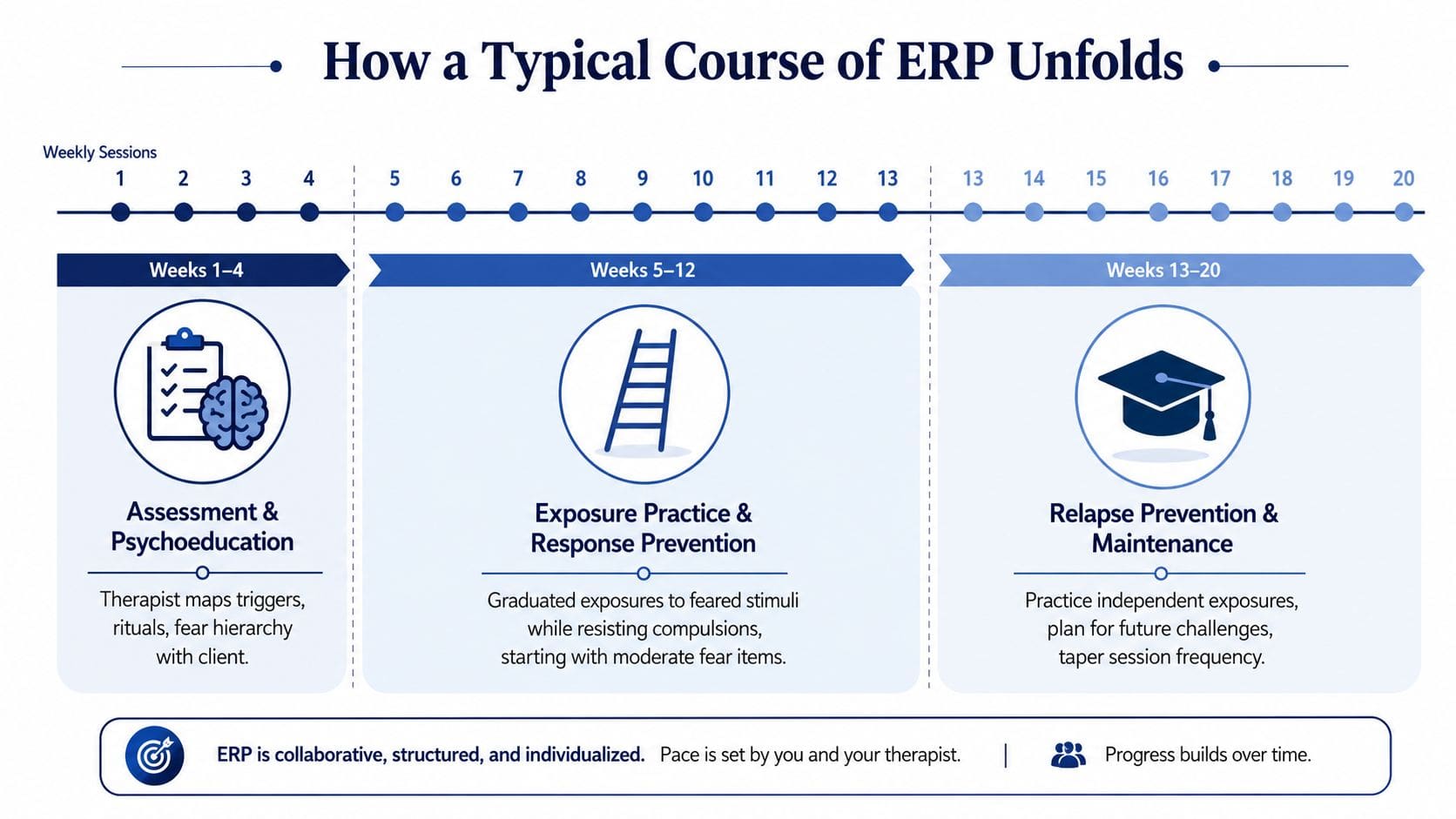
A standard outpatient ERP course is commonly described as 12 to 20 weekly sessions, with early appointments devoted to assessment and psychoeducation. Some guidance describes an initial 2 to 3 sessions for education and detailed mapping of obsessions, compulsions, and avoidance patterns, as outlined in this overview of ERP therapy for OCD.
Assessment comes before exposure
The clinician first maps the patient's symptoms. That includes the trigger, the feared meaning, the ritual, the short-term relief, and the longer-term cost. The therapist also asks about depression, panic, trauma symptoms, substance use, medications, medical concerns, and any factor that could affect treatment readiness.
The patient and therapist then build a hierarchy. A hierarchy ranks feared situations by subjective distress rather than by what appears objectively dangerous. One NHS patient guide recommends starting tasks in the 50% to 60% anxiety range, repeating them until starting anxiety falls below about 40%, and practicing 4 to 5 times per week. These figures and recommendations appear in the NHS ERP patient guide.
Practice becomes more independent
The therapist doesn't usually begin with the most frightening item. Early tasks should challenge the cycle while remaining workable. Homework may involve repeating an exposure, recording urges and rituals, or practicing response prevention during ordinary routines.
Progress isn't measured only by whether anxiety disappears. The clinician may track how long the patient stays with a trigger, whether a ritual occurs, how much avoidance decreases, and whether the patient can continue valued activities despite uncertainty.
A typical session may include review of homework, a planned exposure, response-prevention coaching, and a specific practice plan. Medication decisions, if relevant, can be coordinated through online medication management.
Real Examples of Exposure Hierarchies
ERP becomes easier to understand when the feared situation and the blocked ritual are named precisely. A hierarchy is personal. The same task can feel mildly uncomfortable to one person and highly threatening to another.
Contamination concerns
A patient might begin by touching a doorknob at home and delaying or skipping handwashing. Later tasks could involve touching a more challenging public surface, eating without a repeated cleaning routine, or using a public restroom while resisting washing rituals. The clinician adjusts the plan according to distress, compulsive patterns, health context, and the patient's willingness to practice.
The exposure is touching the feared object. The response prevention is not washing, sanitizing, changing clothes, or asking someone else to confirm that the object was safe.
Harm-related intrusive thoughts
A patient with harm OCD may fear that an unwanted thought reveals dangerous intent. Treatment might use an imaginal exposure involving the feared scenario, followed by refusal to seek reassurance, mentally review intentions, or test emotional reactions.
The clinician doesn't provide endless certainty that the thought means nothing. That reassurance can become part of the cycle. Instead, therapy helps the patient allow uncertainty about the thought without treating it as a command or confession.
Checking and social fears
Someone with checking OCD might leave the home after completing an agreed routine and resist returning to inspect the stove or lock. The exposure is leaving. The response prevention is tolerating doubt without a second check.
For social anxiety, early practice may involve brief eye contact or a short comment. Later work may include initiating a conversation, speaking without over-preparing, or allowing a minor conversational pause. The patient practices dropping safety behaviors, not performing perfectly.
Practical rule: A useful hierarchy targets the behavior that keeps the fear alive, not merely the situation that looks frightening from the outside.
Combining ERP with Medication and Telehealth
ERP and medication can serve different functions. Therapy directly targets avoidance, compulsions, and safety behaviors. Medication may reduce symptom intensity enough for some patients to participate more consistently in exposure work. Serotonin reuptake inhibitors are commonly considered in OCD care, but prescribing requires an individualized evaluation of symptoms, medical history, other medications, side effects, and patient preferences.
The evidence review described earlier found added follow-up benefits when medication was combined with ERP, compared with medication alone, in the pooled analysis of randomized trials. That doesn't make combined treatment mandatory. Some patients prefer psychotherapy alone, while others need medication support because symptoms, depression, sleep disruption, or functional impairment make behavioral practice difficult.
What telehealth can add
Secure video sessions can bring ERP into the environment where compulsions occur. A clinician may coach a patient through a home-based checking exposure, observe how reassurance enters a family interaction, or help plan practice around a neighborhood route.
That convenience can matter for Pennsylvania residents who face long travel times or limited access to clinicians with specialized ERP training. Philadelphia patients and people in rural communities can discuss whether virtual care is appropriate through telepsychiatry services.
Telehealth isn't automatically suitable for every exposure or every patient. Privacy, internet access, symptom severity, household involvement, emergency planning, and the clinician's ability to assess risk all matter. A careful provider will choose exposures that can be conducted safely and will modify the format when an in-person setting is clinically necessary.
Preparing for Your First ERP Appointment
The first appointment usually focuses on understanding the pattern rather than forcing an exposure. A qualified clinician asks about intrusive thoughts, images, urges, rituals, avoidance, reassurance seeking, mental compulsions, symptom duration, daily impairment, and previous treatment attempts.
Preparation can make the evaluation more useful. Before the appointment, a patient can write down:
- A recent trigger: What happened immediately before distress increased.
- The feared meaning: What the person feared the thought or situation could indicate.
- The response: The physical or mental ritual used to feel safer.
- The cost: Time lost, activities avoided, relationship strain, or work disruption.
- Past care: Therapy approaches, medications, benefits, side effects, and barriers.
Patients don't need to describe intrusive thoughts perfectly. Clinicians hear difficult symptom content without treating it as evidence of character or intent. Specific examples help distinguish an obsession from a genuine wish, a compulsion from an ordinary safety behavior, or OCD from another condition that may need a different treatment plan.
Discomfort should be discussed openly
ERP involves temporary discomfort by design. The therapist should explain the rationale, obtain collaboration, identify warning signs, and build confidence before asking for difficult practice. A qualified provider also evaluates whether another condition needs stabilization first, particularly when severe depression, acute safety concerns, substance-related instability, or other clinical factors could interfere with exposure work.
Pennsylvania residents can consider virtual evaluation whether they live in Philadelphia, Pittsburgh, or a rural area. Guidance on recognizing the need for professional assessment is available in when to see a psychiatric clinician.
Common Questions About ERP Safety and Access
Is ERP safe?
ERP is generally considered safe when a trained clinician completes an appropriate assessment, selects exposures carefully, and coaches response prevention. The work can raise anxiety temporarily, but the patient should understand the plan and participate voluntarily. A therapist shouldn't use surprise exposure, humiliation, physical restraint, or uncontrolled flooding.
Why do some patients stop treatment?
The quantified review cited earlier reported that approximately 25% of patients drop out. Dropout can reflect fear of the exercises, misunderstanding of response prevention, poor preparation, practical barriers, an inadequate therapeutic match, or symptoms that require a different sequence of care. Discussing discomfort and homework expectations early can reduce avoidable surprises.
Can ERP address different OCD themes?
ERP can be adapted to contamination, harm, checking, symmetry, scrupulosity, relationship doubts, intrusive sexual thoughts, and other obsessional patterns. The theme changes the hierarchy. The treatment principle remains focused on approaching triggers and resisting the rituals or safety behaviors that maintain the cycle.
How can a patient find a qualified provider?
A provider should have specific training and supervised experience in ERP, not only a general CBT credential. Patients can ask how often the clinician treats OCD, whether mental compulsions are assessed, how hierarchies are built, how homework is monitored, and how medication coordination works when needed.
What about session length, cost, and insurance?
Session length, fees, and insurance participation vary by practice and plan. Before starting, patients can ask whether the clinician accepts their insurance, whether telehealth is covered, what out-of-pocket costs may apply, and how missed appointments or extended care are handled. These questions are practical, not confrontational. Clear financial expectations help patients stay engaged.
Integrative Psychiatry of America provides virtual psychiatric evaluations, medication management, and integrative mental health treatment through telehealth for patients throughout Pennsylvania. Patients seeking OCD care can review treatment options, confirm whether ERP is available for their presentation, and ask about access through the practice's online services.
Integrative Psychiatry of America offers virtual psychiatric evaluations, medication management, and integrative OCD care through secure telehealth for adults across Pennsylvania. Visit Integrative Psychiatry of America to explore care options, verify insurance, or request an appointment to discuss whether ERP fits the current symptoms and treatment needs.