
A person in Philadelphia can look successful on paper, keep up with work, answer everyone else's texts, and still feel like their nervous system is always braced for impact. Another adult in Harrisburg might be the one everyone counts on, yet private life feels tense, relationships feel confusing, and sleep never feels fully restful. When those patterns keep repeating, it's easy to assume the problem is personality, stress, or weakness, but the effects of childhood trauma on adults often show up exactly this way, as a persistent state of being on edge, disconnected, or exhausted.
That kind of suffering makes sense. Childhood trauma can shape how the brain, body, emotions, and relationships respond for years afterward, and understanding those patterns is often the first step toward relief. For adults across Pennsylvania, that understanding can also lead to practical help through confidential telehealth care, so healing doesn't have to start with a scary in-person appointment.
Table of Contents
- The Lingering Echoes of Childhood Trauma in Pennsylvania Adults
- Four Core Ways Trauma Reshapes Adult Life
- The Unseen Wounds and Neurobiology of Childhood Trauma
- Common Signs and Red Flags in Adulthood
- Evidence-Based Pathways to Healing and Recovery
- Finding Trauma-Informed Telehealth Care in Pennsylvania
- When to Seek Help and Your First Steps with IPA
The Lingering Echoes of Childhood Trauma in Pennsylvania Adults
A woman in Lancaster may spend years telling herself she just needs to try harder. She gets things done, but she also feels tense in every relationship, second-guesses herself constantly, and crashes emotionally after even small conflicts. The pattern can look unrelated on the surface, yet it often traces back to earlier experiences that taught her body to stay alert, her feelings to stay hidden, and her needs to stay small.
That same pattern shows up in adults from Erie to Allentown in different forms. Some people become overachievers who can't rest. Others shut down, avoid conflict, or keep people at arm's length even when they long for closeness. These are not character flaws, and they're not signs that someone is broken. They can be learned survival responses that stayed active long after childhood ended.
One useful lens comes from trauma-informed residential care models that understand childhood trauma as something that can affect every layer of adult life, including mood, relationships, and health. A helpful overview appears in Luxury dual-diagnosis treatment for trauma, which reflects how trauma and other mental health concerns often overlap in real life.
Adults often ask a quiet question in therapy, sometimes after years of struggle. “Why do I keep reacting this way when I know I'm safe now?” That question matters, because the answer usually isn't simple willpower. Childhood trauma can keep old alarm systems active, which means adult life can feel like constantly trying to live normally while the body still expects danger.
Practical rule: if the same emotional pattern keeps showing up in work, relationships, sleep, or physical health, it deserves attention even if there's no single dramatic event that seems to explain it.
Four Core Ways Trauma Reshapes Adult Life
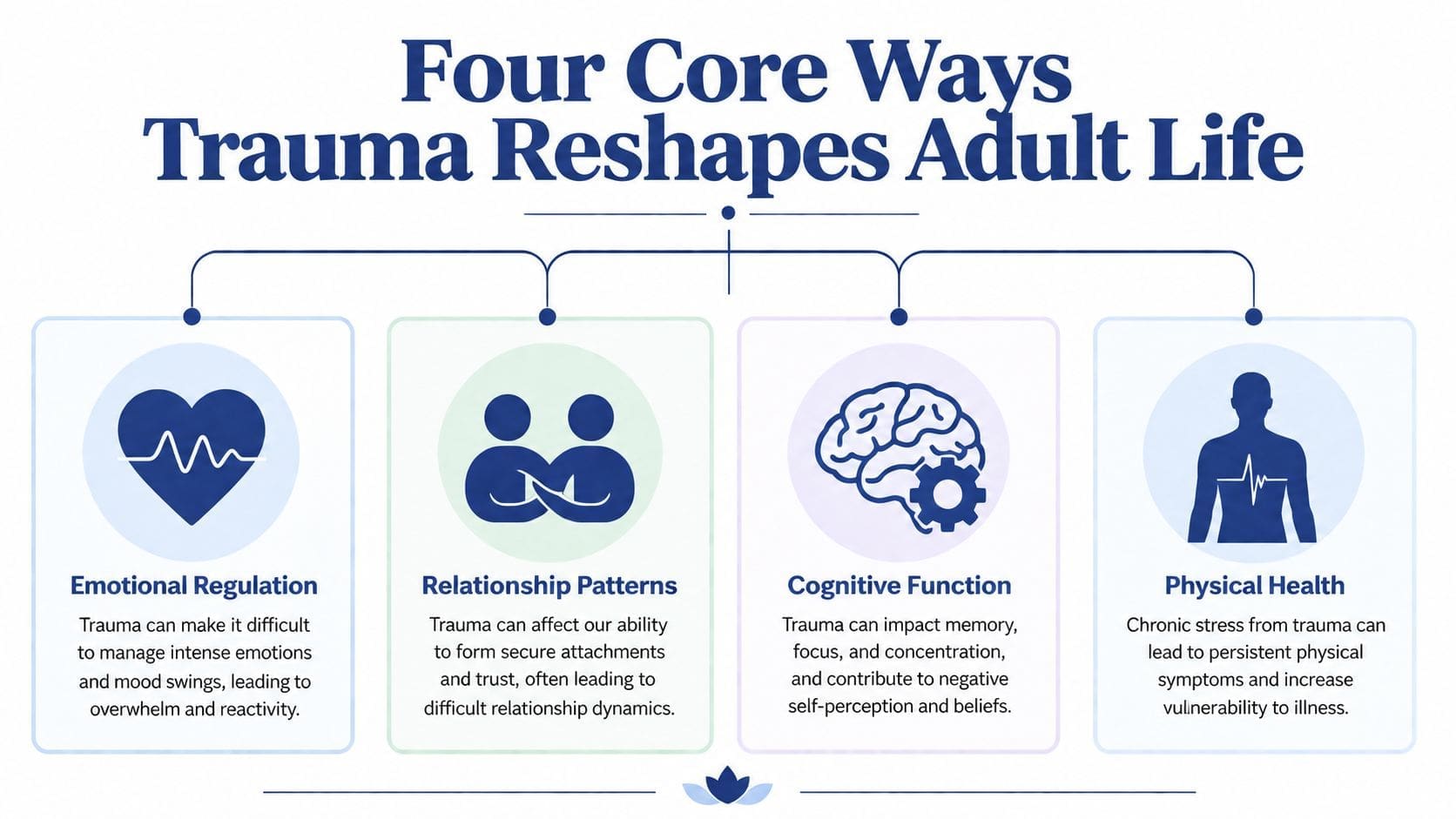
Emotional Regulation
Trauma can make emotions feel bigger, faster, and harder to settle. Adults may swing between numbness and overwhelm, or they may feel anxious, angry, ashamed, or panicked without understanding why. In the ACE literature, adults abused during childhood are reported to be more than twice as likely to have at least one lifetime psychiatric diagnosis, almost three times as likely to have an anxiety disorder, and over 10 times as likely to have panic disorder (ED458451).
Relationship Patterns
Trust problems often start here. Some adults become highly guarded, while others cling tightly to connection because separation feels threatening. Trauma can distort the expectation of safety in close relationships, so ordinary disagreement can feel like rejection and silence can feel like abandonment.
Cognitive Function
Trauma doesn't just affect mood. A systematic review found long-term deficits in attention, working memory, processing speed, and executive function in trauma-exposed people (PMC12308860). That can look like forgetfulness, scattered focus, decision fatigue, or chronic mental fog at work and at home. For some adults, those symptoms can resemble ADHD, which is one reason careful assessment matters.
Physical Health
The body often carries what the mind has tried to survive. Adults with childhood trauma histories have been shown to have more chronic physical conditions, and risky coping behaviors can worsen health over time (NCTSN effects). Some people notice headaches, fatigue, stomach upset, muscle tension, or sleep disruption before they ever connect those symptoms to trauma.
Integrative psychiatry and gut-brain care can be especially relevant for adults whose stress symptoms show up physically, because body-based complaints often travel with emotional ones.
The Unseen Wounds and Neurobiology of Childhood Trauma
The brain doesn't record trauma as a simple memory file. It adapts. Reviews of the literature describe altered development and functioning in the hippocampus, prefrontal cortex, and amygdala, with chronic stress-response activation and epigenetic mechanisms involved in the pathway from childhood adversity to adult PTSD, depression, dissociation, and executive-function problems (PMC3968319).
Think of the brain like a home security system. The amygdala works like an over-sensitive smoke detector, sounding alarms quickly. The prefrontal cortex is like the dispatcher that decides whether there's real danger and what to do next. When trauma has been part of development, the alarm can become too reactive, while the calming, organizing part of the system struggles to step in.
That helps explain why adults can know, logically, that they're safe and still feel flooded in their bodies. The reaction is not fake. It's learned physiology.
When the nervous system gets stuck in survival mode, the person may react before thinking, overread tone of voice, or struggle to calm down after a trigger. That can create shame, because the outside world sees a “small” event while the body experiences a threat. Trauma treatment works better when it respects that mismatch instead of arguing with it.
An adult might also notice that stress affects memory, focus, or word-finding in a way that makes everyday functioning harder. That isn't laziness. It's a nervous system that has spent too long on high alert and has fewer resources left for planning, reflection, and recovery.
Understanding serotonin in a clinical context can also help some adults make sense of why mood, sleep, and stress regulation often travel together during trauma recovery.
Common Signs and Red Flags in Adulthood
A lot of adults do not name trauma first. They say they are too sensitive, too tired, too scattered, or too hard on themselves. In daily life, that can look like missed deadlines, strained relationships, sleep that never feels restorative, or a body that stays tense even during ordinary routines. That is why these signs matter. They often show up as patterns that seem ordinary on the outside and exhausting on the inside.
Some people come in for “anxiety” or “focus problems,” but once the full story is mapped out, the trauma pattern becomes clear.
When the pattern looks like anxiety or burnout
Some adults stay in motion so they never have to feel. They volunteer too much, apologize too quickly, or cannot relax even when nothing is urgent. Others describe a constant internal buzz, as if the next bad thing is always about to happen.
That presentation can be easy to miss in primary care, therapy, or even at home, because the person may still be functioning. The cost shows up in exhaustion, irritability, and the sense that there is no real off switch. For a practical symptom overview, many readers also find understanding childhood trauma symptoms helpful as a starting point.
When the pattern looks like ADHD or “bad time management”
Trauma-exposed people can have real trouble with focus, working memory, and executive function. That can look like missed appointments, unfinished tasks, losing track of conversations, or feeling mentally overloaded by simple decisions. The important trade-off is that these struggles can reflect trauma, ADHD, or both.
A careful Adult ADHD Assessment can help sort out where the attention problems are coming from, so treatment matches the actual problem. In some cases, trauma work is the main need. In others, both conditions need attention at the same time.
When the pattern looks like relationship conflict
Adults with childhood trauma may people-please, avoid honest needs, choose emotionally unavailable partners, or panic when closeness deepens. A small disagreement can feel huge because the body hears danger before the mind has a chance to slow things down.
These patterns often show up in ordinary moments, not dramatic ones. A delayed text, a change in tone, or a partner asking for feedback can trigger shame, anger, or withdrawal. Persistent worry and reactivity can also be tracked with the Anxiety Symptom Checker.
When the pattern looks like physical complaints
Sleep problems, chronic muscle tension, headaches, fatigue, digestive issues, and a sense of never fully being “off duty” can all fit the trauma picture. These signs are especially important when medical workups keep coming back without a complete explanation. Trauma can hide behind a body that looks medically complicated but emotionally unheard.
If those symptoms keep repeating across settings, it is reasonable to look at both body and history. A trauma-informed review can clarify whether the nervous system is carrying more than the person has had words for. For adults who want a practical next step, PTSD treatment options can help explain what care may look like when symptoms have become part of everyday life.
Evidence-Based Pathways to Healing and Recovery
Healing usually works best when it's layered. Trauma is rarely solved by one conversation or one medication change, because the problem lives in memory, body state, beliefs, and habits all at once.
Therapy that targets trauma directly
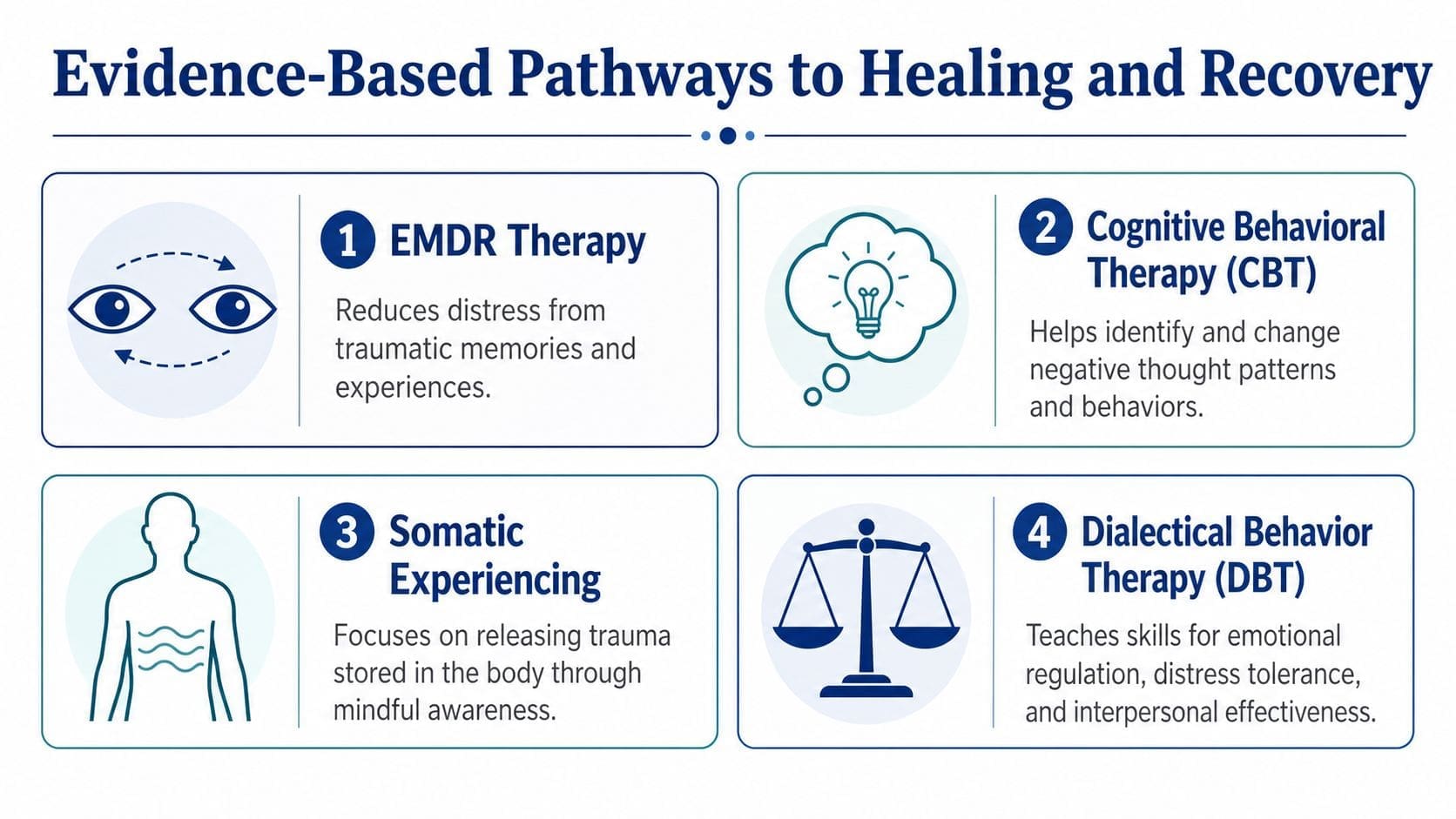
Trauma-focused psychotherapy gives adults a structured way to process memories without being overwhelmed by them. Modalities like EMDR, TF-CBT, CBT, somatic experiencing, and DBT each bring a different strength. For example, EMDR is often used to reduce distress from traumatic memories, while CBT helps identify and change trauma-shaped thought patterns, and DBT teaches emotion regulation and distress tolerance.
Medication when symptoms block progress
Medication doesn't erase trauma, but it can reduce the intensity of overlapping depression, anxiety, sleep problems, or PTSD symptoms so therapy becomes more usable. That trade-off matters. When a person is too activated, too sleepless, or too depressed to engage, medication can create the steadier ground needed for deeper work.
Integrative habits that support the nervous system
Exercise, sleep routine, nutrition, mindfulness, and grounding skills all matter because trauma recovery happens in a body, not just a conversation. The 5-4-3-2-1 Grounding Tool can be a useful short-term reset during spikes of panic or dissociation, while a more complete plan may also include journaling, pacing, and behavior change support. In some adult trauma cases, Integrative Psychiatry of America uses medication management alongside psychotherapy-informed care, exercise counseling, and nutrition education when that combination fits the person's needs.
For a useful comparison of therapy approaches, Nexus Recovery's EMDR and CBT insights can help readers understand why different methods fit different trauma histories.
PTSD treatment options can help adults compare care paths before they book an evaluation.
Finding Trauma-Informed Telehealth Care in Pennsylvania
For many trauma survivors, the hardest part is not knowing whether care will feel safe. Telehealth lowers that barrier. It lets adults meet from home, from a car during a lunch break, or from a quiet room where they feel more in control, which can matter a lot for anyone who gets activated by new places, waiting rooms, or long drives.
That accessibility helps adults across Pennsylvania, including people in Philadelphia, Pittsburgh, Harrisburg, Erie, Scranton, Allentown, Lancaster, Reading, and smaller communities in between. Virtual care can also make it easier to keep appointments consistently, which matters when trauma has already made follow-through harder.
Trauma-informed care is more than a friendly tone. It means the clinician prioritizes safety, transparency, collaboration, and pacing that respects the patient's tolerance. The goal is not to push fast disclosure. The goal is to build enough stability that the person can talk openly without feeling overwhelmed.

For adults who want that kind of structured support, trauma-informed mental health care can be an accessible starting point, especially when the first goal is to feel understood and not rushed.
When to Seek Help and Your First Steps with IPA
A parent who is still losing sleep over old memories, a professional who is missing work because anxiety keeps flaring, or someone who feels on edge with their partner may wonder whether they should just keep pushing through. If childhood trauma is interfering with sleep, work, parenting, relationships, or daily peace of mind, that is reason enough to get help. The question is not whether someone else would label it “serious enough.” The question is whether life feels harder than it should and whether support could make it more manageable.
Adults with trauma histories often improve when evaluation, medication management when appropriate, and therapy are matched to the nervous system's pace. Early care can also prevent people from spending months trying to force themselves to function while symptoms keep getting in the way. The first step is usually simple. Learn what trauma treatment looks like, schedule a confidential virtual evaluation, and check insurance before the stress of doing it alone becomes another barrier.
When to see a psychiatrist can help clarify whether symptoms have reached the point where professional support makes sense. For many adults, that threshold arrives sooner than they expected, especially when trauma symptoms are affecting daily life in Pennsylvania and they want care they can start from home.
If these patterns feel familiar, you do not have to sort them out alone. At Integrative Psychiatry of America, we provide confidential, trauma-informed telehealth care across Pennsylvania, and we can help you take the first step toward steadier sleep, calmer days, and more support that fits your life.