
You can do everything right, pick a telehealth clinic, use your insurance card, and still hit a wall at the pharmacy. A covered video visit does not always mean the medication will be paid for, and that mismatch is where a lot of anxiety treatment gets derailed. For people searching for anxiety medication online with insurance, the hardest part is usually not finding care, it's figuring out which part of the process insurance is covering.
That frustration makes sense. Online anxiety treatment sits between clinical care, insurance rules, and pharmacy benefits, so one approval doesn't guarantee the next one. In Pennsylvania, that means patients need a plan that is clinically sound, documented well, and structured with coverage in mind, not just a quick prescription sent after a brief conversation.
Table of Contents
- The Reality of Virtual Psychiatric Care
- Verifying Your Pennsylvania Telehealth Benefits
- The Clinical Intake and Diagnostic Evaluation
- Navigating Prior Authorization and Formularies
- Safety Monitoring and Controlled Substance Rules
- Handling Claim Denials and Insurance Appeals
- Starting Your Integrative Anxiety Treatment
The Reality of Virtual Psychiatric Care
A common path looks simple at first. A patient books a telehealth visit, confirms the clinic takes insurance, and expects the medication to be ready after the appointment. Then the pharmacy says the drug needs a prior authorization, the formulary does not match the prescribed medication, or the plan covers the visit but not the exact prescription.
That split between the appointment and the medication is the main reality patients run into. Telehealth coverage can support evaluation, follow-up, and prescription management, but pharmacy coverage is a separate system with its own rules. The result is that “insurance accepted” is only the beginning, not the finish line.
Visit coverage and drug coverage are not the same
A telepsychiatry practice can document symptoms, assess risk, and send a prescription, but the insurer still decides whether the medication is on formulary and whether extra review is needed. That is why many people get a covered visit and still owe a surprise amount at the pharmacy counter. It is also why a careful intake should not feel rushed.
A patient can have a valid telehealth appointment and still face a medication denial at the pharmacy, because the visit and the drug are paid through different rules.
For readers comparing providers, a useful outside overview of how teams organize care digitally is the guide to healthcare industries. For a closer look at how virtual psychiatric visits work, see what is telepsychiatry.
The practical takeaway is straightforward. A legitimate online anxiety workflow starts with diagnosis, not with a shortcut to a refill. That protects the patient, gives the prescriber the documentation insurers expect, and lowers the chance of being stuck with a rejected prescription after the visit is already complete.
Verifying Your Pennsylvania Telehealth Benefits
The best time to sort out coverage is before the intake is booked. Pennsylvania law requires individual health plans to cover mental and behavioral health outpatient services, and parity rules mean insurers can't apply less favorable limits to mental health than to physical health. That still doesn't mean every telehealth visit, every clinician, or every medication is automatically covered.
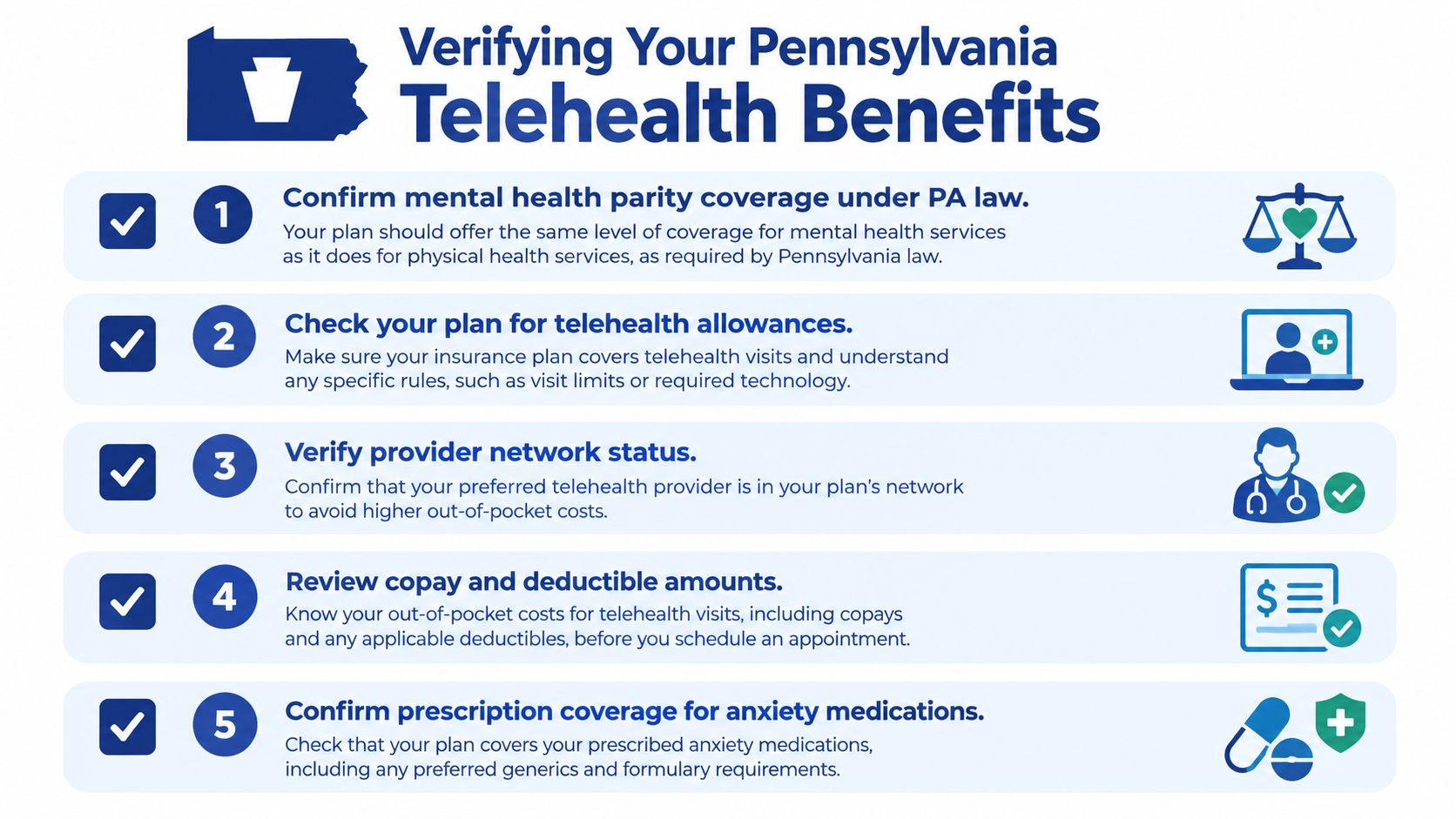
A smart benefits check starts with the member services number on the insurance card. Ask whether the clinician is in-network, whether telehealth psychiatry is covered the same way as office visits, and whether the plan requires a referral. Then ask how the plan applies the deductible, copay, coinsurance, and out-of-network rules to both the visit and the prescription.
Questions to ask before booking
- Is the psychiatric provider in-network? Network status drives cost and often determines whether the claim processes smoothly.
- Does the plan cover telehealth mental-health evaluation and medication management? Some plans treat virtual care differently from in-person care.
- What will the deductible, copay, or coinsurance be for the first visit and follow-ups? The first appointment and ongoing medication checks are not always priced the same.
- Does the prescription itself need separate coverage review? A covered visit does not mean the medication will be covered at the pharmacy.
- Are there pharmacy or prior-authorization rules I should know before the visit? This matters most when a medication sits outside the easiest formulary tier.
For a practical overview of insurance verification steps, see the insurance verification process. The point is to get clarity before symptoms, urgency, and surprise billing pile up.
The Clinical Intake and Diagnostic Evaluation
A psychiatric intake has to gather enough clinical detail to confirm the diagnosis, rule out contributors, and document medical necessity for the insurer. In telehealth, that usually means a clinician is doing two jobs at once, treating symptoms and building the record that supports payment.
A careful virtual evaluation usually starts with symptom history, prior treatment attempts, current medications, sleep, substance use, and safety concerns. Clinicians often document baseline severity with a validated scale such as the GAD-7, because a starting score gives the team something concrete to compare against at follow-up and can support a prior authorization request if one is needed.
The strongest intake visits also look for what anxiety can hide. A patient may report constant worry, but the fuller picture can involve panic symptoms, depression, bipolar-spectrum symptoms, medication side effects, thyroid issues, pregnancy considerations, or substance use that changes the treatment choice.
What a careful intake usually covers
- Symptom pattern: When anxiety began, what triggers it, and how it affects work, sleep, appetite, or relationships.
- Medication history: What has been tried before, what helped, what failed, and what side effects came up.
- Safety review: Substance use, bipolar-spectrum symptoms, suicidality, pregnancy considerations, and other medical causes that can look like anxiety.
- Follow-up plan: When symptoms will be checked again, and what counts as improvement or concern.
That documentation matters to insurers because it shows the treatment is specific, not casual. It also shapes the clinical workflow, since the prescriber still has to check interactions, decide whether the medication fits the diagnosis, and set a follow-up interval that matches the severity of the symptoms.
For a closer look at the evaluation process, see online mental health evaluation. In practice, that level of intake is what makes online anxiety care safer and easier to defend than a quick medication request with little chart support.
Navigating Prior Authorization and Formularies
A covered appointment does not guarantee a covered prescription. That is the point where many people get stuck, because the pharmacy benefit manager decides whether the drug is on formulary, whether step therapy applies, and whether prior authorization is required before payment will go through.
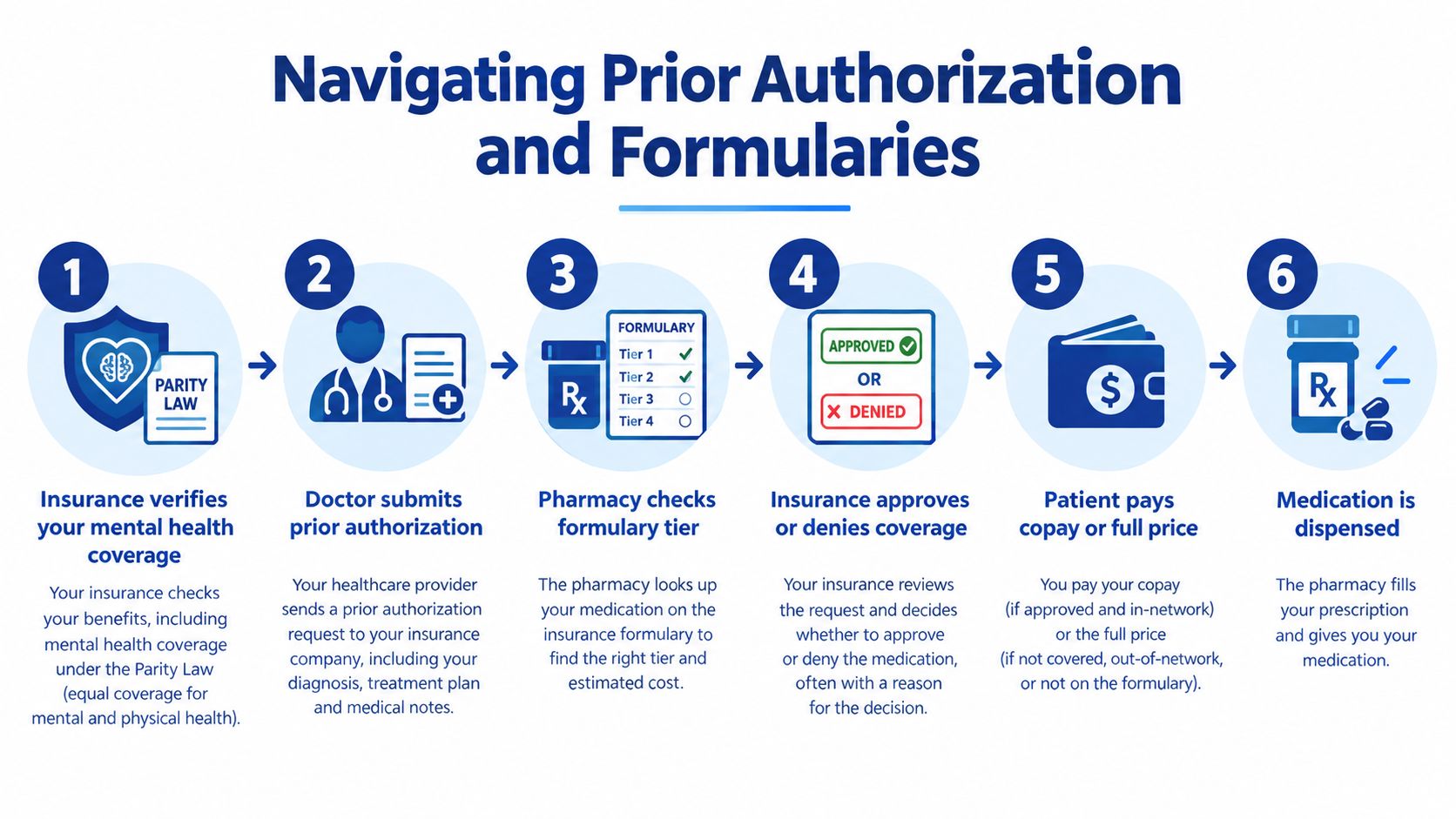
A practical way to think about it is this. The clinician evaluates the patient, the pharmacy checks the formulary, and the insurer decides whether the prescription gets paid. If the medication is not preferred, the office may need to submit notes showing why the chosen drug is medically appropriate and why another option was not enough.
The mechanics vary by plan. A useful overview of payer review is available through navigating payer review steps, but the patient-facing reality is usually simpler, if frustrating. If the first medication is denied, the office may need to appeal, switch to a covered alternative, or wait for the insurer's review before dispensing.
A key point is that visit denial and medication denial are different problems. One can be a coding or network issue, while the other may be a formulary or authorization issue. Patients usually do best when they ask the office which problem they're facing, because the fix is rarely the same for both.
For more background on network rules, see what in network means for online psychiatry in Pennsylvania.
Safety Monitoring and Controlled Substance Rules
Online prescribing works best when the process stays conservative and well documented. That is especially true with controlled substances such as benzodiazepines. The FDA warns that this drug class can lead to misuse, addiction, physical dependence, and withdrawal, even when taken as prescribed. It also warns that abrupt stopping or a rapid dose reduction can cause severe withdrawal, including seizures, and it reported 5.4 million people aged 12 or older misused benzodiazepines in 2018, with an analysis estimating about 500,000 community-dwelling adults had a benzodiazepine use disorder FDA benzodiazepine safety warning.
Safe prescribing usually starts with medication history review before a higher-risk drug is ordered. Alcohol, opioids, and other depressants raise the risk of harm, so interaction screening needs to be part of the visit. The prescriber should also define the smallest effective dose and the shortest practical duration from the start.
Tapering matters just as much as starting the medication. Refills should not continue without reassessment, and follow-up should be scheduled before the first supply runs out. Repeated refill requests without symptom review raise concern, not confidence. Some medications also require labs, vitals, or an in-person exam before the prescriber can continue them.
Insurance and pharmacy rules can affect how this monitoring happens, especially if a plan requires extra documentation before covering a controlled prescription. The safest online care keeps the prescription inside a monitored plan with scheduled reassessment before any refill.
Handling Claim Denials and Insurance Appeals
A denial is easier to fix once the paper trail is clear. The Explanation of Benefits usually shows whether the problem is a coding error, a missing referral, incomplete medical-necessity documentation, or a plan rule applied too narrowly. Each one calls for a different response, so reading the reason carefully saves time.
If the denial involves the medication itself, the prescriber can often ask for a peer-to-peer review. That lets the clinician speak directly with the insurer's medical reviewer and defend the treatment decision with the chart in hand. If the denial looks out of line, Pennsylvania parity rules may help, since mental-health benefits cannot be managed under stricter limits than comparable medical and surgical benefits.
A denied claim does not always mean the treatment was inappropriate. Often, the insurer wants more documentation, a different code, or a covered alternative. The patient's task is to keep the case moving with accurate information, not to guess at the reason.
The next steps after a denial
- Read the denial reason closely. Separate a coding issue from a medical-necessity issue.
- Confirm whether the denied item was the visit or the prescription.
- Ask the office to review the note, diagnosis code, and referral history.
- Request peer-to-peer review when the record supports the treatment.
- Check whether the plan is treating mental-health care more strictly than other benefits.
If you want a broader explanation of how insurance covers online psychiatry, that helps set expectations before the appeal starts.
Starting Your Integrative Anxiety Treatment
The cleanest path is usually the most methodical one. Verify benefits first, expect a real clinical evaluation, prepare for a formulary or prior authorization step, and follow through with safety monitoring. That approach takes more effort than a quick prescription click, but it usually leads to better continuity and fewer billing surprises.
An integrative plan can also include nonmedication supports such as lifestyle coaching, sleep work, nutrition, and follow-up tracking, alongside medication management when it's clinically appropriate. For patients in Pennsylvania, that can be done through secure telehealth if the plan and the clinician's network status line up.
If the next step is getting started, the patient portal is the place to begin. Complete the intake tools, verify insurance, and request the first virtual appointment so the treatment plan can be built around both symptoms and coverage.
Integrative Psychiatry of America provides virtual psychiatric care across Pennsylvania, including evaluation and medication management for anxiety when clinically appropriate. If you're trying to sort out insurance, prior authorization, or the difference between a covered visit and a covered prescription, visit Integrative Psychiatry of America to verify benefits and request an appointment.