
It's 9:40 on a Tuesday night. The dishes are still in the sink, the email you meant to send at lunch is open in a tab you've scrolled past forty times, and the laundry basket has been next for four days. Your week looks fine on paper. Your head disagrees.
That gap between how things look and how they feel is where most adult ADHD conversations begin. The question has usually been circling for years. Is this ADHD, or is this just what being an adult costs now?
Adult ADHD diagnosis and treatment isn't one event. It's a sequence: recognizing a lifelong pattern, having it assessed properly, then building a plan that survives a bad week. This guide walks that sequence in order, with plain explanations of what each step is for, what it can't do, and where the trade-offs sit.
Clinically reviewed by Christopher Clark, MSN, PMHNP-BC, board-certified psychiatric mental health nurse practitioner. Last reviewed: February 2026.
Table of Contents
- Why Adult ADHD Shows Up Later
- Adult ADHD Evaluation Beyond the Checklist
- Medication and Therapy After Diagnosis
- Two Pennsylvania Paths Through Care
- Frequently Asked Questions About Adult ADHD Care
- Start Adult ADHD Care in Pennsylvania
Why Adult ADHD Shows Up Later
A 38-year-old billing specialist in Lancaster has spent years calling herself careless. Projects stall near the finish line, birthday cards sit in a drawer, and browser tabs remain open because closing them feels like losing something. From the outside, she may look successful. The strain of keeping daily life on track can still be real. This composite example is illustrative, not a real patient.
Adult ADHD is a neurodevelopmental condition that can continue from childhood into adulthood. It is not a phase that reliably disappears, though its effects can be hidden by routines, effort, or support from others. Some adults recognize the pattern only when work, home responsibilities, or relationships demand more than their coping strategies can manage. A description of adult ADHD symptoms in everyday life can help put those experiences into words.
In 2023, roughly 15.5 million U.S. adults, or 6.0% of the adult population, about 1 in 16, reported a current ADHD diagnosis, according to the CDC's National Center for Health Statistics. The same survey found 8.1% had ever received a diagnosis. That difference matters: some people had been diagnosed at some point but did not describe ADHD as current.
About half of adults with a current diagnosis received it at age 18 or older. The timing also differed by sex: 61% of women and 40% of men were diagnosed in adulthood, while 45% of men and 25% of women were diagnosed before age 11.
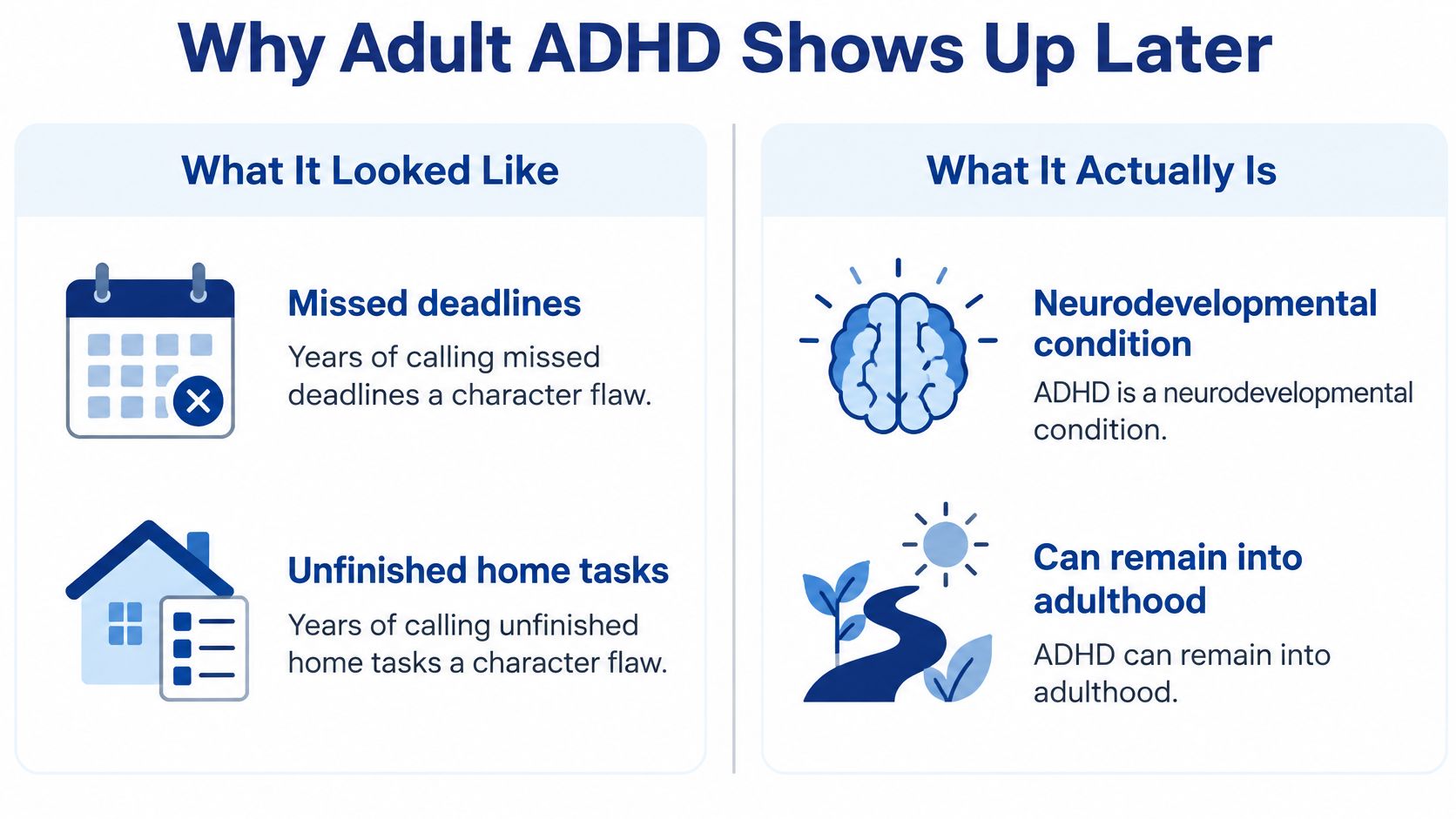
A past diagnosis that no longer causes trouble and a lifelong pattern nobody ever named are two different things. Both are common, and only one needs treatment now.
A history of diagnosis does not, by itself, mean someone needs treatment today. The present-day effect matters. The reverse can happen too: focus problems that seem new may trace back to childhood, when they were understood as anxiety, depression, stress, or personality.
The story has two parts: how life is going now, and what school and home were like earlier. ADHD can coexist with apparent success, so the question is not whether someone kept up. It is how much effort, structure, or strain it took to do so. A screener may help organize questions, but it cannot settle the diagnosis.
Adult ADHD Evaluation Beyond the Checklist
A screener is not a diagnosis. An ADHD diagnosis in adults is a clinical judgment built from a person's history, current impairment, and how symptoms behave across different settings. The evaluation itself is a functional, developmental assessment rather than a symptom checklist, as the NICE quality standard for ADHD sets out.
For starters, symptoms have to persist, show up in at least two important settings, and cause at least moderate trouble at work, school, home, or in relationships. For adults older than 17, the diagnostic threshold is five symptoms in the inattention or hyperactivity and impulsivity domain rather than the six required in children, according to CDC data on ADHD in adults. Five is still a pattern, not a bad Tuesday.
Here's how the pieces of a real evaluation divide the work.
| Piece of the visit | What it is meant to show | What it cannot do alone |
|---|---|---|
| Clinical interview and mental-status exam | Current symptoms, history, and how the person thinks and feels today | It is not a diagnosis from a symptom count |
| Developmental history | Signs before age 12, including school and home patterns | Missing records do not automatically end the evaluation |
| Cross-setting impairment | Moderate trouble in at least two areas such as work, home, school, or relationships | Problems in only one setting are not enough |
| Collateral history when available | A parent, partner, or old report that confirms early patterns | Lack of a witness does not by itself rule ADHD out |
| Differential diagnosis | Anxiety, depression, trauma, sleep, substances, medicines, or medical illness | A positive ADHD screen does not exclude these |
| Rating scales | A baseline number and a way to track change | A scale never establishes the diagnosis by itself |
Where the picture gets muddy
Concentration problems have a long list of causes, and most of them are treatable on their own terms. Depression flattens attention. Anxiety pulls it toward threat. Trauma, chronic poor sleep, alcohol or stimulant use, thyroid disease, and even a new blood pressure medicine can all imitate the pattern. So can an unrecognized learning disorder or an autism spectrum profile.
This is why adult diagnosis without a childhood history deserves specialist eyes. The work is less about counting symptoms than about explaining why this person, in this life, struggles in these specific ways.
Why capable adults get missed
Functioning well is not a negative test. A nurse who runs a flawless shift may come home and be unable to start dinner. A student who follows every lecture may stare at a blank document until 2 a.m. A manager may stay late redoing work colleagues finished at five. Sustained overwork, perfectionism, crisis-driven productivity, and a partner who handles the logistics can all hide substantial impairment.
Disparities compound the problem. A 2025 consensus statement on telepsychiatry and ADHD care cites continuing underdiagnosis alongside sex, racial, and ethnic gaps in diagnosis and treatment, and describes delayed diagnosis among women, racial and ethnic minorities, and people with high intelligence.
Practical rule: one setting and one symptom list is a conversation starter, not an evaluation.
The overlap with anxiety trips up more adults than any other pairing, and a comparison of ADHD and anxiety helps separate a lifelong attention pattern from a worry-driven one. For a plain-language walk through how the traits show up outside a clinic, explore adult ADHD traits before your appointment.
What to bring to a telehealth visit
Board-certified psychiatric mental health nurse practitioners at Integrative Psychiatry of America complete ADHD evaluations for children ages 6 and older, adolescents, and adults through secure telepsychiatry, so the history has to be gathered deliberately rather than assumed from a form.
- Work examples. The report you rebuild three times, the shift you arrive early for but can never start on time.
- Home and money evidence. Late fees, unopened mail, the tax paperwork, the appointment you missed twice.
- Relationship friction. Losing the thread mid-conversation, interrupting, the recurring argument about unfinished chores.
- Childhood traces. Report card comments, a relative's memory of the desk you couldn't keep tidy, the class you nearly failed.
- A collateral voice when one exists. A partner, sibling, or old teacher who can describe you before age 12. It doesn't have to be a parent.
Medication and Therapy After Diagnosis
Medication helps many adults with ADHD. It does not help all of them, and the published numbers describe group averages rather than a forecast for one person.
An adult pharmacotherapy meta-analysis found a pooled treatment effect of about Cohen's d = 0.65 against placebo, with stimulants at d = 0.67 and nonstimulants at d = 0.59. Another adult meta-analysis reported symptom effects against placebo of SMD -0.89 for lisdexamfetamine, -0.64 for mixed amphetamine salts, and -0.50 for methylphenidate.
Read those figures as evidence that the drugs work on average, not as a promise. They come from short controlled trials, and a moderate average effect leaves plenty of room for a strong response, a partial one, or none at all.
Titration is measurement, not guesswork
Treatment usually starts low and climbs in small steps until the target improves or side effects get in the way. The target should be concrete: finishing the report before the deadline, calmer highway merges, a steadier mood at 6 p.m. Symptom scores alone miss most of what matters.
Monitoring runs alongside the dose changes.
- Heart rate and blood pressure before treatment starts, after dose changes, and about every six months.
- Weight and BMI when appetite or weight shifts.
- Sleep, anxiety, and appetite at each visit, since these are the reasons people stop treatment early.
- Cardiac symptoms and misuse risk, especially with stimulants.
- A specialist medication review at least once a year.
When medication is not enough, not wanted, or not available
Consumer articles tend to frame treatment as picking a stimulant and moving on. Shared care guidance for adults with ADHD sets out what follows a prescription: blood pressure, pulse, weight, appetite and cardiac symptoms, plus psychiatric effects such as anxiety, mood change, psychosis, or substance-use concerns.
The same guidance keeps medication and behavioral therapy as the mainstays, treats evidence for alternatives such as diet or neurofeedback as limited, and favors hybrid models that combine in-person and telehealth care.
The decision itself is tied to impairment, not to a label. NICE guideline NG87 recommends medication when symptoms keep causing significant impairment in at least one area of life after practical changes have been tried and reviewed, and it names clear reasons to consider non-drug treatment: an informed decision against medication, trouble sticking with it, no benefit, or intolerable side effects.
Medication is also less universal than it looks. In 2023, 50.4% of U.S. adults with current ADHD reported being prescribed ADHD medication in the previous 12 months, according to a National Center for Health Statistics analysis. Roughly half were not.
| Option | Usual role | What to monitor | When it may fit poorly |
|---|---|---|---|
| Methylphenidate stimulants | Often a first medication trial; short-trial symptom effect about SMD -0.50 versus placebo | Blood pressure, pulse, sleep, appetite, anxiety, misuse | Heart risk, severe appetite loss, or supply problems |
| Amphetamine stimulants, including mixed salts and lisdexamfetamine | Often a first or next stimulant trial; short-trial effects about SMD -0.64 and -0.89 | Same physical checks plus emotional side effects | Worsening anxiety, insomnia, or diversion risk |
| Nonstimulants such as atomoxetine | When stimulants fail, are not tolerated, or misuse risk is high; group effect near d=0.59 | Mood, pulse, blood pressure, adherence, drug-specific warnings | Someone who needs a fast effect or cannot take the medicine daily |
| No ADHD medicine yet | Appropriate while diagnosis, differentials, or safer supports are still being sorted | Symptoms and impairment without assuming a prescription | Significant impairment that persists after practical changes have been tried |
The skills plan that sits under the medication
Medication changes what's possible. Skills decide what happens on a Wednesday.
Fix a wake time and protect it, because a stimulant can't rescue a shifting sleep schedule. Move daily, even briefly, since exercise supports mood and attention without pretending to be a cure. Eat protein at breakfast before the dose lands, which makes appetite loss easier to manage later. Check alcohol and other substance use, since that conversation changes which medicine is safe. Then carve out one protected focus block for the task that matters most.
For the behavior side of attention, fewer triggers, better things to do is a practical read on shaping your environment instead of relying on willpower. Therapy and prescribing aren't rivals either; what a psychologist can add to adult ADHD care explains where skills work fits.
Providers at Integrative Psychiatry of America conduct evaluations and, when clinically appropriate, prescribe and manage ADHD medications in line with current Pennsylvania and federal telehealth prescribing rules.
Two Pennsylvania Paths Through Care
Two composites show how differently the same diagnosis can play out. Both started with a telehealth ADHD evaluation. Neither is a real patient, and neither outcome is guaranteed.
Allentown, 41. A project coordinator has been treated for anxiety since 2019. The worry improved. The hours lost to unfinished tasks did not. Her evaluation rebuilds a quiet childhood of lost homework and a report card note about not applying herself, screens sleep and trauma, and lands on inattentive ADHD alongside anxiety. The first stimulant sharpens her focus and worsens her evening worry. The plan pivots to a nonstimulant, weekly CBT skills work, and a blood pressure recheck at the next visit. What she tracks is narrower than a symptom score: missed shifts, calmer driving, fewer 11 p.m. spirals.
Pittsburgh, 20. A sophomore understands every lecture and cannot begin a paper. A parent's account of half-built projects since elementary school supports early signs. After campus supports are reviewed, a stimulant trial targets one measurable outcome, work submitted on time, with appetite, sleep, and misuse risk checked at follow-up. His markers are submitted assignments and fewer all-nighters, not a mood rating.
Notice how the pivots differ. One changed medication class because side effects undercut the benefit. The other stayed on the same plan and changed the measure of success.
Before you book: write down three examples of impairment and one honest sentence about sleep, anxiety, and substance use.
That single page of notes does more for a first appointment than a dozen online quizzes. If depression, PTSD, or a substance problem is also in the picture, it reorders the plan, because treating an untreated mood or sleep problem first sometimes changes what the attention picture looks like.
Frequently Asked Questions About Adult ADHD Care
Can adult ADHD be evaluated by telehealth? Yes, when it's clinically appropriate and the history is gathered carefully. Expert consensus favors hybrid care that blends in-person and virtual visits, and virtual assessment is used when clinically warranted. The quality of the interview matters more than the camera.
Do I need my childhood school records? No. An evaluation can rebuild early functioning from your memories and from someone who knew you then. Records help when they exist, and their absence doesn't end the process.
Is ADHD medication always a stimulant? No. Nonstimulants such as atomoxetine are real options when stimulants fail, aren't tolerated, or carry meaningful misuse risk. They tend to work more slowly.
Does starting medication mean lifelong treatment? No. Treatment is a decision reviewed over time, with at least yearly medication review, and changes are based on how life is going rather than a fixed end date.
Will my insurance cover an evaluation? Coverage can't be guaranteed. Benefits, copays, deductibles, network status, and prior authorization vary by plan, so verify benefits with your plan before scheduling.
Start Adult ADHD Care in Pennsylvania
The next step depends on whether you need an evaluation, follow-up, or help sorting out what symptoms mean. Choose one starting point, then take it at a pace you can manage.
| Situation | Appropriate next step | First action |
|---|---|---|
| Difficulties affect work, home, or school, and you have no diagnosis | ADHD evaluation covering symptoms and their impact | Verify insurance |
| You already have a diagnosis and have a medication question or follow-up due | Medication management with a scheduled review | Request an appointment |
| Anxiety, depression, PTSD, or substance use is also part of your history | ADHD evaluation and assessment of related concerns | Request an appointment |
| You are unsure whether symptoms may be ADHD | Use a free Adult ADHD Screener to prepare for a visit | Review your results and request an appointment if you want to discuss them |
A screener can help organize your questions, but it cannot establish a diagnosis. If difficulties have continued since childhood and affect more than one part of life, a clinical evaluation can examine how your functioning developed over time. Looking successful from the outside does not by itself answer whether ADHD is affecting the effort it takes to manage daily responsibilities.
For an existing diagnosis, medication is one part of follow-up. Medication management includes reviewing how treatment fits your actual week and arranging a follow-up, rather than treating a medication choice as the whole plan.
Integrative Psychiatry of America offers ADHD evaluations and ongoing medication management for children, adolescents, and adults through secure telepsychiatry in Pennsylvania. Board-certified psychiatric nurse practitioners provide this care. To learn about adult ADHD evaluations and treatment, or to ask about related concerns such as anxiety, depression, or PTSD, you can request an appointment.
Free tools can help you prepare for that conversation. The Adult ADHD Screener, Anxiety Symptom Checker, 5-4-3-2-1 Grounding Tool, Focus Block Planner, and My Self-Care Tracker are among the 15 tools in the practice's library. Use a screener result as a starting point for discussion, not as a diagnosis.
Before scheduling, check your plan or ask the practice to help you verify your coverage. Benefits, copays, deductibles, network status, and prior authorization requirements vary by plan, so coverage cannot be assumed.
If you recognize these patterns, consider requesting an evaluation or checking your insurance before scheduling. An appointment can begin a careful assessment of how symptoms affect your life and what follow-up may fit your needs. Visit Integrative Psychiatry of America to request an appointment or verify your insurance.