
A lot of adults in Pennsylvania start looking into ADHD care the same way. They miss another deadline, forget an important appointment, lose track of a conversation halfway through, or feel exhausted from working twice as hard as everyone else just to stay organized. Then comes the second frustration. Finding an evaluation that feels legitimate, affordable, private, and available.
A telehealth ADHD evaluation can be a practical first step when it's done the right way. It isn't a quick quiz or a rushed medication visit. A real assessment is a structured clinical process designed to answer a bigger question: is ADHD the best explanation for what's going on, or is something else contributing?
For adults in Philadelphia, Pittsburgh, Harrisburg, Erie, Scranton, Allentown, Lancaster, Reading, and throughout Pennsylvania, virtual assessment can make specialty care easier to reach. According to CDC data, approximately 46.0% of adults with ADHD reported ever receiving telehealth services specifically for their condition, and 15.5 million U.S. adults, or 6.0% of the population, had a current ADHD diagnosis in 2023. Nearly half were diagnosed in adulthood, which reflects how often symptoms are missed earlier in life (CDC ADHD telehealth data).
Table of Contents
- What a Comprehensive Telehealth ADHD Evaluation Includes
- Benefits and Limits of Remote ADHD Assessment
- Preparing for Your Virtual ADHD Appointment
- Pennsylvania Insurance and Documentation Explained
- From Diagnosis to a Personalized Treatment Plan
- Your Next Steps for ADHD Care in Pennsylvania
What a Comprehensive Telehealth ADHD Evaluation Includes
A legitimate telehealth ADHD evaluation looks a lot more like building a clinical case than taking an online symptom quiz. The clinician isn't just checking whether someone feels distracted. The clinician is trying to determine whether symptoms fit ADHD, whether they began in the right developmental pattern, whether they affect more than one area of life, and whether another condition explains the problem better.
According to the Sachs Center, a telehealth ADHD evaluation for adults is clinically valid and diagnostically equivalent to in-person assessment when it includes four core components: a detailed live clinical interview, validated standardized rating scales, collateral information gathering, and behavioral observation during the video session (telehealth ADHD diagnosis standards).
The parts that make the evaluation valid
A good evaluation usually starts with a live clinical interview over secure video. This is the backbone of the assessment. The clinician asks about current symptoms, childhood patterns, school history, work performance, relationships, sleep, substance use, medical issues, and past mental health treatment.
Then come validated rating scales. Tools such as the ASRS or DIVA-5 help organize symptom information in a standardized way. These forms don't replace clinical judgment, but they do add structure and reduce the chance that important symptom patterns are missed.
A third piece is collateral information when appropriate. For some adults, that may mean input from a spouse, partner, parent, or old records that help clarify whether attention and impulsivity problems have been longstanding. Collateral information isn't always required, but when the history is unclear, it can make the assessment stronger.
The fourth piece is behavioral observation during the video visit. Even on screen, clinicians can observe pace of speech, distractibility, fidgeting, response style, organization of thought, and how the patient manages the flow of the conversation.
Practical rule: If an ADHD diagnosis is based only on a short form and a brief medication visit, that's not a comprehensive evaluation.
For patients who want a deeper overview of structured assessment options, psychological testing for ADHD can help explain when broader testing is useful and when a strong clinical interview is enough.
What doesn't count as a real evaluation
Many adults have already taken online screening quizzes before booking care. Those can be useful for prompting questions, but they don't establish a diagnosis. A quiz can't sort out ADHD from anxiety, trauma, sleep deprivation, depression, substance effects, or burnout.
The peer-reviewed review on telehealth ADHD assessment describes a thorough live video consultation lasting two hours or more, with a detailed interview, standardized measures, and history gathering. It also notes that telehealth assessment has been shown to be as reliable and effective as in-person evaluation when validated tools and structured interviews are used, while some patients still perceive the quality as lower than in-person care (review of telehealth ADHD assessment).
A useful way to judge quality is to ask simple questions:
- How long is the evaluation: Longer visits usually allow a fuller history and better differential diagnosis.
- What tools are used: ASRS, DIVA-5, and structured clinical questioning are more meaningful than a generic checklist.
- Will the clinician review other explanations: ADHD shouldn't be diagnosed in isolation.
- Is there a feedback process: Patients should leave understanding the reasoning, not just the label.
Benefits and Limits of Remote ADHD Assessment
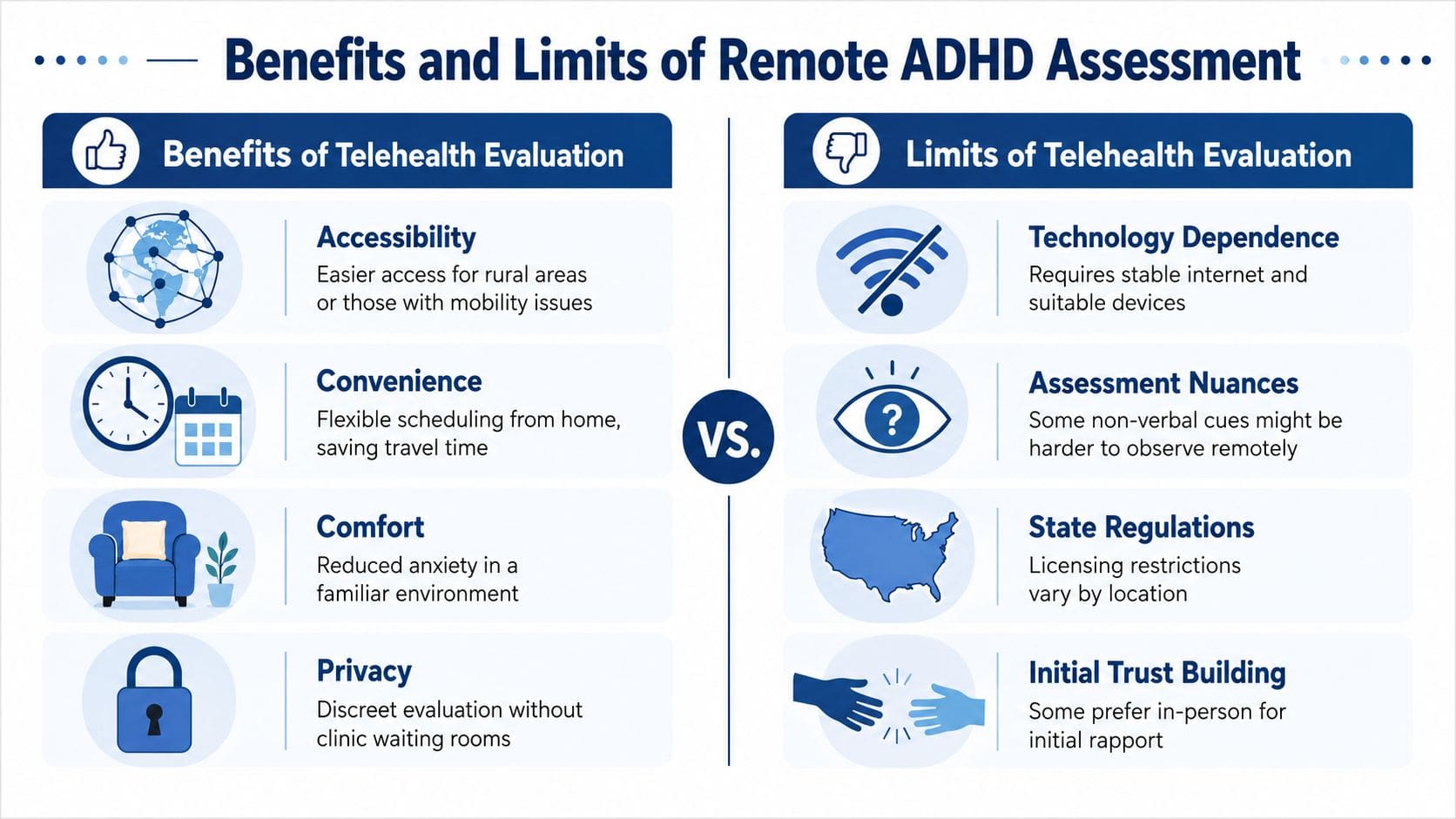
For many adults, remote assessment solves the hardest part of getting care. It cuts out travel, time off work, waiting rooms, and the challenge of finding a specialist nearby. That matters in a state as geographically varied as Pennsylvania, where access can look very different in Philadelphia than it does in Erie, Lancaster, or a smaller community between Harrisburg and Scranton.
Telepsychiatry for ADHD in Pennsylvania is clinically as effective as in-person care for diagnosis and medication management, and virtual clinics often offer appointments within a few days compared to weeks for traditional care, while also allowing direct scheduling without a referral (online ADHD treatment in Pennsylvania).
Where telehealth works especially well
For adults with packed schedules, telehealth often makes follow-through more realistic. A patient can attend from home, a private office, or another quiet location without losing half a day to transportation and waiting time.
It can also make the visit feel less intimidating. Some adults talk more openly from familiar surroundings than they do in a clinic setting. That can help when the conversation turns to academic struggles, work problems, shame, relationship strain, or years of feeling misunderstood.
A few practical strengths stand out:
| Situation | Why telehealth can help |
|---|---|
| Busy work schedule | Less disruption to the day and easier appointment logistics |
| Rural or smaller-town location | Access to statewide specialists without a long drive |
| Anxiety about appointments | Home setting can feel calmer and more private |
| Need for ongoing follow-up | Simpler scheduling can support consistency |
Patients who want to understand how privacy protections work during virtual care can review HIPAA compliance in telehealth.
When remote care has real limits
Telehealth isn't perfect, and pretending otherwise doesn't help patients. It depends on a stable internet connection, a device with functioning camera and audio, and a private place to talk freely. If the visit keeps getting interrupted by roommates, children, work messages, or poor connectivity, the quality of the assessment drops.
Some people also prefer face-to-face contact for the first appointment. That doesn't make telehealth less valid. It just means comfort and rapport matter.
Some adults are excellent candidates for a virtual ADHD evaluation. Others need a hybrid plan, especially when the history is unusually complex or safety concerns need closer assessment.
There is also an equity issue that often gets ignored. Telehealth has improved access, but it hasn't erased disparities. Research on underserved populations shows that youth who received telehealth ADHD evaluation were more likely to be older, White, healthier, and living farther from clinics, which means remote care doesn't automatically reach everyone equally (telehealth ADHD disparities research).
For most Pennsylvania adults seeking an ADHD evaluation, telehealth is a strong option. It works best when the technology is solid, the setting is private, and the provider uses a thorough process rather than a shortcut.
Preparing for Your Virtual ADHD Appointment
Preparation doesn't need to be complicated, but it does make the visit more useful. Adults often arrive knowing they struggle with focus or organization, yet they have trouble pulling specific examples together in the moment. A little planning helps the clinician see the pattern clearly.
What to gather before the visit
Not everyone has old report cards or childhood records, and that's fine. The goal isn't to build a perfect file. The goal is to bring anything that helps show how symptoms have affected daily life over time.
Helpful items may include:
- Past school records: report cards, teacher comments, testing records, or any notes about distractibility, unfinished work, or behavior
- Work examples: performance reviews, recurring feedback about lateness, follow-through, missed details, or organization
- Prior treatment history: names of medications, therapy experiences, prior diagnoses, and anything that helped or didn't help
- Current medication list: prescriptions, supplements, and over-the-counter products
- Personal notes: examples of forgetfulness, procrastination, impulsive spending, emotional reactivity, or chronic disorganization
A broader online mental health evaluation can also identify when attention problems overlap with anxiety, depression, OCD, PTSD, or sleep-related concerns.
How to make the appointment go smoothly
The visit itself goes better when the environment is set up in advance. A rushed start usually leads to unnecessary stress.
A simple checklist works well:
- Choose a private location. Bedrooms, parked cars, or work break rooms can work if they are quiet and confidential.
- Test technology ahead of time. Check camera, microphone, internet connection, and login details.
- Use headphones if possible. They improve privacy and sound quality.
- Set aside enough time. Don't schedule the visit in the middle of errands or between meetings if it can be avoided.
- Write down questions. Common ones include whether symptoms fit ADHD, what happens if the diagnosis is uncertain, and what treatment options follow.
One practical strategy is to track symptoms for several days before the appointment. A short daily log of missed tasks, distractibility, emotional shifts, and sleep patterns gives the clinician real examples instead of vague impressions. Patients often find that tools such as a Daily Agenda Planner or Feeling Journal make this easier because they turn frustration into observable patterns.
The better the examples, the better the evaluation. "I've always been scattered" is less useful than "I miss deadlines, leave tasks half-finished, and lose track of conversations at work."
If a partner or family member has noticed patterns that the patient tends to minimize, it can help to jot those down too. ADHD symptoms often become clearest when daily life is described in concrete terms.
Pennsylvania Insurance and Documentation Explained
Cost and insurance questions stop many people before they even book. That's understandable. Patients don't just want to know whether the evaluation is clinically sound. They want to know whether it's covered, what paperwork they'll receive, and what to do if coverage is limited.

What insurance usually covers in Pennsylvania
Pennsylvania gives patients an important baseline protection. According to the Pennsylvania Department of State, Medical Assistance permanently reimburses behavioral health services delivered via telemedicine after October 31, 2022, and commercial insurance must cover telehealth services when they are provided by in-network providers (Pennsylvania telemedicine FAQ).
That doesn't mean every plan covers every service in the same way. Patients still need to verify details such as:
- Whether the provider is in network
- Whether the visit is billed as an evaluation, medication management visit, or therapy visit
- What copay, deductible, or coinsurance applies
- Whether prior authorization is required
When a plan has a high deductible or limited behavioral health benefits, patients may need to compare self-pay and insurance-based options carefully. General budgeting resources on ways to reduce healthcare costs can help patients think through questions to ask before committing to care.
Some patients also compare formal testing fees across settings before choosing an evaluation path. A practical starting point is how much ADHD testing costs, especially when deciding between a full diagnostic workup and a narrower medication-focused assessment.
What documentation patients receive
After a thorough evaluation, patients should expect more than a verbal impression. They should receive clear documentation of the clinician's findings, diagnostic reasoning, and recommendations. That report becomes part of the medical record and can guide future treatment.
For some adults, documentation may also matter outside treatment. Workplace accommodations, academic support requests, or coordination with a primary care clinician often require a clear statement of diagnosis and functional impact.
The administrative side of care is easier to handle when patients ask direct questions before the first appointment:
- Will there be a written diagnostic summary
- Can documentation support work or school accommodations when clinically appropriate
- How are follow-up visits scheduled if treatment starts
- What records should be sent in advance
This short video gives a helpful overview of telehealth logistics and access questions that often come up during the planning stage.
Insurance coverage makes care more reachable, but patients still need to confirm the details before the visit. The difference between "covered" and "covered under this plan with this provider" matters.
From Diagnosis to a Personalized Treatment Plan
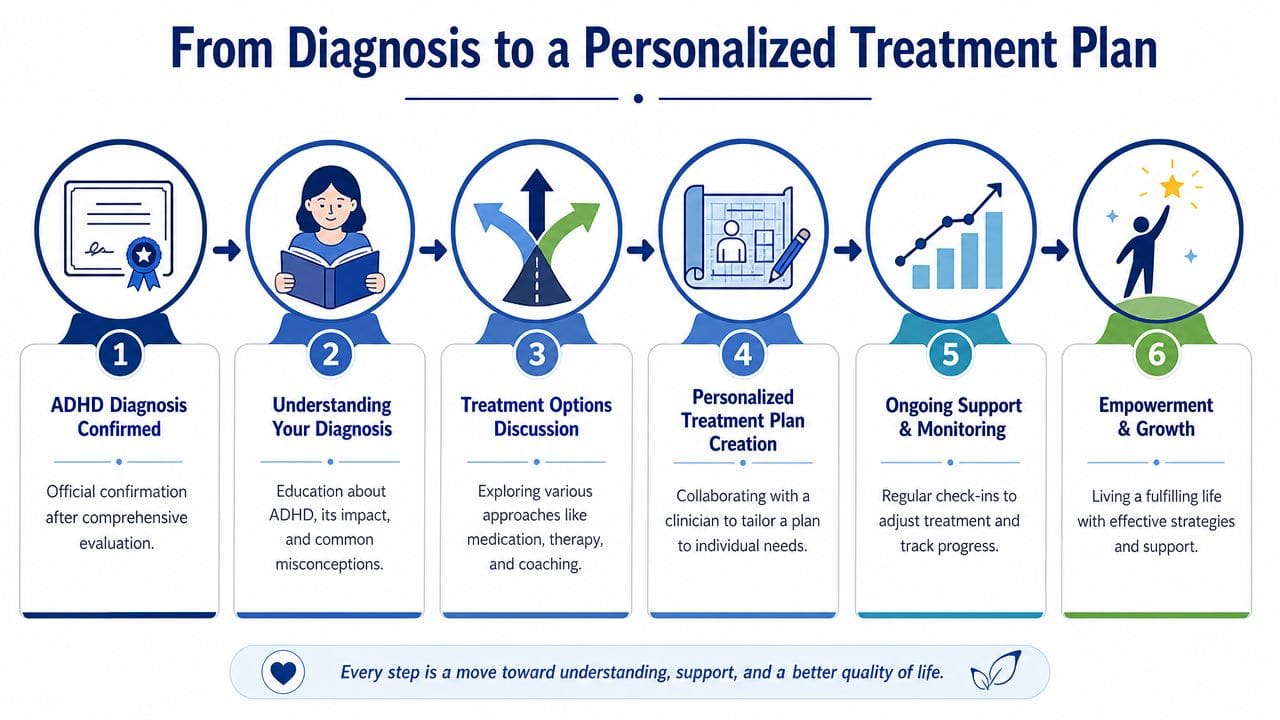
A diagnosis doesn't fix anything by itself. What it does is create a clearer map. Once the evaluation identifies ADHD, or identifies ADHD alongside another condition, treatment becomes more targeted and much less guesswork-driven.
Diagnosis is the starting point
A careful clinician doesn't assume every concentration problem is ADHD. Anxiety can impair attention. Depression can slow thinking and motivation. PTSD can cause distractibility and hypervigilance. Poor sleep, substance use, chronic stress, and certain medical issues can look similar on the surface.
That is why differential diagnosis matters. The evaluation should sort out whether ADHD is the main issue, one part of a larger picture, or not the best diagnosis at all.
For adults whose symptoms do fit ADHD, the next step is a treatment plan matched to their goals and risks. Some need help with work performance. Others are trying to manage emotional impulsivity, relationship strain, missed appointments, or chronic task paralysis. The treatment plan should reflect the actual problems that brought the patient in.
A structured treatment discussion may include:
| Treatment area | What it may address |
|---|---|
| Medication management | Attention, impulsivity, restlessness, task initiation |
| Therapy or skills-based support | Routines, coping strategies, emotional regulation |
| Lifestyle interventions | Sleep habits, exercise, nutrition, daily structure |
| Monitoring and follow-up | Side effects, symptom response, dose adjustment, safety |
Medication and non-medication treatment options
In Pennsylvania, telehealth can include medication treatment when the evaluation supports it and legal requirements are met. In 2026, psychiatric nurse practitioners licensed in Pennsylvania can prescribe Schedule II ADHD stimulants via live-video telehealth without an initial in-person visit, provided the federal extension through December 31, 2026 remains active, and the visit includes live video evaluation, state licensure, and PDMP checks (PMHNP ADHD prescribing in Pennsylvania).
That matters for adults who need access to treatment without unnecessary travel. It also makes the quality of the initial evaluation even more important. If medication is being considered, the prescriber should understand the full clinical picture before starting anything.
Medication isn't the whole plan for most adults. Many benefit from practical strategies for planning, emotional regulation, task initiation, and follow-through. Some also do well with exercise routines, sleep stabilization, and environmental changes that reduce friction in daily life. For working adults trying to apply those changes right away, these ADHD productivity tips for professionals can be a useful companion to treatment.
For patients who are weighing medication options, ADHD medication information can help explain how stimulant and non-stimulant treatment decisions are made in routine care. Integrative Psychiatry of America also offers virtual psychiatric evaluation and medication management for adults in Pennsylvania through secure telehealth, alongside broader treatment planning that may include lifestyle and behavioral strategies when clinically appropriate.
A good treatment plan should feel specific. "Let's see how it goes" isn't enough. Patients should know what is being treated, how progress will be judged, and when adjustments will happen.
Follow-up matters because ADHD treatment is rarely one-and-done. Medication response, side effects, life stressors, sleep, and coexisting anxiety or depression all influence what works over time.
Your Next Steps for ADHD Care in Pennsylvania
If ADHD has been affecting work, relationships, school, finances, or daily functioning, the next step doesn't have to be complicated. A telehealth ADHD evaluation gives many Pennsylvania adults a valid and practical way to get answers without waiting for the perfect moment.
The strongest path is usually simple. Find a licensed Pennsylvania clinician who performs a full evaluation, verify insurance or self-pay details, gather a few records or symptom examples, and book the appointment. Adults in Philadelphia, Pittsburgh, Harrisburg, Erie, Scranton, Allentown, Lancaster, Reading, and statewide can often do all of that from home.
It also helps to think in terms of clarity rather than labels. The point of an evaluation isn't just to confirm ADHD. The point is to understand what has been making life harder and what type of treatment is most likely to help.
For patients who aren't ready to book immediately, a useful first step is self-screening and symptom tracking. Tools such as an Adult ADHD Assessment, Anxiety Symptom Checker, Daily Agenda Planner, Feeling Journal, Exercise Routine Generator, and 5-4-3-2-1 Grounding Tool can help organize symptoms before the visit and make the clinical conversation more productive.
The hardest part for many adults is moving from endless searching to one concrete action. Scheduling an evaluation, checking insurance, or gathering documentation is often enough to break that cycle and start care.
If ADHD symptoms are interfering with daily life, Integrative Psychiatry of America offers virtual psychiatric evaluations, medication management, and evidence-informed mental health treatment for adults across Pennsylvania. Patients can review treatment options, verify insurance coverage, schedule an appointment online, or explore free tools like the Adult ADHD Assessment, Anxiety Symptom Checker, Daily Agenda Planner, Feeling Journal, Exercise Routine Generator, and 5-4-3-2-1 Grounding Tool before getting started.