
You've been putting this off because the process sounds murky. A child's teacher keeps flagging attention problems, a college student can't finish readings, or an adult in Philadelphia or Pittsburgh has been compensating for years and finally wonders whether ADHD testing in Pennsylvania could explain what's going on.
The hard part is sorting real evaluation from fast screening. A responsible ADHD evaluation Pennsylvania families can trust is not a quiz, a blood test, or a quick checklist. It's a clinical process that looks at symptoms, development, functioning, and the conditions that can look just like ADHD.
Table of Contents
- Why ADHD Testing in Pennsylvania Matters Now
- What ADHD Testing Evaluates
- How an ADHD Evaluation Works Step by Step
- Telehealth vs In-Person ADHD Testing in Pennsylvania
- Who ADHD Testing Often Misses and How to Avoid a False Negative
- Insurance, Cost, and Documentation for ADHD Testing
- Preparing for and Choosing an ADHD Provider in Pennsylvania
- Next Steps and Where to Start ADHD Testing in Pennsylvania
Why ADHD Testing in Pennsylvania Matters Now
A lot of people start looking up ADHD testing near me only after years of patching over the same problem. A professional in Philadelphia may be using reminders, caffeine, and extra hours just to stay afloat. A parent in Pittsburgh may be watching homework turn into a nightly battle. A graduate student in Harrisburg may keep rereading the same paragraph and still miss the point.
That pattern is not rare in Pennsylvania. School-health records from 2016 to 2017 show 51,794 students with a medical diagnosis of ADHD statewide, and one county grouping in the state PDF listed 56,304 students, which shows how embedded ADHD identification already was in Pennsylvania school systems by that point, not just in clinics (Pennsylvania school-health PDF). More recent CDC-linked state estimates put Pennsylvania's current ADHD prevalence at 9.3% in children, which helps explain why access is such a major issue (CDC-linked Pennsylvania estimate).
Three common paths to care
Families usually arrive with one of three goals. Some adults want a first-time ADHD diagnosis Pennsylvania evaluation after years of coping without an answer. Some parents want child ADHD testing Pennsylvania because school performance, behavior, or emotional regulation has changed. Some students and professionals need documentation for accommodations, work, or college.
Practical rule: if symptoms are affecting school, work, home, or relationships, it's reasonable to seek a real ADHD assessment Pennsylvania rather than guessing from a screening questionnaire.
That's especially important in a state where demand is high and options can feel fragmented. If access has felt confusing, the broader context in Pennsylvania's behavioral health workforce helps explain why many people wait longer than they should before getting assessed, which is covered in this overview of the mental health provider shortage in Pennsylvania.
For adults, parents, and students, the takeaway is simple. A fair evaluation exists, and the process is more structured than most online search results suggest.
What ADHD Testing Evaluates
ADHD testing is a structured diagnostic evaluation. Instead of relying on one laboratory result, one brain scan, or one score on an ADHD screening questionnaire, the process looks at the full clinical picture. The clinician is trying to answer a broader question, whether the pattern fits ADHD symptoms over time and across settings.
A careful ADHD psychiatric evaluation compares what the patient reports with DSM-5-TR criteria. The clinician looks for childhood onset, current impairment, and signs that the difficulties show up in more than one setting, such as home, school, college, or work. This distinction matters because executive dysfunction by itself is not a diagnosis. Concentration problems can also come from anxiety, depression, trauma, sleep disturbance, substance use, or medical issues, so the clinician must weigh those possibilities before labeling the problem as ADHD.
The three classic presentations are easier to understand in plain language:
- Inattentive ADHD, where distractibility, disorganization, forgetfulness, or losing track of tasks stands out.
- Hyperactive ADHD, where restlessness, impulsive action, or trouble sitting still is more prominent.
- Combined type ADHD, where both clusters are present.
A thoughtful clinician compares three sources at once, what the person says, what other people have noticed, and how the symptoms affect real life. That is why a generic note about “attention problems” usually is not enough for school or college documentation.
A valid evaluation asks, “What has this looked like over time?” not just, “Which boxes are checked today?”
Penn State's guidance says there is not a specific test that can determine ADHD, and diagnosis comes from a complete history with input from significant others and formal written or computer assessments (Penn State ADHD guidance). That approach fits adults, teens, and children alike. A careful evaluator may also use targeted psychological testing for ADHD when the history is unclear or when learning, mood, or attention concerns overlap, which is why a responsible clinic explains what each tool can and cannot show before anyone books.
For patients comparing ADHD diagnosis near me Pennsylvania options, the most useful question is not whether a clinic offers a quick test. It is whether the clinic evaluates development, function, and differential diagnosis with enough depth to avoid false positives.
How an ADHD Evaluation Works Step by Step
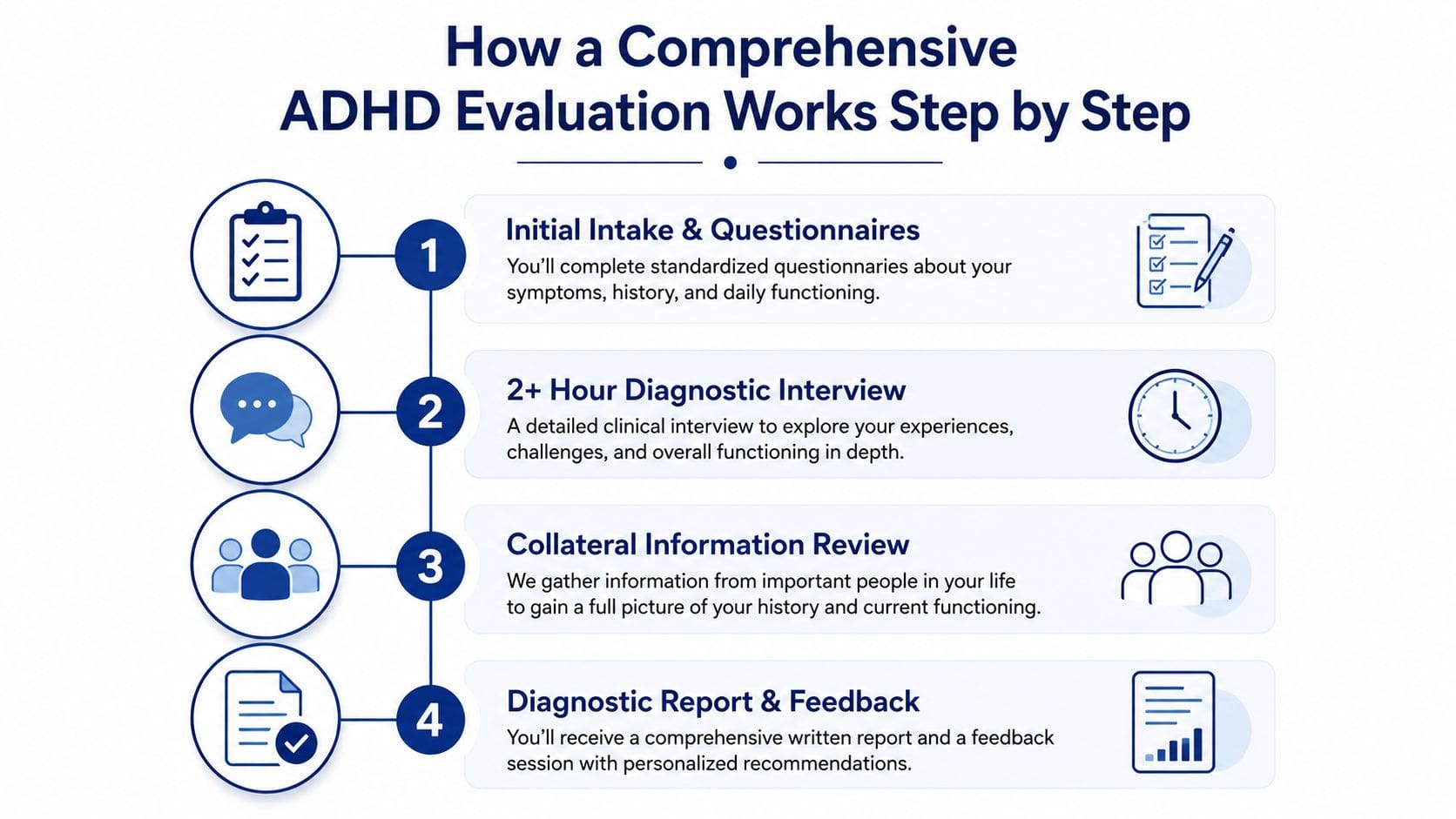
A careful adult ADHD testing or child ADHD testing process should feel methodical, not rushed. The sequence usually starts before the appointment, because good clinicians want context before they make conclusions.
Step 1. Intake and questionnaires
The first contact usually includes intake forms, symptom checklists, and background details about medical history, psychiatric history, school or work concerns, and current medications. These forms help the clinician prepare for the interview, but they do not diagnose anything by themselves. They are more like a map with landmarks than the trip itself.
Step 2. A long diagnostic interview
A strong ADHD evaluation online or in person often uses a semi-structured diagnostic interview that takes 2 hours or more when done properly (integrative psychiatry evaluation guidance). The clinician reviews childhood behavior, current symptoms, functional impact, sleep, mood, anxiety, trauma, and substance use. That time matters because rushed screening can blur ADHD with other conditions, especially when attention problems come from stress, burnout, or disrupted sleep. For people comparing a clinic's process with dedicated psychological testing for ADHD, the key question is whether the clinician is examining the full story or just checking boxes.
Step 3. Collateral information
If appropriate, the clinician asks for input from a partner, parent, or teacher. That step matters when the patient's own memory is incomplete, or when symptoms were obvious to others long before they were obvious to the patient. School records, report cards, and past evaluations can help show whether the pattern has been stable. A report card is often more useful than a single stressful week, because ADHD assessment is about patterns over time, not a snapshot.
Step 4. Differential diagnosis and medical safety
Pennsylvania Medicaid guidance says ADHD assessment should include a complete medical and psychiatric evaluation, DSM-5-based interview, rating scales such as Vanderbilt or Conners when available, and targeted labs or ECG only when clinically indicated, such as cardiovascular history or suspected drug use (PA Health & Wellness ADHD policy). The same policy lists computerized attention tests, education and achievement testing, hair analysis, IgG blood tests, and zinc measurement as investigational or unproven in that context (PA Health & Wellness policy). That matters because a responsible evaluator should sort ADHD from anxiety, trauma, sleep problems, depression, substance use, or burnout instead of assuming every attention complaint has the same cause.
If ADHD is confirmed, the next conversation is about ADHD treatment, which may include stimulant medication or non-stimulant medication depending on the person's profile and medical history.
Telehealth vs In-Person ADHD Testing in Pennsylvania
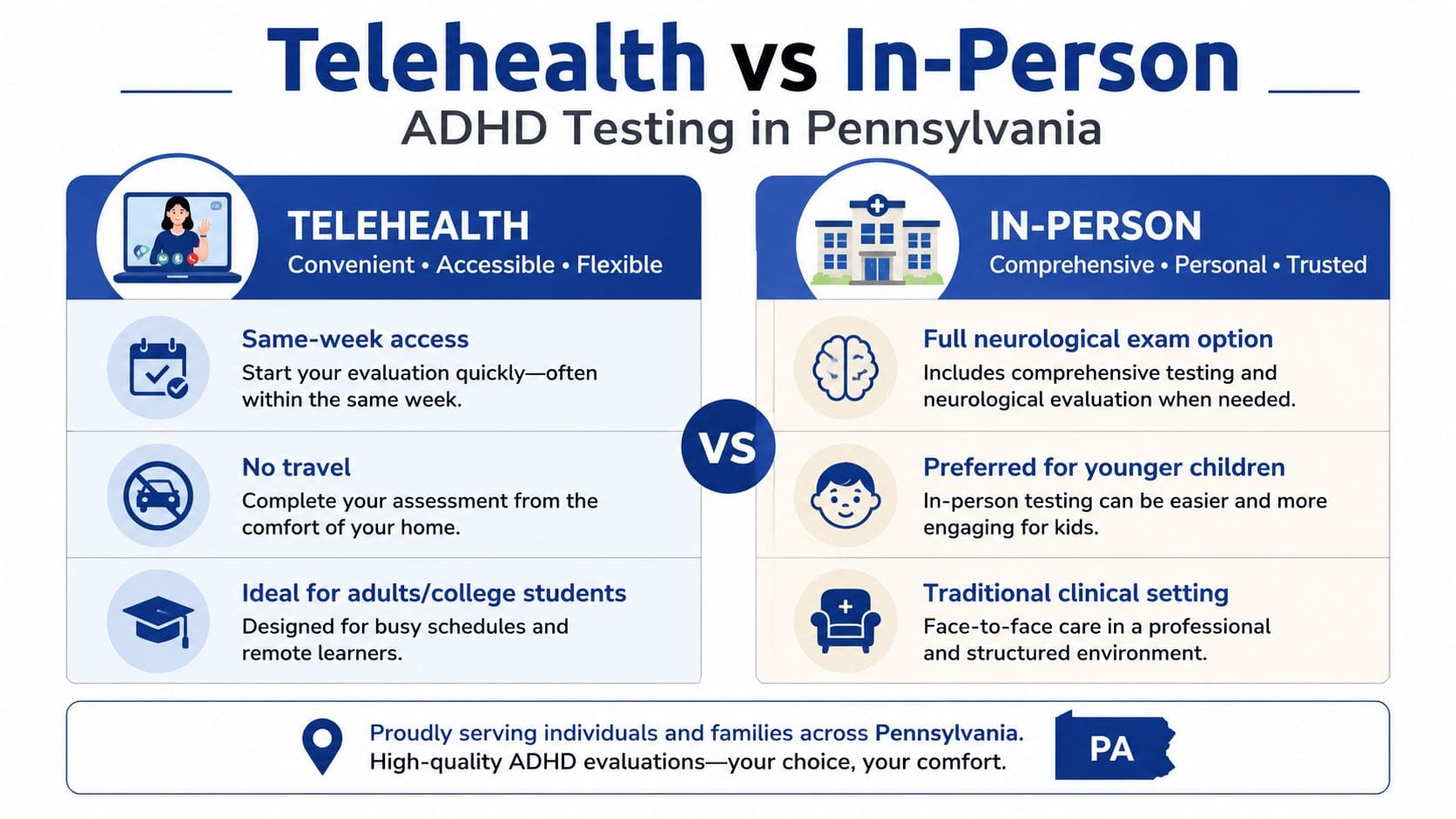
The right format depends on the person, not the marketing. For many adults and college students, virtual ADHD evaluation Pennsylvania care works well because it removes travel time, fits tighter schedules, and makes it easier to get seen without driving to Philadelphia, Pittsburgh, or another major center. Younger children and more complex diagnostic questions may still benefit more from in-person assessment.
When telehealth makes sense
Telehealth is often a strong fit for adults with longstanding symptoms, professionals who need flexibility, and students who want an online ADHD testing Pennsylvania option that doesn't require time off work or campus travel. It also supports people who are more comfortable discussing symptoms from home. Many people seeking ADHD evaluation online choose it primarily for access, not convenience alone.
When in-person care helps more
In-person testing may be a better fit when a clinician needs direct behavioral observation, broader neuropsychological data, or a younger child has trouble engaging on video. Some families prefer an office visit because it feels more structured. That structure can help when a child is easily distracted, distressed, or unlikely to tolerate a long virtual interview.
Limits and access considerations
Telehealth also has limits. Federal and Pennsylvania-focused research has noted that telehealth ADHD evaluations have tended to reach more older, White, and healthier patients, which means a virtual practice has to work actively to avoid repeating access gaps (HHS barriers to adult ADHD diagnosis). A good virtual model should be designed to widen access, not narrow it.
Best fit check: choose the format that lets the clinician gather the most accurate history, not the one that sounds fastest on a search result.
When Pennsylvania patients compare formats, the credential matters more than the medium. The evaluator should be a board-certified psychiatric provider who can diagnose and prescribe, not a coach or a short-form screener. Readers exploring a remote option can use telehealth ADHD evaluation details to see how a virtual visit is typically structured.

Who ADHD Testing Often Misses and How to Avoid a False Negative
A rushed ADHD screening Pennsylvania visit can miss people whose symptoms do not match the old classroom picture of a disruptive boy who cannot sit still. Many girls, women, Black children, and bilingual learners are misread because their symptoms may show up as forgetfulness, quiet drifting, shutdown, or internal restlessness instead of obvious disruption.
Why the misses happen
A large U.S. study found that Black children were less likely to have an ADHD diagnosis than observationally similar White children, girls were less likely than boys, and emergent bilingual children were much less likely than English-speaking peers; among children who did have ADHD, girls and emergent bilinguals were also less likely to use prescription medication (pubmed study on diagnostic inequities). The point is not that symptoms are absent. It is that the evaluation system can overlook them.
Adults are often missed for the same reason. Many women have spent years being told they are anxious, disorganized, overextended, or burned out, and sometimes those are real parts of the picture. In other cases, those labels reflect surface symptoms of ADHD that no one examined closely enough by asking about childhood onset, long-term patterns, and whether the symptoms interfere with work, school, home life, or relationships.
What a fair evaluation does differently
A careful clinician changes the process in several practical ways. In practice, that often means spending more time on developmental history, seeking collateral input from a parent, partner, or school record when available, and noticing inattentive symptoms that do not show up as classroom disruption. Cultural and language context also matter because a school, a family, and a clinician may interpret the same behavior very differently.
If the history feels off, the next step is usually a better evaluation, not self-blame.
People searching for ADHD testing for women, ADHD testing for executive dysfunction, or ADHD diagnosis for professionals need more than a generic checklist. They need an evaluator who understands how bias changes presentation and who will ask whether anxiety, sleep loss, trauma, or depression belong in the differential instead of forcing every symptom into one label.
The right workflow also means ruling out look-alikes before finalizing a diagnosis. A responsible Pennsylvania clinician should be skeptical of quick “tests” that promise certainty from a short form alone. The clinician should also stay alert to medical or psychiatric conditions that can mimic ADHD. This matters for adults, parents, and students alike because missed sleep, chronic stress, trauma reactions, and mood symptoms can blur the picture. Without a careful review, they can also lead to a false negative.
If cost is part of the concern, how ADHD testing costs are usually structured can help families compare what is being billed with what is being evaluated. Families also sometimes need to think about broader coverage questions, especially when a child's care affects household budgeting and insurance decisions. In that context, self-employed CHIP income rules can be useful background for Pennsylvania households reviewing coverage options.
Insurance, Cost, and Documentation for ADHD Testing
Coverage varies, but the logic is fairly consistent. Many insurers want a real diagnostic interview and screening for comorbid conditions before approving stimulant treatment. If the clinician thinks extra medical checks are needed, those can include ECG or lab work when there's a relevant cardiovascular or medical concern.
What payers usually care about
Commercial plans often treat the evaluation like a psychiatric visit, not a special “test package.” In Pennsylvania, Medicaid managed care policies may require a more specific medical workup before stimulant therapy. Because of that, ADHD evaluation covered by insurance can feel more detailed than a routine screening appointment. That extra detail serves a purpose, clinicians use it to catch medical mimics and medication risks.
Cost considerations and coverage paths
For families comparing cost paths, how ADHD testing costs are usually structured is a useful starting point. Some readers also need to think about broader benefits eligibility, especially if a child's care overlaps with family budgeting and insurance choices. In that context, self-employed CHIP income rules can be helpful background for Pennsylvania households reviewing coverage options.
Documentation for school and college
For accommodations, documentation is a separate issue from diagnosis alone. The University of Pennsylvania says that, in most cases, the evaluation should be completed within the past three years, use adult-normed instruments, and provide a specific ADHD diagnosis based on DSM criteria. Accommodation decisions depend on current functional impact (UPenn ADHD documentation guidelines). A note that only says “attention problems” is usually not enough.
What schools usually look for
| Requirement | Why it matters | Who usually needs it |
|---|---|---|
| DSM-based diagnosis | Shows the condition meets clinical criteria | Students, adults seeking treatment |
| Recent evaluation | Documents current impact | College and disability services |
| Adult-normed instruments | Improves fit for adult documentation | College students, working adults |
| Medical review before stimulants | Screens for safety issues | Patients considering medication |
| Collateral history | Confirms childhood onset and real-world impairment | Children, teens, adults without records |
Questions to ask before you pay
For readers comparing ADHD testing with insurance, self-pay, or membership options, ask what the visit includes. You can also ask whether the clinician will coordinate with primary care when medical issues need follow-up. A transparent clinic should explain that clearly before anyone books.
Preparing for and Choosing an ADHD Provider in Pennsylvania
The strongest first visit usually starts with preparation. A few documents and a short timeline can turn a vague conversation into a solid diagnostic workup.
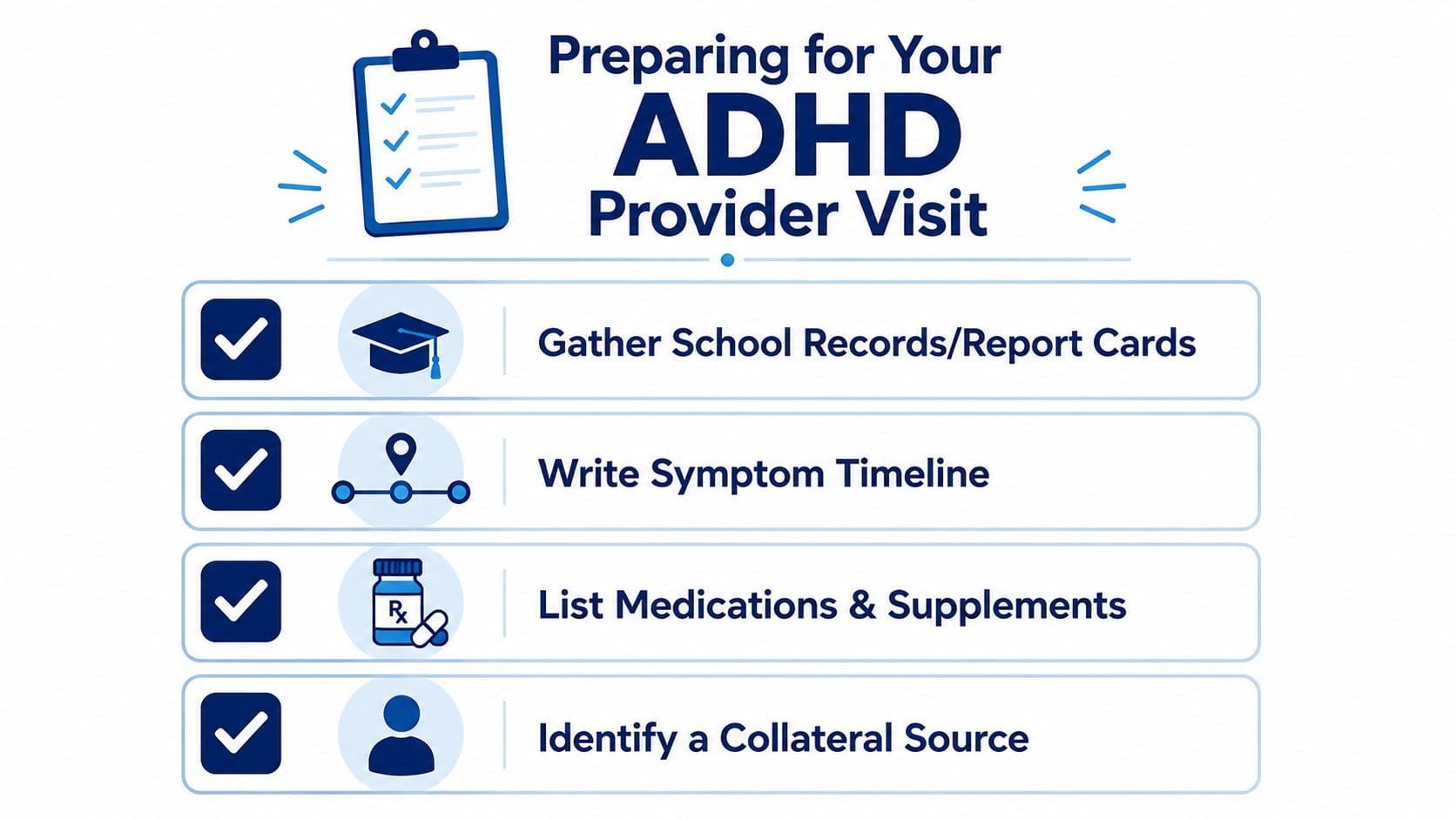
What to gather before the appointment
- School records or report cards. These help show whether focus, organization, or behavior problems were present earlier than the current crisis.
- A symptom timeline. Write down when the problems started, where they show up, and what makes them better or worse.
- Current medications and supplements. Stimulants, antidepressants, sleep aids, caffeine products, and supplements all matter.
- One collateral source. A parent, partner, teacher, or another adult who knew the patient earlier can add important context.
A first visit with a virtual psychiatric practice should cover medical history, psychiatric history, developmental history, and the next step after the evaluation. That is especially important for adults seeking an ADHD psychiatrist Pennsylvania option or families searching for an ADHD psychiatrist accepting new patients who can also prescribe medication if the diagnosis is confirmed. For a practical starting point, ADHD doctor near me can help readers understand what to look for in a provider.
What to ask before booking
A good Pennsylvania provider should be board certified or otherwise clinically trained to diagnose ADHD, willing to coordinate with primary care when needed, and transparent about pricing and follow-up expectations. For patients who want a virtual route, online ADHD specialist Pennsylvania care should still include real diagnostic depth, not a shortcut.
People also benefit from a clear onboarding process. Resources like onboarding steps for new clients can help patients understand how organized intake should feel before they sign up.
Simple filter: if the intake sounds like a sales call or a personality quiz, keep looking.
For some patients, a virtual psychiatric evaluation and medication-management visit with a practice like Integrative Psychiatry of America can fit that model, especially when the goal is evidence-based care across Pennsylvania. For others, especially young children or very complex presentations, a different setting may be more appropriate. The right choice is the one that gives the clearest answer.
Next Steps and Where to Start ADHD Testing in Pennsylvania
ADHD cannot be diagnosed with a single test. A proper evaluation looks at symptoms over time, childhood onset, real-world impairment, and other conditions that can mimic ADHD. That's why people in Philadelphia, Pittsburgh, Harrisburg, Erie, Scranton, Allentown, Lancaster, Reading, Bethlehem, and York often do best with a clinician who can slow the process down enough to get it right.
Virtual care is a legitimate path for many adults, parents, college students, and professionals across Pennsylvania. It can be a practical way to start ADHD diagnosis Pennsylvania care without waiting for an office slot that may be far away. The main question is whether the provider uses a serious diagnostic workflow and can guide treatment after the evaluation.
If symptoms have been getting in the way for a while, the next step doesn't need to be complicated. Verify insurance, schedule a virtual ADHD evaluation Pennsylvania visit, or use a symptom-tracking tool first if you want more clarity before booking.
Integrative Psychiatry of America offers virtual psychiatric evaluations, ADHD assessment, and medication management throughout Pennsylvania, which can be a practical fit for adults and families who want a thorough, evidence-based review without unnecessary travel. If you're ready to take the next step, visit Integrative Psychiatry of America to check coverage, explore care options, and start the conversation about ADHD testing in Pennsylvania.