
Work is piling up. Emails get starred and forgotten. Bills are paid late even when there's enough money in the account. A Pennsylvania adult might have spent years calling it stress, burnout, anxiety, or “just being bad at follow-through” before finally typing ADHD doctor near me into a search bar.
That search is reasonable. It's also more complicated than it looks. Adult ADHD care isn't only about finding the closest office. It's about finding a clinician who knows how to separate ADHD from sleep problems, anxiety, depression, thyroid issues, or substance use, and who can manage treatment over time instead of turning a complex condition into a rushed prescription visit.
Adult diagnosis is common. In the United States, an estimated 6.0% of adults, or 15.5 million people, had a current ADHD diagnosis in 2023, and about half were diagnosed in adulthood, according to the CDC's adult ADHD report. For Pennsylvanians trying to make sense of years of disorganization, impulsivity, or mental overload, that matters. Seeking an evaluation as an adult isn't unusual. It's part of mainstream care.
Table of Contents
- Starting the Search for Adult ADHD Care in Pennsylvania
- Where to Find Qualified ADHD Providers
- How to Evaluate and Choose the Right Provider
- Preparing for Your First ADHD Appointment
- Navigating Insurance and Affordability in Pennsylvania
- Take the Next Step with Integrative Psychiatry of America
Starting the Search for Adult ADHD Care in Pennsylvania
Many Pennsylvania adults start this search after a pattern becomes impossible to ignore. Deadlines get missed despite strong effort. A kitchen table fills with unfinished paperwork. Relationships strain because listening, planning, and follow-through keep breaking down. A person may function well enough on the outside while feeling internally scattered all day.

That's often the moment the search for an ADHD specialist, adult ADHD evaluation, or ADHD diagnosis in Pennsylvania begins. The first instinct is usually local. People look for an ADHD clinic, a mental health provider, or a telehealth ADHD provider nearby. That makes sense, especially if privacy, travel time, and scheduling already feel hard to manage.
Why local doesn't always mean better
The closest office isn't always the strongest fit. In Pennsylvania, someone in Philadelphia, Pittsburgh, Scranton, Harrisburg, Erie, or a smaller community may find that the nearest option has limited appointment availability, treats only children, or doesn't offer ongoing medication management and therapy coordination in one clear plan.
Practical rule: Search for the right level of expertise first, then decide whether that care should be in person, virtual, or hybrid.
A useful search starts with broader terms than “doctor.” ADHD care can involve a psychiatric nurse practitioner, psychologist, therapist, physician, or another licensed clinician, depending on the stage of care and treatment needs. For adults, the strongest fit is often the provider who takes history seriously, asks about work and home functioning, and can build a realistic follow-up plan.
What Pennsylvania adults usually need
For most adults, the need isn't just a label. It's a workable path that may include:
- A careful diagnostic review that looks beyond self-report
- ADHD testing or assessment that considers childhood patterns and current impairment
- Behavioral strategies for organization, procrastination, and emotional regulation
- Medication follow-up when clinically appropriate
- Telepsychiatry in Pennsylvania if distance or scheduling is a barrier
That's where the search becomes less about proximity and more about fit, access, and clinical quality.
Where to Find Qualified ADHD Providers
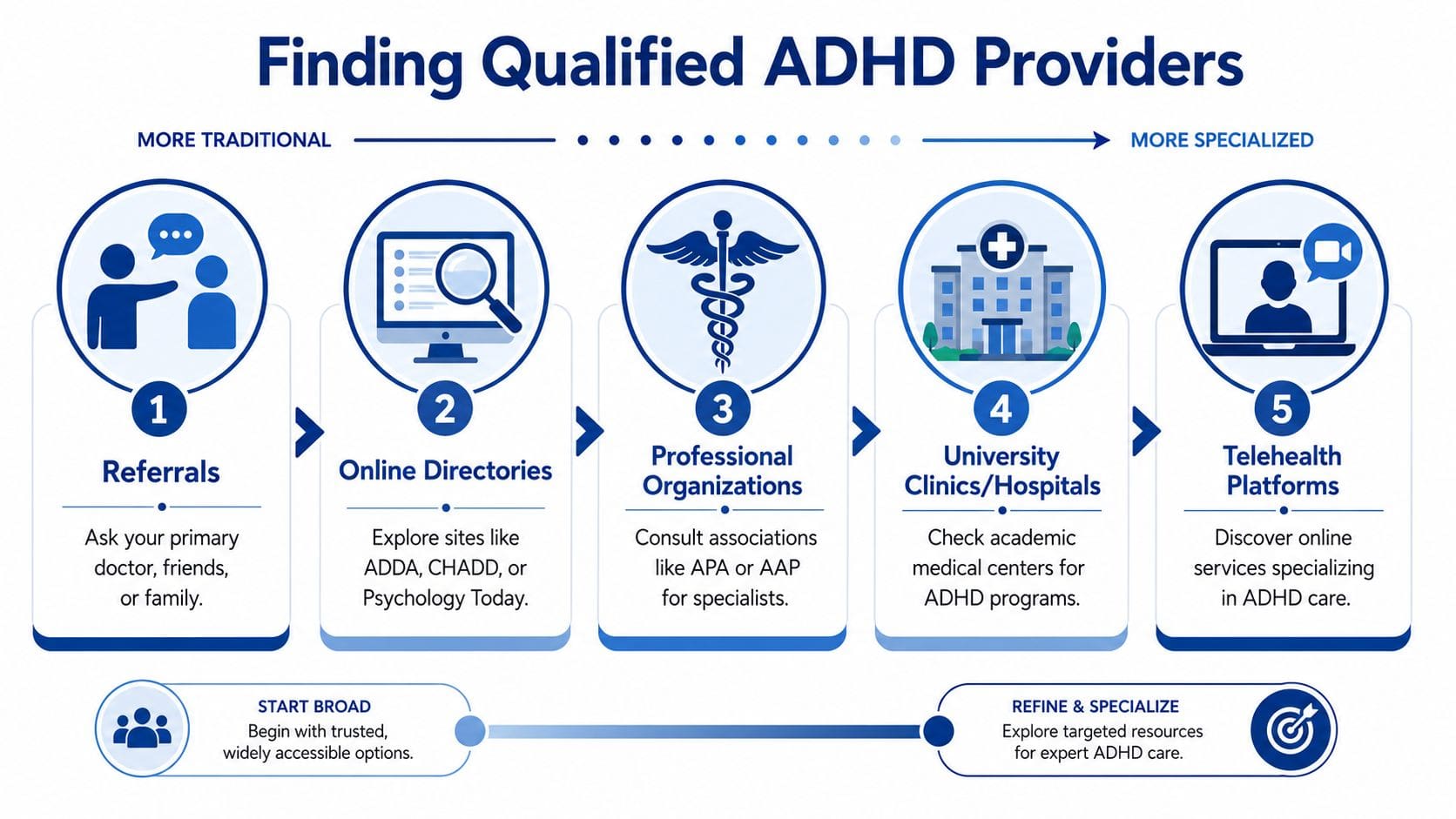
A broad search works better than relying on one directory. Many people type ADHD doctor near me, click the first few results, and assume those are the only realistic options. In practice, Pennsylvania residents usually need to compare several channels side by side.
Traditional routes that still work
Primary care referrals remain useful, especially when a family doctor already knows the patient's medical history. Insurance directories can also help narrow the field to in-network clinicians. Hospital systems and university clinics may offer more structured evaluation pathways, though they can be slower or more centralized.
CHADD notes that ADHD diagnosis and treatment may be provided by physicians, psychologists, social workers, and psychiatric nurse practitioners, among others, in its guidance on professionals who diagnose and treat ADHD. That matters because many adults limit their search to “psychiatrist near me” and accidentally overlook qualified clinicians who diagnose and treat ADHD every day.
Telehealth expands the Pennsylvania map
Telehealth changes the search in an important way. Instead of being limited to one zip code, a patient can often access a licensed Pennsylvania provider from anywhere in the state. For someone in a suburb, rural county, college town, or a city with long waitlists, that can make the difference between getting evaluated soon and putting it off again.
A statewide telehealth model can help with:
- Scheduling flexibility for working adults, parents, and students
- Privacy for people who don't want to sit in a local waiting room
- Continuity of care if travel, traffic, or distance make follow-up hard
- Broader provider choice across Pennsylvania instead of one neighborhood
One example is online ADHD care in Pennsylvania through Integrative Psychiatry of America, which offers virtual psychiatric care statewide through psychiatric nurse practitioners.
A short drive to the wrong clinician still leads to the wrong care plan.
A practical way to build a shortlist
Instead of choosing from one search result page, build a shortlist from several sources:
- Start with insurance. Check which ADHD providers, therapists, and medication prescribers appear in your plan's directory.
- Ask primary care for names. A family doctor often knows who handles adult ADHD well and who tends to rush.
- Use condition-specific directories. CHADD, Psychology Today, hospital systems, and university clinics can widen the list.
- Include telehealth. A virtual provider licensed in Pennsylvania may be a better fit than the nearest office.
- Screen for adult focus. Some clinicians list ADHD but mostly see children. Adults need someone comfortable with adult presentations, overlap with anxiety or depression, and work-related impairment.
Here, many searches improve fast. The question stops being “Who is closest?” and becomes “Who can assess and manage adult ADHD well?”
How to Evaluate and Choose the Right Provider
Once a shortlist exists, the next job is filtering out poor fits. A polished website doesn't tell a patient much about diagnostic quality. What matters is how the clinician evaluates attention problems, how they think about overlap with other conditions, and whether they offer realistic ongoing care.
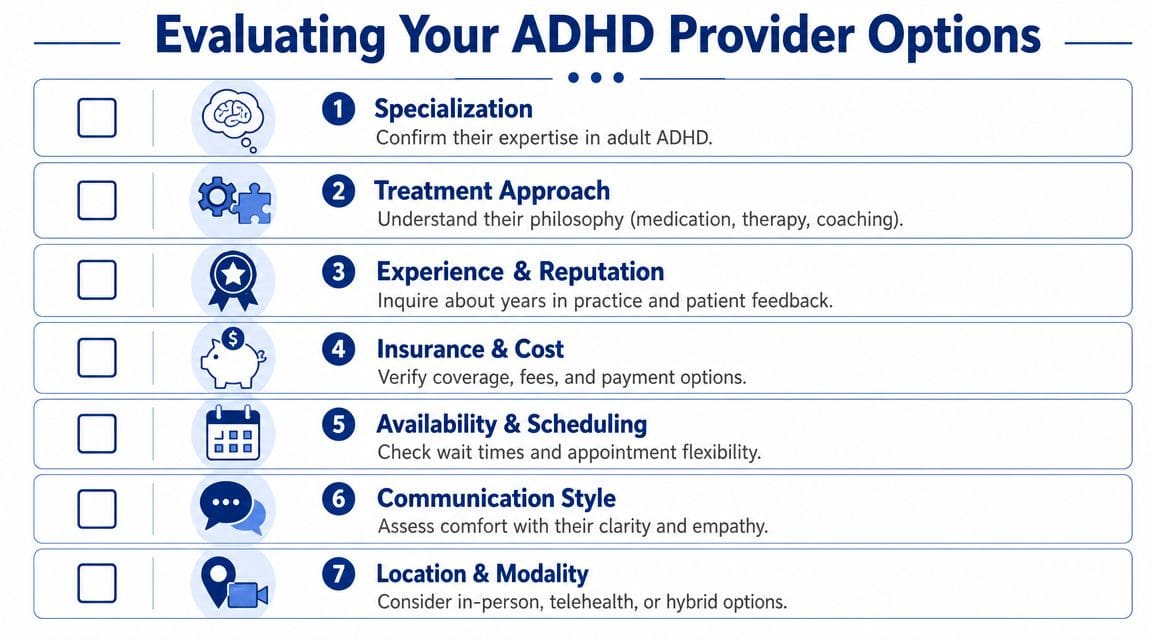
A strong ADHD assessment isn't a single quiz or a five-minute conversation. Mayo Clinic describes ADHD diagnosis as a thorough process that includes ruling out other causes, gathering history, and using information from multiple sources in its overview of ADHD diagnosis and treatment. That's the standard to look for when comparing providers.
Green flags during the vetting process
The best adult ADHD providers usually sound measured, not hurried. They ask about childhood symptoms, school patterns, job performance, relationships, sleep, anxiety, depression, substance use, and medical issues. They want context.
Good signs include:
- They explain the differential diagnosis. The clinician talks about ruling out other causes before confirming ADHD.
- They ask for collateral information when useful. Old report cards, family input, or past records may help clarify patterns across settings.
- They discuss function, not just symptoms. It's not only “Do you lose focus?” but also “How is this affecting work, money, parenting, driving, or relationships?”
- They describe treatment as ongoing care. A good provider discusses monitoring, side effects, therapy, coaching, and follow-up.
- They are clear about modality. They explain how telehealth, in-person care, or hybrid follow-up works in real life.
For patients wondering whether a psychiatric NP is the right fit, this comparison of a psychiatric NP versus psychiatrist can help frame the difference in roles and training.
Red flags that deserve caution
Some warning signs are easy to miss because they can feel efficient at first.
- Instant certainty. If a clinician appears ready to diagnose after a few surface questions, caution is warranted.
- Prescription-first language. If the whole intake seems built around one medication decision, the evaluation may be too narrow.
- No questions about sleep, mood, or medical history. That's a major gap.
- No plan for follow-up. ADHD treatment needs monitoring. A one-and-done approach often falls apart.
- Dismissiveness. Adults, especially women and high-functioning professionals, are sometimes told they're “too successful” to have ADHD. That's not careful assessment.
Here's a helpful video for patients who want to think more critically about choosing mental health care.
Questions worth asking before booking
A brief phone call or intake form can reveal a lot. Useful questions include:
| Question | Why it matters |
|---|---|
| Do you evaluate adult ADHD, not only childhood ADHD? | Adult presentation can look different and needs specific experience. |
| How do you rule out anxiety, sleep problems, depression, or thyroid issues? | Thorough clinicians expect overlap and mimic conditions. |
| Do you offer medication management, therapy coordination, or both? | Many adults need more than one tool. |
| What does follow-up look like after the first visit? | Ongoing treatment matters as much as diagnosis. |
| Do you provide telehealth across Pennsylvania? | This affects access, convenience, and continuity. |
The right provider should make the process feel thorough and understandable, not fast and vague.
Preparing for Your First ADHD Appointment
A first ADHD appointment goes better when the patient shows up with patterns, examples, and questions. That doesn't mean having perfect records. It means bringing enough real-life detail for the clinician to see what daily impairment looks like.
What to gather before the visit
Adults often underreport symptoms because they've normalized years of struggle. Concrete examples help. A patient should write down what keeps happening, where it happens, and what the fallout looks like.
Bring or prepare:
- A symptom list with examples from work, home, school, finances, driving, and relationships
- Past records if available, such as report cards, prior evaluations, or therapy notes
- Medication history, including what was tried before and what side effects occurred
- Medical history that includes sleep issues, anxiety, depression, thyroid problems, substance use, or other relevant concerns
- Questions for the clinician so nothing important gets forgotten during the visit
A practical guide on how to get an ADHD diagnosis as an adult can help patients organize this information before a telehealth intake.
What happens during a strong intake
A quality intake usually includes detailed history, current symptoms, cross-setting impairment, and review of other possible explanations. The clinician may ask about childhood behavior, school performance, family patterns, work habits, emotional regulation, and sleep. Patients are often surprised by how much of the interview focuses on context instead of a checklist.
Useful examples sound like this:
- “Reports are always turned in at the last minute even when they were started early.”
- “Conversations drift because attention drops after a few minutes.”
- “The house runs on crisis mode because routine tasks keep getting skipped.”
- “Anxiety got diagnosed first, but focus still falls apart even when anxiety is better.”
What to expect from treatment planning
Treatment usually isn't instant or one-dimensional. One large clinical summary reports that stimulant medications help 70 to 80% of children with ADHD, but better outcomes come when medication is paired with behavioral strategies, and stable patients still need follow-up every 3 to 6 months, as described in this summary of ADHD treatment options and follow-up.
For adults, that translates into realistic expectations:
- The first plan may not be the final plan. Dosing, timing, side effects, and goals often need adjustment.
- Behavioral tools matter. Calendars, reminders, routines, sleep support, and therapy aren't optional extras.
- Function is the benchmark. The key question is whether work, home life, and relationships improve.
A useful first appointment doesn't end with “You have ADHD.” It ends with a care plan the patient can actually follow.
Navigating Insurance and Affordability in Pennsylvania
Cost stops many adults from moving forward. In Pennsylvania, the details matter more than the headline question of “Do you take insurance?” A patient may have in-network coverage for one type of visit, out-of-network reimbursement for another, or lower up-front cost with self-pay depending on wait times and visit structure.
What to verify before booking
Call the insurer or check the member portal before the appointment, not after. Patients should verify whether the provider is in network, whether telehealth visits are covered, and whether follow-up medication visits are handled the same way as intake appointments.
Important items to confirm:
- Provider network status with the specific clinician
- Telehealth coverage under the plan
- Mental health deductible and copay details
- Out-of-network reimbursement rules
- Pharmacy coverage for prescribed ADHD medication if treatment reaches that stage
Pennsylvania patients often compare local systems, independent practices, and virtual clinics differently once they understand the billing structure. Someone with a high deductible may prefer transparent self-pay. Someone with strong out-of-network benefits may choose a specialist and submit claims afterward.
Comparing ADHD care models in Pennsylvania
| Factor | Traditional In-Person Provider | Telehealth Provider (like IPA) |
|---|---|---|
| Travel | Requires commuting, parking, and time away from work | Attends visits from home or another private location |
| Geographic access | Limited to nearby offices | Access across Pennsylvania if the clinician is licensed statewide |
| Scheduling | Office hours may be narrower | Often easier for adults balancing work and family demands |
| Privacy | Waiting room and travel may feel less discreet | More private for many patients |
| Payment model | Often insurance-first | May include insurance, self-pay, or membership options |
| Follow-up convenience | Missed visits are more likely when travel is hard | Ongoing care is easier to maintain consistently |
Some patients also want to understand broader pricing questions before they commit. This overview of ADHD testing cost considerations can help frame what to ask when comparing practices.
A less expensive visit isn't always the better value if the evaluation is too shallow. On the other hand, the most expensive option isn't automatically more thorough. What matters is clarity about what the appointment includes, how follow-up works, and whether the practice can support ongoing ADHD care instead of only intake.
Take the Next Step with Integrative Psychiatry of America
For Pennsylvania adults who want private, structured, statewide ADHD care, telehealth can solve several practical problems at once. It removes the need to search only within driving distance, makes follow-up easier to maintain, and helps patients fit care into jobs, parenting, school, and daily life.
Integrative psychiatry can also be a better fit for adults whose attention symptoms overlap with anxiety, depression, sleep problems, trauma, or stress-related burnout. Those cases need nuance. They don't benefit from rushed diagnosis or one-note treatment.
A practical starting point is virtual mental health services in Pennsylvania through Integrative Psychiatry of America, where adults can access online psychiatric care through board-certified psychiatric nurse practitioners.
For patients ready to move from searching to scheduling, the process is straightforward:
- Visit the practice website and review whether the care model fits current needs.
- Verify insurance or review payment options so there are no surprises.
- Schedule an initial consultation through the patient portal and prepare records, symptom notes, and questions in advance.
Searching for ADHD doctor near me often starts from frustration. It should end with clarity. The right provider doesn't just confirm a diagnosis. The right provider helps a patient understand what's happening, what else needs to be ruled out, and what a workable treatment plan looks like in real life.
If finding ADHD care in Pennsylvania has felt confusing or delayed, Integrative Psychiatry of America offers a practical next step with secure statewide telehealth, online scheduling, and insurance verification options designed to make starting care easier.