
The prescription is the same one that felt like a revelation in month one. Then the deadlines start slipping again, the kitchen fills with half-finished projects, and the bottle on the counter seems to be doing nothing at all. Many people land on one of two explanations. The dose is too low, or the drug has quit working for good.
Both explanations skip the step that solves the problem. Before a prescriber raises a dose or swaps a molecule, someone has to work out which of several different things is happening. A formulation that wears off at 4 p.m. looks identical to a dose that is too low, and both look identical to a person sleeping five hours a night.
The phrase ADHD medications not working describes at least four situations. True nonresponse is the least common of them. Getting the category right is what turns a frustrating appointment into a productive one.
Table of Contents
- Match Your Symptoms to a Likely Cause
- Causes Behind Apparent Medication Failure
- How to Track Symptoms, Side Effects and Safety Checks
- Medication Adjustments to Discuss With Your Prescriber
- Non-Medication Support That Strengthens Treatment
- Decide When to Request a Medication Review
Match Your Symptoms to a Likely Cause
A medication that seems to have stopped working is usually one of a few distinct problems, and each has its own fix. Sorting by pattern takes ten minutes and can save months of dose changes aimed at the wrong target.
Patterns that point to different fixes
Read down the middle column until a row describes the last month.
| Pattern you notice | Likely explanation | First check |
|---|---|---|
| Benefit fades by late afternoon or evening | Wearing off or dose timing | Note the hour symptoms return and the time of the dose |
| No clear change after several weeks at a stable dose | Inadequate dose, formulation or nonresponse | Review titration history with the prescriber |
| Better focus but worse sleep, appetite or mood | Side effect or co-occurring condition | Track sleep, appetite and mood daily |
| Works on taken days, poor results after missed doses | Adherence gap | Count missed doses over two weeks |
| Work improves, but relationships or emotions remain hard | Partial response or unmet non-drug needs | Compare results against target outcomes |
| Symptoms changed after a new prescription or supplement | Possible interaction | Share the full medication and supplement list |
| Racing heart, chest pain, fainting or marked mood change | Possible adverse effect needing prompt review | Contact the prescriber urgently; seek emergency care for chest pain or fainting |
A row is a hypothesis, not a diagnosis. Coverage that collapses by late afternoon points at formulation and timing far more often than at tolerance. A flat response after several weeks at a steady dose is a titration question, and the answer may be a higher dose, a different delivery system, or a different molecule entirely.
Two rows deserve urgency rather than a routine visit. Racing heart, chest pain, fainting, or a marked shift in mood or behavior needs the prescriber's office the same day. Chest pain or fainting means emergency care, not a message through the portal.
When the problem is the expectation
Partial benefit is the ordinary outcome, not a disappointment. A 2025 qualitative study of adults with ADHD found that people who expected medication to act as a near-total solution judged it ineffective when it improved only selected symptoms or specific situations, and participants described too little clinician contact to tell an inadequate response apart from wrong timing, dose, formulation, or side effects (King's College London). The same 2025 evidence review found that ADHD medications reliably improve core symptoms while showing inconsistent effects on co-occurring psychiatric conditions, which is why untreated anxiety can make a working drug feel like a failed one.
A medication that moves three of five target outcomes is working at partial strength, not failing.
Track named outcomes instead of a general sense of focus: starting the hardest task before noon, finishing a report without a full rewrite, fewer near-misses while driving, a bedtime that holds, a conversation that doesn't turn into an interruption. Three of those, rated weekly, give a prescriber far more to work with than "it just isn't working."
Where worry and restlessness sit on top of the attention problem, telling ADHD apart from anxiety answers a question that dose changes can't.
For a school-age child, a second strand matters. When reading or written work is the sticking point, assessing a child's academic learning needs with David T C Tutoring covers the learning question that medication was never designed to answer.
Write the matching row in one sentence and take it to the next visit. Don't adjust the dose independently, because a change made without a record turns the next appointment into guesswork.
Causes Behind Apparent Medication Failure
A prescription aimed at the wrong target produces the same result as a prescription that's too weak. That's why the diagnosis comes first.
Start with the diagnosis
CDC guidance on ADHD diagnosis requires symptoms in two or more settings, such as home, school, work or social situations, and recommends gathering information from parents or guardians, school staff, mental health professionals, and the person being evaluated. Rating scales help document whether DSM-5-TR criteria are met. If the original assessment leaned on a single checklist completed in one setting, apparent nonresponse may really be a diagnostic question.
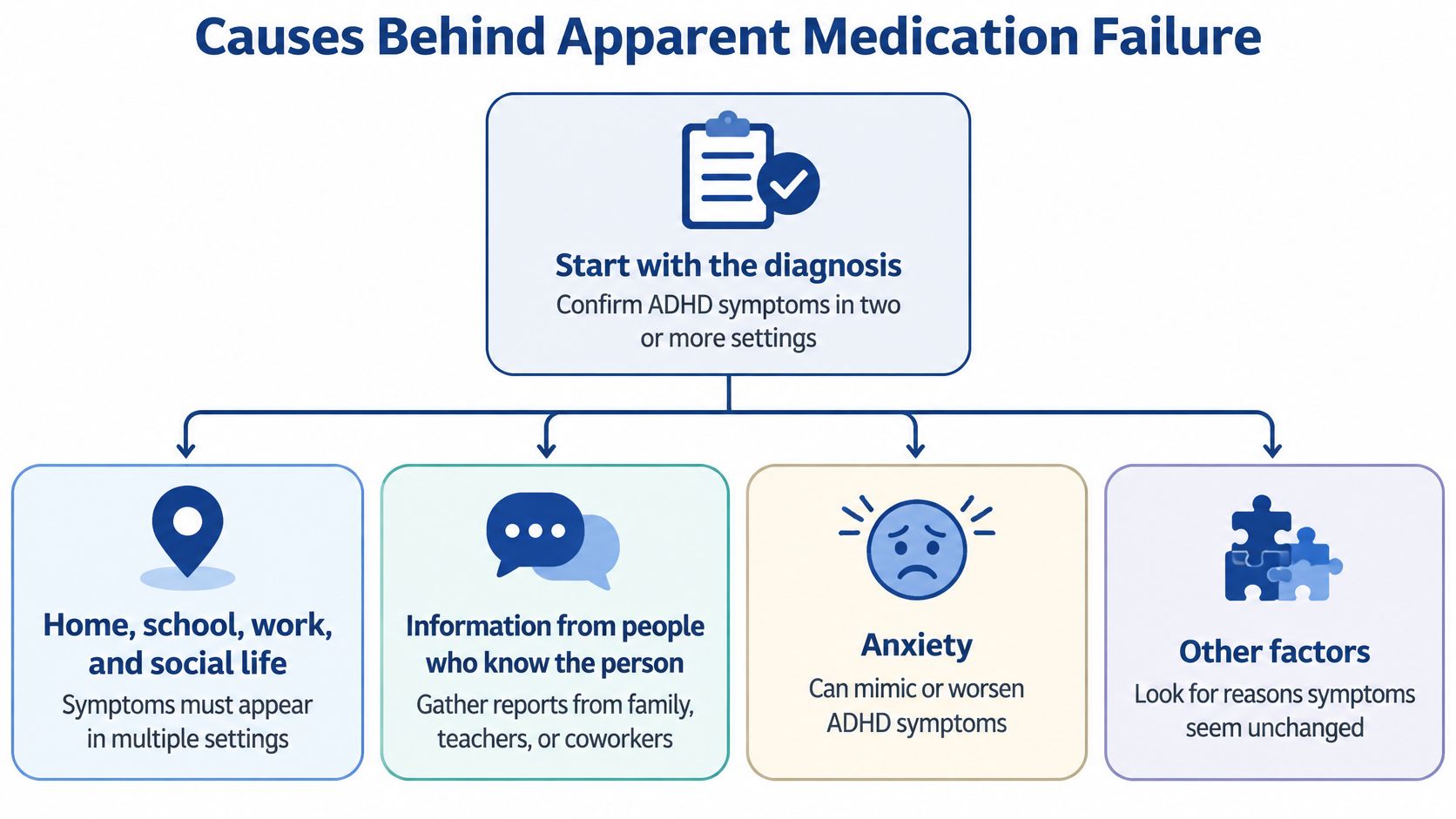
Second conditions set a ceiling on what any stimulant can deliver. Anxiety, depression, insomnia, bipolar disorder and substance use can leave core attention improved while impairment persists, and the person reasonably concludes the drug failed. A sleep disorder does the same. Attention problems that travel with daytime fatigue deserve a sleep evaluation, and it helps to know that persistent tiredness after sleep apnea treatment is a recognized problem rather than proof that nothing is wrong. Low iron stores are another physical contributor worth checking, and iron deficiency and ADHD symptoms explains what ferritin testing adds to the picture.
Adherence and the days that get skipped
Dose and timing come next. An unoptimized dose, a formulation that wears off before the evening routine, or a dose taken at 10 a.m. because the morning collapsed will each look like treatment failure.
Daily use is the bigger issue more often than people expect. In a 2025 analysis of 4,011 patients with ADHD, average adherence was 56%, and only 27.5% met an 80% adherence threshold; adherence tracked with age, race and ethnicity, depressive symptoms, and healthcare utilization (Journal of Attention Disorders). Cost, stigma, refill delays, pharmacy stock and fear of dependence all push people toward intermittent use. Someone taking a stimulant four days a week has effectively tested a much lower average dose and then judged the result.
Interactions and metabolism close out the list. New prescriptions, supplements, caffeine, nicotine, alcohol, cannabis and acid-reducing medications can all shift how a dose lands. Genetic variation in liver enzymes such as CYP2D6 can make someone a fast or slow metabolizer, which may explain an unusual response across several drugs. Pharmacogenomic testing can inform a prescribing decision. It doesn't diagnose ADHD.
What the long-term studies show
The longest-running evidence suggests that "it stopped working" usually reflects changing use and changing needs rather than lost drug effect. The NIMH Multimodal Treatment Study followed 579 children with combined-type ADHD through a 14-month randomized trial, and 88% were successfully treated for the full study duration. By the 36-month follow-up, the share taking medication more than half the time had risen from 14% to 45% in the behavioral-treatment group, fallen from 91% to 71% in the medication-management groups, and held near 60% to 62% in community care (NIMH summary of the MTA study). A separate long-term methylphenidate study found that only 3 of 108 patients, or 2.7%, lost therapeutic response over 3 to 10 years without an identifiable explanation.
Treat "stopped working" as a prompt for structured reassessment, not as a verdict about tolerance.
How to Track Symptoms, Side Effects and Safety Checks
The audit that resolves most of these questions is unglamorous. It's a written record kept the same way at every dose and judged against functioning, not against a feeling of focus. Medscape's ADHD diagnosis and treatment reference describes the approach as a titration audit: document baseline symptoms, impairment, sleep, adherence and adverse effects, repeat the same scales after every change, then increase gradually until meaningful improvement plateaus or side effects become unacceptable. NICE defines optimization as reduced symptoms plus improved functioning in employment, education, behavior or relationships, not merely a lower symptom score.
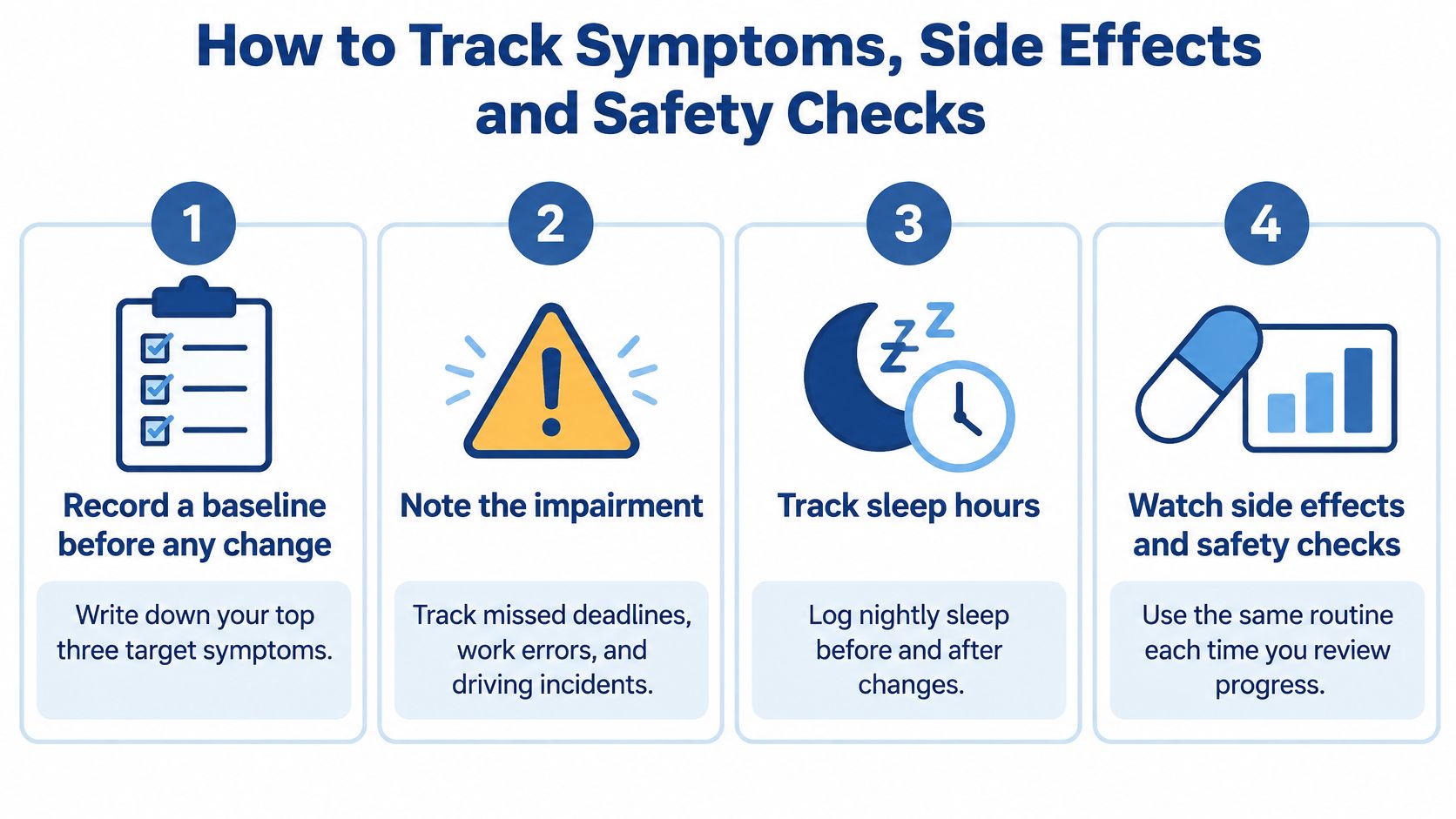
A six-step audit, in order
- Set a baseline before anything changes. Name the top three target symptoms and the impairment they cause: missed deadlines, work errors, driving incidents, arguments at home. Record sleep hours, appetite and mood alongside them.
- Log every dose. Time taken, formulation, missed doses and late doses. Two weeks of this data explains more failed trials than any lab test.
- Rate the same symptoms at fixed points. Morning, midday and evening, using one validated scale each time, such as the Adult ADHD Self-Report Scale. A rating scale supports tracking. It doesn't establish a diagnosis.
- Check blood pressure and pulse before and after every dose change. During titration, repeat checks every one to two weeks. NICE guideline NG87 advises measuring heart rate and blood pressure before and after each change and at least every six months afterward, while the American Academy of Pediatrics suggests cardiovascular follow-up within one to three months of starting and every six to twelve months after that.
- Record side effects daily. Appetite, weight, sleep, mood, anxiety and palpitations belong in the same log as the symptom ratings, because they decide whether a dose can go higher.
- Bring the log to the appointment. No independent dose changes, no stopping on a bad week. The record is the argument.
The log itself
| Log item | What to record | How often |
|---|---|---|
| Target symptoms | Top three symptoms rated on the same scale | Morning, midday and evening |
| Impairment | Missed deadlines, work errors or driving incidents | Daily |
| Dose record | Time taken, formulation, missed or late doses | Every dose |
| Sleep, appetite and mood | Hours slept, meals skipped, mood and anxiety rating | Daily |
| Vitals | Blood pressure and pulse before and after each dose change | Every 1 to 2 weeks during titration |
| Side effects | Palpitations, weight change, irritability or other symptoms | Daily |
| Substances | Caffeine, nicotine, alcohol and cannabis use | Daily |
For children and adolescents, add ratings from a parent, a teacher and the clinician, using tools such as the Vanderbilt scales, because no single setting tells the whole story. Pharmacists, school nurses and coaches can supply useful observations too.
What should trigger a call
Worsening behavior, a marked mood change, cardiovascular symptoms or intolerable side effects call for prompt clinical reassessment rather than another increase, and guidelines specifically recommend reviewing the diagnosis when behavior worsens. Treating medication-related insomnia as residual ADHD is a common and costly mistake, since it invites a dose increase that makes the sleep worse.
Practical rule: if a new symptom appears within days of a dose change, log it and call before the next scheduled visit.
Logs like this are the backbone of adult ADHD medication management, where the review is only as good as the information that arrives with the patient.
Medication Adjustments to Discuss With Your Prescriber
One stimulant trial that falls short settles very little. The useful question is which adjustment comes next, and in what order.
Options compared
| Option | What changes | How it's judged |
|---|---|---|
| Dose adjustment within the approved range | Same drug, different dose | Weekly titration steps until benefit plateaus or side effects limit |
| Formulation change | Immediate versus extended release, patch, liquid | Whether coverage matches the hours that actually matter |
| Switch within the stimulant class, or to the other class | Methylphenidate-based to amphetamine-based, or the reverse | Response after an adequate trial at an adequate dose |
| Nonstimulant medication | Atomoxetine, viloxazine, bupropion | Slower onset, so judged over weeks rather than days |
| Treat a co-occurring condition | Anxiety, depression, insomnia, substance use | Whether the remaining impairment comes from the other condition |
American Academy of Pediatrics guidance describes weekly stimulant titration as the way to find the dose with the most improvement and fewest adverse effects, and reports that roughly 80% of children respond to at least one of the two major stimulant classes (American Academy of Pediatrics). That single figure explains why one unsuccessful trial proves so little.
Response patterns are not identical between the classes. A 2023 review of randomized stimulant trials found that about 40% of children responded equally well to immediate-release amphetamine and methylphenidate, nearly 38% responded better to amphetamine, about 15% responded better to methylphenidate, and roughly 15% did not respond adequately to either class. The same review cites a more recent estimate that about 90% of people with ADHD respond to at least one of the two major classes, while cautioning that real-world response runs lower because trials exclude people with complex comorbidity.
Adults follow a similar curve. Controlled stimulant studies show a response range of about 25% to 78%, with a short-term weighted mean near 60% and a longer-term weighted mean near 74%, which means roughly 4 in 10 adults may not get adequate benefit from an initial controlled trial and many later respond to systematic optimization or a different agent (review of adult stimulant response).
Five questions to bring
- What dose range have we tried, and for how long at each step?
- What result would count as success for me, in functional terms?
- Are side effects capping the dose before benefit arrives?
- Should we change formulation, switch class, or add a nonstimulant, and in what order?
- What's the plan if I don't respond after optimization?
The clinical reasoning behind that order is laid out in stimulant versus non-stimulant options. Every change still needs a licensed prescriber. Abrupt switching, doubling a dose on a bad day, or borrowing a family member's tablets creates new problems on top of the old one.
Non-Medication Support That Strengthens Treatment
Medication lowers the effort required to start, plan and finish. It doesn't teach the skills, and it doesn't repair a sleep schedule.
Skills-based ADHD therapy builds the planning, task-initiation and time-management habits that a stimulant makes easier to practice but never installs on its own.

Sleep consistency does more for perceived medication effectiveness than many might expect. A steady wake time matters more than a perfect bedtime, and an afternoon caffeine cutoff protects the evening. Regular meals blunt the appetite suppression that stimulants cause, which keeps weight and energy stable enough for an honest dose trial. Exercise and ADHD benefits covers how aerobic activity fits alongside treatment rather than replacing it.
Environmental supports lower the daily load: one calendar rather than three, reminders for repeating tasks, written lists that live where the work happens, and a single visible spot for the things that get misplaced.
What testing can and cannot tell you
Basic screening catches medical contributors that mimic persistent ADHD or blunt medication response, including thyroid dysfunction and vitamin deficiencies. These tests are cheap, fast and worth ruling out before a third stimulant trial.
Pharmacogenomic testing answers a narrower question. It can indicate how quickly someone processes certain medications, which may guide drug or dose selection when responses have been unusual. It doesn't diagnose ADHD, and the evidence for using it routinely to guide treatment is still developing.
Practical rule: change one habit at a time for two weeks and record its effect in the same log used for symptoms.
Honest about the strength of each lever, the picture is consistent. Exercise, mindfulness and sleep work modestly on attention, mood and stress, and they work best beside medication rather than instead of it.
Decide When to Request a Medication Review
The question behind most searches for ADHD medications not working isn't which drug comes next. It's which of these causes applies, and that answer is usually sitting in a two-week log.
Ask for a review once the record shows a consistent pattern that the first checks don't explain. Two weeks of data beats months of recollection, and a specific request gets a specific response.
Signs that need a call today
- Symptoms in only one setting. If difficulty shows up at work or school but nowhere else, that points toward the environment, a learning issue or anxiety rather than ADHD.
- Another condition is driving the picture. Untreated anxiety, depression, insomnia or substance use limits what any stimulant can do.
- The diagnosis is old. An evaluation from a decade ago, or one based on a single checklist, deserves a fresh look.
- Several adjustments haven't helped. After adequate doses across more than one option, a broader reassessment is the better use of the next appointment.
- Safety is a concern. Chest pain, fainting, marked mood change or thoughts of self-harm need urgent care, not a routine follow-up.
Integrative Psychiatry of America provides ADHD evaluations and ongoing medication management for children age 6 and older, adolescents, college students, and adults across Pennsylvania through secure telepsychiatry, with board-certified psychiatric mental health nurse practitioners prescribing when clinically appropriate. A free Adult ADHD Screener in the practice's tools library helps organize symptoms before that conversation, though a screener is not a diagnosis.
Coverage questions deserve an answer before booking, since benefits, copays, deductibles, network status and authorization requirements vary by plan. If chest pain, fainting or thoughts of self-harm occur, seek emergency care or call or text 988, the Suicide and Crisis Lifeline.
Bringing a written record of what changed and when is the single most useful thing a patient can do, and Integrative Psychiatry of America builds ADHD care around exactly that kind of collaborative, monitored review through secure telepsychiatry across Pennsylvania. Whether the answer turns out to be a formulation change, a different class, an added nonstimulant, or treatment for a condition sitting alongside ADHD, the decision starts with evidence rather than a guess. Visit Integrative Psychiatry of America to request an appointment or verify insurance before booking.