
Some ADHD stories sound the same at first. Medication helps, then stalls. Therapy adds useful skills, but the daily friction stays. You still miss details, lose momentum, feel mentally tired, and wonder why effort does not match results.
In Pennsylvania, I hear this from adults trying to manage work and family life, and from parents who have done everything they were told to do for a child who still struggles at school or at home. The question underneath is simple. What are we missing?
Sometimes the answer is not a new diagnosis. Sometimes it is not a stronger stimulant dose either. Sometimes the missing piece is physiological. In psychiatric practice, that means looking beyond symptom checklists and asking whether nutrition, sleep, inflammation, hormones, or iron status may be affecting attention, motivation, and regulation.
As board-certified psychiatric nurse practitioners, we take that question seriously. ADHD is real. It is also complex. A whole-person evaluation can matter, especially when symptoms are treatment-resistant, unusually variable, or mixed with fatigue, restless sleep, brain fog, or low stamina. That is one reason we pay attention to adhd iron deficiency and related lab patterns in both adults and children.
The Hidden Struggle with ADHD and a Potential Clue
A common scenario looks like this. An adult in Philadelphia has an ADHD diagnosis, takes medication consistently, and still feels scattered by late afternoon. A parent in rural Pennsylvania sees a child work hard in therapy and school supports, yet homework still turns into tears, irritability, and shutdown.
These situations are frustrating because they can make people feel as if they are failing treatment. Often, they are not. They may be dealing with a treatment plan that addresses part of the picture but not the whole picture.
When standard care is not the whole answer
ADHD care often focuses on diagnosis, medication, therapy, and school or work accommodations. Those pieces matter. But they do not tell us whether the brain has the nutritional support it needs for attention and self-regulation.
That gap matters most when someone says things like:
- “My medication works, but not enough.”
- “The focus problem feels worse around my period.”
- “My child is restless, wired, and exhausted at the same time.”
- “I have ADHD symptoms, but I also feel physically drained.”
In those cases, iron status becomes a reasonable clinical question.
Why integrative psychiatry changes the conversation
Integrative psychiatry does not replace evidence-based ADHD treatment. It widens the lens. We still assess core symptoms, safety, mood, sleep, anxiety, trauma history, and medication response. We also ask whether an overlooked biological factor is amplifying the symptom burden.
If you want broader context on how often ADHD shows up across age groups, this overview of the prevalence of ADHD and mental health impact is a useful starting point.
Key takeaway: Persistent ADHD symptoms do not always mean the diagnosis is wrong or the medication has failed. Sometimes they signal that another modifiable factor is making the brain work harder than it should.
For some patients, iron deficiency is that factor. For others, the issue is more subtle. Bloodwork may look “acceptable” on paper while brain-related iron needs are still not being met well. That distinction becomes important when symptoms keep resisting otherwise appropriate treatment.
The Brain-Iron Connection and ADHD Symptoms
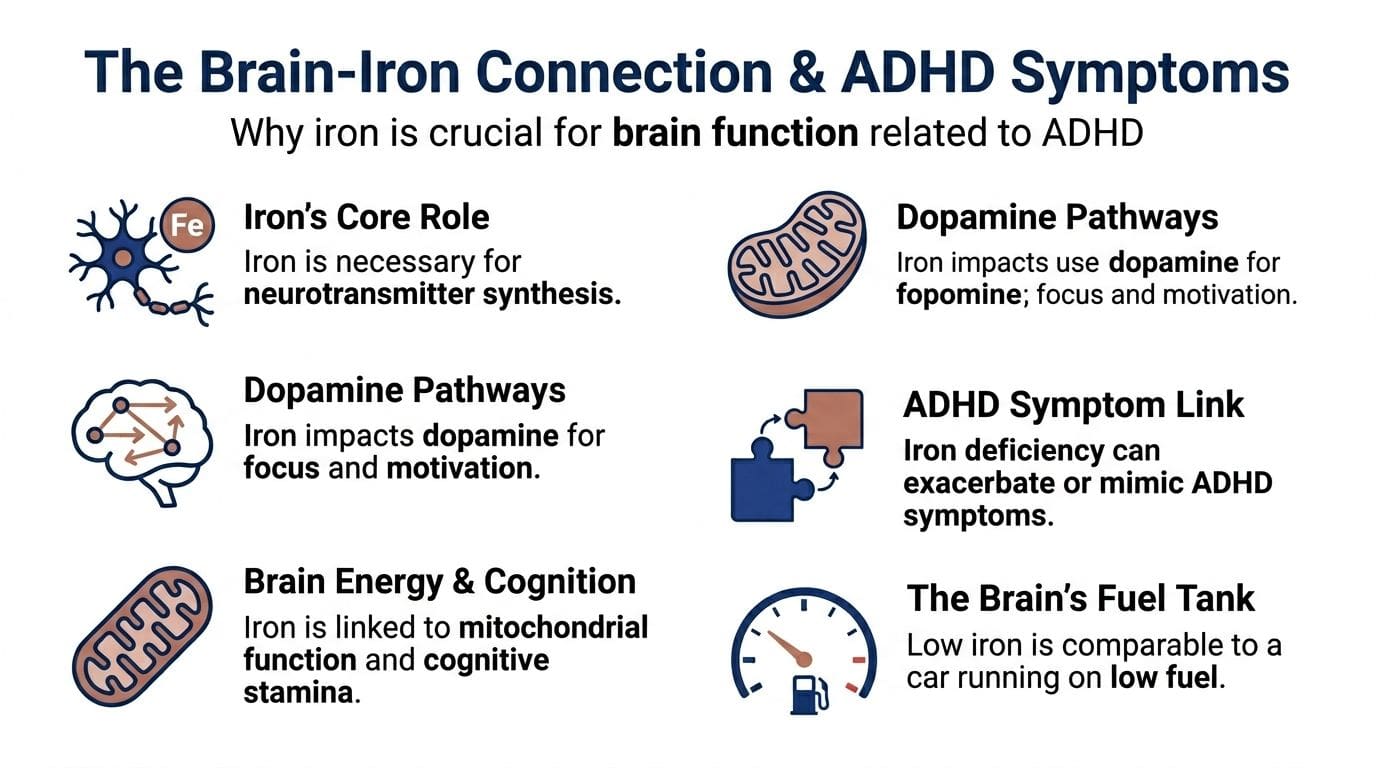
Iron is easy to think of as a blood issue. In ADHD care, it is more useful to think of it as a brain function issue too.
The simplest analogy is this. If dopamine is part of the brain’s focus and motivation system, iron is one of the ingredients required in the recipe. Without enough of it, the system can still run, but often less smoothly.
Why iron matters in the ADHD brain
Iron helps support dopamine-related pathways. That matters because dopamine is tied to attention, motivation, task initiation, reward processing, and behavioral regulation. When iron status is poor, those systems can look less efficient, which may show up as distractibility, low drive, impulsivity, poor follow-through, or mental fatigue.
That does not mean low iron “causes” every case of ADHD. It does mean iron can change how severe symptoms feel and how well someone responds to treatment.
A good overview of the broader nutrition-mental health relationship is this article on how nutrition affects mental health.
What the research supports
A 2014 case-control study in Qatar involving 1,260 children found that children with ADHD had significantly lower serum iron levels, reinforcing evidence that iron deficiency contributes to ADHD pathophysiology through complex genetic, environmental, and nutritional pathways that may affect inattentiveness and behavior, as described in the PubMed record for that study.
For patients, the practical meaning is straightforward. If attention symptoms coexist with fatigue, restless sleep, poor stamina, or limited response to treatment, it is reasonable to ask whether iron status is part of the picture.
Symptoms that can overlap
Iron-related cognitive strain can overlap with ADHD in ways that confuse the clinical picture. Patients may report:
- Trouble sustaining attention: They can start tasks but cannot stay with them.
- Mental fatigue: Their brain feels spent before the day is over.
- Restlessness: They feel keyed up but not productive.
- Low motivation: Initiating routine tasks feels disproportionately hard.
- Emotional short fuse: Frustration tolerance drops when the brain is under strain.
This is one reason a careful evaluation matters. Not every concentration problem is “more ADHD.” Sometimes it is ADHD plus a modifiable biological burden.
How We Evaluate Iron Status Beyond Basic Labs
A single iron number rarely gives a complete answer. In practice, that is one of the biggest reasons adhd iron deficiency gets missed.
Patients often tell me, “My iron was checked and it was normal.” Usually that means one marker was measured, often without enough context to interpret the full pattern. For ADHD-related concerns, we want a wider view.

Why one lab value is not enough
Serum iron can change based on timing and other short-term factors. Ferritin helps estimate stored iron, but ferritin also behaves as an acute-phase reactant, which means it can look misleading in some situations. A complete blood count can show whether anemia is present, but brain-related symptoms may appear before classic anemia does.
Meta-analytic evidence shows children with ADHD have significantly lower serum ferritin levels, and MRI studies have shown lower estimated brain iron in the thalami of children with ADHD, supporting the idea that iron status is relevant beyond routine blood markers, as reviewed in this PMC article on iron and ADHD.
For some patients, we also think about whether broader personalized testing has value. In selected cases, genetic testing for mental health treatment can help guide medication decisions while lab work helps identify biological factors that affect symptoms.
Understanding your iron panel results
| Lab Marker | What It Measures | Why It Matters for ADHD |
|---|---|---|
| Ferritin | Stored iron | Helps estimate whether the body has reserve iron available. This is often more clinically useful than a simple serum iron value when attention symptoms overlap with fatigue or poor stamina. |
| Serum iron | Iron circulating in the blood at that moment | Can provide part of the picture, but it is not enough by itself to judge overall iron status. |
| TIBC | The blood’s capacity to bind iron | Helps show how the body is handling iron transport and whether the pattern fits deficiency. |
| Transferrin saturation | The percentage of transport protein carrying iron | Adds context when ferritin and serum iron do not fully explain symptoms. |
| CBC | Red blood cells, hemoglobin, and related measures | Shows whether anemia is present, but normal CBC results do not rule out clinically relevant low iron stores. |
Normal is not always optimal
Nuance matters here. A lab reference range tells you what is statistically common in a population. It does not tell you what is optimal for cognitive function in a specific patient with ADHD symptoms, restless sleep, or poor treatment response.
That is why we interpret labs in context:
- Symptoms matter: Brain fog, inattention, and exhaustion shape how we read the panel.
- History matters: Heavy periods, diet pattern, gastrointestinal issues, and sleep quality all matter.
- Medication response matters: If treatment only partly works, biology may be adding drag.
Clinical tip: If you have persistent ADHD symptoms and only one iron number has ever been checked, that does not count as a full evaluation of iron status.
The brain-specific question
A key issue in treatment-resistant ADHD is that systemic iron deficiency and brain-specific iron insufficiency are not always the same thing. Standard labs may not capture what is happening in the brain. That does not mean blood tests are useless. It means they are a starting point, not the whole story.
When symptoms, sleep patterns, and history strongly suggest an iron-related burden, a thoughtful clinician looks at the full pattern rather than relying on a single “normal” result to close the case.
Who Is Most Affected by ADHD Iron Deficiency
Not everyone with ADHD has an iron problem. But some groups deserve a lower threshold for screening because the overlap is more clinically meaningful.
Children and adolescents
Iron matters to the developing brain. In children, low iron can complicate attention, behavior, learning, and emotional regulation in ways that overlap with ADHD symptoms.
A landmark 1996 study found that children with ADHD had a mean serum ferritin of 23 ng/mL compared with 44 ng/mL in controls, and 84% of the children with ADHD had ferritin levels below 30 ng/mL versus 18% of controls. Low ferritin also correlated with more severe ADHD symptoms, according to the JAMA Pediatrics article.
For parents, that does not mean iron is the entire answer. It does mean screening deserves consideration when a child has ADHD plus signs like poor stamina, restless sleep, selective eating, or slow cognitive recovery after demanding school days.
Adult women
This group gets overlooked often. Women may live with undiagnosed ADHD for years, then seek care only after work, parenting, or hormonal shifts make compensation harder. If menstrual blood loss is also lowering iron stores, the result can look like “worsening ADHD” when the picture is more layered.
That is one reason the topic deserves special attention. This discussion of ADHD in women and integrative treatment options speaks to that overlap.
Common clues include:
- Symptoms that worsen around menstruation
- Low energy plus poor focus
- Restless legs or fragmented sleep
- Difficulty tolerating cognitive load despite treatment
People eating plant-based diets
A plant-based diet can be healthy. It also requires more deliberate planning for iron intake and absorption.
The main issue is not that plant-based eating is a problem. The issue is that non-heme iron can be harder for some people to absorb efficiently. If someone already has ADHD and then develops lower iron stores over time, the cognitive strain may become more visible.
This does not call for fear. It calls for strategy. If you follow a vegetarian or vegan pattern and notice more fatigue, reduced attention, or poorer treatment response, iron status is worth discussing with a clinician.
A practical lens
The people I think about most quickly in clinic are:
- A child with ADHD and restless sleep
- A menstruating adult with fatigue and concentration problems
- A patient on a plant-based diet whose focus has slipped despite otherwise stable care
These groups are not the only ones at risk. They are the ones in whom adhd iron deficiency is easiest to miss if nobody asks the right questions.
Safe Treatment Strategies for Iron and ADHD
Iron can help when iron is the problem. It can also cause harm when people self-prescribe it casually. That is why treatment should be guided, not improvised.

Start with food, but be realistic
Diet is the first place many patients want to begin. That makes sense. Food supports long-term stability and can complement a medical plan well.
Iron-rich options include:
- Heme iron foods: Beef, lamb, dark poultry, liver, shellfish
- Non-heme iron foods: Lentils, beans, tofu, spinach, pumpkin seeds, fortified cereals
Absorption matters too. Pairing iron-containing meals with vitamin C-rich foods can help. Tea and coffee taken with meals may reduce absorption for some people, so timing can matter.
Food is useful, but it has limits. If someone has clearly low stores, symptoms that are affecting daily function, or an underlying cause of depletion, diet alone may not be enough.
Supplementation requires judgment
The nuanced issue is not just deficiency on paper. A key clinical concern is the difference between systemic iron deficiency and brain-specific iron insufficiency, which can occur even when standard blood tests look normal. One review notes that ferritin levels considered more supportive for cognition are often higher, in the 50 to 100 ng/mL range, and addressing this kind of gap may account for 20 to 30% improvement in symptoms in some treatment-resistant cases, as discussed in this PMC article on brain iron and ADHD.
That finding is useful, but it should not be turned into self-treatment advice. Iron overload is a real risk. Patients should not start high-dose iron because a social media post suggested it or because “normal” felt unsatisfying.
A safer process looks like this:
- Confirm the pattern with labs and history.
- Choose the right product form for tolerability and need.
- Set a plan for monitoring symptoms and repeat labs.
- Adjust based on response, side effects, and the full treatment picture.
Different iron products behave differently in the body. Some are effective but harder on the stomach. Some are gentler but still need proper dosing and follow-up. The “best” option depends on the patient, not the marketing label.
Iron is not a replacement for ADHD treatment
People can get sidetracked here. Correcting iron can reduce a biological burden. It does not replace stimulant medication, non-stimulant medication, therapy, coaching, sleep treatment, or school and workplace supports.
For many patients, the most effective plan is coordinated care:
- Medication management for core ADHD symptoms
- Targeted nutrition support to address low intake or absorption issues
- Sleep review when restless legs or fragmented sleep are part of the story
- Follow-up tracking of attention, motivation, stamina, and side effects
Here is a patient-friendly explainer that aligns with this more careful approach:
What does not work well
In practice, a few approaches tend to backfire:
- Self-supplementing without labs: This can miss the underlying issue and create unnecessary risk.
- Treating the number, not the person: A lab value means little without symptom context.
- Assuming every focus problem is iron-related: ADHD, anxiety, sleep deprivation, depression, and iron issues can overlap.
- Stopping psychiatric treatment too early: If iron is one contributor, removing effective ADHD treatment too soon may worsen function.
Best next step: If you suspect adhd iron deficiency, ask for a clinically interpreted iron panel and a treatment plan that includes follow-up, not just a supplement suggestion.
One practical option is IPA Integrative Psychiatry of America, which offers telepsychiatric evaluation, lab review, and nutritional guidance as part of broader ADHD care for Pennsylvania patients.
Our Integrative Approach for Pennsylvania Patients
For many patients, the hardest part is not deciding they want help. It is figuring out what the process looks like when they live in Pennsylvania and want care that is thorough without being complicated.

The first visit
The evaluation starts with symptoms, but it does not end there. We review attention patterns, school or work impairment, sleep quality, diet, menstrual history when relevant, prior medication response, medical history, and the physical clues that suggest iron may be worth checking.
That matters for patients in Philadelphia and for patients in smaller Pennsylvania communities who want a fuller review without having to build care across multiple offices.
If you want a broader overview of this model, integrative psychiatry treatment in Pennsylvania explains how telehealth-based whole-person care works.
Lab coordination and result review
If iron status seems clinically relevant, the next step is arranging appropriate labs. The goal is convenience and clarity. Patients do not need a vague message saying “your labs were fine.” They need an explanation of what the pattern means.
In follow-up, we review:
- Whether the iron panel fits deficiency, borderline stores, or an unclear pattern
- Whether CBC findings support or fail to explain symptoms
- Whether history suggests absorption issues, dietary shortfalls, or ongoing loss
- How symptoms map onto the lab picture
This is especially useful for adults who have heard for years that their fatigue or inattention was “just stress.”
Building the treatment plan
A personalized plan may include several layers. Some patients need dietary changes and monitoring. Some need supplementation under supervision. Some need ADHD medication adjustments because low iron was reducing treatment effectiveness. Some need a sleep-focused workup because restless legs or poor sleep continuity are keeping the brain from recovering.
This approach is often helpful for patients who also need anxiety treatment online in Pennsylvania because anxiety and ADHD can blur together when cognitive stamina is low.
Why telepsychiatry helps
Telepsychiatry works well for this type of care because much of the value comes from detailed history, careful interpretation, education, and follow-up. Patients can review labs, symptoms, and treatment options from home. That tends to reduce one more layer of friction for people who already feel mentally overloaded.
The practical advantages include:
- Access across Pennsylvania
- Private follow-up from home
- Easier medication and symptom review
- More room for education about labs, nutrition, and trade-offs
What patients usually find most helpful: not just ordering labs, but having someone connect those lab results to attention symptoms, sleep, diet, and treatment response in plain language.
A Whole-Person View for Lasting ADHD Management
Iron is not the whole ADHD story. For some patients, though, it is a meaningful missing piece.
That is why adhd iron deficiency deserves careful attention. The important questions are not only “Is the ferritin low?” They are also “Does the history fit?” “Do the symptoms fit?” and “Is there a broader pattern suggesting the brain is under-supported?”
Good ADHD care rarely comes from a single tool. Medication can help. Therapy can help. Skills work can help. Lab screening can help when the clinical picture points that way. Lasting progress usually comes from combining the right pieces for the right person.
A whole-person model matters because the brain does not function separately from the body. Sleep, nutrition, hormones, inflammation, and daily stress all shape what attention feels like. When those factors are ignored, patients often get blamed for poor follow-through when they are pushing through a heavier biological burden.
If you have persistent ADHD symptoms, partial treatment response, fatigue, or questions about whether iron could be affecting your focus, it is reasonable to ask for a more complete evaluation. Looking deeper is not overcomplicating care. It is often how care becomes more accurate.
Frequently Asked Questions About Iron and ADHD
Can low iron look like ADHD
Yes, it can overlap with ADHD symptoms such as poor concentration, restlessness, and low motivation. It can also worsen symptoms in someone who already has ADHD. That is why clinicians should look at the full picture instead of assuming every attention problem is purely psychiatric.
If my CBC is normal, can iron still be an issue
Yes. A normal CBC does not rule out low iron stores or a clinically relevant iron pattern. Patients can have cognitive symptoms before classic anemia shows up.
Should I start iron supplements on my own
No. Iron should be guided by labs, symptoms, and medical history. Too much iron can be harmful, and self-treatment can delay a correct diagnosis if iron is not the problem.
Can iron supplements interact with ADHD medications
They can affect the timing or absorption of some medications and other supplements, which is one reason coordinated prescribing matters. The solution is usually not avoidance. It is planning. A clinician can tell you when to take each product.
How long does it take to feel better after treating low iron
Response varies. Some patients notice changes in stamina, mental clarity, or restlessness earlier than others. What matters most is having a clear baseline, a monitoring plan, and realistic expectations. Improvement tends to be easier to detect when symptoms are tracked rather than guessed at.
What if my ferritin is “normal” but I still have symptoms
That is one of the most important questions in this area. Symptom history, sleep patterns, diet, menstrual history, and the full iron panel become important in such cases.
Does treating iron deficiency mean I do not have ADHD
Not necessarily. Some patients have true ADHD plus an iron issue that increases severity. Treating iron may reduce symptom burden without eliminating ADHD entirely.
Who should ask about iron testing first
It is especially reasonable to ask if you have ADHD symptoms plus fatigue, restless sleep, heavy menstrual periods, a plant-based diet, or only partial response to standard treatment.
If you live in Pennsylvania and want a whole-person evaluation of ADHD symptoms, medication response, sleep, and possible lab contributors like iron status, IPA Integrative Psychiatry of America offers telepsychiatric care designed to connect those pieces into a practical treatment plan.