
A Pennsylvania adult finishes a workday with unfinished tasks, a missed afternoon deadline, and a familiar question: Is the current ADHD medication wearing off too soon, or is a different option worth discussing? That's the kind of situation behind many searches for Adderall vs Focalin XR. The answer usually depends less on which name sounds stronger and more on how each medication fits a person's symptoms, schedule, health history, and experience with treatment.
Both are extended-release stimulant medications used for ADHD, but they belong to different medication families. This guide offers a practical way for adults in Pennsylvania to compare them and prepare for a conversation with a qualified psychiatric provider. It doesn't replace an ADHD evaluation, diagnosis, or individualized prescription.
Table of Contents
- Choosing Between Two Adult ADHD Options
- How Adderall XR and Focalin XR Work
- Comparing Key Medication Features
- Assessing Adult ADHD Effectiveness
- Matching Medication Profiles to Adult Needs
- Managing Side Effects Through Telehealth
- Making a Clinician-Directed Medication Choice
Choosing Between Two Adult ADHD Options
Consider an adult who has partial benefit from a stimulant: mornings feel more organized, but focus fades before household responsibilities begin. Or perhaps symptoms improve, but sleep or appetite becomes difficult to manage. In either situation, asking which medication is “stronger” doesn't capture the decision. A useful comparison considers prior response, side effects, needed coverage, and health history together.
Adderall XR contains mixed amphetamine salts. Focalin XR contains dexmethylphenidate, a medication in the methylphenidate family. Both are prescription stimulants used to treat ADHD, but their active ingredients and release profiles differ. A dose in milligrams for one isn't a direct measure of equivalent strength in the other.
A psychiatric provider may consider how well a medication supports work, home responsibilities, and other individual goals, as well as whether the person experiences appetite changes, insomnia, rebound symptoms, anxiety, or irritability. Medical history and other medicines can also affect the risk-benefit assessment. For adults comparing treatment options, earlier medication experiences can offer useful context, but they don't guarantee how another medication will work.
The central question isn't “Which one is stronger?” It's “Which treatment can support the person's daily goals with manageable effects, under appropriate clinical monitoring?”
Adults who want to understand a range of options can review adult ADHD treatment options. Any medication choice still needs to follow an appropriate evaluation and an individualized conversation with a qualified provider. The aim is to leave with a decision framework, not a one-size-fits-all verdict.
How Adderall XR and Focalin XR Work
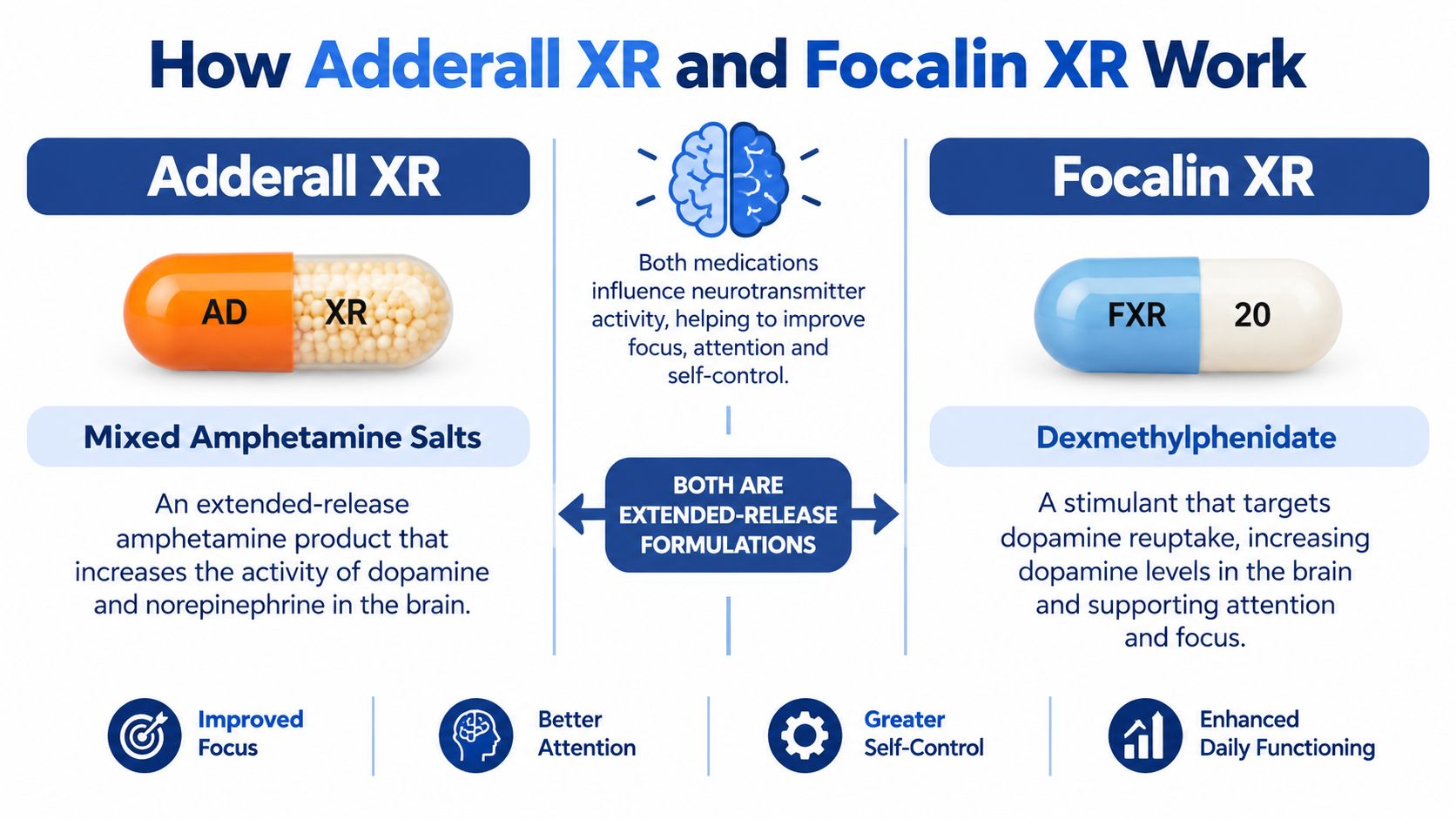
Adderall XR and Focalin XR are both central nervous system stimulants, but they contain different active ingredients. Adderall XR contains mixed amphetamine salts, while Focalin XR contains dexmethylphenidate, the more pharmacologically active d-isomer of methylphenidate. Both are FDA-approved for ADHD in patients aged six years and older, according to FDA product labeling for Adderall XR.
That difference in drug family is the starting point for understanding why their doses can't be compared by matching milligrams. A milligram figure describes an amount of a specific medicine. It doesn't establish equal clinical effect across medicines with different active ingredients and pharmacology. A lower number on a prescription doesn't automatically mean a weaker effect, either.
What to compare beyond the medication name
A clinician considers more than the active ingredient. Relevant questions include the labeled dose range, how the extended-release formulation behaves, how long the benefit seems to last for the individual, and whether symptoms return as the effect fades. The person's treatment goals matter, too. One adult may prioritize focus through a workday; another may be concerned about sleep, anxiety, appetite, or completing tasks at home.
A medication review also needs to account for cardiovascular considerations, psychiatric symptoms, other medicines, and prior treatment experiences. These factors help a provider decide what to monitor and whether a medication trial is appropriate. The details can't be reduced to an online dose conversion or a universal ranking.
A closer look at ADHD medication management can help readers understand the role of an ongoing clinical review. This video also discusses ADHD medication:
Dose rule: Milligram-for-milligram substitution isn't a valid way to establish equivalence between Adderall XR and Focalin XR.
Comparing Key Medication Features
The table below summarizes differences that can inform a medication discussion. It's a starting point for considering a supervised trial, not a ranking or a dose-conversion guide.
| Comparison criterion | Adderall XR | Focalin XR | Decision relevance |
|---|---|---|---|
| Active ingredient family | Mixed amphetamine salts, an amphetamine-based product | Dexmethylphenidate, in the methylphenidate family | Prior response to a medication family can inform the discussion, but can't guarantee the next response. |
| Labeled adult dose range in the cited studies | 20–60 mg daily in the cited adult trial | 20–40 mg daily in the cited adult trial | These study doses aren't conversion guidance. |
| Release pattern | Extended-release mixed amphetamine formulation; the cited FDA labeling describes linear pharmacokinetics across labeled adult doses | Two delivery components produce two plasma-concentration peaks roughly four hours apart | Release behavior may matter when evaluating symptom timing and coverage. |
| Adult trial duration | Four weeks | Five weeks | The separate trials don't provide a direct head-to-head comparison. |
| Adult efficacy evidence | Improved ADHD symptom scores versus placebo in the cited controlled trial | Tested doses improved symptoms versus placebo in the cited registration study | Trial results establish evidence beyond placebo, not a universal winner. |
| Appetite and sleep | Appetite and sleep are monitored during stimulant treatment | Appetite and sleep are monitored during stimulant treatment | A patient's own experience helps guide follow-up. |
| Cardiovascular monitoring | Pulse and blood pressure are monitored | Pulse and blood pressure are monitored | Health history and observed response matter to prescribing decisions. |
| Practical prescribing considerations | The choice depends on individual response, tolerability, coverage needs, and clinician judgment | The choice depends on individual response, tolerability, coverage needs, and clinician judgment | Switching needs clinician direction, not matching milligrams. |
Focalin XR's two concentration peaks, roughly four hours apart, are described in FDA labeling for Focalin XR. The cited Adderall XR labeling describes linear pharmacokinetics across its labeled adult dose range. Neither fact predicts exactly when an individual will notice benefit or when it will wear off.
Both products warrant attention to appetite, weight, sleep, pulse, and blood pressure. The relevant comparison is not whether one medication “wins” a row in a table. It's whether a clinician-directed trial provides useful coverage while keeping adverse effects and other health considerations in view.
The practical comparison is personalized coverage across the day, including any times when attention, appetite, sleep, or emotional symptoms change.
Assessing Adult ADHD Effectiveness
A full-day treatment trial tells you more than a milligram contest. Both medications have controlled-trial evidence showing improvement in ADHD symptoms compared with placebo, and those results give useful context. They still cannot prove that one product is superior for every adult, because the studies were built differently and the medicines are not interchangeable.
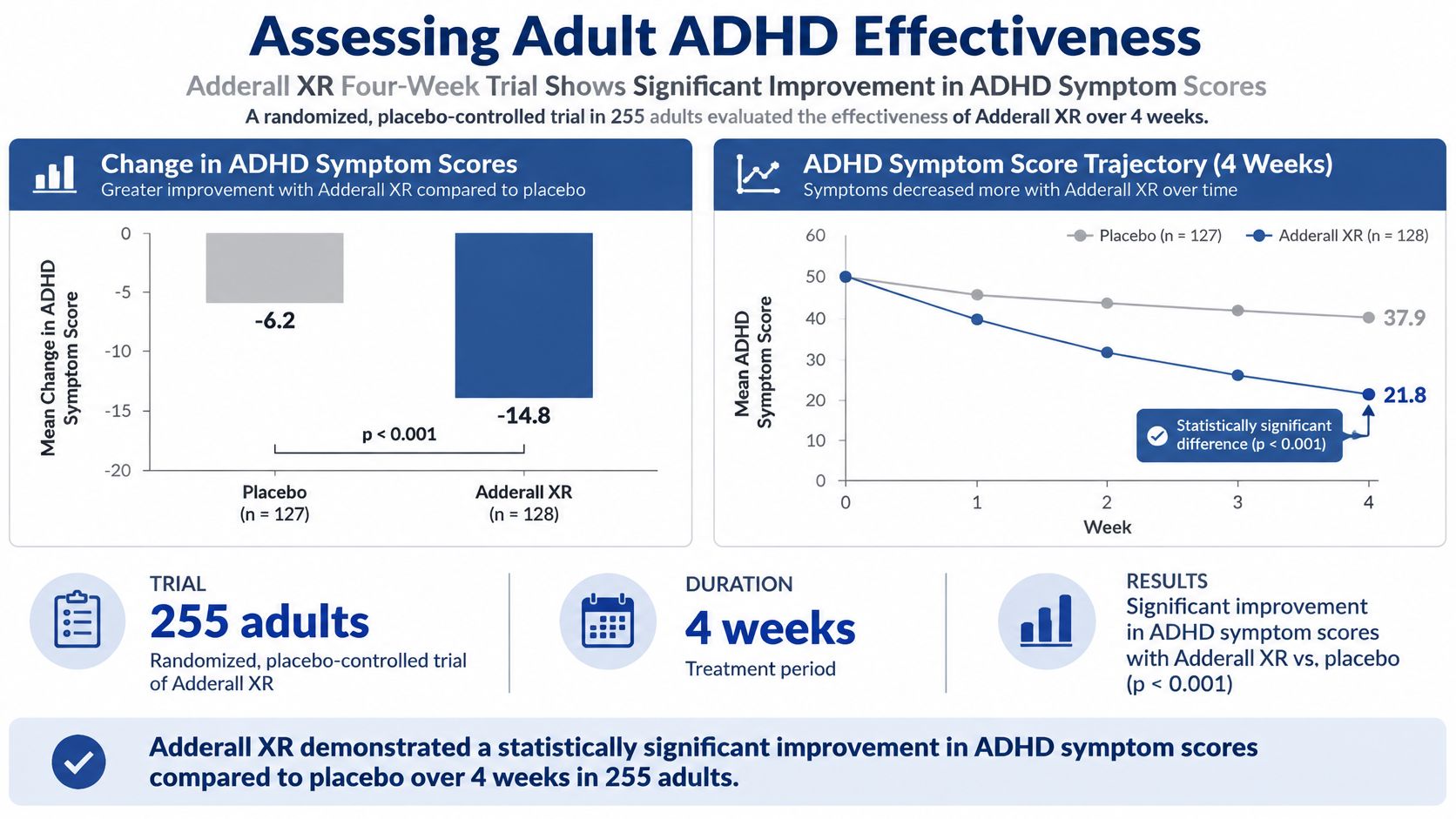
In an Adderall XR adult trial, 255 participants were randomized to 20, 40, or 60 mg daily for four weeks. Adjusted ADHD symptom-score improvements compared with placebo were 6.6 points at 20 mg, 7.2 points at 40 mg, and 7.8 points at 60 mg. Each comparison was statistically significant, as reported in the FDA registration evidence for Adderall XR.
What the Focalin XR study adds
The Focalin XR adult registration trial randomized 221 participants to 20, 30, or 40 mg daily for five weeks. Mean symptom-score improvements compared with placebo were 5.8 points, 5.5 points, and 9.0 points, respectively. The corresponding standardized effect sizes were 0.53, 0.49, and 0.83. The trial also found that 47% of treated participants were rated much or very much improved on the Clinical Global Impressions scale, compared with 26% receiving placebo, as summarized in this review of ADHD medication trials.
The Focalin XR labeling reported statistical superiority to placebo at all tested adult doses, but increasing the dose didn't show an obvious, consistent increase in effectiveness. For an individual patient, a higher dose can mean better coverage, more side effects, or no clear added benefit.
Why the trials don't identify a winner
The Adderall XR and Focalin XR studies used different designs, doses, durations, rating scales, and participant samples. Treating their results like a head-to-head randomization would overstate what the evidence shows. The pooled estimate from the stimulant-trial review cited above also combines multiple products and age groups, so it still doesn't answer which adult product fits a specific day.
A clinic visit usually turns on practical questions instead. Did focus hold through the afternoon meeting. Did appetite drop at lunch. Did sleep shift later. Symptom scores matter, and functional goals matter too, such as completing a work task, catching fewer careless errors, or keeping up with responsibilities at home.
Matching Medication Profiles to Adult Needs
A 38-year-old analyst may feel clear and productive before lunch, then watch attention slide during late-afternoon email. A parent with ADHD may need the opposite: calmer mornings for getting kids to school, steadier evenings for homework and meals. The useful question is which profile covers a real day with tolerable tradeoffs, not which name sounds stronger.
Adderall XR and Focalin XR are both long-acting stimulants, but they are not interchangeable milligram-for-milligram. Adderall XR contains mixed amphetamine salts; Focalin XR contains dexmethylphenidate. A past trial still gives clues: benefit that was too brief, appetite loss that disrupted eating, irritability after wear-off, or insomnia can all shape the next choice. According to the stimulant-trial review cited earlier, pooled results show an average advantage over placebo across several formulations, but that average cannot predict which product will cover one adult's schedule.
Build a picture of the whole day
A simple timing log turns “it helped” into usable evidence. Note when the dose seems to start working, when concentration fades, whether symptoms rebound, and what happens to meals, sleep, tension, patience, and task completion. Bring concrete anchors: a report finished, a commute handled without missed exits, a conversation followed without drifting, or an evening routine that did not collapse.
Anxiety needs context instead of a blanket rule. Some adults feel less overwhelmed when ADHD symptoms are better controlled; others notice more jitters, a shorter fuse, or a heavier crash later. Adults sorting through that overlap can read more about how ADHD and anxiety can interact in adults before discussing options with a psychiatric provider.
Include pharmacy access in the plan
A prescription only works if it can be filled. Supply can vary by exact formulation, manufacturer, strength, package size, and local stock, and stimulant shortages have affected different products at different times. Public reporting described a nationwide mixed amphetamine salts shortage announcement in October 2022, while methylphenidate-family products can face their own constraints (shortage summary).
If a pharmacy cannot fill the exact product, contact the prescriber before the supply runs out, confirm the precise formulation and strength, and avoid improvised dose changes. The profile that fits is the one that works for the required hours, keeps side effects acceptable, and can be refilled reliably.
Managing Side Effects Through Telehealth
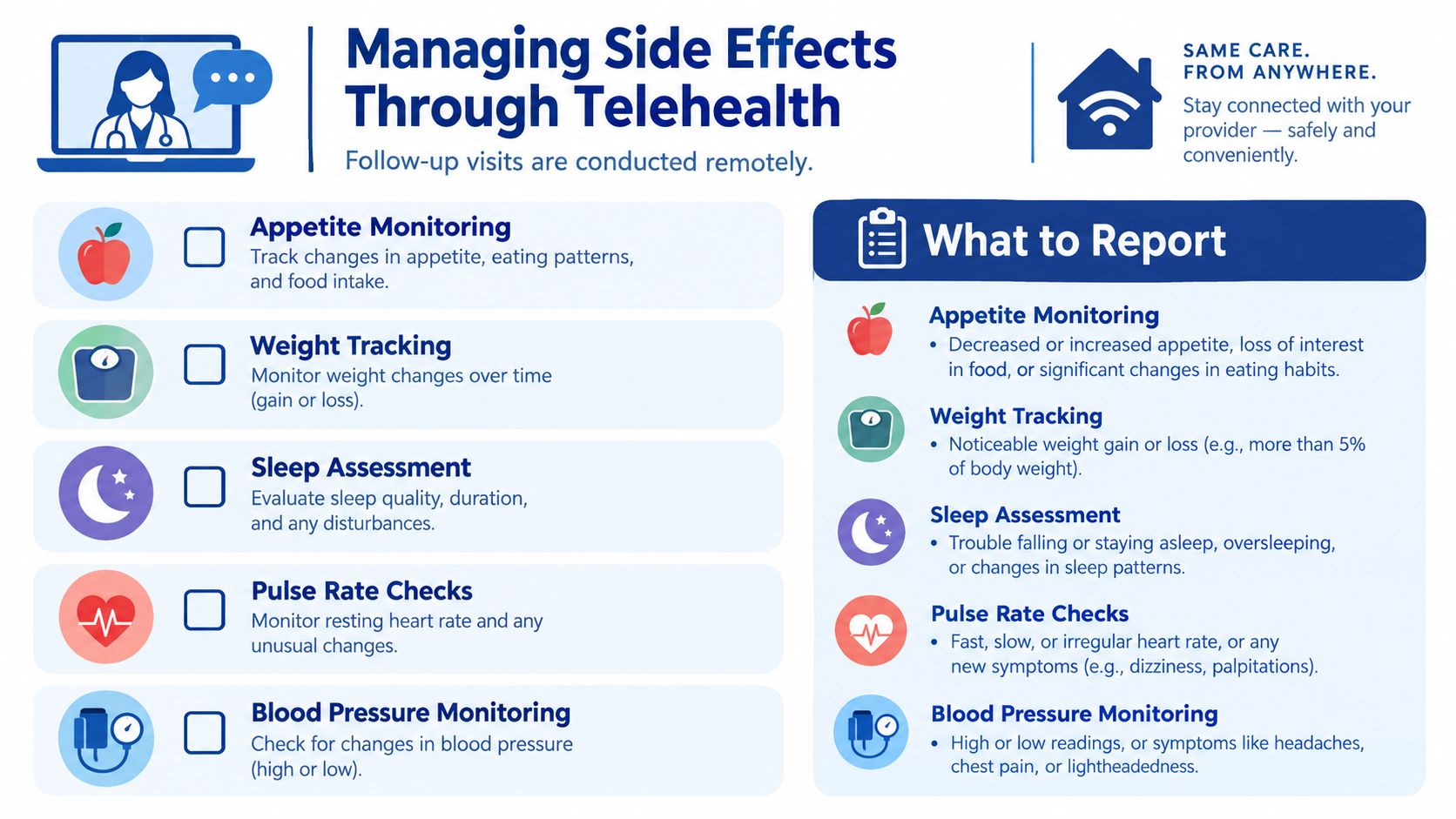
A useful follow-up visit starts with specific observations. Both Adderall XR and Focalin XR are stimulants, so providers commonly monitor appetite, weight, sleep, pulse, and blood pressure. A remote visit can support ongoing medication management when it's appropriate, but it doesn't remove the need to review health history, the full medication list, supplements, and substance use before making changes.
Prepare a practical follow-up checklist
Before a telehealth appointment, it can help to record:
- Medication details: The exact product, formulation, prescribed dose, and schedule.
- Symptom timing: When benefit seems to start, how long it lasts, and whether symptoms return late in the day.
- Daily function: Tasks completed, work or household difficulties, and any change in focus.
- Side effects: Changes in appetite, sleep, anxiety, irritability, or emotional experience.
- Safety and missed doses: Available pulse and blood-pressure readings, if measured, and what happens when a dose is missed.
This record gives the psychiatric provider something more actionable than a general impression. A patient can describe, for example, whether sleep changed on days when the medication seemed to last later, or whether appetite was affected around meals. The provider can then weigh those observations alongside the treatment goals and clinical history.
Cardiovascular symptoms or changes in psychiatric symptoms warrant individualized review. Telehealth may be appropriate for routine follow-up, but urgent, emergency, or in-person evaluation may be needed when symptoms are severe, concerning, or require direct assessment. A remote medication visit isn't a substitute for emergency care.
Adults seeking ongoing remote support can review online ADHD medication management. A prescriber should direct decisions about dose changes, switching, or stopping medication.
Making a Clinician-Directed Medication Choice
Adderall XR may be part of a discussion when a person's prior amphetamine response, symptom coverage, or tolerability supports considering that medication family. Focalin XR may be discussed when prior methylphenidate response or a clinician's assessment of its release profile is relevant. Neither is a default choice for every adult, and the available separate placebo-controlled trials don't create a universal ranking. The AHRQ comparative-effectiveness review reports a statistically significant symptom-reduction advantage for amphetamines over methylphenidate in children and adolescents, but that finding isn't a direct adult comparison of Adderall XR and Focalin XR.
A sound medication trial starts with agreed functional goals and a plan for reviewing adverse effects, cardiovascular measures, and symptom timing. The provider can use follow-up information to consider whether the treatment meets those goals and whether a clinician-directed adjustment is appropriate.
Adults shouldn't switch medications by matching milligrams, make abrupt discontinuation decisions on their own, or treat online testimonials as equivalent to controlled evidence. If diagnosis remains uncertain, the next step may be an adult ADHD evaluation. Adults with an established diagnosis can ask about medication management and check insurance benefits before scheduling; coverage, network status, authorization requirements, and out-of-pocket costs vary by plan.
Integrative Psychiatry of America provides virtual psychiatric care across Pennsylvania, including ADHD evaluation and treatment planning, with follow-up through telehealth. Adults comparing stimulant options can visit Integrative Psychiatry of America to review services, ask about insurance verification, or request an appointment.