
In-network means that the clinician has a contract with the patient's specific insurance plan. That arrangement typically lowers out-of-pocket costs, but it never guarantees that online psychiatric care will be free or fully covered.
A Pennsylvania adult may find an online psychiatric practice, check an insurer's app, and see “in-network” beside the practice name. The phrase sounds reassuring, but it doesn't answer the questions that affect the final bill: Which plan is active? Does the behavioral-health network include the clinician? Has the deductible been met? Does the plan require authorization for the visit or medication?
The answers depend on the patient's specific benefits, not only the insurer's name or the fact that the appointment happens by video. The following guide explains how network status, cost-sharing, telehealth rules, and claims processing fit together.
Table of Contents
- What In-Network Means for Virtual Psychiatric Care
- In-Network vs Out-of-Network for Online Psychiatry
- Insurance Terms Every Psychiatric Patient Should Know
- Behavioral-Health Networks and Telehealth Coverage Rules
- Prior Authorization and Pharmacy vs Medical Benefit
- Why In-Network Does Not Guarantee Free or Fully Covered Care
- How to Verify Your Benefits Before a Telepsychiatry Appointment
What In-Network Means for Virtual Psychiatric Care
A clinician is in-network when the clinician or practice has a participation contract with the patient's specific health plan. The contract generally uses negotiated rates for covered services, so the patient's responsibility follows the plan's in-network rules instead of the practice's full self-pay or out-of-network rate.
That definition matters because “in-network with an insurer” can be too broad. A practice might participate with one employer plan offered by an insurer but not another. A plan might also use a separate behavioral-health network for psychiatric services. The patient needs confirmation for the exact member ID, product, and behavioral-health benefit.
Telepsychiatry means care delivered remotely through secure technology. Patients can learn more about the clinical format through what telepsychiatry involves, but the technology alone doesn't establish coverage.
The practical meaning of the phrase
For a patient, “in-network” usually means:
- The provider participates: The clinician has a contract connected to the relevant plan.
- The claim follows plan rates: The insurer processes the service under its contracted rate and benefit rules.
- The patient may pay less: The plan may apply a copay, deductible, or coinsurance instead of the full private-pay charge.
- The service still has conditions: Coverage can depend on medical necessity, authorization, eligible visit codes, telehealth rules, and an active policy.
Pennsylvania's Department of Insurance explains that individual health plans must cover mental-health and substance-use-disorder services, while insurers may still limit benefits to in-network providers or medically necessary care. The state also says mental-health benefits can't face less favorable limits than medical and surgical benefits under parity rules. Pennsylvania's individual health insurance parity guidance provides the regulatory context.
The working definition is simple: in-network status is the first checkpoint for estimating cost, not a promise of payment. The next checkpoints are the plan's cost-sharing terms, behavioral-health network, telehealth policy, authorization rules, and claim outcome.
In-Network vs Out-of-Network for Online Psychiatry
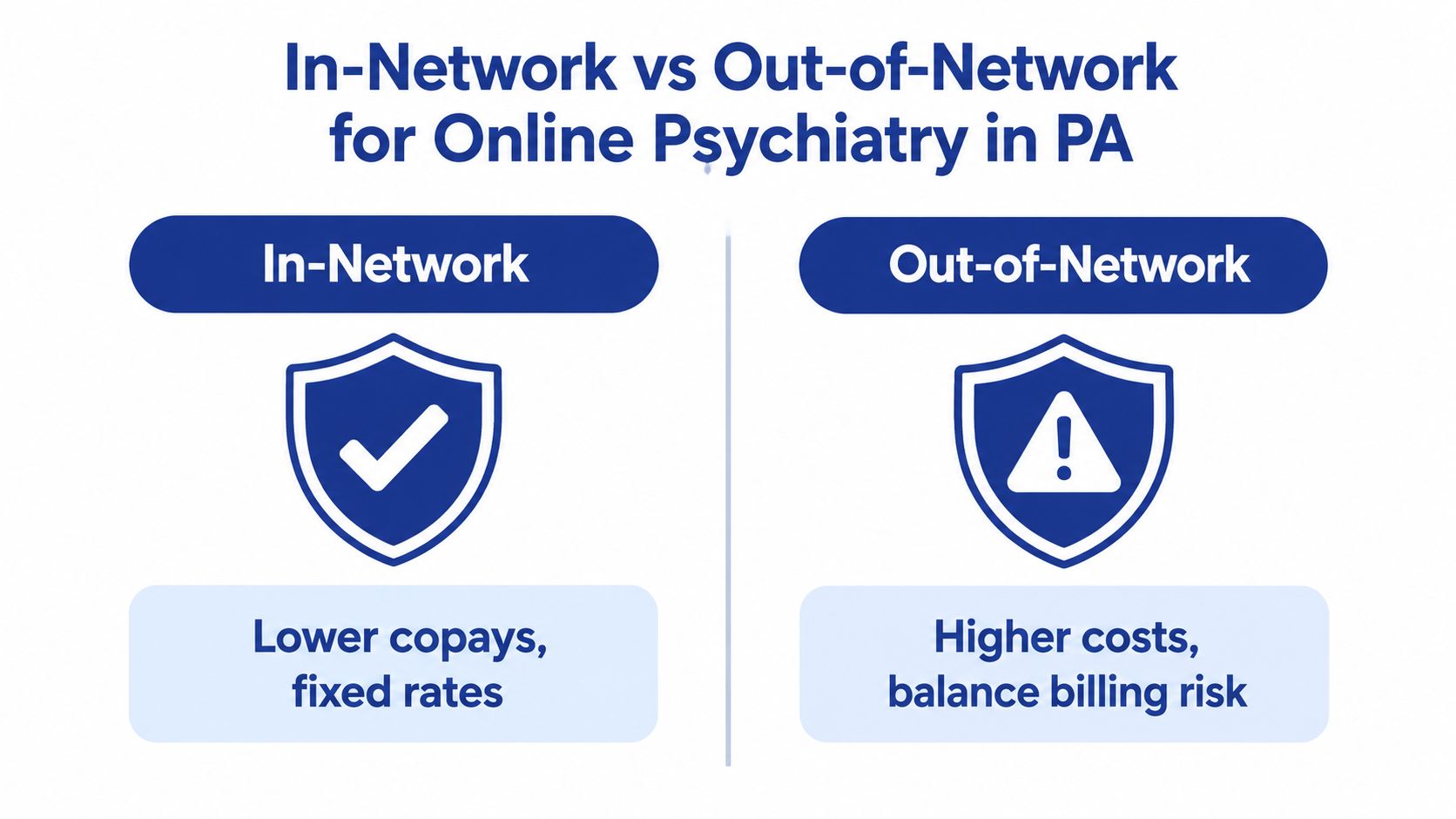
In-network and out-of-network describe the financial relationship between a provider and a patient's plan. An in-network provider has agreed to the plan's contracted terms. An out-of-network provider doesn't have that same contract, so the plan may apply different benefits, provide limited reimbursement, or exclude the service altogether.
| Billing path | What may happen | What the patient must confirm |
|---|---|---|
| In-network | The claim is submitted under contracted plan terms. The patient may owe a copay, deductible, or coinsurance. | Whether the exact plan recognizes the provider for behavioral health and telehealth |
| Out-of-network | The patient may face a higher responsibility, separate deductible, reduced reimbursement, or no coverage. | Whether out-of-network outpatient psychiatric care is included |
| Self-pay | The patient pays the practice directly under its published fees. | The fee, payment policy, and whether the patient can submit a claim |
A hypothetical Pennsylvania example
Hypothetical example, not a real patient story: A Pennsylvania adult seeking online psychiatric care checks a plan and learns that the selected practice is in-network for that exact behavioral-health benefit. Billing may be more predictable than using an out-of-network practice, but the patient could still owe a copay, deductible, or coinsurance.
A second patient has the same insurance company but a different employer plan. That plan may use another network, apply a different deductible, or require authorization. The two patients could receive similar virtual services and still receive different cost estimates.
The difference isn't caused by the video visit itself. It comes from the contract, the plan design, and the claim rules. An out-of-network route can also create balance-billing risk, depending on the circumstances and applicable plan terms.
Patients comparing online options can review whether insurance may cover online psychiatry, then confirm the result with the insurer. Network status narrows the cost question, but it doesn't answer the whole question.
Insurance Terms Every Psychiatric Patient Should Know
Insurance language becomes easier when each term is tied to a specific billing question. A deductible works like an initial spending threshold. Until the plan applies covered costs toward that threshold, the patient may pay more for eligible care. A copay is a set amount assigned to a visit, while coinsurance is a percentage of the plan's allowed amount.
The terms can combine. For example, a plan may apply a deductible first and then require coinsurance for covered telepsychiatry visits. Another plan may use a copay for certain visits. The patient needs the benefit details rather than a general assumption about how mental-health care is billed.
Questions behind the vocabulary
- Deductible: Has the patient met the individual or family deductible for covered outpatient behavioral-health care?
- Copay: What fixed amount applies to an outpatient psychiatric evaluation or follow-up visit?
- Coinsurance: What percentage applies after the deductible, and what allowed amount does the plan use?
- Behavioral-health network: Is psychiatric care administered through a separate provider list or network?
- Telehealth coverage: Does the plan cover the specific virtual service, technology, provider type, and place of service?
- Allowed amount: What amount does the plan recognize when it processes the claim?
- Explanation of Benefits: What did the insurer apply, pay, deny, or assign to the patient after processing?
Plain-English Glossary of Insurance Terms for Online Psychiatry
| Term | What It Means for You |
|---|---|
| In-network | The provider participates in the applicable plan's contracted network. |
| Out-of-network | The provider doesn't participate in that plan's network, so different benefits or no benefits may apply. |
| Deductible | The amount the patient may need to pay for covered care before the plan begins sharing costs under its rules. |
| Copay | A fixed patient charge for a covered service. |
| Coinsurance | A percentage of the plan's allowed cost that the patient pays. |
| Behavioral-health network | The network used for mental-health and substance-use services, which may differ from the medical network. |
| Telehealth coverage | The plan's rules for eligible services delivered by video or another approved remote method. |
| Prior authorization | Insurer approval that may be required before a service or medication is covered. |
| Pharmacy benefit | The part of the plan that governs prescription coverage, formulary rules, and pharmacy cost-sharing. |
| Medical benefit | The part of the plan that generally processes professional services such as evaluations and medication-management visits. |
| Explanation of Benefits | A claim statement showing how the insurer processed a service and what responsibility remains. |
A benefits quote can estimate the likely responsibility, but the Explanation of Benefits controls the claim's final assignment. Patients should compare the quote with the explanation rather than treating either document as a clinical recommendation.
Behavioral-Health Networks and Telehealth Coverage Rules
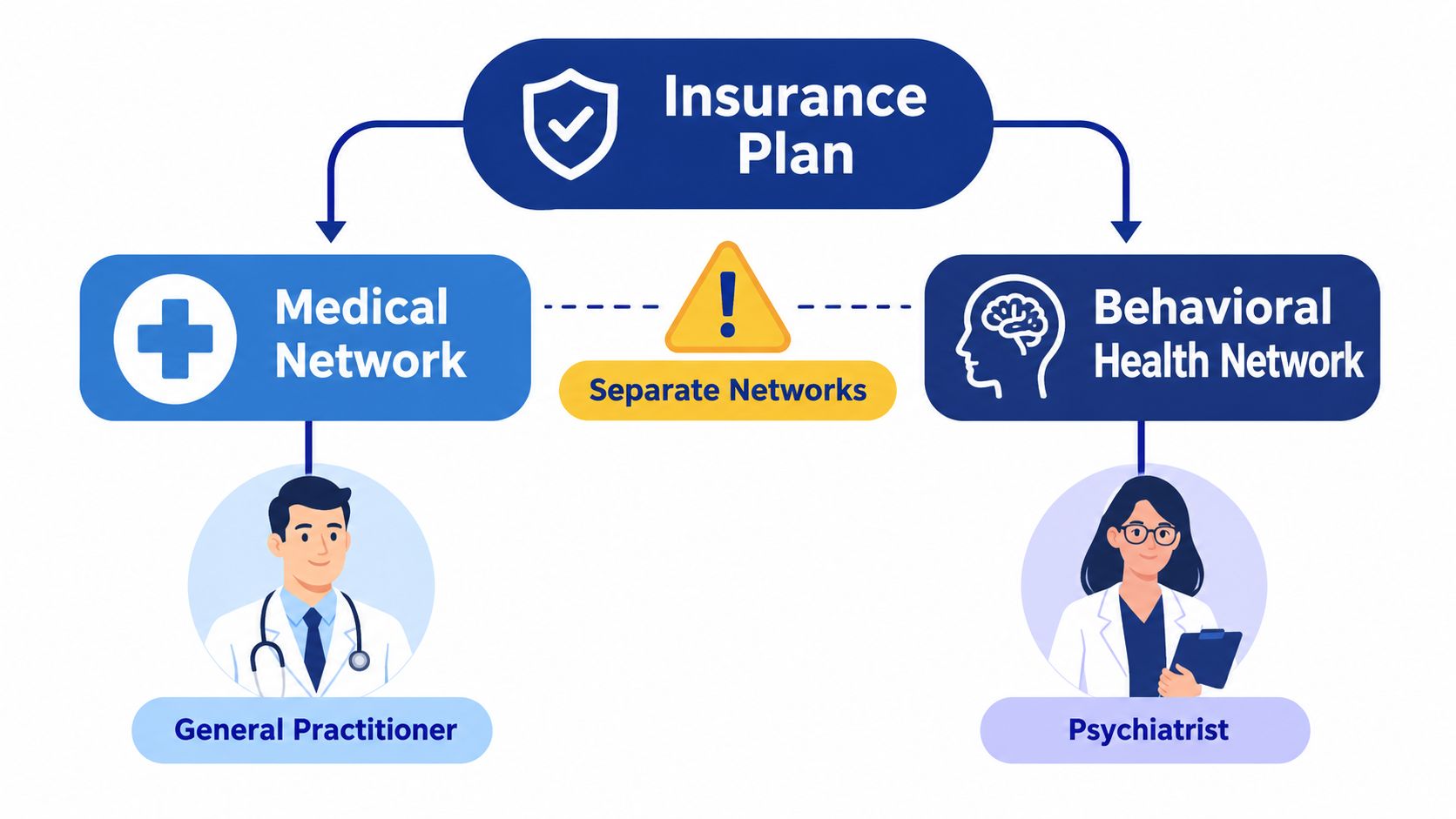
A health plan can use different networks for medical and behavioral-health services. That means a primary-care provider may participate in the medical network while a psychiatric provider does not participate in the behavioral-health network used by the same member's plan.
The distinction surprises patients because the insurer's brand may appear on both services. The network administrator, employer plan, product type, and benefit category can still differ. A directory search for general medical care doesn't necessarily confirm participation for psychiatric evaluation or medication management.
Pennsylvania telehealth conditions
Pennsylvania guidance describes commercial telehealth coverage as dependent on several conditions. The service generally must involve a participating provider, be medically necessary, follow the standard of care, and use HIPAA-compliant technology. Patients can review Pennsylvania online psychiatric care options while separately confirming the plan's benefit rules.
Pennsylvania has also treated telebehavioral health as an established reimbursement issue. The state Department of State says Medical Assistance enrolled providers have delivered certain behavioral-health services through telemedicine since 2011. Pennsylvania's Department of Human Services has required telehealth services in the fee-for-service system to receive the same reimbursement rate as in-person care, subject to the applicable rules. The Center for Connected Health Policy's Pennsylvania overview summarizes these state telehealth policies.
That history doesn't mean every commercial plan covers every virtual service in the same way. A patient still needs answers about the provider's participation, the service category, medical necessity, technology, and any plan-specific exclusions.
Practical rule: Asking whether telehealth is covered isn't enough. The question should identify the exact behavioral-health service and the exact participating provider.
Prior Authorization and Pharmacy vs Medical Benefit
Prior authorization means that an insurer may require approval before it will cover a particular service, test, or medication. Approval requirements vary by plan and don't guarantee that the insurer will pay every related claim.
A psychiatric evaluation or medication-management visit may process through the medical benefit. A prescription written during that visit usually processes through the pharmacy benefit. These are separate billing pathways, so coverage for the visit doesn't automatically determine coverage for the medication.
A medication example
A patient may have an in-network virtual medication-management appointment but encounter a separate pharmacy rule for a stimulant prescription. The pharmacy benefit may require documentation, use a formulary, apply step therapy, or assign a different copay. The clinician's network status for the visit can't remove those pharmacy conditions.
Patients who want a plain-language explanation of the approval process can review prior authorization for medical practices. The relevant questions include:
- Service approval: Does the plan require prior authorization for the psychiatric evaluation or follow-up?
- Medication approval: Does the prescription require authorization, documentation, or a preferred medication trial?
- Submission responsibility: Which office or prescribing clinician submits the request?
- Timing: Can the medication or service begin before approval, or must approval come first?
An in-network visit can still produce a pharmacy claim that the insurer processes differently. Details about virtual prescribing and follow-up care appear in telepsychiatry medication management, while the insurer remains the source for formulary and authorization decisions.
Why In-Network Does Not Guarantee Free or Fully Covered Care
“In-network” doesn't mean free. It means the provider participates in a contracted network, while the patient's plan still determines cost-sharing and coverage conditions.
Two patients can carry cards from the same insurer and owe different amounts because their employer plans differ. One plan may have a remaining deductible. Another may use a copay. A third may route behavioral-health care through a separate network or impose a telehealth authorization rule.
What Pennsylvania parity does and doesn't do
Pennsylvania's parity guidance says insurers must provide the same level of coverage for mental-health and substance-use-disorder treatment as for medical and surgical services. Parity can address differences involving copays, deductibles, visit limits, network access, prior authorization, out-of-pocket maximums, and medical-necessity criteria. The Pennsylvania Mental Health Parity guidance also notes that reasonable plan limits can remain, including requirements for an in-network provider and medically necessary care.
Parity doesn't erase the plan's deductible or make every virtual service payable. It also doesn't mean that a provider's participation with one product extends automatically to every product sold under the same brand.
Potentially relevant insurer names may include Cigna, Aetna, UnitedHealthcare or Optum, Independence Blue Cross or Blue Cross Blue Shield, and Highmark. Those names alone can't confirm participation or benefits. The exact plan, member information, behavioral-health network, telehealth policy, and authorization requirements control.
IPA serves both insured and self-pay patients but doesn't publish a validated percentage of patients using in-network benefits. Benefit verification can provide an estimate based on insurer information. The insurer determines final responsibility after the claim is processed.
How to Verify Your Benefits Before a Telepsychiatry Appointment
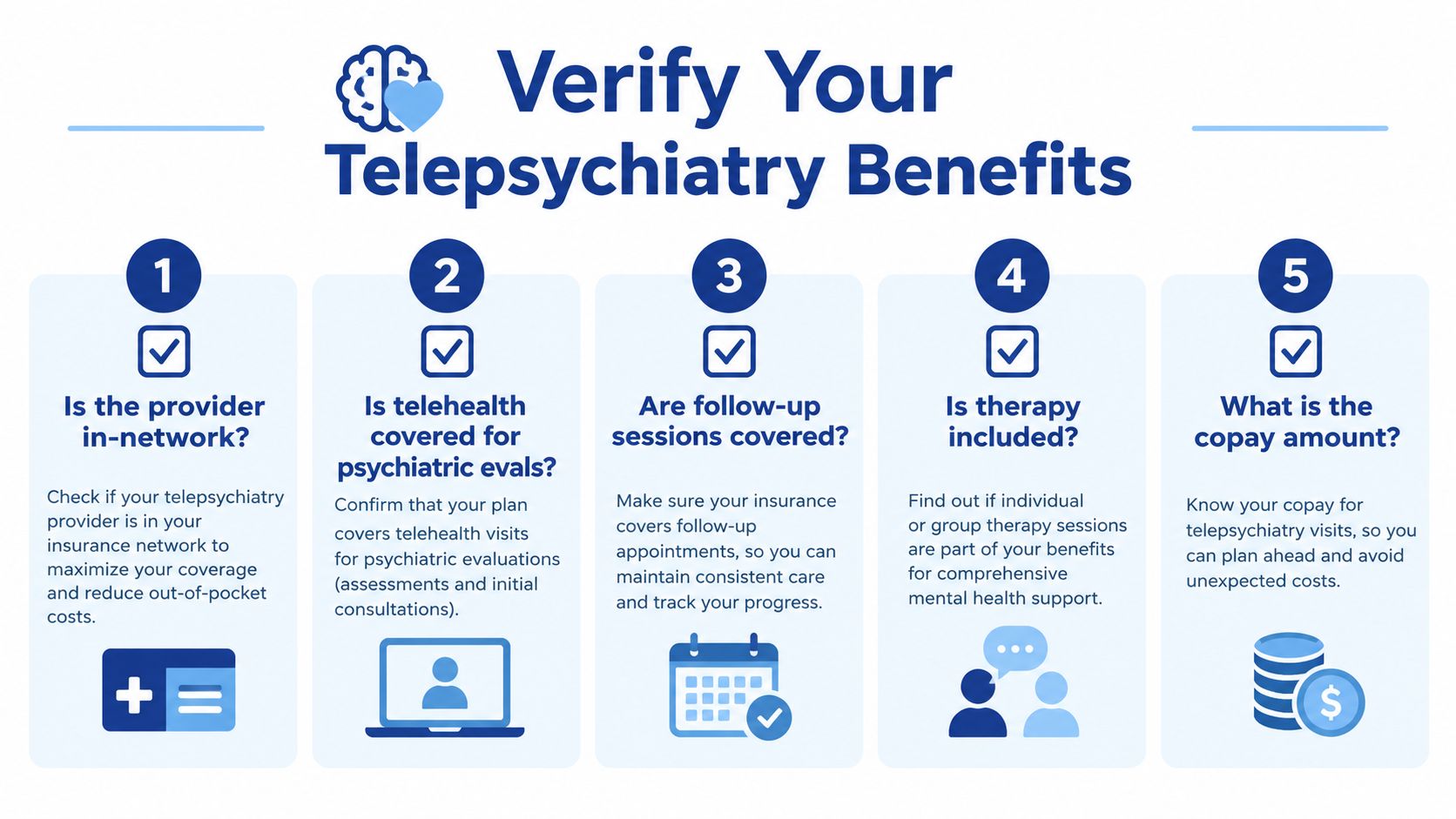
The fastest useful verification checks two things at the same time: the provider's network status and the patient's behavioral-health telehealth benefits. Patients can call the member-services number on the insurance card and ask the following questions.
- Is Integrative Psychiatry of America in-network for the specific plan and member ID?
- Are outpatient psychiatric evaluation and medication-management visits covered when delivered by telehealth?
- What copay, deductible, or coinsurance applies to those services?
- Does the plan use a separate behavioral-health network?
- Is prior authorization required for the evaluation, follow-up care, or prescribed medication?
A patient should provide accurate insurance information to the practice before scheduling or before the first appointment. Integrative Psychiatry of America's workflow allows patients to submit insurance information, and benefits are reviewed when available. The resulting information is an estimate, not a guarantee of payment. The insurer makes the final determination after claims processing, and the patient remains responsible for any amount assigned under the plan.
A separate resource on steps to verify insurance coverage can help patients prepare before calling member services. Patients can also review the practice's insurance verification process and Insurance & Fees information before requesting care.
The following video can provide another visual explanation of insurance verification and telehealth preparation:
Patients seeking virtual psychiatric care across Pennsylvania can submit insurance details, review expected benefits when available, and ask about evaluation or medication-management appointments before scheduling. Integrative Psychiatry of America provides secure online psychiatric care and insurance-verification support, while final payment responsibility remains with the insurer after claims processing. Prospective patients can use that information to decide whether an appointment pathway fits their clinical needs and financial circumstances.