
A patient returns for a depression follow-up expecting a quick refill. Instead, the psychiatric provider asks about sleep, appetite, concentration, anxiety, work, relationships, side effects, missed doses, and thoughts of self-harm. The conversation takes longer than a prescription renewal because the purpose is not only to continue medication. It is to determine whether the treatment remains safe, useful, and aligned with the patient's goals.
Psychiatric medication management for depression works best as an ongoing clinical partnership. A board-certified psychiatric mental health nurse practitioner or other qualified prescriber reviews the patient's experience, compares it with the treatment plan, and makes decisions within the patient's own medical context. The following guide focuses on what a thorough follow-up involves for adults receiving virtual psychiatric care in Pennsylvania.
| What the visit reviews | Why it matters |
|---|---|
| Mood and symptom changes | Shows whether depression is improving, persisting, or worsening |
| Side effects and tolerability | Helps balance potential benefit against problems affecting daily life |
| Adherence and medication access | Clarifies whether the prescribed treatment has had a fair opportunity to work |
| Sleep, appetite, energy, and concentration | Identifies both depressive symptoms and medication effects |
| Functioning and patient goals | Measures progress beyond a symptom score |
| Safety and medical changes | Helps identify urgent concerns, interactions, or other contributors |
Table of Contents
- What a Depression Follow-Up Actually Looks Like
- The Clinical Domains a Provider Reviews
- How Those Reviews Show Up in the Visit
- What to Bring to a Medication Management Follow-Up
- Labs, Genetics, and How Often to Be Seen
- How Therapy and Integrative Care Fit In
- When the Plan Changes or Comes to an End
- Your Next Step in Pennsylvania
What a Depression Follow-Up Actually Looks Like
A patient who started an SSRI returns after several weeks and says, “The sadness is a little better, but everything feels flat.” The original expectation was a refill, yet the provider asks when the emotional flattening began, whether sleep changed, whether work performance improved, and whether any doses were missed. The provider also asks about anxiety, appetite, energy, concentration, alcohol or cannabis use, and any thoughts of self-harm.
That sequence is deliberate. Psychiatric medication management is a structured clinical review, not a prescription renewal. The prescriber reassesses the working diagnosis, the medication's response, possible adverse effects, adherence, and the patient's priorities together. A medication may appear ineffective when doses are frequently missed, or it may appear helpful while creating side effects that the patient has steadily tolerated.
A patient's week-by-week report provides information that a prescription record cannot. “The mornings are easier” gives a different clinical signal from “the depression is gone.” “The panic is lower, but the patient is sleeping most of the day” may point toward a tolerability concern or another change requiring review. The provider decides what those signals mean in context and whether the plan should continue, change, or include additional support.
The appointment is a checkpoint
The visit also creates space to reassess whether the original treatment target still fits. Depression can occur alongside anxiety, trauma symptoms, ADHD symptoms, substance use, medical illness, or emerging mood instability. The provider may ask questions that seem broader than depression because accurate prescribing depends on the whole presentation.
Patients and prescribers share different responsibilities. The patient supplies honest observations about daily life, while the Pennsylvania psychiatric provider applies clinical judgment, reviews risks, and retains prescribing authority. A plain-language overview of this process appears in how online psychiatric medication management works.
Practical rule: A refill answers whether medication is available. A follow-up answers whether the treatment still makes clinical sense.
The Clinical Domains a Provider Reviews
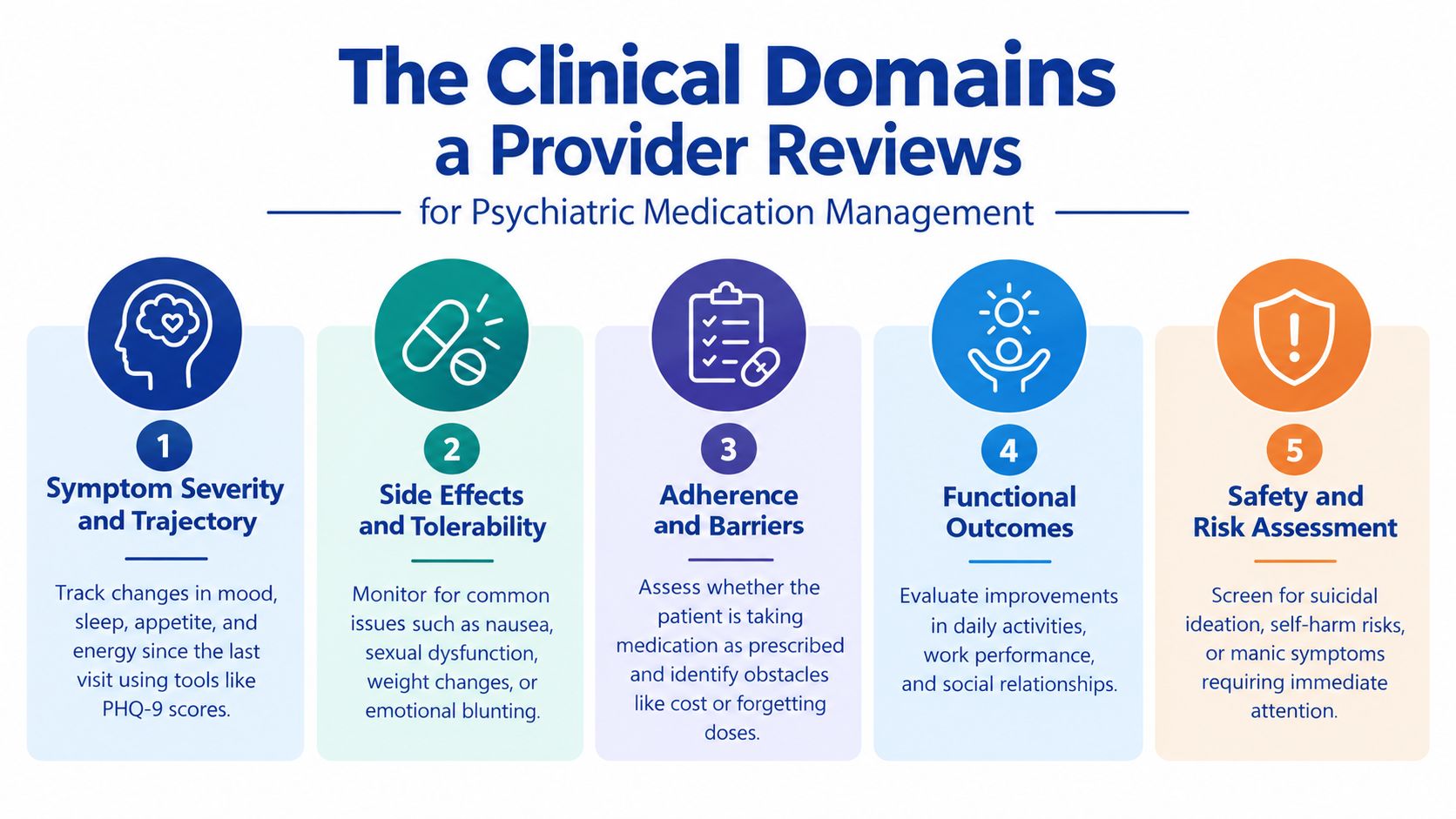
A depression medication-management follow-up usually covers several connected domains rather than one isolated symptom. The provider may use a structured questionnaire, such as the PHQ-9 for depressive symptoms or the GAD-7 for anxiety, but scores don't replace conversation. The patient's functioning, safety, and experience of treatment remain central.
Symptoms and daily functioning
The provider compares the current mood, interest, hopelessness, irritability, sleep, appetite, energy, and concentration with the previous visit. A mood or sleep log can reveal changes that are difficult to remember during a short appointment. The provider may ask whether the patient is completing household tasks, attending work or school, maintaining relationships, and handling responsibilities with less effort.
Functioning provides an important test of meaningful improvement. A patient may report fewer crying spells but still be unable to leave bed, manage deadlines, or participate in family life. Another patient may have a modest questionnaire change but regain enough energy to cook, attend class, or reconnect socially.
Safety and co-occurring symptoms
A provider should ask directly about suicidal thoughts, self-harm urges, access to lethal means, and changes in risk. A tool such as the Columbia-Suicide Severity Rating Scale can support this assessment, but a clinical conversation remains necessary. New agitation, unusually high energy, reduced need for sleep, impulsivity, or racing thoughts also require attention because they may alter the diagnostic and medication picture.
Anxiety, ADHD symptoms, trauma reactions, and substance use can affect both symptoms and treatment choices. Patients should report alcohol, cannabis, supplements, and nonprescription substances without fear of judgment. Silence can leave the provider with an incomplete picture of interactions, sleep disruption, or adherence barriers.
Medication experience and medical context
The provider reviews whether the medication is being taken as prescribed, what gets in the way, and whether cost, forgetfulness, travel, pharmacy access, or an irregular schedule has affected adherence. Side effects may include nausea, sexual changes, weight changes, sedation, activation, emotional blunting, or sleep disruption. Their timing matters because a symptom that began after treatment may not have the same meaning as a symptom that preceded it.
New medical diagnoses, reproductive changes, pregnancy planning, allergies, urgent-care visits, and medications from other clinicians can change the risk assessment. Medical contributors also deserve consideration. For example, anemia can contribute to depression-like symptoms, although a provider must interpret testing alongside the history and examination.
The provider also asks whether psychotherapy is occurring and whether it feels useful. Patient goals complete the review. One person may prioritize motivation, another sleep, another concentration, and another the ability to remain emotionally present with family.
How Those Reviews Show Up in the Visit
A telehealth follow-up often begins with an open question, such as “What has changed since the last appointment?” The patient's answer gives the provider a starting point before structured questions narrow the focus. A PHQ-9 or GAD-7 may then provide a consistent symptom snapshot, while targeted questions clarify what the score cannot show.
A patient might say, “Sleep is better, but the patient feels flat.” The provider documents the improvement in sleep and the possible emotional blunting, then asks about timing, severity, motivation, pleasure, and functioning. That statement isn't vague reassurance. It contains two separate clinical signals that may influence the shared plan.
From conversation to clinical decisions
The provider may document several findings in one visit:
- Mood trajectory: Whether sadness, hopelessness, irritability, or loss of interest has changed.
- Function: Whether the patient is working, studying, caring for children, maintaining hygiene, or managing household tasks.
- Tolerability: Whether nausea, fatigue, sexual side effects, activation, or emotional flattening is acceptable.
- Adherence: Whether missed doses, pharmacy problems, cost, or forgetfulness affected the treatment trial.
- Safety: Whether suicidal thoughts, self-harm urges, severe agitation, or manic symptoms are present.
- Coordination: Whether psychotherapy, primary care, laboratory work, or another specialist should be involved.
The plan may include continuing the current approach, discussing a medication adjustment, reviewing laboratory results, addressing an interaction, coordinating therapy, or arranging earlier contact. The patient's goals matter because a technically improved symptom score may not represent acceptable recovery if the person still can't function at work or feels disconnected from daily life.
Telehealth doesn't remove the need for clinical structure. A virtual visit can still include symptom measurement, medication reconciliation, risk assessment, and review of sleep and functioning. Portal communication may help a patient report a non-emergency concern between appointments, but it doesn't replace scheduled clinical follow-up or emergency services when safety is at risk.
“The patient feels less hopeless but remains unable to manage basic responsibilities” is more useful than “the medication seems to help.”
The prescribing clinician decides whether the information supports continuing or changing treatment. Patients shouldn't increase, stop, or switch medication based on a symptom score or an online article.
What to Bring to a Medication Management Follow-Up
Preparation isn't a test. It gives the provider better information and makes it easier to connect daily experiences with the clinical domains under review.
A practical preparation list
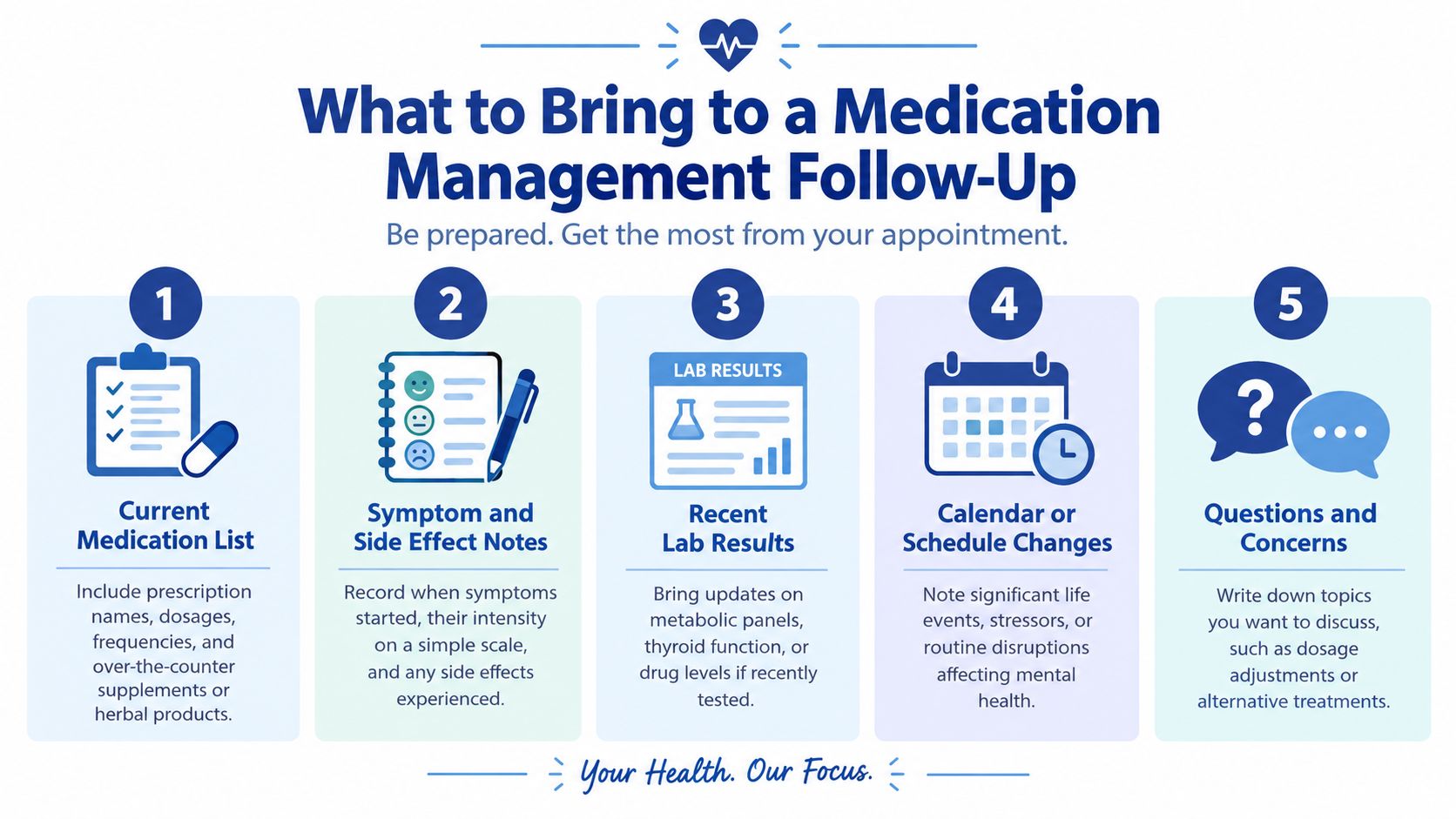
- Current medication list: Include prescriptions, over-the-counter products, vitamins, herbal supplements, frequency of use, and occasional substances. This supports interaction and adherence review.
- Symptom and side-effect notes: Record changes in mood, sleep, appetite, energy, concentration, anxiety, and physical symptoms. A short daily note is enough.
- Recent medical records: Bring laboratory results, urgent-care summaries, new diagnoses, allergy updates, or records from another prescriber when available.
- Home measurements: Blood pressure or weight can be useful when a patient already tracks them, although the provider decides which measurements matter for the medication being considered.
- Schedule and life changes: Note work demands, school changes, caregiving stress, travel, relationship disruption, or changes in daily routine.
- Questions and goals: Write down concerns about side effects, therapy, functioning, future pregnancy, medication access, or the purpose of continued treatment.
A daily mood journal can help organize observations without requiring lengthy writing. Patients in Pennsylvania should also disclose alcohol or cannabis use openly. The purpose isn't to punish or label anyone. The information helps the provider interpret sleep, anxiety, mood shifts, medication effects, and potential interactions.
A concise timeline often works better than a long narrative. For example, “fatigue began after the medication change, occurred most afternoons, and caused missed assignments” gives the provider information about onset, pattern, and function.
Labs, Genetics, and How Often to Be Seen
There isn't one standard laboratory or genetic panel that determines which antidepressant a patient should receive. A Pennsylvania provider may consider testing when symptoms, medical history, current medications, reproductive considerations, or possible medical contributors make it clinically relevant. The order, timing, and interpretation remain individualized.
Follow-up timing depends on clinical need
A patient starting treatment or experiencing a medication change may need closer contact than someone in a stable maintenance phase. Follow-up frequency can depend on symptom severity, early tolerability, safety concerns, adherence, response, and the complexity of other medications. NICE recommends an agreed management plan that explains the medication choice, expected benefits, possible harms, dose-adjustment expectations, and concerns about starting or stopping treatment. NICE recommendations for adult depression also emphasize slow tapering when treatment ends.
A Dartmouth-Hitchcock depression guideline recommends contact one week after diagnosis and treatment initiation, followed by contact every two to four weeks until response or remission, and continuation of pharmacotherapy for four to nine months after remission. The Dartmouth-Hitchcock depression clinical practice guideline defines response as at least a 50% reduction in PHQ-9 symptoms and remission as PHQ below 5. These are clinical reference points, not a fixed IPA scheduling promise.
| Stage of treatment | Typical visit frequency | Common labs or workup |
|---|---|---|
| Initial evaluation | Set by symptoms, safety, history, and treatment needs | Medical history, medication reconciliation, and clinically indicated testing |
| Early treatment or medication change | Often closer follow-up than stable care | Testing guided by symptoms, medical conditions, interactions, or medication risks |
| Stabilization | Visits become less frequent when response and tolerability are consistent | Review of relevant results and ongoing medical coordination |
| Maintenance | Interval is individualized by the treating provider | Repeat workup only when clinically indicated |
What testing can and cannot show
A provider may consider thyroid studies when hypothyroidism could resemble or worsen depression. A complete blood count, metabolic testing, vitamin studies, pregnancy testing when relevant, or other workup may be appropriate for selected patients. None of these tests independently establishes a depression diagnosis or selects a medication.
Pharmacogenomic testing examines genes such as CYP2D6 and CYP2C19 that can affect medication metabolism. A recent review found that guided treatment may improve early response and remission at eight to twelve weeks compared with usual care, while benefits may be less pronounced by six months and gene-outcome findings remain difficult to replicate across studies. The PubMed review of pharmacogenomic testing supports a measured interpretation. Testing may be more relevant after prior nonresponse, dose-limiting side effects, polypharmacy, or suspected exposure mismatch, but it doesn't replace clinical judgment.
A discussion of genetic testing for psychiatric medications should leave room for uncertainty. Insurance policy doesn't create a universal testing schedule, and the treating clinician remains responsible for deciding whether testing adds useful information.
How Therapy and Integrative Care Fit In
Medication can reduce depressive symptoms, while psychotherapy helps patients recognize patterns, practice coping skills, process difficult experiences, and change behavior. For severe depression, the AAFP pharmacologic treatment guideline identifies combined medication and psychotherapy as the preferred approach and supports continuing treatment for four to nine months after remission.
Cognitive behavioral therapy and interpersonal therapy are established options for depression. Behavioral activation gives patients a practical way to resume meaningful activities when motivation is low. An integrative plan might also address sleep, movement, nutrition, mindfulness, and stress with specific goals rather than a general list of wellness advice.
Integration requires coordination
A patient with low energy, irregular meals, poor sleep, and little daily structure may need more than a medication adjustment. The provider might coordinate psychotherapy with two or three brief behavioral activation goals, a consistent sleep-wake window, and a manageable activity target. At the next follow-up, the team can review which goals were completed, whether sleep improved, and whether medication adherence or tolerability changed. Progress may show up as more consistent mornings, improved energy, better work attendance, or fewer depressive symptoms.
These changes support treatment but do not replace indicated medication or therapy. They also do not establish that one diet or exercise program works for everyone.
Supplements require the same disclosure as prescriptions. Omega-3 fatty acids, vitamin D, and SAMe differ in evidence, formulation, quality control, and interaction risk. SAMe may affect serotonergic treatment, while other products can influence bleeding, sedation, metabolism, or laboratory results. Tell the prescriber about every supplement before combining approaches.
A closer look at integrative depression treatment options can help patients distinguish coordinated whole-person care from unsupported promises. The psychiatric provider coordinates medication decisions and may refer to psychotherapy, primary care, nutrition, exercise, or other services. The patient's own prescriber and treatment team make final decisions.
When the Plan Changes or Comes to an End
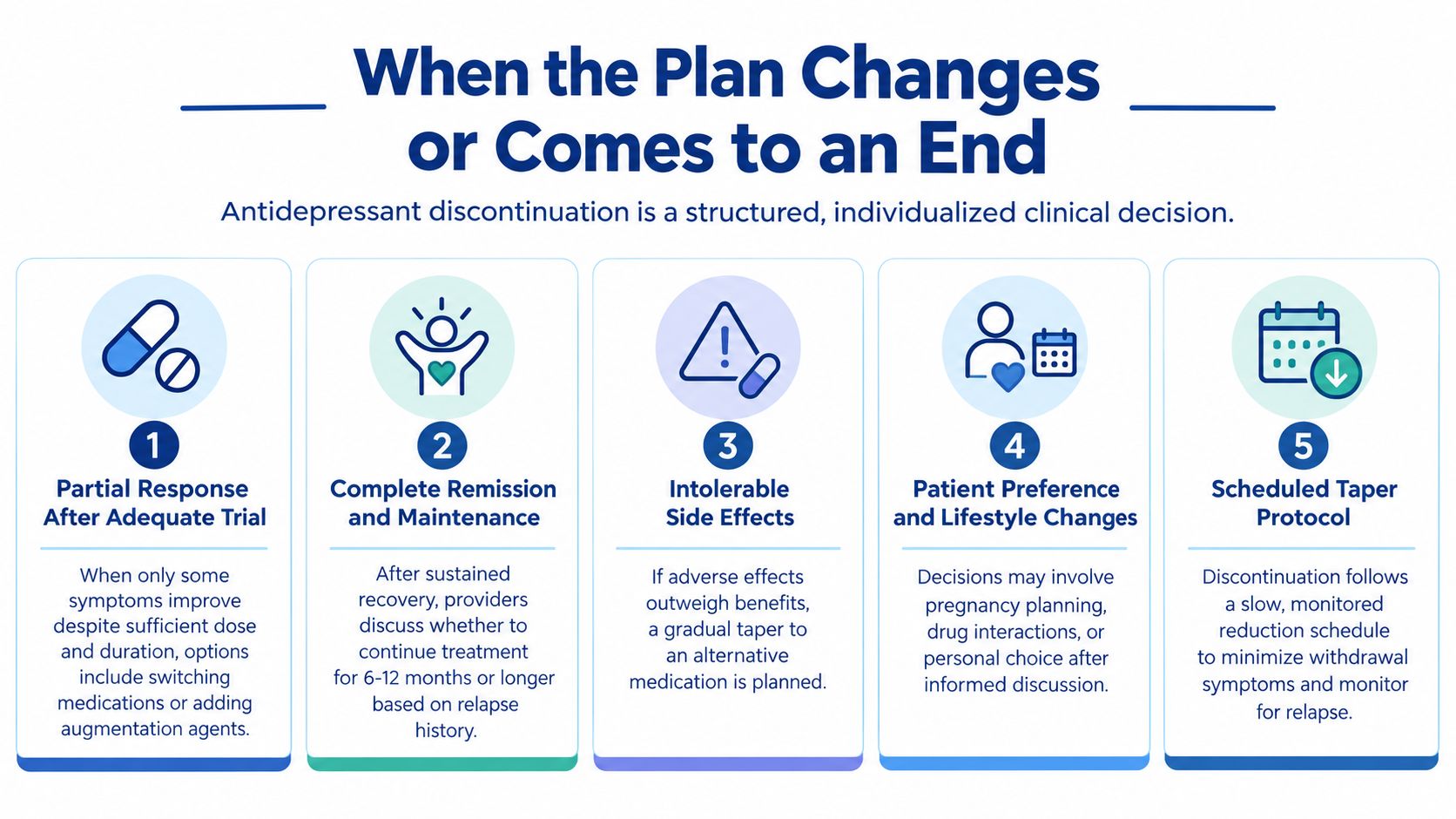
Antidepressant discontinuation is a clinical decision, not a self-directed endpoint. A plan may change after partial response, persistent side effects, a new medical condition, pregnancy planning, an interaction, or sustained remission that warrants a fresh discussion about continued treatment.
The provider considers the medication's history, symptom course, relapse risk, previous withdrawal experiences, and patient preference. Short half-life medications may require slower tapering, and some patients need reductions over weeks or months with monitoring between changes. NICE advises tapering antidepressants slowly to zero and tapering short half-life drugs more gradually. The recent guidance on stopping antidepressants safely explains that some patients may need reductions of 25% every one to four weeks, while higher-risk situations may call for 10% or 5% steps with two to four weeks of monitoring. Those figures are examples from guidance, not instructions for self-treatment.
Withdrawal and relapse aren't identical
Discontinuation symptoms can emerge during dose reductions and may include physical or emotional changes. Relapse usually reflects the return of the underlying depressive illness, although the two can overlap and become difficult to distinguish. Timing, symptom pattern, prior history, and the response to a slower or paused plan help the prescriber evaluate what is happening.
Patients should never stop, restart, increase, or reduce medication without the prescribing clinician. Insurance changes, travel, pharmacy problems, and pregnancy planning don't remove the need for supervision. The provider may slow the plan, pause it, reconsider the medication, or arrange additional support.
A patient should report returning suicidal thoughts, severe mood shifts, marked agitation, new manic symptoms, or concerning physical symptoms promptly. Emergency services or crisis support may be necessary when immediate safety is at risk.
Your Next Step in Pennsylvania
A Pennsylvania patient preparing for depression medication management should bring a current medication list, recent symptom notes, prior treatment history, and questions. The first evaluation usually reviews symptoms, medical and psychiatric history, earlier medication trials, psychotherapy, safety, personal goals, and whether further assessment is appropriate. A follow-up is therefore more than a refill request. It gives the prescriber a structured chance to assess response, tolerability, functioning, and the next clinical decision.
Follow-up timing belongs to the clinician and the patient's prescriber, not to a fixed schedule chosen alone by the patient. Starting medication, changing symptoms, side effects, safety concerns, or complex medical history may require closer contact. Stable treatment may support a different rhythm, but significant symptoms or safety concerns should prompt earlier communication.
Insurance verification can prevent avoidable scheduling problems. Confirm benefits, deductibles, copays, network status, telehealth rules, and authorization requirements, including the details for Cigna, Aetna, UnitedHealthcare, and BCBS or IBX products. Insurance & Fees information can help identify what needs confirmation before an appointment.
Pennsylvania residents can review Psychiatric Care, Psychology Care, and Telepsychiatry Medication Management to compare available care pathways. Established patients may continue virtual follow-ups across much of Pennsylvania, subject to licensure, clinical appropriateness, and practice availability. Leaping Lemur Media services offer a separate resource for digital healthcare content and patient education.
Medication management depends on shared communication. The patient reports changes from daily life, while the prescriber evaluates medication effects, risks, and options. Integrative Psychiatry of America's homepage provides general information and the appointment pathway for Pennsylvania telepsychiatry.