
Exposure and response prevention (ERP) is an evidence-based psychotherapy for obsessive-compulsive disorder, and medication may also be used when clinically appropriate, either alone or in combination with psychotherapy depending on the individual situation. A person may complete difficult exposures, resist rituals, and still feel trapped by intrusive thoughts, mental compulsions, avoidance, or a second condition that drains the energy needed for treatment. That experience can feel discouraging, but a plateau doesn't automatically mean ERP has failed or that the patient has done anything wrong.
Table of Contents
- Understanding ERP and Treatment Plateaus
- Why ERP Alone May Not Be Enough
- The Three Step Clinical Reassessment Roadmap
- The Role of Medication in OCD Treatment
- Combining Therapy and Integrative Psychiatric Care
- Taking the Next Step in Your OCD Recovery
Understanding ERP and Treatment Plateaus
A person may have spent months facing feared situations, delaying rituals, and practicing response prevention between sessions. At first, progress was clear. A contamination exposure became manageable, checking reduced, or reassurance seeking lost some of its urgency. Then improvement slowed. The person still works hard, but daily life remains restricted by obsessions, mental review, avoidance, or renewed compulsions.
That pattern is a treatment plateau, not necessarily a treatment failure. ERP asks a patient to approach feared triggers while refraining from the behavior or mental act used to obtain certainty or relief. The process requires courage, repetition, and close attention to less visible compulsions. A person can appear to complete an exposure while still neutralizing internally through analysis, prayer, self-reassurance, memory checking, or repeated internet searches.
What ERP does and does not mean
ERP is considered a core OCD treatment because it directly targets the cycle linking an obsession, distress, and a compulsive response. The patient learns, with clinical guidance, to experience uncertainty or discomfort without automatically performing the ritual. The aim isn't to prove that a feared outcome is impossible. It is to change the person's relationship with the obsession and reduce the control that compulsions have over behavior.
ERP also needs to fit the patient's presentation. Resources explaining how ERP works for children can help families understand why developmental level, caregiver involvement, and age-appropriate practice matter. Adults may face different barriers, including work demands, relationship patterns, shame, perfectionism, or years of covert rituals.
A plateau may signal several possibilities:
- The hierarchy needs revision: Exposures may no longer match the current obsessional themes or may be too easy, too difficult, or too disconnected from daily life.
- Compulsions have changed form: An outward ritual may decrease while mental reviewing, reassurance seeking, or avoidance takes its place.
- Treatment engagement has become harder: Depression, sleep disruption, stress, ADHD, or medication side effects can reduce attention and follow-through.
- The treatment needs another component: Some patients benefit from psychiatric medication, additional psychotherapy support, or care for a co-occurring condition.
A qualified clinician may review the treatment history through OCD treatment and ERP care before recommending a change. The practical question isn't “Why can't this patient make ERP work?” It's “What is maintaining the symptoms, and what support is missing?”
Why ERP Alone May Not Be Enough
ERP may be highly useful while still leaving important clinical needs unaddressed. Some people have severe OCD, limited insight, depression, intense anxiety, ADHD, substance-use concerns, or physical exhaustion. Those factors can make it difficult to complete exposures, identify mental rituals, or tolerate distress long enough for therapy to influence everyday functioning.
Research summarized in clinical guidance identifies poor adherence, poor insight, comorbid depression, and greater OCD severity as predictors of poorer ERP outcomes. Clinician delivery errors can also reduce effectiveness, which means a stalled course deserves a careful review of treatment fidelity rather than automatic blame placed on the patient. A person asking, “Why isn't ERP working for me?” may need a more precise formulation, not just more difficult exposures.
Common barriers to progress
Hidden compulsions often receive too little attention. A patient may stop washing but continue mentally reviewing whether contamination occurred. Another may resist asking a partner for reassurance but repeatedly compare feelings, search for certainty, or test an internal response. These actions can preserve the same cycle even when visible rituals appear improved.
Co-occurring conditions create a separate challenge. Depression can reduce motivation and concentration. Anxiety can broaden the range of triggers. ADHD may interfere with planning and homework completion. Sleep disruption can intensify emotional reactivity. Treating those issues doesn't replace ERP, but ignoring them can make ERP harder to use.
Access also affects continuity. In the United States, 23% of adults received mental health treatment in 2022, compared with 19% in 2019, while only 25% of insured adults and 11% of uninsured adults reported receiving care. The figures come from KFF's analysis of mental health care use, which also reports that one-third of APA survey respondents couldn't obtain needed mental health services, with cost and stigma among commonly cited obstacles. A patient may need medication management, therapy, and follow-up but receive only one fragmented part of that care.
Clinical perspective: A plateau is information. It tells the treatment team to examine the process, the patient's broader health, and the fit between the intervention and the symptom pattern.
A broader discussion of intrusive thoughts and OCD treatment can help distinguish unwanted thoughts from the compulsive responses that keep them clinically significant. That distinction matters because reassurance about the content of a thought can become part of the cycle. Treatment focuses instead on function, response patterns, impairment, and values-based behavior.
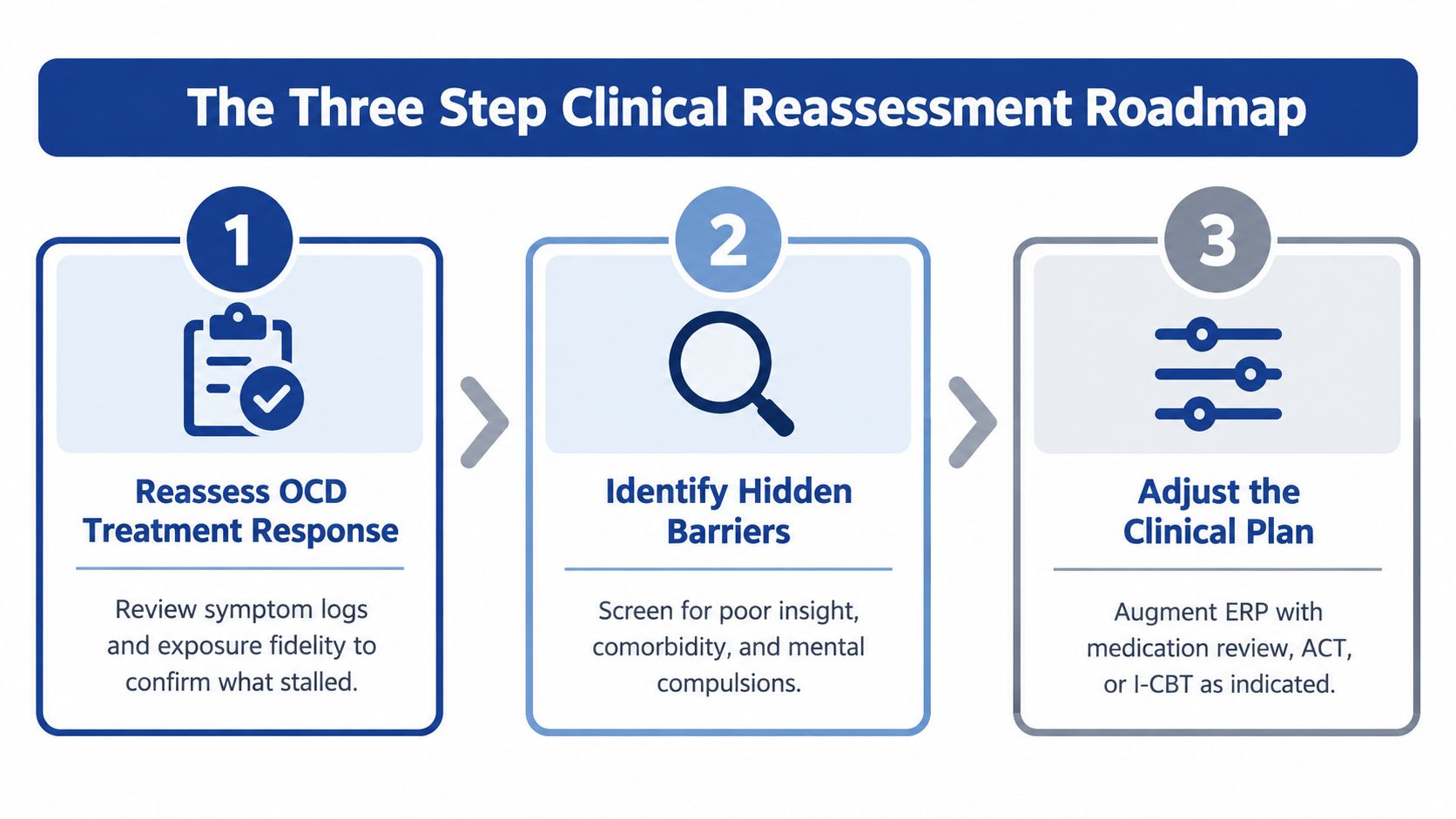
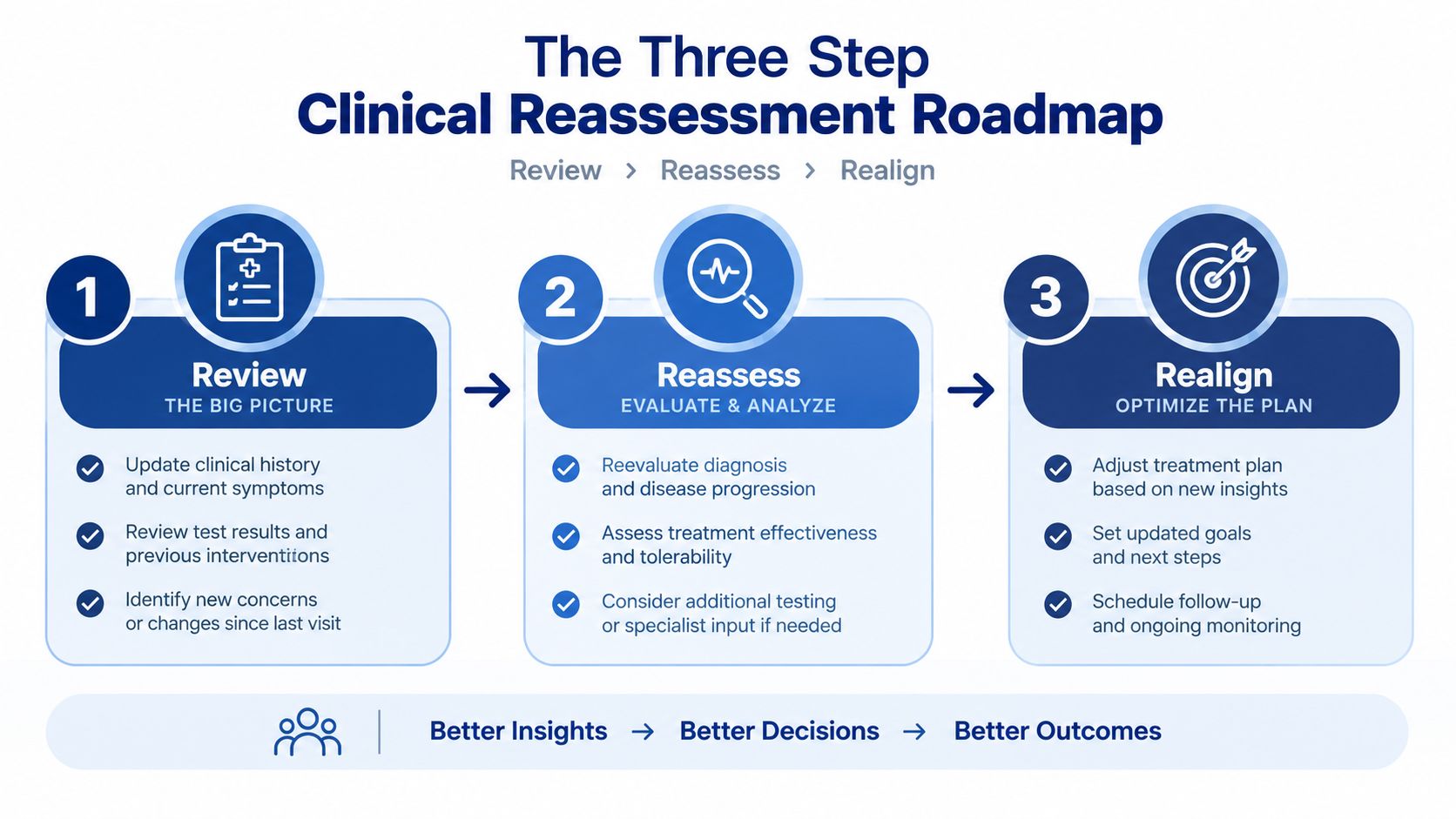
The Three Step Clinical Reassessment Roadmap
When ERP alone isn't delivering enough progress, a psychiatric provider can use a structured reassessment before changing medication or abandoning the therapy. The process usually begins with the treatment itself, moves to barriers outside the exposure plan, and ends with a collaborative adjustment.
Step 1 Reassess the OCD treatment process
The provider reviews the exposure hierarchy, recent symptom changes, attendance, homework, and response prevention. The assessment asks whether exposures still target the main fear structure and whether the patient is approaching triggers without substituting a less visible ritual.
A symptom log can clarify the sequence:
- What triggered the obsession?
- What did the patient predict or fear?
- What action, thought, search, or request followed?
- What short-term relief occurred?
- What did the patient avoid afterward?
This review isn't a test of compliance. It helps identify whether the treatment is targeting the maintaining behavior. If a patient has shifted from checking a lock to repeatedly visualizing the lock, the hierarchy and response-prevention plan may need refinement.
Step 2 Identify factors interfering with progress
The clinician evaluates depression, anxiety, ADHD, sleep problems, substance use, stress, medication adherence, side effects, and relevant medical concerns. Family accommodation and reassurance patterns may also need attention, particularly when relatives help rituals continue without intending to.
ADHD evaluation illustrates why symptoms alone don't establish a diagnosis. Adults generally need at least five symptoms, present for at least six months, across at least two settings, with functional impairment and evidence of childhood onset, typically before age 12, according to Cleveland Clinic's ADHD screening overview. A proper assessment also reviews development, functioning, psychiatric history, family history, physical health, and possible medical causes, as outlined by AAFP guidance on adult ADHD evaluation. The same careful approach helps prevent every concentration problem from being attributed to OCD.
Step 3 Adjust the plan collaboratively
The final step may involve refining ERP, increasing psychotherapy support, reviewing medication, addressing sleep, coordinating medical care, or adding another evidence-informed modality. Mindfulness can help a patient notice an intrusive thought or urge without automatically responding, but it should support rather than replace response prevention. Nutrition and lifestyle measures can support general health, but they aren't primary OCD treatments.
A patient who needs a broader psychiatric review can learn more about when to seek psychiatric care. The purpose isn't to replace ERP automatically. It's to match the plan to the patient's current symptoms, capacity, risks, and goals.
The Role of Medication in OCD Treatment
Is medication used for OCD? Yes. A psychiatric provider may discuss medication when OCD remains significantly impairing, ERP is difficult to engage in, symptoms are severe, depression or anxiety is also present, or the patient prefers a combined approach after reviewing benefits and risks. Medication isn't required for every person with OCD, and no patient should start, stop, or change it without guidance from the prescribing clinician.
Selective serotonin reuptake inhibitors, or SSRIs, are commonly considered in OCD treatment. Their use differs from treatment for depression or generalized anxiety because OCD may require a more sustained medication trial and careful monitoring before the full response can be judged. Exact prescribing decisions depend on the medication, medical history, other treatments, tolerability, and the individual treatment plan. No dosing instructions belong in a general article.
OCD and depression are not identical medication decisions
A medication that helps mood may not provide the same level of relief for obsessions and compulsions. OCD symptoms can remain active even when sadness improves, and a person may need continued ERP alongside medication. Psychiatric follow-up helps separate partial response, inadequate adherence, side effects, an inaccurate diagnosis, and an untreated co-occurring condition.
| Clinical factor | OCD treatment | Depression treatment |
|---|---|---|
| Main symptoms monitored | Obsessions, compulsions, avoidance, mental rituals, and impairment | Mood, interest, energy, sleep, concentration, and safety |
| Role of psychotherapy | ERP often targets compulsive responses and avoidance | Psychotherapy may address mood, behavior, relationships, and beliefs |
| Medication review | Tracks obsessional distress, ritual frequency, function, tolerability, and interaction with ERP | Tracks mood response, functioning, safety, tolerability, and recurrence |
| Partial response | May prompt ERP refinement, adherence review, or an augmentation discussion | May prompt psychotherapy, medication review, or assessment of other causes |
Guideline reviews describe several paths for partial or nonresponders. One recommends CBT or ERP for people with incomplete response to SSRIs, followed by low-dose antipsychotic augmentation when CBT isn't feasible. Another discusses combined treatment and additional options, including atypical antipsychotics, memantine, and neuromodulation approaches such as rTMS or tDCS for resistant cases. These options require specialist assessment, and they aren't interchangeable or appropriate for everyone. The clinical review of OCD treatment strategies provides context for this stepped-care approach.
Medication aims to reduce symptom intensity or improve functional capacity. It doesn't erase the need to learn new responses to uncertainty. Patients who want a plain-language explanation of serotonin-related concepts can review what 5-HT means in psychiatric care, while keeping in mind that a biological explanation doesn't determine an individual outcome.
Combining Therapy and Integrative Psychiatric Care
Can ERP and medication be used together? Yes. A patient may continue ERP while a psychiatric provider evaluates or manages medication, with each treatment addressing a different part of the problem. ERP changes how the person responds to obsessions and urges, while medication may reduce symptom burden enough to improve concentration, sleep, participation, or follow-through.
Combined care works best when the clinicians communicate about goals and obstacles. A medication visit should include more than a prescription decision. The provider may review changes in compulsions, avoidance, intrusive-thought distress, mood, sleep, side effects, adherence, substance use, and daily functioning. The therapist can then use that information to refine exposures without turning medication into a measure of success or failure.
What integrative care can add
Whole-person care may include practical support for sleep routines, stress management, exercise, nutrition education, mindfulness, and coordination with other clinicians. These measures can support treatment engagement, but they should remain in proportion. No food plan, supplement, breathing exercise, or laboratory result can substitute for appropriate OCD treatment.
Routine genetic or laboratory testing doesn't tell a clinician whether ERP will work. Testing may be considered when symptoms or medical history suggest a possible medical contributor, medication-safety issue, or another clinically relevant concern. If a medical abnormality appears, the psychiatric plan may be reconsidered with the appropriate medical provider.
Pennsylvania patients can receive behavioral health services by telemedicine when the licensed provider stays within the existing scope of practice and the service is appropriate and consistent with accepted standards. Pennsylvania's Medical Assistance program reimburses certain telemedicine behavioral health services at the same rate as in-person care, according to the Pennsylvania Department of State telemedicine guidance. Coverage still depends on the member's plan, eligibility, network status, and applicable requirements.
Telehealth considerations for OCD care
Virtual treatment can reduce travel barriers and support continuity across Pennsylvania, including patients in Philadelphia, the Lehigh Valley, Pittsburgh, and rural communities. It also requires privacy, reliable technology, a workable space for sessions, and a plan for exposures that can be practiced safely at home. The clinician must determine whether telehealth is appropriate for the patient's symptoms, risk level, treatment needs, and environment.
A Pennsylvania practice such as Integrative Psychiatry of America offers virtual psychiatric evaluations and medication management for adults with OCD, with treatment planning that can coordinate medication care and ERP referrals. Patients should still ask how therapy coordination, insurance verification, follow-up, and urgent concerns are handled before choosing a provider. Details about integrative OCD treatment can help a patient prepare for that conversation.
Taking the Next Step in Your OCD Recovery
Medication concerns deserve a direct conversation rather than pressure. A patient may fear side effects, worry about dependence, or believe that needing medication proves therapy has failed. The more accurate view is that medication can be one support within a broader plan, particularly when symptom intensity, depression, anxiety, sleep disruption, or another condition limits participation in ERP.
A psychiatric evaluation should clarify the diagnosis, current symptoms, treatment history, medical history, other medications, substance use, safety concerns, and functional impairment. It should also examine what has changed since ERP began. If progress has plateaued, the provider can ask whether exposures remain appropriate, whether compulsions have become covert, and whether the patient is avoiding situations or seeking reassurance in ways that aren't obvious.
A useful next step is a careful review, not an automatic escalation. The treatment plan should change because the clinical picture supports a change.
Follow-up matters after any medication decision. The provider needs to monitor benefit, tolerability, mood, sleep, activation, adherence, interactions, and day-to-day function. Medication should be adjusted only through the prescribing clinician. Patients shouldn't stop treatment abruptly or make changes based on an online article.
Lifestyle support can strengthen the foundation for therapy without replacing it. A practical sleep and stress habits guide may offer general ideas for protecting routines and managing strain. Those habits are most useful when they support attendance, exposure practice, emotional regulation, and recovery from daily stress.
Patients may also want to ask:
- What is the main treatment target? Is the plan addressing compulsions, avoidance, depression, sleep, or another source of impairment?
- How will progress be measured? Which symptoms and functional changes will be reviewed at follow-up?
- How will ERP and medication care coordinate? Can the therapist and prescribing provider share relevant updates with consent?
- What happens if response remains incomplete? A stepped plan can include therapy refinement, medication review, additional support, and referral when clinically indicated.
The question “What if ERP is not enough?” has a practical answer. Reassess the treatment process, identify barriers, and adjust care collaboratively. ERP remains valuable, but it doesn't have to carry the entire burden of recovery by itself.
Integrative Psychiatry of America provides virtual psychiatric evaluations and medication management for Pennsylvania adults considering additional support for OCD alongside ERP. Visit Integrative Psychiatry of America to review OCD care options, verify insurance, and request an appointment for an individualized treatment discussion.